
 Home
Home North(
 Chiang Mai(


Rating: 3.4/5 (8 votes)
 |
|  Map
Map 
 Have Map
  No Map
Bangkok attractions
Attractions in Thailand
Open Days: Daily
Opening Hours: 07:00 – 18:00
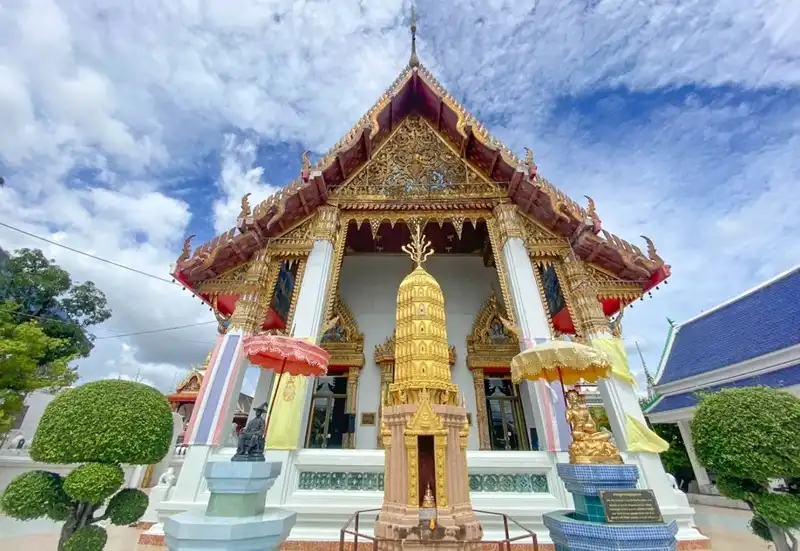
Wat Khuhasawan Worawihan is a third-class royal temple (worawihan type) on Bangkok’s Thonburi side—a place many people may have heard of or passed by, but haven’t truly “set aside time to visit.” And that’s a shame, because this temple offers something genuinely tangible: traces of Ayutthaya-period artistry that still remain within the ordination hall (ubosot). The most striking examples are the carved wooden pediment patterns on both the front and the back of the ubosot, as well as paired boundary stones (sema) made from red sandstone, attributed to late Ayutthaya craftsmanship. What makes Wat Khuhasawan special isn’t simply that it’s “an old temple,” but that its age is supported by details you can still walk up to, look at closely, and appreciate—details that naturally slow you down the moment you arrive.
In earlier times, the temple was known as “Wat Sala Si Na” (literally, the Four-Sided Pavilion Temple). It is regarded as an ancient temple dating back to the period when Ayutthaya was still the capital, although there is no clear evidence identifying its founder. The strongest indicators of its Ayutthaya timeline come from the surviving woodwork and the elements associated with the sacred boundary of the ubosot—features that many old temples no longer retain in full because time and later restorations often replaced original components. Wat Khuhasawan stands out precisely because it still preserves “storytelling pieces” that allow us to read history through art, without relying too heavily on guesswork.
One of the most important features that draws visitors interested in Ayutthaya-era craftsmanship is the ubosot’s carved wooden pediment, preserved on both the front and the back. There are also smaller pediment “wings” aligned with the tiered roof structure, two on each side. This arrangement reflects the way Ayutthaya artisans thought about proportion and the rhythm of rooflines, as well as the refinement of wood carving that wasn’t created for decoration alone, but to underscore the sanctity of the space and the temple’s role as a community center in earlier times. When you stand facing the pediment and let your eyes move slowly along the roof tiers, it can feel as though you’re reading a language—one spoken by craftspeople centuries ago, yet still intelligible today.
Another feature not to miss is the pair of boundary stones (sema) made from red sandstone, associated with late Ayutthaya craftsmanship. Sema stones relate to the concept of “wisungkhamsima,” the consecrated boundary used for major monastic ceremonies such as ordination. In the past, many temples clearly defined their sacred boundary, but surviving sema stones with distinct late-Ayutthaya characteristics are not easy to find. At Wat Khuhasawan, there is also information that the “sema shrine structures” (sum sema) were added later; originally, the sema stones were simply placed on a cement base. Small details like this help us see the temple’s evolution across different periods—what belongs to the original layer, and what later generations added in order to maintain and protect the sanctity of the place over time.
Later, in the early Rattanakosin period, King Rama I (Phra Phutthayotfa Chulalok) ordered the temple to be restored and elevated it to the status of a third-class royal temple (worawihan type). The name was changed from “Wat Sala Si Na” to “Wat Khuhasawan Worawihan.” Records from the relevant authorities also state that the temple was established and received its wisungkhamsima in 2320 BE. Having a clearly stated year matters, because it keeps the temple’s story grounded and helps readers picture how this place traveled through time, moving from the Ayutthaya era into Rattanakosin history.
The atmosphere at Wat Khuhasawan feels calm, like an old community temple, and it carries a gentle connection to the waterways and canal-side life that define Thonburi. Many visitors find it pleasantly uncrowded and easy to explore, making it better suited for people who want to look closely at artistic details rather than rushing in and out. If you come without hurrying, you can take in the overall presence of the ubosot and also pause to observe the historical “time markers”—the carved pediments and the sema stones—at a comfortable pace.
If you enjoy temple-hopping as a connected route, Wat Khuhasawan is also easy to build into a half-day plan, because several well-known temples and neighborhoods are nearby—places people genuinely visit, such as Wat Paknam Phasi Charoen, Wat Tha Phra, Wat Nak Prok, Wat Khun Chan, and the Talat Phlu area. It’s the kind of outing that feels efficient without being exhausting: start with merit-making and art appreciation, then move on to good food in Talat Phlu without having to cross the city.
Another element that makes a temple article feel “complete” is its religious calendar and community activity. As with many royal temples, Wat Khuhasawan has hosted important annual ceremonies, including royal Kathina robe-offering events in certain years. If you plan to visit during a major merit-making occasion, it’s wise to allow extra time and pay special attention to respectful attire, since the temple will be busier than usual and the space will be used primarily for monastic and community activities.
Getting There If you’re coming by rail transit, you can choose a station that connects conveniently to the Thonburi side and then continue by taxi or motorcycle taxi toward the Charan Sanitwong/Phetkasem area. The temple is located in Khuha Sawan Subdistrict, Phasi Charoen District. If you’re driving, allow a little extra time because the area includes many smaller lanes and local streets. The most reliable approach is to pin the temple name in your map app and follow the real route, then drive slowly as you enter the neighborhood out of respect for pedestrians and the surrounding community.
For the best light when viewing the wooden pediments and taking respectful photos, morning is ideal—softer light and fewer people. But if you prefer a more relaxed pace after other errands, an afternoon visit also works well because the temple remains open into the early evening. No matter the time, the essentials are the same: dress modestly, keep noise low around the ubosot, and avoid photographing in a way that disturbs worshippers—especially during ceremonies or chanting.
In short, Wat Khuhasawan Worawihan is a strong choice for anyone who wants to see “age with evidence” in Bangkok. You’re not only coming to pay respects and leave; you’re walking through layers of the city’s timeline, guided by carved wooden pediments and paired red-sandstone sema stones that speak of Ayutthaya craftsmanship, alongside the early Rattanakosin restoration that helped the temple endure into the present. If you have half a day, come without rushing, and let the temple’s small details tell their story in their own quiet way.
| Name | Wat Khuhasawan Worawihan |
| Type | Third-Class Royal Temple (Worawihan) |
| Location | Charan Sanitwong Soi 3 (Sak Charoen), Khuha Sawan Subdistrict, Phasi Charoen District, Bangkok |
| Open Days | Daily |
| Opening Hours | 07:00 – 18:00 |
| Phone | 02-458-1842 |
| Current Abbot | Phra Khru Sritammathorn (Sompong Thitapanyo) (Acting Abbot) |
| Highlights | Carved wooden pediments on the ubosot (front & back), smaller pediment wings along the tiered roofline, paired red-sandstone sema stones (late Ayutthaya), former name “Wat Sala Si Na,” wisungkhamsima recorded in 2320 BE |
| Facilities | Parking available |
| Nearby Attractions + Distance | Wat Tha Phra – 1.3 km Wat Paknam Phasi Charoen – 1.5 km Wat Pradu Chimphli – 1.3 km Wat Khun Chan – 1.7 km Wat Nak Prok – 1.8 km Talat Phlu Area – 2.1 km |
| Nearby Restaurants + Distance + Phone | Baan Tao Huay Nom Sod – 0.1 km – 083-426-6850, 096-101-5867 Kid Ki (Charan Soi 3) – 0.9 km – 094-645-4229 Café Amazon - SD4553 (Charan Sanitwong 3) – 0.7 km – 082-210-5409 Haus of Thura Thura Heritage 1921 – 1.0 km – 093-639-5541 Santa Cat (Fruity Coffee) – 1.0 km – 094-642-9466 |
| Nearby Accommodations + Distance + Phone | Siwalai Place – 2.0 km – 02-457-6593 Hop Inn Bangkok Krung Thonburi Station – 4.8 km – 02-438-4500 Ama Hostel Bangkok – 5.8 km – 02-221-0463 Avani+ Riverside Bangkok Hotel – 5.0 km – 02-431-9100 Amdaeng Bangkok Riverside Hotel – 4.8 km – 02-162-0138 |
Frequently Asked Questions (FAQ)
Q: What time does Wat Khuhasawan Worawihan open?
A: The published visiting hours are daily from 07:00 – 18:00.
Q: What makes this temple different from other temples nearby?
A: The temple’s key distinction is its surviving Ayutthaya-era artistry, especially the carved wooden pediments on the ubosot and the paired red-sandstone sema stones, which are not easy to find in Bangkok.
Q: If I want to focus on “Ayutthaya-era elements,” what should I look for?
A: Look closely at the carved wooden pediments (front and back of the ubosot), the smaller pediment wings along the tiered roofline, and the paired red-sandstone sema stones associated with late Ayutthaya craftsmanship.
Q: What’s the easiest way to get to Wat Khuhasawan?
A: A convenient option is to use rail transit to reach the Thonburi side and then take a taxi or motorcycle taxi toward the Charan Sanitwong/Phetkasem area. Pin the temple name in your map app to enter the local lanes accurately.
Q: What can I visit after the temple?
A: Nearby options include Wat Tha Phra (about 1.3 km), Wat Paknam Phasi Charoen (about 1.5 km), Wat Nak Prok (about 1.8 km), or the Talat Phlu area (about 2.1 km).
 Wat Khuhasawan Worawihan Map
 Category:
  Group:
  Last Update: 2 MonthAgo
Comment
 Nearby Attractions
| Keyword (Advance) |
 Region
|
 Phra Nakhon(