
 Home
Home North(
 Chiang Mai(


Rating: 3/5 (9 votes)
 |
|  Map
Map 
 Have Map
  No Map
Bangkok attractions
Attractions in Thailand
Open Days: Daily
Opening Hours: 08.00 – 17.00
Wat Dusidaram Worawihan is an important temple on Bangkok’s Thonburi side, with the spirit of a true “community temple” at its core. At the same time, it carries layers of history and architecture that can be read far more deeply than they first appear. If you have ever heard another name for it—“Wat Sa Prakhon”—that story becomes the first doorway into understanding this temple in a more dimensional way. It is not simply a nickname people repeat, but a plausible hypothesis that links together both “something once seen on the site” and “the meaning of language” in an intriguing way.
Roughly 60 years ago, when the narrator was still young, they reportedly saw a stone pillar—thick, about the size of a four- or five-handspan post—standing a little over two cubits high. It was planted at an inner corner of the cloister that surrounds the ordination hall, near a stupa located to the north behind the ordination hall that still remains today. At that time, the area was still overgrown with thatch grass and was regarded with reverence by local people (some visitors said they could see it, while others said they could not). Later, the narrator returned but no longer saw it and never learned how or when it disappeared. From this, one may reasonably infer that the name “Sa Prakhon” (pillar-marker) might have been adopted by taking that stone pillar as an omen or sign. This also aligns with the meaning of the word “prakhon,” which can refer to a large pillar used to mark boundaries. Considered this way, it sounds plausible—but it cannot be confirmed as a final certainty.
As for the term “prakhon,” which is part of this monastery’s name, Prince Narisara Nuwattiwong defined it as follows: “Khon likely means a pole, a pillar, a post—as in sa prakhon. ‘Pra’ is a prefix used to make words sound more refined or elegant, for example: chop becomes prachop, chuap becomes prachuap, chum becomes prachum.” As for documentary evidence showing exactly what year the temple was founded, who founded it, or what permanent structures or sacred objects were established in the earliest period, none appears. For that reason, the origin story remains a hypothesis with some weight, but it must be held with a historian’s caution: listened to seriously, without rushing to a verdict.
When we move into the heart of devotion, the immovable sacred objects of Wat Dusidaram Worawihan become clear and tangible. The principal Buddha image in the posture of subduing Mara is enshrined in the ordination hall, with a lap width of 2.12 meters and a height to the halo of 2.00 meters. It is flanked by two chief disciples, each 97 centimeters tall, seated with folded legs on lotus bases on the right and left, turned inward toward the main image. In addition, there are 64 standing Buddha images made of plaster, lacquered and gilded, attached to the walls of the cloister encircling the ordination hall. This makes a walk “around the ordination hall” not merely a pass-by, but a slow reading of devotion woven into fine detail.
At the two front corners of the cloister courtyard on either side of the ordination hall stand two prangs (one on each side), each with a base width of 4.10 meters and a height of 9.75 meters. At the rear corners of the cloister courtyard stand two stupas (one on each side), each with a base width of 4.10 meters and a height of 10.15 meters. Beyond these, there are many movable sacred objects as well—Buddha images in various postures, large and small. Together, these elements create a sense of “balance” in the temple’s space: a clear center (the principal Buddha) and surrounding structures (the cloister, prangs, and stupas) that complete the overall sacred layout.
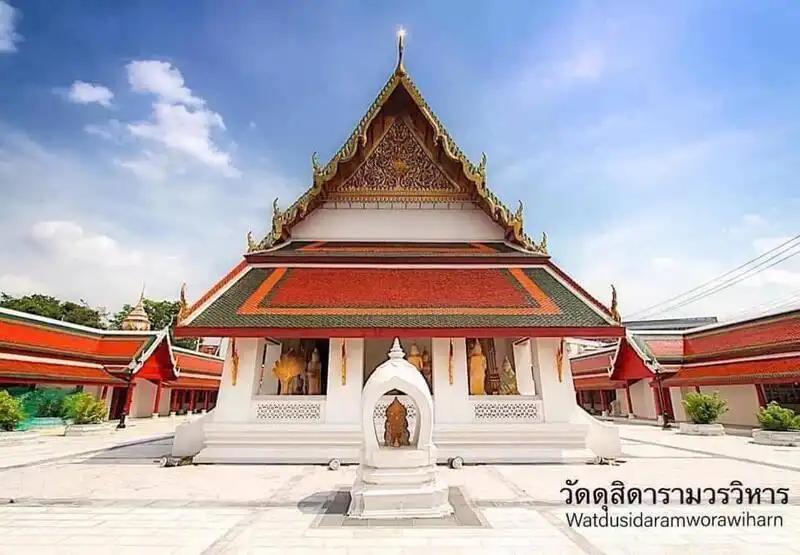
Architecturally, the key permanent structure that remains today is the ordination hall. Its columns and walls up to the beams are built of brick and mortar, while the upper structure is wooden. The roof is a three-tiered reduced roof, with chofa and bai raka finials, and is covered with ordinary baked clay tiles—understood to reflect an Ayutthaya-style form. Measured externally (the main ordination hall itself), it is 22.10 meters long and 10.10 meters wide. The front and rear porches are each 4.10 meters long and 10.10 meters wide. Inside the hall, the interior is 19.52 meters long and 7.92 meters wide, with a height from floor to beam underside of 9.57 meters. The side porches are each 3.36 meters long and 9.80 meters wide. These figures are not meant for memorization; they help us visualize the real proportions and how the space is composed to be both dignified and functional for ritual use.
The gables on both the front and rear sides of the ordination hall have a lower portion in brick and mortar, while the upper portion is carved wood in a scrolling vine motif, featuring a deity holding a sword, seated on a pedestal, executed in lacquer and gilding and inlaid with mirrored glass—matching on both sides. The front and rear door canopies, the inner porch areas, and the exterior window frames along both sides are decorated with molded plaster designs, with chofa and bai raka elements, and mirrored glass inlay. The outer doors and windows were originally lacquered with gold-on-black (lai rot nam) in the “rice-offering bouquet” motif, though the window patterns have faded away entirely; some traces remain on parts of the doors. Details like these are the “language of craftsmanship” that speaks of era, taste, and intent without needing lengthy explanation.
If you like visiting temples for both serenity and knowledge, it is best to explore without rushing. Begin by paying respects to the principal Buddha image in the ordination hall, then slowly walk along the cloister to observe the rows of standing Buddha images, as well as the paired prangs at the front corners and the paired stupas at the rear corners. Along the way, look closely at the gables, door and window frames, and the remaining gold-on-black lacquer details. You will quickly see that this temple offers more than a pleasant atmosphere; its craftsmanship becomes a starting point for a respectful conversation with the past.
Getting There If you are traveling by private car or taxi, set your map pin to the temple name and choose the most convenient Thonburi-side route for the time of day. In general, it connects conveniently from the Pinklao or Siriraj areas. If you are using public transport, start from the Siriraj–Pinklao area or from the old-city side, then continue by taxi or a short local ride depending on traffic. If traveling by boat, you can use piers or river-crossing points around the old-city–Thonburi area and then continue by road to the temple based on your starting point.
Ultimately, Wat Dusidaram Worawihan is compelling because it tells multiple layers of story within a single place. The first layer is living faith—people still returning to make merit. The next layer is the “Sa Prakhon” narrative that gives the temple name a pulse. The deepest layer is the ordination hall’s architecture and its surrounding elements, which clearly reflect Thai craftsmanship and aesthetic sensibilities. If you want a Bangkok temple visit that offers both calm and insight, this is a strong landmark to visit slowly, observe carefully, and let the details do the storytelling.
| Place Name | Wat Dusidaram Worawihan |
| Zone | Bangkok Noi – Thonburi side (connected to Siriraj / Pinklao / Old City) |
| Summary | A community temple associated with the “Sa Prakhon” name-story, alongside Ayutthaya-style ordination hall architecture and key surrounding elements such as 64 standing Buddha images, paired prangs at the front corners, and paired stupas at the rear corners. |
| Notable Sacred Objects / Architecture | Principal Buddha in Mara-subduing posture (lap width 2.12 m, height to halo 2.00 m) with two chief disciples, 64 standing Buddha images around the cloister, three-tiered reduced roof with chofa and bai raka, clay tiles, and scrollwork gables in lacquer, gilding, and mirrored glass. |
| Getting There | Car/Taxi: pin the temple name and enter via Thonburi routes / Public transport: start from Siriraj–Pinklao or the Old City and connect by a short taxi/local ride / Boat: use piers or river crossings around the Old City–Thonburi area, then continue by road |
| Current Status | Open for merit-making and visits (recommended to call ahead if visiting during ceremonies) |
| Temple Phone | 0-2424-6168, 0-2433-9854 |
| Current Abbot | Phra Thammavachirawethee |
| Nearby Attractions (approx. road distance) | National Theater (approx. 1.0 km) Phra Arthit Pier (approx. 1.3 km) Tha Chang Pier (approx. 1.5 km) The Grand Palace (approx. 2.6 km) Wat Pho (approx. 2.9 km) |
| Nearby Restaurants (approx. road distance) + Phone | Supanniga Eating Room (Tha Tien) (approx. 3.1 km) Tel. 092-253-9251 The Deck by Arun Residence (approx. 3.1 km) Tel. 0-2221-9158 Sala Arun Restaurant (approx. 3.1 km) Tel. 0-2622-2932 Above Riva (Riva Arun) (approx. 3.2 km) Tel. 0-2221-1188 Praya Dining (Praya Palazzo) (approx. 2.2 km) Tel. 081-402-8118 or 0-2883-2998 |
| Nearby Accommodations (approx. road distance) + Phone | Riva Surya Bangkok (approx. 1.6 km) Tel. 0-2633-5000 Praya Palazzo (approx. 2.2 km) Tel. 081-402-8118 or 0-2883-2998 Theatre Residence (approx. 3.4 km) Tel. 0-2848-9488 Riva Arun Bangkok (approx. 3.2 km) Tel. 0-2221-1188 sala rattanakosin bangkok (approx. 3.0 km) Tel. 0-2622-1388 |
Frequently Asked Questions (FAQ)
Q: Is Wat Dusidaram Worawihan open every day?
A: It is generally open daily for merit-making. It is recommended to call the temple if you plan to visit very early or during special ceremonies.
Q: Is “Wat Sa Prakhon” the same place as Wat Dusidaram Worawihan?
A: Yes. The name is associated with a story about a stone pillar once seen inside the cloister, aligning with the meaning of “prakhon” as a large boundary-marking pillar. However, it remains a hypothesis that cannot be confirmed with final certainty.
Q: What are the must-see art and architectural highlights?
A: The principal Buddha image in the ordination hall is a key focus. Also recommended are the walk around the cloister to see the 64 standing Buddha images, the lacquered and gilded gable panels with mirrored glass, and the plasterwork door and window frames.
Q: From which area is it most convenient to travel to the temple?
A: Starting from the Siriraj–Pinklao area or the Old City side and continuing by a short taxi/local ride is the most flexible. If you travel by boat, connect via piers or river crossings in the Old City area, then continue by road to the temple.
Q: What is the temple phone number, and who is the current abbot?
A: The temple phone numbers are 0-2424-6168 and 0-2433-9854, and referenced information identifies the current abbot as Phra Thammavachirawethee.
 Website: www.watdusidaram.org
 Wat Dusidaram Worawihan Map
 Category:
  Group:
  Last Update: 2 MonthAgo
Comment
 Nearby Attractions
| Keyword (Advance) |
 Region
|
 Phra Nakhon(