
 Home
Home North(
 Chiang Mai(


Rating: 3.3/5 (13 votes)
 |
|  Map
Map 
 Have Map
  No Map
Phetchaburi attractions
Attractions in Thailand
Open Days: Every day
Opening Hours: 08:00 – 17:00
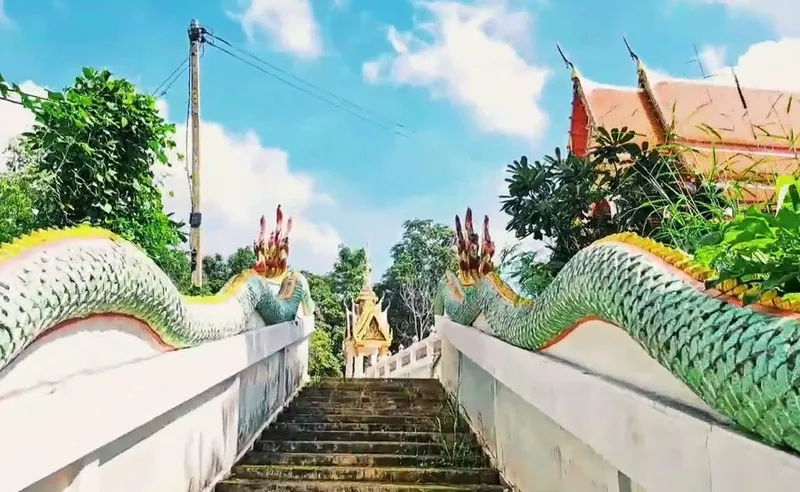
Wat Khao Chomphu is a local Buddhist temple in Ban Tha Takhro, Moo 2, Tha Takhro Subdistrict, Nong Ya Plong District, Phetchaburi Province. As a Maha Nikaya community temple, it reflects a lived-in, working rhythm rather than a commercial sightseeing spot. The temple functions as a genuine spiritual and civic anchor for the surrounding village, supporting everyday worship, merit-making on Buddhist holy days, life-cycle ceremonies, and community gatherings. Visiting here feels less like “checking in” and more like stepping into the cultural infrastructure that still holds rural Thai communities together.
The registered temple land covers 6 rai 2 ngan 84 square wah, giving Wat Khao Chomphu a compact, approachable scale typical of countryside temples. That smaller footprint is part of its character: the atmosphere becomes calm almost immediately, and the space feels intimate and easy to navigate. There is no sense of crowds or staged photo points; instead, the environment follows the real timetable of monks and locals. This simplicity is precisely what makes the temple meaningful for cultural travelers who want to understand Phetchaburi beyond the city core and the more famous landmark routes.
Wat Khao Chomphu was officially established on January 21, 1974. This date matters because it places the temple in a period when many rural Thai communities were moving through social and economic transitions, balancing traditional agricultural life with gradually increasing connectivity and modernization. Temples founded in this era often emerged from local need and collective faith: villagers required a formal place for communal rituals, shared moral education, and a stable center for public life. In that sense, Wat Khao Chomphu embodies the logic of Thai community temples: it exists because the community needed it, and it remains relevant because the community continues to use it.
A key milestone that confirms the temple’s full ecclesiastical standing is its receipt of Wisungkhamsima, granted on January 12, 1979. The designated boundary measures 40 meters wide by 80 meters long. In Buddhist administration, Wisungkhamsima establishes an officially recognized sacred boundary for monastic acts connected to the ordination hall and other formal Sangha procedures. For the local community, it is more than a legal boundary: it is an institutional confirmation that the village has a stable, formally sanctioned spiritual center where major rites can be conducted correctly and consistently over time.
The temple is also known for continuity in leadership. Based on local temple records, the abbot is Phra Khru Phatchara Sela Khun, serving from 1974 to the present. Long-term continuity matters especially in community temples because it supports consistent development, reliable stewardship, and trust between monks and laypeople. It also helps sustain programs that require long-run commitment, such as Buddhist education, youth activities, and annual merit-making events that depend on collective planning and coordination.
Another defining dimension of Wat Khao Chomphu is Buddhist education. The temple operates a Dhamma studies division of a Phra Pariyatti school, opened in 1974—the same year the temple was established. This alignment signals a clear founding intention: the temple was meant not only for ritual but also for structured learning. In rural settings, a Pariyatti school helps communities keep faith paired with understanding, and it gives monks, novices, and interested laypeople a stable pathway to study the Dhamma. It also creates a year-round cadence of meaningful activity rather than limiting the temple’s role to occasional festivals.
In Nong Ya Plong, community temple life typically revolves around annual merit-making events where participation is high—such as Kathin and Pha Pa—as well as major Buddhist holy days and activities connected to Dhamma learning. During these periods, the temple becomes a living stage of community cooperation: setting up spaces, preparing food, organizing offerings, running small charity kitchens, and cleaning up together afterwards. These events are not only religious; they are practical training in social cohesion. That is why temples like Wat Khao Chomphu remain deeply relevant in contemporary rural Thailand.
Visitors should treat the temple as an active religious space rather than a tourist set. Dress modestly, keep voices low, respect monastic areas, and be attentive when ceremonies are underway. When making offerings, practical items that the temple can use in daily operations are appropriate, especially for a compact community temple: basic household supplies, shelf-stable food, essential medicines, or cleaning necessities. Such offerings are directly useful and support the temple’s ability to maintain its services to the community.
The wider ambiance of Nong Ya Plong enhances the experience. The district carries a rural, semi-hilly character, and the drive itself naturally slows your pace as you leave urban intensity behind. For travelers seeking a softer, more reflective itinerary, stopping at Wat Khao Chomphu introduces a cultural and spiritual tone before continuing onward to nearby dining stops or nature-focused accommodation in the broader Nong Ya Plong and Kaeng Krachan areas.
Getting There If you drive, set your map pin to “Wat Khao Chomphu, Tha Takhro, Nong Ya Plong, Phetchaburi” and follow the main route into Nong Ya Plong District, then continue into Tha Takhro Subdistrict toward Ban Tha Takhro, Moo 2. Local roads are generally accessible by standard vehicles; allow extra time for rural intersections and stay cautious around agricultural traffic. Many visitors plan the temple as a calm cultural stop, then continue toward restaurants or cafés along the same general corridor and finish the day at a nature-oriented stay in the Nong Ya Plong–Kaeng Krachan zone.
Wat Khao Chomphu ultimately stands as a clear window into “Phetchaburi beyond the city.” Its value comes from verifiable milestones—its establishment date, Wisungkhamsima status, long-standing abbot leadership, and its Pariyatti Dhamma school—combined with the everyday reality of a temple that still functions as a shared community foundation. For travelers who want cultural depth rather than spectacle, this is exactly the kind of place that adds meaning to the route.
| Summary | A Maha Nikaya community temple in Ban Tha Takhro, established in 1974, granted Wisungkhamsima in 1979, and operating a Dhamma division of a Phra Pariyatti school since 1974; well-suited for worship, merit-making, and a quiet cultural stop in rural Nong Ya Plong. |
| Name | Wat Khao Chomphu |
| Address | Ban Tha Takhro, Moo 2, Tha Takhro Subdistrict, Nong Ya Plong District, Phetchaburi, Thailand |
| Abbot | Phra Khru Phatchara Sela Khun |
| Highlights | Authentic rural community-temple atmosphere, formally established and granted Wisungkhamsima, sustained Buddhist education via a Pariyatti Dhamma school, ideal for a quiet merit-making visit. |
| Period | Established January 21, 1974; Wisungkhamsima granted January 12, 1979 (40 m × 80 m) |
| Key Evidence | Temple land 6 rai 2 ngan 84 sq wah; Wisungkhamsima boundary 40 m × 80 m; Pariyatti Dhamma school opened in 1974. |
| Name Origin | The name reflects the local toponym “Khao Chomphu” associated with the area and community identity. |
| Travel | Drive into Nong Ya Plong District, continue to Tha Takhro Subdistrict, then Ban Tha Takhro (Moo 2); rural roads are accessible by standard cars; allow extra time for local intersections and agricultural traffic. |
| Current Status | Open for worship and merit-making |
| Nearby Tourist Attractions With Distance | 1) Nong Ya Plong District Office – ~12 km 2) Wat Wang Phu Sai – ~18 km 3) Wat Cha Prong – ~25 km 4) Kaeng Krachan Dam – ~55 km 5) Phra Nakhon Khiri (Khao Wang), Phetchaburi – ~65 km |
| Popular Restaurants Nearby | 1) Little Forest Coffee House (Kaeng Krachan) – ~55 km – 062-339-8678 2) 289 Hill Farm Cafe & Resort (Kaeng Krachan) – ~60 km – 099-289-9628 3) NABI CAFE (Kaeng Krachan) – ~60 km – 086-335-6771 4) Baan Suan Restaurant (Kaeng Krachan) – ~60 km – 032-459-844 5) Krua Kluay Hom (Kaeng Krachan) – ~55 km – 064-962-9509 |
| Popular Accommodations Nearby | 1) Trin Wellness Phetchaburi – ~25 km – 032-595-138 2) River Tales Kaeng Krachan – ~60 km – 032-772-189 3) Leaves Valley Resort (Kaeng Krachan) – ~55 km – 089-811-6931 4) Together Resort Kaeng Krachan – ~60 km – 091-706-6393 5) Baan Thanthip Resort Kaeng Krachan – ~60 km – 092-586-9559 |
Frequently Asked Questions (FAQ)
Q: Where is Wat Khao Chomphu located?
A: It is in Ban Tha Takhro, Moo 2, Tha Takhro Subdistrict, Nong Ya Plong District, Phetchaburi Province.
Q: When was the temple established?
A: The temple was officially established on January 21, 1974.
Q: When did Wat Khao Chomphu receive Wisungkhamsima, and what is the boundary size?
A: Wisungkhamsima was granted on January 12, 1979, with a boundary of 40 meters by 80 meters.
Q: Does the temple provide Buddhist education?
A: Yes. It operates a Dhamma division of a Phra Pariyatti school that opened in 1974.
Q: Who is the current abbot of Wat Khao Chomphu?
A: Phra Khru Phatchara Sela Khun.
Q: Can I combine this temple visit with a Kaeng Krachan day trip?
A: Yes. Many travelers visit the temple for a calm merit-making stop, then continue toward Kaeng Krachan for cafés, meals, and nature-oriented stays.
 Wat Khao Chomphu Map
 Category:
  Group:
  Last Update: 1 MonthAgo
Comment
 Nearby Attractions
| Keyword (Advance) |
 Facebook Fanpage
 Region
 Art, Culture and Heritage
 Historical Sites and Monuments(
 Landmarks and Memorials(
 Royal Palace(
 Art, Craft Centres, Tradition(
 Museums(
 Educational Places
 Educational Gardens, Farm(
 University
 Other religious and spiritural sites(
 Research and Development
 Royal Project(
 Suburban Living
 Village, Community(
 Floating Market(
 Nature and Wildlife
 National Parks and Marine Reserves(
 Mountain (Doi)(
 Dam, Reservoir, Lake(
 Waterfalls(
 Hot Springs(
 Caves(
 River, Canal(
 Bays and Beaches(
 Islands(
 Other natural attractions(
 Entertainment and Agricultural
 Farm, Parks, Gardens and Ecotourism(
 Theater(
 Outdoor and Adventure Activities(
 Travel Articles, Recipes
 Travel Review, Food Review(