

 Home
Home Chiang Mai(









Rating: 4/5 (5 votes)
 |
|  Map
Map 
 Have Map
  No Map
Chiang Mai attractions
Attractions in Thailand
Open Days: Daily
Opening Hours: Recommended 09.00–18.00 (please avoid prayer times, especially Friday congregational prayer)
Masjid Masjidun Nur is one of Chiang Mai’s long-established Muslim community centers, rooted in the historic Muslim settlement of the Chang Phueak area. The community traces its origins to approximately four to five Muslim families of Pakistani and Indian descent who migrated from Pakistan and India and settled in this area. The locality was commonly known as “Thung Wesali,” a fertile area that was not prone to flooding and had a continuous flow of water from Huai Kaeo and Huai Chang Khian streams, making it suitable for livestock raising and small-scale vegetable farming. From the very beginning, the mosque served not only as a place of worship but also as a spiritual anchor for migrants who had traveled far to establish a new life in Chiang Mai.
In the early period, there was no permanent mosque building in the Chang Phueak area. As a result, Muslims here traveled regularly to perform the important Friday congregational prayer at Chang Klan Mosque. Over time, the area became more widely known among traders, leading to an increase in Muslim settlers, including Pakistani-Indian merchants and Chinese Yunnanese Muslim tea traders. The image of community members walking together to pray in another neighborhood reflects the determination to preserve religious practice even when facilities were still limited.
A key figure frequently mentioned in the history of the mosque is “Napazang,” widely known among traders as “Pho Liang Laena.” He was relatively well-off economically and took the lead in improving and rebuilding the mosque into a more stable structure. What had once been a temporary shelter made of bamboo poles, woven walls, banana-leaf roofing, and no flooring was transformed into a wooden plank building with greater durability. Due to his leadership and trust within the community, he was selected to serve as the imam of the congregation. This transition from a temporary prayer space to a purpose-built structure marked an important milestone for the migrant Muslim community, symbolizing their intention to settle permanently and sustainably.
Around 2–3 years before Imam Laena passed away, approximately in 1930, a respected Islamic scholar of Pakistani origin named “Molvi Gayim Makin” migrated to Thailand. He was renowned for his beautiful and melodious recitation of the Holy Qur’an and resided in the Chang Klan area. After Imam Laena’s death, the Muslim community of Chang Phueak invited him to serve as the imam of Masjid Dun-Nur. He held this position for nearly 30 years and was remembered for his exemplary conduct, strict adherence to religious duties, and consistent devotion. He also played a major role in advancing education and social development within the Chang Phueak Muslim community. After his passing, he was initially buried within the mosque compound near the right side of the entrance gate, although his descendants later relocated his remains to the Muslim cemetery.
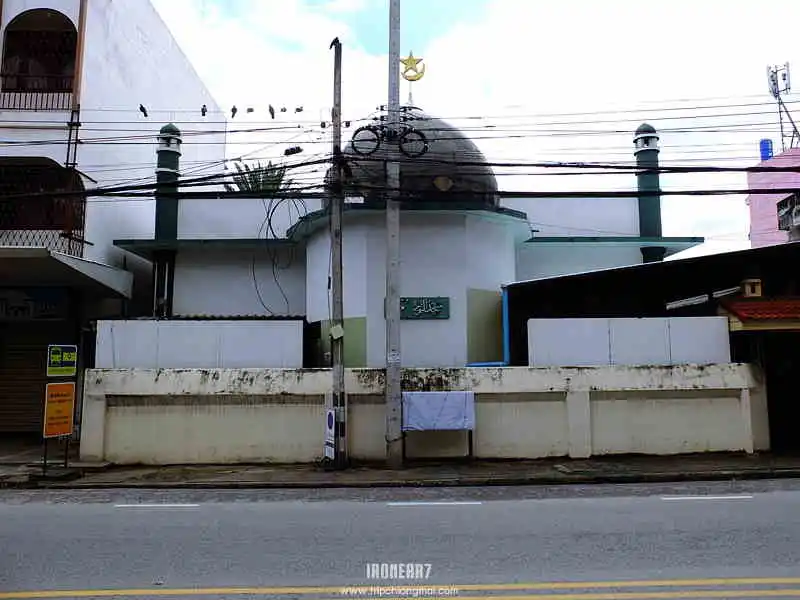
By 1951, the original mosque building had deteriorated significantly. The mosque committee and congregation therefore agreed to construct a new building. Muslims living throughout Chiang Mai joined together to raise funds, with a formal committee overseeing the construction. At that time, Haji Sribut Waree served as chairman, with Nana Muhammad Hussein, Noi Bansak, and Siddiq Chao Duri as committee members. The construction was successfully completed in 1953, resulting in a single-storey brick-and-mortar building with a tent-shaped roof. Its dignified appearance reflects Pakistani architectural influence, and the mosque has since stood prominently along Chotana Road near Chang Phueak Market.
For visitors, Masjid Masjidun Nur is best experienced with an attitude of respect. As an active place of worship, appropriate attire, soft conversation, and avoidance of prayer areas during religious services are essential. Photography or entry into certain spaces should be done only after asking permission from mosque staff or committee members. When approached thoughtfully, a visit here offers insight into Chiang Mai’s multicultural fabric and the long-standing presence of Muslim communities in the city.
Getting There From Chiang Mai’s old city moat, head toward the Chang Phueak area and Chang Phueak Market, then follow Chotana Road into the surrounding community where Masjid Masjidun Nur is located. Private vehicles and local taxis are convenient options. Parking may be limited during busy market hours or on Fridays during congregational prayer, so allow extra time.
| Place Name | Masjid Masjidun Nur (Masjid An-Nur / Dun-Nur) |
| Location | Chang Phueak area, Mueang Chiang Mai District, Chiang Mai Province (Chotana Road / Chang Phueak Market zone) |
| Open Days | Daily |
| Opening Hours | Recommended 09.00–18.00 (actual access depends on prayer schedules) |
| Main Features | Historic mosque serving a Pakistani-Indian Muslim community in Chang Phueak; evolved from a temporary prayer space into a permanent brick structure completed in 1953, with Pakistani architectural influence |
| Historical Period | Early settlement by 4–5 families; major reconstruction undertaken in 1951 and completed in 1953 |
| Key Historical Notes | Leadership of “Pho Liang Laena,” long tenure of Imam Molvi Gayim Makin (approx. 30 years), and community-led reconstruction in the mid-20th century |
| Name Meaning | “An-Nur” / “Dun-Nur” refers to “light,” symbolizing spiritual guidance in Islamic tradition |
| Access | From Chiang Mai Old City, head to Chang Phueak / Chang Phueak Market area, then enter Chotana Road and nearby community streets |
| Current Status | Active mosque serving the local Muslim community (contact recommended for group visits) |
| Contact Phone | 053-211-723 |
Frequently Asked Questions (FAQ)
Q: Where is Masjid Masjidun Nur located in Chiang Mai?
A: It is located in the Chang Phueak area, near Chang Phueak Market and Chotana Road, one of Chiang Mai’s historic Muslim neighborhoods.
Q: When is the best time to visit?
A: Daytime hours between 09.00 and 18.00 are recommended, avoiding prayer times—especially Friday congregational prayer.
Q: What makes Masjid Masjidun Nur significant?
A: It represents the long-standing Pakistani-Indian Muslim community in Chiang Mai and showcases the evolution from a temporary prayer shelter to a permanent mosque completed in 1953.
Q: How can I contact the mosque?
A: You can call 053-211-723 for inquiries.
 Masjid Masjidun Nur Mosque Map
 Category:
  Group:
  Last Update: 4 HourAgo
Comment
 Nearby Attractions
| Keyword (Advance) |
 Region
|
 Muang Chiang Mai(