

 Home
Home Chiang Mai(













Rating: 4.3/5 (4 votes)
 |
|  Map
Map 
 Have Map
  No Map
Bangkok attractions
Attractions in Thailand
Open Days: Daily
Opening Hours: Open 24 hours (public outdoor area / viewpoints nearby)
Rama VIII Bridge is one of the Chao Phraya River crossings that gives the word “landmark” real weight in Bangkok. Even if you’ve only ever treated it as a route you pass through, pausing for a moment is enough to see how this structure tells a complete story—about easing traffic pressure, linking the Phra Nakhon and Thonburi sides of the city, and Bangkok’s ongoing relationship with the Chao Phraya that has never truly faded.
The bridge is often described as a project rooted in royal initiative and a very clear urban logic: adding one more river crossing to relieve congestion on Pin Klao Bridge and make movement between the two banks smoother. When a new bridge appears, a city doesn’t just gain “a way across.” It gains a new option—one that redistributes traffic away from old bottlenecks and subtly changes the rhythm of entire neighborhoods.
Seen through a “city planning” lens, Rama VIII Bridge sits in a zone where Bangkok’s meanings are especially layered. On the Phra Nakhon side, you’re close to the old city and major civic areas where the river opens out in long, unobstructed views. On the Thonburi side, you’re in a landscape of communities and routes that connect into the west-bank road network. The fact that the bridge has no piers in midstream matters not only as engineering, but as city-making: it reduces obstructions in the channel and keeps the river vista clear, allowing the bridge to fully “show its lines.”
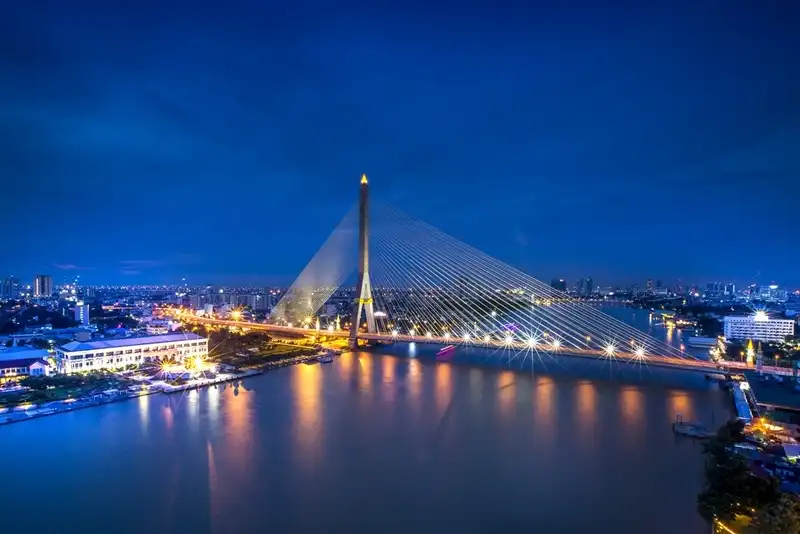
From an engineering standpoint, Rama VIII Bridge is widely recognized as an asymmetrical single-pylon cable-stayed bridge. Its signature image is the massive main pylon on the Thonburi bank carrying a web of stay cables. Those cables are not decoration—they are the language of force, distributing load and controlling balance so the span works with stability. The farther you step back—especially in morning or late-afternoon light—the more you see the sharp, clean geometry that makes the bridge look light, even though it carries a heavy daily workload.
Another reason Rama VIII Bridge remains memorable is the decision to keep the river free of midstream piers. That choice helps water flow more cleanly and keeps the riverfront skyline visually open. Combined with its location near historically significant districts and important civic buildings, the intent to preserve “dignity of the view” becomes part of the bridge’s identity—just as much as its role as transport infrastructure.
If you want Rama VIII Bridge to feel like a “place to visit” rather than simply a “place you cross,” the best approach is to come for the atmosphere—without rushing—and stay in safe, pedestrian-friendly areas such as riverside parks, walkways, or viewpoints near the bridge (not in traffic zones). In the morning, the river feels calmer and the light gradually reveals structural details. In the evening, softer light and changing sky colors make the cables stand out like pencil lines drawn across a vast canvas.
Another layer of the bridge’s appeal is how easily it connects you to a wider one-day itinerary. It sits close enough to the Bang Lamphu–Phra Athit–old Phra Nakhon areas to continue your trip naturally, and on the Thonburi side you can also flow into older neighborhoods and riverside communities. Put simply, you don’t have to “visit only the bridge.” You can use the bridge as a connector that gives your full-day route a richer narrative.
Getting There Visiting Rama VIII Bridge is most convenient by private car, taxi, or ride-hailing apps, because you can choose a safe drop-off near a park or viewpoint and walk a short distance. If you come by public transport, plan to get off near the Phra Athit/Bang Lamphu area or a convenient point on the Thonburi side and then connect by taxi, motorcycle taxi, or a manageable walk. It’s wise to avoid rush hours and prioritize safety, since the areas around the bridge approach roads are major routes with constant traffic flow.
In the end, if you read the city like a local observer, Rama VIII Bridge isn’t valuable only for its beauty. It is a solution from a specific era—one that tried to deliver both mobility and a dignified riverscape at the same time. The bridge reminds you that Bangkok didn’t grow on roads alone; it kept reshaping its relationship with the Chao Phraya, and bridges are one of the most important tools in that ongoing transition.
| Name | Rama VIII Bridge |
| Location | A bridge across the Chao Phraya River connecting the Phra Nakhon side and the Thonburi side, Bangkok |
| Key Characteristics | Asymmetrical single-pylon cable-stayed bridge, iconic cable lines, no midstream piers |
| Period / Context | A modern-era river crossing built to ease traffic congestion and strengthen links between Phra Nakhon and Thonburi |
| Travel | Private car / taxi / ride-hailing apps (recommended: stop near a safe park/viewpoint and avoid rush hours) |
| Current Status | In active use as a river crossing and a city landmark viewed from nearby public areas |
| Nearby Attractions | Rama VIII Park (approx. 1 km) Tel. 02-465-5009 Santichaiprakarn Park (near Phra Sumen Fort) (approx. 2 km) Tel. 02-221-0195 National Museum Bangkok (approx. 3 km) Tel. 02-224-1402 Wat Bowonniwet Vihara (approx. 3 km) Tel. 02-281-9835 The Grand Palace (approx. 4 km) Tel. 02-623-5500 |
| Nearby Restaurants | Steve Cafe & Cuisine (approx. 1 km) Tel. 02-281-0915 Savoey Tham Maharaj (approx. 3 km) Tel. 086-341-8472 Supanniga Eating Room Tha Tien (approx. 5 km) Tel. 02-015-4224 Baan Khanitha by the River (approx. 5 km) Tel. 02-108-4910 Babble & Rum (Riva Surya Bangkok) (approx. 4 km) Tel. 02-633-5000 |
| Nearby Accommodations | Riva Surya Bangkok (approx. 4 km) Tel. 02-633-5000 Praya Palazzo (approx. 4 km) Tel. 02-883-2998 Chillax Heritage (approx. 4 km) Tel. 02-629-2699 The Royal River Hotel (approx. 5 km) Tel. 02-422-9222 Casa Nithra Bangkok (approx. 4 km) Tel. 02-282-3034 |
Frequently Asked Questions (FAQ)
Q: When is the best time to visit Rama VIII Bridge?
A: Early morning or late afternoon/evening offers softer light, clearer cable lines, and a more comfortable riverside atmosphere than midday.
Q: Where can I walk nearby to enjoy the bridge safely?
A: Rama VIII Park is a good choice because it is a riverside public space suitable for strolling and viewing the bridge safely.
Q: What should I be careful about when taking photos of Rama VIII Bridge?
A: Choose safe viewing points, avoid risky areas, and never stand where you might block walkways or traffic—approach roads can be busy and fast-moving.
Q: Why does Rama VIII Bridge feel especially open and unobstructed?
A: The design avoids midstream piers, keeping the river channel clear and the riverscape visually wide and open.
Q: Where can I go after visiting Rama VIII Bridge?
A: You can continue to the Phra Athit–Bang Lamphu area or the National Museum to add historical context, and Tha Maharaj is a convenient next stop for food and a riverside stroll.
 Rama VIII Bridge Map
 Category:
  Group:
  Last Update: 5 HourAgo
Comment

Photo Gellery(9) 
 Thank you photo(3) from: Rapeephat