

 Home
Home Chiang Mai(







Rating: 4/5 (4 votes)
 |
|  Map
Map 
 Have Map
  No Map
Kanchanaburi attractions
Attractions in Thailand
Open Days: Daily
Opening Hours: 06:00 – 21:00 (the liveliest time is usually in the morning)
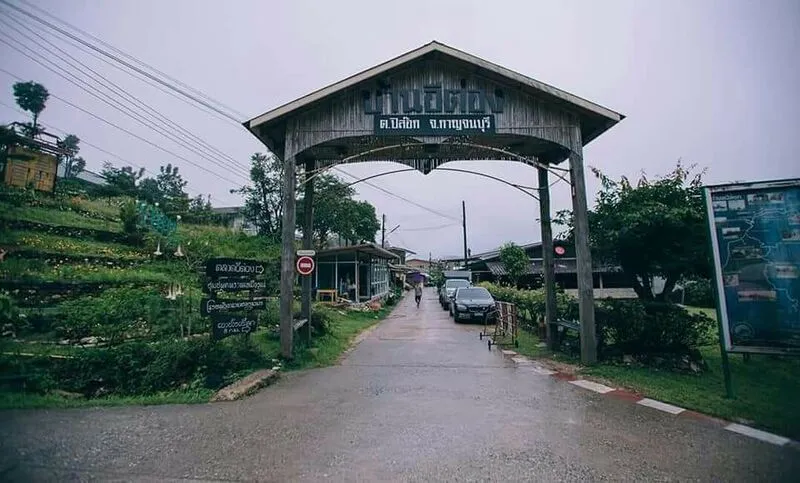
Ban Etong Market in Kanchanaburi is the kind of “mountain-border market” that isn’t large or flashy, yet carries a quiet charm rooted in a real community that grew out of everyday necessity during the mining era. Ban Etong is located in Pilok Subdistrict, Thong Pha Phum District, Kanchanaburi Province, at the end of a winding mountain road many travelers know as the “399 curves” route, leading up to an old mining village along the Tenasserim range. Cool weather nearly year-round, plus mist drifting through morning and evening, gives the market a distinctive mood, as if time slows the moment you step into the village.
The story of Ban Etong Market began with “miners’ housing” rather than organized stalls or a tourism project. In the past, Ban Etong was closely tied to mining operations, and many people moved in to live in housing provided for staff, workers, and employees of the state agency that oversaw the mines at the time. Life in a mining community meant large numbers of people living on a mountain far from town. As the need for food, daily necessities, and basic supplies grew, small-scale trading started “among the housing clusters themselves.” Some households cooked and sold meals, some laid out everyday items for exchange, and others brought goods up from lower areas to resell. The market gradually took shape naturally and expanded steadily as the community population increased.
The key turning point that made Ban Etong Market distinct from other small mountain markets was cross-border trade linking people on the “Thai side” with those on the “Myanmar side.” As communities across the border traded more actively with Thailand, a wide range of goods were brought in and exchanged around Ban Etong, including everyday consumables and items reflecting the border economy. Goods remembered from the Myanmar side included salted fish, turtle eggs, crab, fresh shrimp, and dried shrimp. Business-related goods connected to larger income streams at the time included minerals, cattle, buffalo, fish maw, and gemstones. From the Thai side came gold, cloth, general household goods, and what people often recalled as the “best sellers” in one era: liquor, beer, and charcoal, closely tied to hard work, cold weather, and the community’s need for fuel and energy on the mountain.
If you look at Ban Etong Market beyond the tourist lens, you’ll see that the “market” functions as a social hub as much as an economic one. A mining community draws people from many places, brought together by work and necessity. When life is remote, meeting, exchanging news, helping one another, and finding warmth as neighbors naturally happens around the market. A morning might begin with buying something hot to eat, but along the way people chat about rain, mist, mountain roads, or children who have gone to work in the city. The market becomes a kind of shared “living room” for the village rather than a place for hurried shopping.
The cool climate of Ban Etong isn’t merely a beautiful backdrop; it sets the rhythm of daily life. In many seasons—especially late rainy season into early winter—thick fog arrives before dawn, giving the morning market the depth of an old photograph. The sound of boiling water for coffee blends with the comforting aroma of breakfast drifting through the cold air. This simple atmosphere becomes an experience many travelers come specifically to enjoy by staying overnight, just to “wake up to a morning like this” at least once.
From an economic-history perspective, the mining boom years allowed many people to build stability and achieve success. Some families shaped their lives through mine work and trading, eventually sending children to further study or helping them establish themselves elsewhere. But when the mines ceased operations, the economic structure that supported the community weakened. Many people moved away from Ban Etong and “hardly ever returned,” leaving behind a handful of homes, memories, and stories passed down through generations. For a time, Ban Etong grew noticeably quiet, yet the market—as a place of exchange for those who remained—continued to fulfill its role, becoming smaller and simpler as the population declined.
What’s compelling about Ban Etong’s revival today is that it didn’t happen by “rebuilding until the original roots disappeared.” Instead, it came from telling the original roots anew through tourism. Travelers became interested in the mountain route, misty viewpoints, the old mining community, and the border stories. As Ban Etong came back to life, the market became more than a place to buy things. It became a place where visitors can get to know the community up close, buy local souvenirs, enjoy simple foods suited to the cold weather, chat with shop owners who are locals, and experience a pace of life that feels entirely different from the city.
If you ask why Ban Etong Market is “worth strolling,” the answer isn’t the number of shops. It’s the fact that the market remains a true “community market.” Visitors will find a mix of goods—from food and small daily items to souvenirs that reflect the border character of the area. Another lovely detail is how unhurried buying and selling feels. Vendors often smile easily, chat readily, and are happy to share village stories. If you speak respectfully, you may learn which homes once worked in the mines, which once supplied goods for workers, which still keep old photographs, or which have relatives across the border who traded long before the roads became as convenient as they are today.
As for the “local voices” travelers often hear again and again when talking about Ban Etong Market, it’s phrases like “there used to be far more people” or “when the mines were still running, everything was much more lively.” These remarks aren’t only about nostalgia; they underscore that the market and village were not originally created for tourism. This was a village with real economic functions—real workplaces, real homes, real memories. Tourism is simply a newer chapter that helps the village generate income and find reasons to continue, without needing to abandon its original identity.
Another common local perspective, especially from homestay owners and shopkeepers, is concern about “road safety” and “seasonal conditions.” The route up to Ban Etong is a continuous series of mountain curves, so it’s important to drive carefully and allow extra time—particularly in the rainy season when fog can be heavy and roads can be slippery. If you want the full morning-market experience, locals often recommend arriving before evening, staying overnight in the village, then waking early to visit the market without rushing. This style of travel fits Ban Etong’s rhythm best.
To enjoy Ban Etong Market at its most atmospheric, many people begin by “waking up in time for the fog,” then slowly strolling out to choose warm foods from shops in the village. Along the way you’ll see wooden houses and buildings that reflect life in a mountain community. At times the chill in the air makes you hold your coffee cup a little tighter, then you continue selecting small souvenirs or daily items that suit the border setting. On a good-weather morning, you’ll feel the market isn’t just for shopping; it’s a place that encourages you to slow down, listen more, and notice more.
Getting There Most visitors travel to Ban Etong and Ban Etong Market by private car. From Thong Pha Phum District, take Highway 3272 for about 70 kilometers. The road is paved but features continuous winding mountain curves and is widely known for its many bends. Check your vehicle condition in advance—brakes, tires, and fuel—and avoid driving at night if you are unfamiliar with the route. Many travelers choose to stay overnight in the village so they can wake up early for the market and the fog. Within the village, walking is convenient because key spots are located close to one another.
For those who want to pair the market with nearby attractions for a fuller Ban Etong experience, many people stop by sites near the village such as Noen Chang Suek, which is not far before reaching Ban Etong, and Jokkradin Waterfall along the same route. Both places reflect the “mountain nature” that complements the atmosphere of an old mining community market. Planning your trip this way means it isn’t only about fog and stalls; it also includes the landscape, the route, and the area’s stories.
| Name | Ban Etong Market (Ban Etong Village) – Pilok Subdistrict, Thong Pha Phum District, Kanchanaburi |
| Address | Pilok Subdistrict, Thong Pha Phum District, Kanchanaburi 71180 |
| Place Summary | A community market in an old mining village that grew from miners’ housing and Thai–Myanmar border trade, now a misty mountain destination known for local life and slow mornings. |
| Highlights | Cool mountain atmosphere, morning fog, stories of the old mining community, and local food and souvenirs reflecting border-life character. |
| Open Days | Daily |
| Opening Hours | 06:00 – 21:00 (mornings are usually the busiest) |
| Travel | From Thong Pha Phum, take Highway 3272 for about 70 km. The route is mountainous with continuous curves; check vehicle condition and allow extra travel time. |
| Current Status | An active community and tourism area that continues to welcome visitors; trading and village life run throughout the day. |
| Nearby Attractions With Distance | 1) Noen Chang Suek (1 km) 2) Jokkradin Waterfall (5 km) 3) Pilok Mine (0.5 km) 4) Wat Pilok (0.3 km) 5) Pilok Subdistrict Administrative Organization (30 km) |
| Popular Restaurants Nearby With Distance + Phone | 1) Krua Je Nee, Ban Etong (0.4 km) Tel. 089-515-3528 2) Chao Mueang Pilok Cake Shop (0.5 km) Tel. 098-408-6509 3) Chang Kae Classic Home, Ban Etong (0.3 km) Tel. 082-291-6373 4) Brume Cafe N' Room (0.6 km) Tel. 082-258-5456 5) Krua View Sud Daen (6 km) Tel. 095-606-4606 |
| Popular Accommodations Nearby With Distance + Phone | 1) Pilok Hill House (0.7 km) Tel. 080-781-5702 2) Baan Tawan Homestay Pilok (0.8 km) Tel. 080-781-5729 3) Etong Homestay (0.3 km) Tel. 092-249-1915 4) Baan Chan Pilok Homestay (0.4 km) Tel. 081-116-4578 5) Nat Aeng Tong House (0.5 km) Tel. 081-942-3057 |
Frequently Asked Questions (FAQ)
Q: Is Ban Etong Market open every day?
A: Yes. It is generally open daily from 06:00 – 21:00, and mornings are usually the most lively.
Q: When is the best time to visit Ban Etong Market?
A: If you want foggy mornings and cool weather, late rainy season into winter is ideal. Waking up early is recommended for the best misty atmosphere.
Q: How did Ban Etong Market begin?
A: It started as small-scale trading among miners’ housing, then expanded through trade between Thai and Myanmar border communities, eventually becoming the village’s community market.
Q: Is the drive up to Ban Etong difficult?
A: The route is mountainous with continuous curves. Drive carefully, check your vehicle condition, and allow extra time—especially in the rainy season when roads may be slippery and fog can be heavy.
Q: If staying overnight in Ban Etong, what else should I do besides visiting the market?
A: Many travelers also visit Noen Chang Suek for mountain views and stop by Jokkradin Waterfall along the same route for a nature-and-community itinerary.
 Ban Etong Market Map
 Category:
  Group:
  Last Update: 4 HourAgo
Comment
 Nearby Attractions
| Keyword (Advance) |
 Region
|
 Muang Kanchanaburi(