

 Home
Home Chiang Mai(










Rating: 4.2/5 (5 votes)
 |
|  Map
Map 
 Have Map
  No Map
Kanchanaburi attractions
Attractions in Thailand
Open Days: Daily
Opening Hours: 07:00 – 17:00
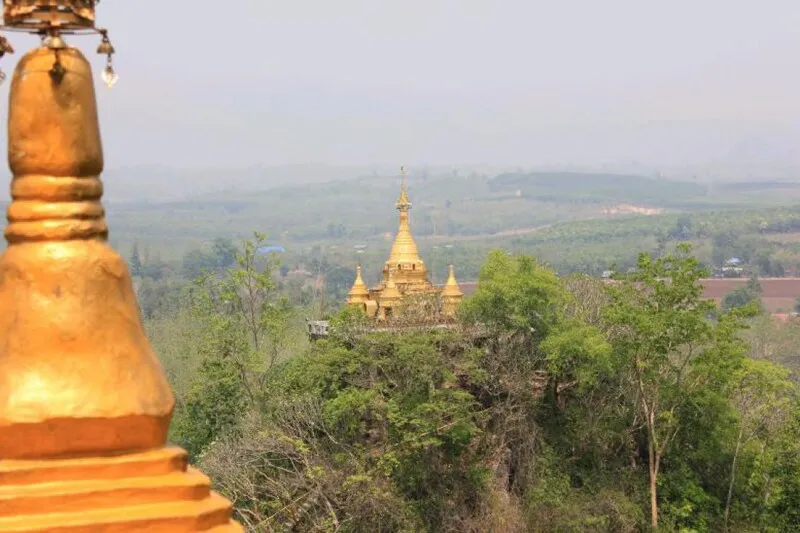
Female Chedi – Male Chedi at Wat Prang Kasee in Ban Prang Kasee, Tha Khanun Subdistrict, Thong Pha Phum District, Kanchanaburi is one of the most meaningful faith landmarks in Thailand’s western border communities, especially among Karen and Mon people who have lived in the area for generations. What makes this place stand out is not only the distinctive twin chedis set on two small hills, but the role they play as a living symbol of marital fidelity, family responsibility, and moral discipline — values that are continually reinforced through the community’s annual merit-making traditions.
The landscape of Wat Prang Kasee and the surrounding hills creates the feeling of stepping into a “scene of faith,” where geography and belief naturally connect. The Female Chedi sits on a small hill to the left of the temple area, while the Male Chedi stands on another hill to the right. Their placement allows the two chedis to be seen in relation to one another, which local people interpret as a symbolic pairing. Many residents also refer to them as “Father Chedi – Mother Chedi,” underscoring the idea that these structures were not created merely for visual beauty, but as moral reminders that remain present in everyday life.
Local oral accounts describe the Male Chedi as having a complex construction history that reflects the persistence of the community. It is said that the Male Chedi was originally built by a monk from Sangkhlaburi District, but later collapsed. It was rebuilt, only to collapse again. The third reconstruction is the version that has endured and is seen today. This repeated cycle of collapse and rebuilding has become part of the site’s identity, leading many to view the Male Chedi as a symbol of patience, resilience, and steadiness in moral conduct.
The Female Chedi does not have a widely agreed-upon record of who first built it, but local narratives commonly state that it was constructed after the third rebuilding of the Male Chedi. Its appearance is often seen as completing the “balance” of the paired symbolism. Visiting the site is therefore not simply about reaching one point; many worshippers choose to pay respects at both hilltops for completeness, especially those who come to pray for love, family harmony, and stability in married life.
What sets the Female Chedi – Male Chedi apart from many other devotional sites is the direct connection to Karen social values and customs. For many Karen families, marriage and partnership are treated with deep seriousness, particularly the principle of remaining faithful and not interfering in other people’s families. This ethic is strongly embedded in community life, and the paired chedis serve as a visible reminder of that moral commitment. In this sense, the chedis are not only religious monuments but also a cultural mechanism that helps protect trust and stability within the community.
Because of this, prayers made at the Female Chedi – Male Chedi are often spoken of as prayers for a peaceful and harmonious household, rather than requests for quick or superficial outcomes. Many believers feel that visiting the chedis is also a way to steady one’s mind and reflect on personal responsibility in relationships. At the same time, the annual tradition associated with the site functions as a powerful community gathering point, bringing people together to make merit, walk in candlelit processions, offer alms, observe precepts, and share moments of simple celebration. Faith here is not separated from life — it is woven into how the community cares for its relationships.
In local practice, Karen and Mon communities commonly perform merit-making and devotional activities in the ninth lunar month. During this period, the community gathers in a familiar rhythm each year. The atmosphere combines religious devotion with gentle warmth and mutual care, reflecting Karen cultural values such as respect for elders and strong reverence for monks. The annual gathering becomes both a religious rite and a social space where shared values are learned, reinforced, and passed to younger generations.
Seen as a whole, the Female Chedi – Male Chedi serve as a bridge linking three dimensions: Buddhism, marital ethics, and community relationships. When local people emphasize that the chedis symbolize “a couple,” they are not referring only to romance in a sentimental sense. They are pointing to living principles — discipline of the heart, respect for others, non-harm, and the commitment to good conduct that allows families and communities to remain stable. This is why the site holds profound meaning for residents beyond its value as a tourist stop.
Another important dimension of the site is the role of temple leadership in safeguarding and sustaining its story. Local information identifies Phra Khru Worakanchanachot, the abbot of Wat Prang Kasee and the district ecclesiastical head of Thong Pha Phum, as recognizing the value of the Female Chedi – Male Chedi as heritage monuments with narratives worth preserving. The annual merit-making event is supported as a way for Ban Prang Kasee and nearby communities to gather, make merit, observe precepts, and continue passing on the meaning of this paired symbol.
For visitors who want to “understand the meaning” rather than come only for photographs, one approach is to reflect on why the principle of marital fidelity is emphasized so strongly in the community. In places where people depend heavily on mutual trust, breaking commitments or damaging families can fracture community confidence as a whole. The Female Chedi – Male Chedi therefore function as a cultural reminder that helps uphold social stability amid modern change.
During the annual merit-making period, visitors often witness genuine community cooperation — food preparation, space arrangements, religious coordination, and collective participation. When candlelit processions or other rituals take place, the mood is typically calm and respectful, reflecting disciplined practice and sincere devotion. When community activities shift toward celebratory moments, the warmth of togetherness becomes clear, highlighting the strong bonds that characterize local life.
Those who come to pray about marriage or family life often begin by calming the mind and making a respectful wish. Some offer flowers, incense, candles, or make merit according to their means. The essential point, however, is the intention: this place is primarily a reminder to practice goodness, not merely a place to request outcomes. When visitors carry that intention into real life, the act of worship becomes deeper than a quick stop for photos.
The Female Chedi – Male Chedi also stand as a meaningful cultural learning site, reflecting long-standing coexistence among diverse ethnic communities in Kanchanaburi — particularly Karen and Mon groups connected to the western borderlands. The ninth-month tradition and the continuing devotion to these chedis show how cultural roots can be sustained through living religious practice. This is a strong example of how a religious site can serve as a center of shared values that remain genuinely alive today.
In responsible travel terms, visitors should observe appropriate temple etiquette: dress modestly, keep voices low, avoid disturbing people who are praying or making merit, and help maintain cleanliness. While taking photos is generally possible, visitors should avoid climbing or risky behavior that could damage heritage structures. The hilltop setting also requires mindful movement, and respect shown by visitors is closely tied to how the sacredness of the place is experienced.
Thong Pha Phum is also known for nature and scenic routes, allowing travelers to experience another side of Kanchanaburi through mountains, waterways, and local communities. Many visitors can include the Female Chedi – Male Chedi in a wider itinerary, gaining both spiritual and landscape perspectives. Still, the defining value of this place remains its story and meaning — a reminder of enduring human values expressed through living community tradition.
When viewed carefully, the Female Chedi – Male Chedi are a clear example of how religious symbols can communicate ethics at the community level. Worship here is not only about personal hopes, but also about reaffirming shared values such as fidelity, responsibility to family, and non-harmful coexistence — principles that remain essential regardless of how much the world changes.
Getting There Wat Prang Kasee is located in Ban Prang Kasee, Tha Khanun Subdistrict, Thong Pha Phum District, Kanchanaburi. Most travelers begin from Thong Pha Phum town or the Tha Khanun area and follow local roads into Ban Prang Kasee. Once inside the community, visitors can ask locals for the temple entrance, parking guidance, and the walking route up to the Female and Male Chedi viewpoints. Reaching the hilltops requires a short uphill walk, so suitable footwear and careful steps are recommended, along with enough time to pay respects at both hilltops properly.
| Place Summary | Twin chedis on two small hilltops within Wat Prang Kasee, symbolizing marital fidelity among Karen and Mon communities, and serving as the center of an annual merit-making tradition (9th lunar month). |
| Place Name | Female Chedi – Male Chedi (Father Chedi – Mother Chedi), Wat Prang Kasee |
| Location | Wat Prang Kasee, Ban Prang Kasee, Tha Khanun Subdistrict, Thong Pha Phum District, Kanchanaburi |
| Key Highlights | Female Chedi on the left hilltop and Male Chedi on the right hilltop; strong symbolism of marital fidelity (“no infidelity”) and community merit-making tradition tied to Karen–Mon culture. |
| Abbot / Temple Steward (Latest) | Phra Khru Worakanchanachot (Wat Prang Kasee abbot and Thong Pha Phum district ecclesiastical head) |
| Nearby Tourist Attractions with Distance | 1) Pha Tad Waterfall (approx. 4.7 km) 2) Vajiralongkorn Dam (approx. 7.6 km) 3) Khwae Noi River Bridge (approx. 14 km) 4) Noen Sao Thong Viewpoint (approx. 29 km) 5) Hindad Hot Springs (approx. 30 km) |
| Nearby Restaurants with Distance + Phone | 1) Kakai Kitchen (approx. 6.8 km) Tel. 095-227-4775 2) Keereewong Kitchen (approx. 8 km) Tel. 085-361-8011, 089-481-1229 3) Sri Krua Restaurant (approx. 9.3 km) Tel. 034-510-735 4) Suan Ruenrom Restaurant, Suan Ruenrom Raft View (approx. 9.7 km) Tel. 034-510-696 5) Krua Paet Riu (approx. 16 km) Tel. 094-947-7727 |
| Nearby Accommodations with Distance + Phone | 1) The River Kwai Paradise (approx. 14 km) Tel. 086-544-3495 2) Na Kha Khiri Resort & Cafe (approx. 16 km) Tel. 034-510-731 3) Cherkhow Boutique Resort (approx. 21 km) Tel. 092-259-4541 4) Pha Tat Valley Hotel (approx. 23 km) Tel. 034-542-875 5) Phu Phrai Than Nam Resort (approx. 24 km) Tel. 080-264-0950 |
Frequently Asked Questions (FAQ)
Q: Where are the Female Chedi and Male Chedi located?
A: They are within Wat Prang Kasee in Ban Prang Kasee, Tha Khanun Subdistrict, Thong Pha Phum District, Kanchanaburi. The Female Chedi is on a small hill to the left of the temple area, and the Male Chedi is on another hill to the right.
Q: Why do Karen and Mon communities worship at this site?
A: The paired chedis symbolize marital fidelity and responsibility in family life, especially the ethic of avoiding infidelity and not harming other families. Many people come to pray for harmony, stability, and peace within the household.
Q: When is the annual merit-making tradition held?
A: Local practice commonly associates the main devotional activities with the 9th lunar month, when communities gather for merit-making, candlelit processions, offering alms, and observing precepts together.
Q: What is the story of the Male Chedi?
A: Oral accounts say it was first built by a monk from Sangkhlaburi, later collapsed, was rebuilt and collapsed again, and was reconstructed a third time — the version that remains today.
Q: What should visitors do when worshipping at the hilltop chedis?
A: Dress modestly, keep a respectful volume, avoid disturbing worshippers, help keep the area clean, and walk carefully on the uphill route. Paying respects calmly and sincerely aligns with the site’s meaning as a moral reminder.
Q: If someone wants to pray about marriage or family life, how should they begin?
A: Many worshippers begin by calming the mind, paying respects politely, making merit according to their means, and then committing to live by the values the site represents — fidelity, responsibility, and non-harm in real life.
 Mobile: 0898376068
 Chedi Ying Chedi Chy Map
 Category:
  Group:
  Last Update: 1 DayAgo
Comment
 Nearby Attractions
| Keyword (Advance) |
 Region
|
 Muang Kanchanaburi(