

 Home
Home Chiang Mai(







Rating: 3.4/5 (5 votes)
 |
|  Map
Map 
 Have Map
  No Map
Kanchanaburi attractions
Attractions in Thailand
Open Days: – (closed indefinitely)
Opening Hours: – (closed indefinitely)
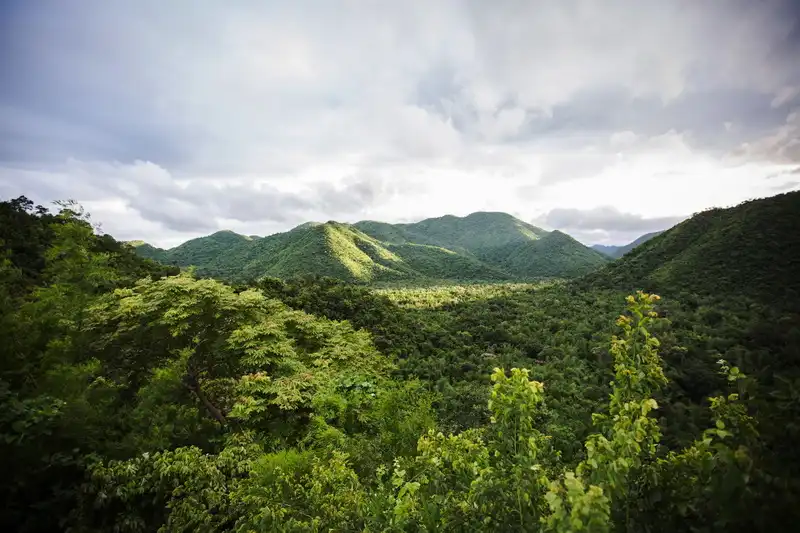
Salak Phra Wildlife Sanctuary in Kanchanaburi is a name long familiar to hikers, birdwatchers, and anyone who loves Thailand’s western forest. It is not known because it is a “tourist attraction” packed with flashy check-in spots, but because it is a protected area with deep ecological and historical significance. The sanctuary spans multiple districts, including Mueang Kanchanaburi, Bo Phloi, Nong Prue, and Si Sawat. Overall, the landscape is a complex range of high mountains with pockets of valley plains, and it plays a crucial role as an important headwater source for the Khwae Yai River. Forests like this are valuable not only for their visible greenery, but as a living structure that supports watersheds and surrounding communities—because healthy headwaters keep rivers flowing, irrigation functioning, and biodiversity able to breathe naturally within its own habitat.
From a geographic perspective, Salak Phra’s identity comes from its continuous mountain ridges and hidden interior basins. This rugged topography shapes winds, fog, and seasonal humidity, creating diverse “microclimates” within the same protected landscape. That means even a small increase in trekking distance can bring noticeable changes in temperature, moisture, and vegetation. This layered diversity forms the foundation for wildlife to use different parts of the sanctuary in different ways—as feeding grounds, shelter, and movement corridors that connect to the larger western forest ecosystem.
The peak most often mentioned here is “Khao Hua Lon” (Bald-Head Mountain), rising to about 1,170 meters above mean sea level, located in the central zone of Salak Phra Wildlife Sanctuary. While the elevation may sound like a simple geographic fact, it carries broader meaning: higher terrain often generates many small streams and captures moisture from monsoon winds during parts of the year. When those headwaters gather and flow downslope, they become fine capillaries that nourish both the forest and, ultimately, the Khwae Yai River. Protecting the integrity of high mountain watersheds is therefore inseparable from protecting the continuity of water across the entire basin ecosystem.
What gives “Salak Phra” a special status in Thailand’s conservation history is that it was the country’s first wildlife sanctuary, established on 31 December 1965. Being the “first” is not merely symbolic; it shows that the value of this forest was recognized from the earliest period when protected-area conservation became a serious policy direction in Thai society. This was the time when the ideas of “wildlife” and “habitat” were increasingly framed as matters of national stewardship. Choosing Salak Phra as the first sanctuary reflects two realities at once: (1) the richness of the forest and its potential as wildlife habitat, and (2) the importance of Thailand’s western forest as a large, connected ecosystem rather than isolated patches of nature.
In the past, “nature study” at Salak Phra commonly meant walking designated routes and learning the forest at the pace of real terrain. Widely shared information notes three nature study trails: (1) Huai Lam Ee Su route, (2) Huai Sa Dong route, and (3) Thung Salak Phra route. Each trail reflects different personalities of the landscape—some following stream corridors through forest, some moving through valley terrain, and some opening onto seasonal clearings that provide wide views of layered mountain silhouettes. The defining feature of trails in a protected area is that they are not designed for maximum comfort like typical tourist sites; they are meant to support learning while minimizing disturbance, and to enable rangers to monitor wildlife and forest conditions in an organized way.
Salak Phra is also sometimes discussed alongside the scenery of Srinagarind Dam Reservoir, because there are routes or viewpoints that can lead to reservoir-edge vistas, and to areas such as Huai Mae Lamun in the context of nature learning. Seeing forest continuity reaching toward the reservoir helps clarify the relationship between headwater forests and major water bodies. Healthy forests reduce soil erosion, slow runoff, filter sediment, and stabilize water systems over the long term. These functions are often invisible to casual visitors, yet they have real consequences for environmental quality across the province and downstream communities.
However, at present, “experiencing Salak Phra on foot” is no longer something that can be done freely. Salak Phra Wildlife Sanctuary has been announced as closed indefinitely. Closures of protected areas are typically linked to management and resource-safety needs—especially wildfire risk, hotspot activity, and ecosystem vulnerability during certain seasons—when the forest needs time to “rest” from additional human pressure. An indefinite closure reflects a hard truth of wild landscapes: at some times, conservation must come before access, and the desire to “see” must step back so the forest can continue to “exist” in the long term.
If Salak Phra is like a vast book of nature, an indefinite closure is like closing that book so its cover and pages can be repaired before they wear out completely. Wildfire does not only burn trees; it also strips moisture from soil, damages understory diversity, removes food sources for small animals, and forces wildlife to change their behavior and feeding areas. As pressure increases, closure becomes one tool that helps rangers work more effectively—patrolling, surveillance, and restoring high-risk spots—without simultaneously carrying the burden of tourist management.
Emotionally, Salak Phra is a place many people associate with the idea of a “real forest.” It does not feel like a tourist attraction lined with concrete paths and signage at every turn. Instead, it feels like a living forest that still belongs to itself: the quiet of valleys, wind passing through the canopy, the sound of streams in certain seasons, and continuous ridgelines that naturally make you feel smaller. Because of that, hearing the words “closed indefinitely” can carry more weight than an ordinary announcement. It does not only mean a place is closed; it means the forest needs time to recover—and that visitors must respect those conditions seriously.
For anyone planning a trip to Salak Phra during this period, the most responsible option is not to look for ways in, but to adjust plans to match reality. Choose nearby nature areas that are open and properly equipped for visitors—such as Srinagarind Dam Reservoir zones, viewpoints or activities outside closure boundaries, and other Kanchanaburi nature sites with clear visitor-management systems. Adjusting plans does not reduce the value of the journey; it preserves the possibility of still having a meaningful trip without increasing pressure on a protected area that needs time to heal.
As for getting to the general vicinity of the office area and the outer zone that people often use as a geographic reference point for Salak Phra, commonly shared route guidance suggests that from Bangkok you can take Highway 4 (Phetkasem Road) via Nakhon Pathom, connect to Highway 323 toward Kanchanaburi, then head to Kaeng Sian intersection and continue on Highway 3199 toward Si Sawat. A frequently mentioned landmark is around kilometer 10–11, where the office location is commonly described as being on the left side of the road (opposite the Subdistrict Administrative Organization office). This route helps illustrate that Salak Phra can be relatively close to town in distance, but “close” does not mean “accessible” when the sanctuary is closed indefinitely. That is another reason to rely on the latest official closure updates and avoid approaching closed zones unnecessarily.
Ultimately, if Salak Phra Wildlife Sanctuary must be summarized in one sentence, its value lies in being a pioneering protected area for wildlife and headwaters—established long before “ecotourism” became a common trend. The indefinite closure may mean we cannot return to stand quietly and listen to the forest any time soon, but it is also a signal that conservation is being prioritized strongly enough to reduce access in order to protect the heart of the landscape for longer. When Salak Phra eventually reopens, the experience will likely feel even more meaningful—because it will have passed through a period when the forest needed space to recover, and visitors can enter with a clearer understanding that “seeing” must always come with “not causing harm.”
| Place Name | Salak Phra Wildlife Sanctuary – Kanchanaburi |
| Address | Covers Mueang Kanchanaburi, Bo Phloi, Nong Prue, and Si Sawat Districts – Kanchanaburi |
| Place Summary | Thailand’s first wildlife sanctuary (established 31 December 1965). A mountainous headwater forest vital to the Khwae Yai River system, traditionally suitable for nature study. Currently announced as closed indefinitely for resource management and safety. |
| Highlights | Complex high mountains and watershed valleys; Khao Hua Lon peak at about 1,170 m; nature study routes (Huai Lam Ee Su / Huai Sa Dong / Thung Salak Phra); landmark role in Thai conservation history as the country’s first wildlife sanctuary. |
| Open Days | – (closed indefinitely) |
| Opening Hours | – (closed indefinitely) |
| Fees | – (entry suspended due to indefinite closure) |
| Getting There | From Bangkok: Highway 4 connects to Highway 323 toward Kanchanaburi, then via Kaeng Sian intersection onto Highway 3199 toward Si Sawat (a commonly referenced point is around km 10–11 based on shared route notes). |
| Current Status | Announced closed indefinitely (check the latest official update before planning travel). |
| Nearby Tourist Attractions With Distance | 1) Srinagarind Dam (approx. 55 km) 2) Huai Mae Khamin Waterfall (approx. 75 km) 3) Khao Laem National Park – Thong Pha Phum Zone (approx. 140 km) 4) Sai Yok National Park – Sai Yok Yai Waterfall (approx. 95 km) 5) Bridge Over the River Kwai (approx. 30 km) |
| Popular Restaurants Nearby With Distance And Phone Number | 1) Keeree Tara Riverside (approx. 30 km) Tel. 034-518-888 2) Mulberry Mellow – Kanchanaburi (approx. 28 km) Tel. 081-933-1871 3) Din Cafe – Kanchanaburi (approx. 29 km) Tel. 097-465-2828 4) Reun Thara – Srinagarind Dam Area (approx. 60 km) Tel. 062-992-4261 5) Krua Chuk Don – Kanchanaburi (approx. 33 km) Tel. 034-516-528 |
| Popular Accommodations Nearby With Distance And Phone Number | 1) Z9 Resort – Kanchanaburi (approx. 70 km) Tel. 061-360-4959 2) Raya Buri Resort – Kanchanaburi (approx. 65 km) Tel. 034-696-165 3) Pufa Engnam Lake Resort – Kanchanaburi (approx. 65 km) Tel. 034-696-179 4) Good Times Resort Kanchanaburi (approx. 32 km) Tel. 090-143-4925 5) River Kwai Bridge Resort (approx. 31 km) Tel. 081-986-2808 |
Frequently Asked Questions (FAQ)
Q: Is Salak Phra Wildlife Sanctuary permanently closed?
A: It is currently announced as closed indefinitely, which means there is no confirmed reopening date yet. Check the latest updates from relevant authorities before planning a trip.
Q: Why would a protected area like Salak Phra be closed indefinitely?
A: Indefinite closures are typically related to managing risks such as wildfires, hotspot activity, and ecosystem vulnerability, and to support effective patrol and restoration work without additional visitor pressure.
Q: Why is Salak Phra important in Thailand’s conservation history?
A: Salak Phra is Thailand’s first wildlife sanctuary, established on 31 December 1965, making it a landmark protected area for wildlife and habitat conservation.
Q: If Salak Phra is closed, where can I go nearby for nature experiences?
A: Consider open sites with clear visitor-management systems such as Srinagarind Dam areas, Huai Mae Khamin Waterfall, or other nature destinations in Kanchanaburi that are currently open to visitors.
Q: What nature study trails were commonly associated with Salak Phra?
A: Widely shared information notes three routes: Huai Lam Ee Su, Huai Sa Dong, and Thung Salak Phra. Access depends on the current open/closed status and official conditions at the time.
Q: What should I check first before planning a visit to Salak Phra?
A: Always confirm the latest open/closed status first, because the sanctuary is currently announced as closed indefinitely and conditions may change depending on risk levels.
 Tel: 034584032
 Salak Pra Wildlife Sanctuary Map
 Category:
  Group:
  Last Update: 54 MinuteAgo
Comment
 Nearby Attractions
| Keyword (Advance) |
 Facebook Fanpage
 Region
 Art, Culture and Heritage
 Historical Sites and Monuments(
 Landmarks and Memorials(
 Art, Craft Centres, Tradition(
 Museums(
 Art Gallery(
 University
 Places of Worship
 Temple(
 Church(
 Other religious and spiritural sites(
 Research and Development
 Royal Project(
 Suburban Living
 Village, Community(
 Local Market(
 Mountain (Doi)(
 Dam, Reservoir, Lake(
 Waterfalls(
 Hot Springs(
 Caves(
 River, Canal(
 Other natural attractions(
 Entertainment and Agricultural
 Zoos and Aquariums(
 Animal camps and shows(
 Farm, Parks, Gardens and Ecotourism(
 Cinema(
 Outdoor and Adventure Activities(
 Travel Articles, Recipes
 Travel Review, Food Review(