
 Home
Home North(
 Chiang Mai(


Rating: 4/5 (4 votes)
 |
|  Map
Map 
 Have Map
  No Map
Nonthaburi attractions
Attractions in Thailand
Open Days: Open Daily
Opening Hours: 08.00–16.30
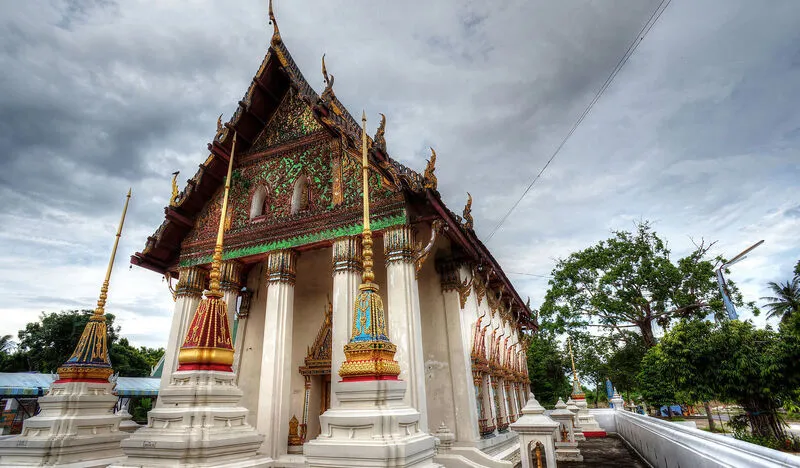
Wat Bang Khanun, Nonthaburi is an old temple in Bang Kruai District that stands out for more than its religious role. It is a place where visitors can encounter traditional medicine tools, ancient folding manuscripts, old sermon seats, and temple architecture linked to the Ayutthaya period. For travelers interested in Thai cultural heritage, this temple offers a quieter and more intellectually rewarding experience than many larger, more commercialized temple sites near Bangkok.
The temple is located in Bang Khanun Subdistrict, Bang Kruai District, Nonthaburi, in a long-established community surrounded by the older landscape of orchards, waterways, and local neighborhoods. That setting contributes greatly to its charm. Wat Bang Khanun does not rely on monumental modern construction to impress visitors. Instead, its importance comes from the layers of history preserved inside the temple grounds and from the way local knowledge has been kept alive through sacred objects, manuscripts, and everyday community memory.
Wat Bang Khanun is an old temple with recorded establishment data placing it in 1560, with its royal boundary charter granted in 1570. At the same time, art historical evidence points to architectural and artistic elements associated with the Ayutthaya period. The temple’s old ordination hall still preserves the curved boat-like base typical of Ayutthaya-style design, while other important features such as the waterfront scripture hall, mural remains, and old wooden furnishings suggest that the site preserves a long and continuous cultural history rather than belonging to only one period.
One of the most distinctive treasures of the temple is its set of traditional medicine grinding stones. These are not decorative objects. They are practical tools once used for preparing Thai herbal medicine. The temple preserves 3 sets, and each set includes 3 parts: a stone grinder, a flat stone base, and a wooden stand supporting the grinding surface. The grinding stone is described as being made from reddish sandstone, shaped into a rectangular block about 1 foot long and roughly a span thick. The wooden support remains in good condition and clearly reflects real use in the past.
The method of use was entirely manual. Herbs and medicinal ingredients were ground by hand until fine enough to be mixed into medicine for treating illness according to the desired formula. This makes the grinding stones especially important because they show that the temple was not only a Buddhist center, but also a place tied to practical healing knowledge in the community. For visitors interested in Thai traditional medicine, the surviving equipment offers a rare glimpse into how medicine was physically prepared before modern pharmaceutical systems became dominant.
This traditional medical connection becomes even more meaningful when viewed alongside the manuscripts once kept at the temple. Around 1988, a former abbot of Wat Bang Khanun, who has since passed away, was known for his knowledge of traditional medicine. That knowledge was closely linked to the temple’s preserved samut thai, or Thai folding manuscripts, which contained traditional medical texts and other forms of inherited knowledge. This tells us that the temple functioned not only as a sacred site, but also as a local knowledge center where religion, healing, education, and community wisdom intersected.
The manuscripts preserved at the temple once covered several fields. These included the Seven Medical Treatises, illustrated scenes from the Ten Great Birth Stories, traditional medical texts, legal texts, and astrological texts. Some were associated with the period of King Rama I, while others belonged to the reigns of King Rama VI and King Rama VII. Although only some manuscripts remain today, the Seven Medical Treatises and the Ten Birth Stories continue to be especially important. Their presence shows that Wat Bang Khanun was part of a much wider intellectual world in which monasteries preserved knowledge relevant to religion, health, law, and everyday life.
Another major highlight is the old thammasat, the elevated sermon seat used by monks when preaching. The example preserved at Wat Bang Khanun is associated with the late Ayutthaya period and is notable for its beautiful colors and finely carved floral motifs. This object is valuable not only because of its age, but because it preserves the craftsmanship and visual language of an earlier era. For those who appreciate wood carving, religious furniture, and historic decorative arts, the sermon seat is one of the temple’s most refined surviving pieces.
The temple also contains other significant artistic features. Information from the Fine Arts Department notes that Wat Bang Khanun preserves an ordination hall with the curved base of a junk-style structure, a waterfront scripture hall with Ayutthaya-period characteristics, mural paintings inside the ordination hall, and several old sermon seats. These details make the temple particularly meaningful for visitors who want to understand Nonthaburi’s older temple culture in depth. Even though the temple is not large, it preserves a dense concentration of artistic and historical material.
What makes Wat Bang Khanun especially appealing is the way it combines religious space with a sense of lived local memory. The important objects inside the temple are not abstract museum pieces removed from their setting. They are part of a temple that still functions in the present. That gives the site a different atmosphere from a formal museum. Visitors are not just seeing preserved artifacts. They are encountering heritage in the place where it has continued to matter.
For cultural travelers, Wat Bang Khanun is best appreciated slowly. Its greatest value lies in careful observation rather than spectacle. The medicine grinding stones, the folding manuscripts, the old sermon seat, and the surviving Ayutthaya-era architectural features all reward close attention. The temple is therefore ideal for people who enjoy history, local heritage, Thai traditional medicine, or old temple art, especially those who prefer quieter destinations over heavily crowded attractions.
In practical travel terms, the temple also works very well as a short half-day visit from Bangkok. Because it is located in Bang Kruai and remains accessible from major roads in western Nonthaburi, visitors can easily combine it with other nearby temples, waterside communities, cafés, and cultural stops. This makes Wat Bang Khanun suitable not only for worshippers, but also for travelers planning a heritage-focused route through Bang Kruai and nearby districts.
The temple further reflects the traditional relationship between monasteries and community knowledge. The preserved medical tools and manuscripts make clear that temples were once places where healing knowledge, moral teaching, manuscript culture, and artistic tradition were kept together. In that sense, Wat Bang Khanun can be understood as a living cultural archive. Even without presenting itself as a museum, it preserves the material traces of how local society once learned, healed, and recorded its knowledge.
Visitors should dress respectfully and maintain proper temple etiquette. Because some historical objects may not be on open display at all times, it is wise to ask temple staff or monks politely if there is a specific object or area you hope to see. The temple is best enjoyed with a patient and respectful approach, especially by those who want to appreciate its cultural value rather than simply pass through for a quick photo stop.
Getting There is straightforward. Wat Bang Khanun is located at 37 Moo 2, Bang Kruai–Jong Thanom Road, Bang Khanun Subdistrict, Bang Kruai District, Nonthaburi. Visitors can reach the area easily by car from Bangkok via Ratchaphruek Road, Nakhon In Road, or the Bang Kruai corridor. Those using public transport can first travel into Bang Kruai or the nearby Ratchaphruek area and then continue by taxi or local transport. Since the distance from central Bangkok is relatively short, the temple is suitable for a half-day cultural outing or as part of a broader temple route in Nonthaburi.
| Name | Wat Bang Khanun |
| Location | Bang Khanun Subdistrict, Bang Kruai District, Nonthaburi |
| Address | 37 Moo 2, Bang Kruai–Jong Thanom Road, Bang Khanun Subdistrict, Bang Kruai District, Nonthaburi 11130 |
| Highlights | Traditional Medicine Grinding Stones, Ancient Folding Manuscripts, Late Ayutthaya Sermon Seat, Curved Boat-Shaped Ordination Hall Base |
| History | Recorded as established in 1560 and granted Wisungkhamsima in 1570, with important artistic elements linked to the Ayutthaya period |
| Name Origin | Named after the Bang Khanun community in Bang Kruai, where the temple has long served the local area |
| Distinctive Character | A historic temple preserving traditional medicine tools, old manuscripts, wooden sermon seats, and Ayutthaya-era artistic heritage |
| Getting There | Accessible via Bang Kruai–Jong Thanom Road and convenient from Ratchaphruek Road, Nakhon In Road, and Bang Kruai |
| Current Status | Open to visitors and still active with ongoing temple activities |
| Open Days | Open Daily |
| Opening Hours | 08.00–16.30 |
| Facilities | Temple Grounds, Worship Areas, Historic Viewing Areas, Wat Bang Khanun School, Parking Within Temple Grounds |
| Main Areas / Zones | Ordination Hall, Waterfront Scripture Hall, Ancient Sermon Seat Area, Traditional Medicine Grinding Stone Area, Manuscript Preservation Area |
| Abbot / Caretaker | Phra Bai Dika Suphachai Piyasilo |
| Main Contact Number | 02-432-6214 |
| Official Website / Official Page | Facebook: Wat Bang Khanun, Bang Kruai, Nonthaburi |
| 1. Nearby Tourist Attractions | 1. Wat Chalo – 4 km 2. Wat Krachom Thong – 5 km 3. Wat Sangkhathan – 6 km 4. Baan Rai Mahasawat – 7 km 5. Wat Uthayan – 8 km |
| 2. Nearby Restaurants | 1. Mae Phua Kitchen @ Bang Khanun – 2 km, Tel: 095-095-4607 2. Khun Poo 1 – 3 km, Tel: 089-445-8448 3. Be Fresh! – 3 km, Tel: 086-771-2197, 089-922-5666 4. Rot Mue Khun Mae Bang Khanun – 4 km, Tel: 063-780-4490 5. SATJA - Eatery & Cafe – 5 km, Tel: 081-526-3173 |
| 3. Nearby Accommodations | 1. Ratchaphruek Place 1 and 2 – 2 km 2. Livotel Express Hotel Bang Kruai Nonthaburi – 6 km, Tel: 02-880-6888, 084-206-0443 3. Bella B Hotel Bang Kruai Rama 7 – 9 km 4. The Rich Ratchapruek Hotel & Residence – 10 km 5. Komol Residence Bangkok – 11 km |
Frequently Asked Questions (FAQ)
Q: What is the main highlight of Wat Bang Khanun?
A: Its most distinctive highlights are the traditional medicine grinding stones, ancient folding manuscripts, the old wooden sermon seat, and Ayutthaya-era artistic features.
Q: How old is Wat Bang Khanun?
A: Recorded temple data places its establishment in 1560, and its artistic heritage clearly connects the site to the Ayutthaya period.
Q: Why are the medicine grinding stones important?
A: They are practical evidence of traditional Thai medicine preparation and show how the temple once preserved healing knowledge used by the local community.
Q: What kinds of old manuscripts were kept at the temple?
A: The temple preserved manuscripts related to the Seven Medical Treatises, the Ten Great Birth Stories, traditional medicine, law, and astrology.
Q: What are the opening hours of Wat Bang Khanun?
A: The temple is open daily from 08.00 to 16.30.
Q: Who would enjoy visiting Wat Bang Khanun?
A: It is ideal for travelers interested in old temples, Thai traditional medicine, local heritage, manuscript culture, and quiet cultural sites near Bangkok.
 Wat Bang Khanun Map
 Category:
  Group:
  Last Update: 1 DayAgo
Comment
 Nearby Attractions
| Keyword (Advance) |
 Region
|
 Muang Nonthaburi(