
 Home
Home North(
 Chiang Mai(


Rating: 3.4/5 (7 votes)
 |
|  Map
Map 
 Have Map
  No Map
Nonthaburi attractions
Attractions in Thailand
Open Days: Open Daily
Opening Hours: 08:00–16:30
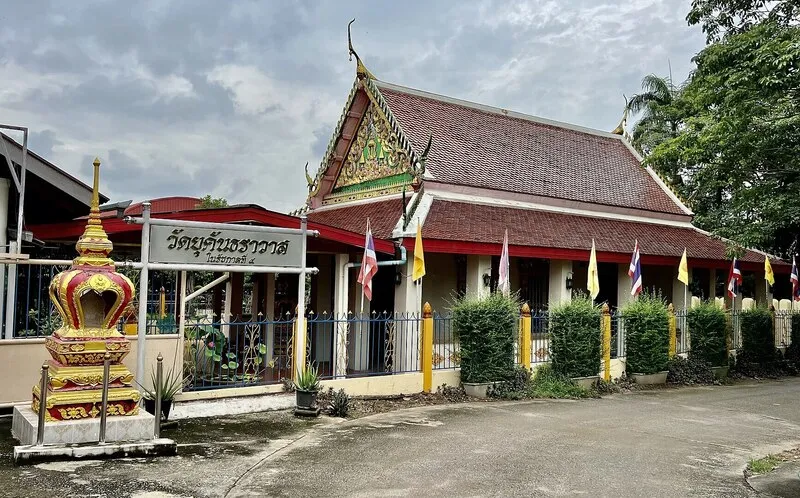
Wat Yukantharawas is one of the most distinctive historic temples in Nonthaburi, not only because of its age but because of the unusual religious concept preserved within its ordination hall. Located in Bang Len Subdistrict, Bang Yai District, this temple belongs to the Dhammayut order and carries an important connection to King Mongkut, Rama IV, and Somdet Phra Ariyavongsagatanana (Sa Pussadevo). Its strongest identity comes from a rare traditional arrangement in which a relic chedi was placed in the ordination hall in place of the usual principal Buddha image. That alone makes Wat Yukantharawas far more interesting than an ordinary temple stop, but its historical depth goes well beyond that single feature.
For readers who want the essential facts quickly, Wat Yukantharawas was established in B.E. 2410 (1867 CE) during the reign of King Rama IV. It stands at 22 Moo 7, Ban Suan Chao, Bang Len, Bang Yai, Nonthaburi, and is open daily from 08:00 to 16:30. The temple is especially known for its old maha-ut ordination hall, the Lanka-style brass relic chedi enshrining sacred relics, and the royal seat associated with King Mongkut. For travelers interested in old temples near Bangkok, unusual Buddhist architecture, or royal-era temple history, this is one of the most rewarding places to visit in western Nonthaburi.
The history of the temple gives it a clear place in the religious landscape of the early modern Rattanakosin period. Wat Yukantharawas was founded in B.E. 2410 by Somdet Phra Ariyavongsagatanana (Sa Pussadevo) together with King Mongkut. The temple was originally known as Wat Yukanthon, a name connected to the Buddhist cosmological concept of Yukanthon or Yukanthorn, one of the mountain rings surrounding Mount Meru. This means the name is not just decorative. It reflects a religious worldview shaped by scriptural imagination and royal-era temple culture. In later usage, the name evolved into Wat Yukantharawas, which is the form used today.
The temple was granted its Wisungkhamsima in B.E. 2440 (1897 CE), confirming its full formal status as a Buddhist temple. Another point of historical interest is that some of the construction materials used here reportedly came from the surplus materials left over from the building of Wat Ratchapradit Sathitmahasimaram, one of the important royal temples associated with King Mongkut. This detail gives Wat Yukantharawas a stronger historical profile than many local canal-side temples, because it links the site directly to a broader royal and ecclesiastical network in the same era.
The temple’s most famous feature is the old concept of its ordination hall without a conventional principal Buddha image. In its original form, the hall centered instead on a Lanka-style brass chedi containing sacred relics. This was placed in the position where visitors would normally expect to see a principal Buddha image. That arrangement makes Wat Yukantharawas one of the rare temples in Thailand discussed repeatedly in cultural writing and heritage articles. It shows that the sacred center of a Thai ordination hall was not always defined by the same architectural or devotional formula. In this case, relic worship formed the visual and symbolic heart of the space.
This detail is important for more than novelty. The chedi arrangement reflects a deeper religious idea in which relics of the Buddha stand as a direct focus of veneration. For visitors interested in Thai Buddhist art, temple planning, and the symbolic meaning of sacred spaces, Wat Yukantharawas offers a rare chance to encounter a temple whose identity is shaped by concept as much as by architecture. The result is a place that feels intellectually and spiritually distinctive at the same time.
Another major historical feature is the royal seat of King Mongkut preserved within the temple grounds. This association strengthens the temple’s connection to the monarch and helps explain why Wat Yukantharawas holds value beyond its local setting. It is not simply an old community temple surrounded by canals and gardens. It is also a site that preserves material memory of royal presence. For cultural travelers, this adds another layer of meaning and makes the visit richer than a standard temple outing.
The atmosphere of the temple still feels calm and traditional. Although Bang Yai has expanded rapidly with major roads, housing developments, and commercial growth, the temple retains a sense of older Nonthaburi. The surrounding area still suggests the canal-and-garden landscape that once defined much of this region. This quiet character is part of the appeal. Wat Yukantharawas is well suited to travelers who prefer historical substance and a reflective setting over heavily commercial temple tourism.
Its identity as a Dhammayut temple is also significant. Many travelers may not immediately notice the difference, but for anyone interested in Thai religious history, this matters. The Dhammayut order played an important role in the reform and reorganization of Thai monastic life during the reign of King Mongkut. Seeing a temple like Wat Yukantharawas within that context helps visitors understand that it is part of a larger story about religion, state formation, and temple culture in 19th-century Siam.
The old sermon hall once housed several Buddha images from the reign of King Mongkut, which further demonstrates the temple’s value in terms of art history and royal-era devotional culture. Some of those images were stolen in 2014, a loss that also reminds us how vulnerable local heritage can be. Even so, the surviving narrative and the temple’s remaining architectural identity are more than enough to make it a serious point of interest for those who care about cultural preservation and lesser-known temple history.
From a travel perspective, Wat Yukantharawas is ideal for visitors who want a meaningful temple near Bangkok that is not defined only by commercial fame. It works especially well for travelers interested in old temples, living religious spaces, and places with an unusual story behind them. It can also be combined easily with nearby destinations in the Bang Yai area, including Wat Bang Len Charoen, Wat Sao Thong Hin, Wat Phra Ngern, the Wat Phra Ngern plant market, and the Wat Takian floating market area. That makes it practical for a half-day or full-day cultural route.
The temple is also strong from the perspective of modern search intent because it answers several common questions at once. Some people are looking specifically for the temple in Nonthaburi whose ordination hall was historically known for not having a principal Buddha image. Others want basic information such as the opening hours, the current abbot, or the exact location. Others are looking for a quiet temple with real historical substance near Bangkok. Wat Yukantharawas satisfies all of those needs, which is why a fuller article is more useful than a brief directory listing.
The temple remains active today, with ongoing religious use and recent community activity. That means it should be approached as a living sacred site rather than only as a historical monument. Visitors should dress modestly, keep noise to a minimum, and show respect in the ordination hall and all worship areas. That respectful approach is particularly important here because the temple’s identity is deeply rooted in sacred relic culture and historic monastic tradition.
Travel Information is straightforward. The easiest way to reach Wat Yukantharawas is by private car via Bang Kruai–Sai Noi Road, then connecting into the local roads in Bang Len and Ban Suan Chao. The temple is also accessible from the wider Bang Yai area and can be reached by continuing from MRT Bang Phlu with local transport into the neighborhood. Because the road connections are good, the temple works well as part of a wider Nonthaburi itinerary without requiring long travel time from Bangkok.
The best time to visit is in the morning or late afternoon, when the weather is more comfortable and the temple grounds can be explored at a slower pace. Weekdays are especially good for visitors who want a quieter atmosphere, while weekends are suitable for travelers combining several local attractions in one route. Either way, Wat Yukantharawas rewards visitors who are willing to move beyond surface sightseeing and pay attention to the deeper story of the place.
In summary, Wat Yukantharawas is one of the most intellectually and spiritually interesting temples in Nonthaburi. It offers a rare combination of royal-era history, Dhammayut identity, a distinctive ordination hall concept, and a peaceful local atmosphere. For foreign travelers, heritage enthusiasts, and Bangkok-based visitors seeking a temple with real historical depth, this is a destination well worth the detour.
| Name | Wat Yukantharawas |
| Location | Moo 7, Ban Wat Yukantharawas (Ban Suan Chao), Bang Len Subdistrict, Bang Yai District, Nonthaburi |
| Address | 22 Moo 7, Ban Suan Chao, Bang Len, Bang Yai, Nonthaburi 11140 |
| Coordinates | 13.8369, 100.4298 |
| Highlights | A Rama IV-era temple, a maha-ut ordination hall, a Lanka-style relic chedi inside the ordination hall, and the royal seat associated with King Mongkut |
| History | Built in B.E. 2410 (1867 CE) during the reign of King Rama IV by Somdet Phra Ariyavongsagatanana (Sa Pussadevo) and King Mongkut; granted Wisungkhamsima in B.E. 2440 (1897 CE) |
| Name Origin | Originally called Wat Yukanthon, the name refers to the Buddhist cosmological concept of Yukanthon, and later became Wat Yukantharawas |
| Distinctive Features | The ordination hall follows an older concept in which a Lanka-style brass relic chedi containing sacred relics was placed in the hall instead of a conventional principal Buddha image, giving the temple a highly unusual identity |
| Travel Information | Easy by car via Bang Kruai–Sai Noi Road and the local roads into Bang Len and Ban Suan Chao; travelers can also continue from the Bang Yai area or MRT Bang Phlu by local transport |
| Current Status | Open and active as a functioning community temple with ongoing religious activities |
| Open Days | Open Daily |
| Opening Hours | 08:00–16:30 |
| Facilities | Parking |
| Main Areas / Zones | Maha-ut ordination hall, Lanka-style relic chedi, royal seat associated with King Mongkut, and the sermon hall area |
| Abbot / Caretaker | Phra Khru Boworn Dhammabhisai (Boonthat Dhammadharo) |
| Official Website / Official Page | Amazing Thailand, Facebook: Wat Yukantharawas |
| Nearby Tourist Attractions | 1) Wat Bang Len Charoen – about 1 km 2) Wat Sao Thong Hin – about 3 km 3) Wat Phra Ngern – about 4 km 4) Wat Phra Ngern Plant Market – about 4 km 5) Wat Takian Floating Market – about 8 km |
| Nearby Restaurants | 1) Krua Ban Phu Yai – about 0.4 km, Tel. 093-028-1569 2) Nam Nong Thaen Khun Coffee – about 0.6 km, Tel. 096-383-8798 3) Mom’s Kitchen Bang Len 21/2 – about 1 km, Tel. 065-628-1609 4) Coco Pomco Cafe & Restaurant – about 2 km, Tel. 094-686-6291 5) Sundayou Cafe Bang Len–Bang Yai – about 3 km, Tel. 092-419-4453 |
| Nearby Accommodations | 1) W1 Bangkoknoi Hotel – about 2 km, Tel. 098-000-8888, 02-195-1111 2) Sabai Residence @ Bangyai – about 4 km 3) The Park Bangyai Residence – about 6 km, Tel. 085-184-9944 4) Westgate Residence Hotel – about 7 km, Tel. 092-539-8855, 02-924-7711 5) OYO 75466 13 Coins Bang Yai Hotel – about 7 km |
Frequently Asked Questions (FAQ)
Q: Where is Wat Yukantharawas located?
A: Wat Yukantharawas is located at 22 Moo 7, Ban Suan Chao, Bang Len Subdistrict, Bang Yai District, Nonthaburi.
Q: What is Wat Yukantharawas best known for?
A: The temple is best known for the original concept of its ordination hall, where a Lanka-style relic chedi was placed in the hall instead of a conventional principal Buddha image.
Q: When was Wat Yukantharawas built?
A: It was built in B.E. 2410, or 1867 CE, during the reign of King Rama IV.
Q: Is Wat Yukantharawas connected to King Mongkut?
A: Yes. The temple is associated with King Mongkut, and the grounds preserve a royal seat linked to his presence.
Q: Is Wat Yukantharawas easy to visit from Bangkok?
A: Yes. It is a practical half-day or full-day trip from Bangkok, especially by car via the Bang Yai area.
Q: What other places can I visit near Wat Yukantharawas?
A: Nearby places include Wat Bang Len Charoen, Wat Sao Thong Hin, Wat Phra Ngern, the Wat Phra Ngern plant market, and the Wat Takian floating market area.
 Wat Yukantharawas Map
 Category:
  Group:
  Last Update: 21 HourAgo
Comment
 Nearby Attractions
| Keyword (Advance) |
 Region
|
 Muang Nonthaburi(