

 Home
Home Chiang Mai(




Rating: 3.6/5 (7 votes)
 |
|  Map
Map 
 Have Map
  No Map
Chai Nat attractions
Attractions in Thailand
Open Days: Open Daily
Opening Hours: 07:00 – 17:00
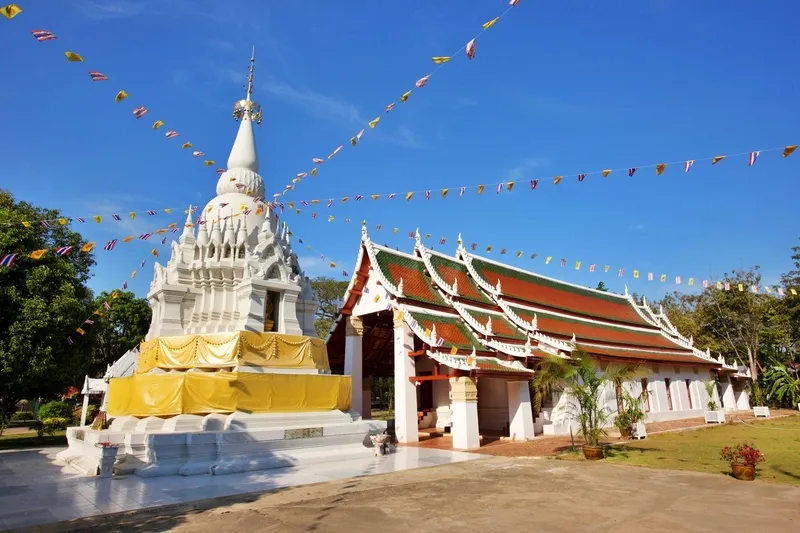
Wat Phra Borommathat Worawihan, Chainat Province, is a second-class royal monastery and an ancient temple that has long stood as one of the city’s most important spiritual landmarks since the early Ayutthaya period. It is distinguished by the Phra Borommathat Chedi in the U Thong architectural style, which enshrines relics of the Buddha, as well as its vihara, ubosot, and important stone inscription. The temple is suitable for worship, merit-making, historical study, and cultural tourism in Chainat.
Wat Phra Borommathat Worawihan is a second-class royal monastery and one of the most important ancient temples in Chainat Province. Its long history has led to its recognition as one of the city’s principal temples since ancient times. The temple is located in Ban Thai Mueang, Chainat Subdistrict, Mueang Chainat District, along the Chao Phraya River, and lies only about 4 kilometers from the city center. It is therefore easy to reach, yet it still retains a calm, solemn atmosphere filled with clear historical value. Upon arrival, visitors immediately sense that this is not merely an ordinary temple for merit-making, but a place where layers of time, faith, and traces of an old city come together in a deeply impressive setting.
The importance of Wat Phra Borommathat Worawihan begins with its status as a royal monastery, reflecting its high standing in both the monastic hierarchy and the history of the nation. What makes this temple especially remarkable, however, is the presence of the ancient Borommathat chedi, which enshrines relics of the Buddha. These relics are among the most sacred objects in Buddhist belief and have long served as the center of devotion for people in Chainat and nearby provinces. For this reason, Wat Phra Borommathat Worawihan is not simply an old monument, but also a destination for those who come to make merit, pay homage, seek blessings, and reflect deeply on the virtues of Buddhism.
From a historical perspective, Wat Phra Borommathat Worawihan has been closely connected with the development of Chainat for many centuries. Various pieces of evidence and oral traditions suggest that the temple was founded in the early Ayutthaya period, while some sources point to traces of even earlier origins that may be linked to U Thong artistic influence or traditions inherited from Lopburi and ancient settlements in the Chao Phraya basin. Regardless of how the debate over its exact age is interpreted, Wat Phra Borommathat Worawihan is still widely acknowledged as one of the core ancient temples of Chainat and as an important source for understanding the picture of the old city in this region.
The temple’s earlier names, as found in documents and local tradition, include “Wat Phra That” and “Wat Hua Mueang,” both of which reflect its role as a center of the city in the past. Its location beside the Chao Phraya River, the main transportation route of earlier times, further increased its importance in religion, administration, and community life. People could easily travel to the temple by water, so the temple functioned not only as a place for religious ceremonies, but also as a community gathering point and a spiritual anchor for people whose lives were bound to the river. In this sense, Wat Phra Borommathat Worawihan is not merely an old temple in architectural terms, but a living historical site deeply rooted in the real experiences of people and place.
The heart of Wat Phra Borommathat Worawihan is the Phra Borommathat Chedi, the temple’s most important ancient monument and the principal reason for its fame. The chedi is built in the U Thong or early Ayutthaya architectural style, with clear and distinctive characteristics. Its rounded bell-shaped body stands on a square base with projecting corners rising to support the structure above. Beneath the bell are four small niches, one on each side, and within each niche is a Naga-Protected Prang image facing one of the four cardinal directions. This arrangement gives the monument not only formal balance, but also reflects a religious worldview that emphasizes the spreading of the Dhamma and protection in all four directions.
When examined closely, the details become even more fascinating. The gables above the niches are arranged in a two-tiered form and decorated with stucco images of seated Buddhas in meditation posture above an upturned lotus base. These decorative Buddha figures are especially noteworthy because they reflect artistic features that combine Lopburi and early U Thong influences, particularly in the forms of the head and face, which differ from the late Ayutthaya Buddha images more familiar to most people. The refined stucco work and the many small subsidiary chedis surrounding the monument are also significant features of U Thong architecture, which often used smaller decorative elements to add visual depth and sacred presence to the principal structure.
Between each niche, the walls are angled upward to support the bell-shaped body above, and above the corners between the niche gables are rows of small subsidiary chedis. This feature gives the Phra Borommathat Chedi a striking appearance, as the more one looks, the more one sees the effort of ancient craftsmen to create architectural rhythm, detail, and spiritual power. The rounded bell is topped by a tapering spire, while the uppermost section includes an element resembling a decorated orb or layered umbrella finial. Altogether, the monument appears graceful, prominent, and fully worthy of being the temple’s defining symbol.
Because this Borommathat chedi enshrines relics of the Buddha, it has long served as the center of sacred power within both the temple and the wider province of Chainat. For Buddhists, relics of the Buddha are not merely symbolic representations of the Enlightened One, but sacred objects that allow worshippers to draw close in remembrance of the Buddha’s virtues. Paying homage at the Borommathat therefore carries meaning in terms of merit, auspiciousness, and inner peace. As a result, Wat Phra Borommathat Worawihan has continually served as a destination for religious devotion, whether for annual worship, important religious festivals, or brief visits by travelers passing through Chainat.
In addition to the Borommathat chedi, the temple’s vihara is another important architectural element that adds historical and artistic depth to the site. The vihara stands to the east of the temple and is thought to have originally been built around the same period as the chedi, although it clearly shows traces of restoration carried out in later times. Today, the vihara is a brick-and-plaster building measuring about 13 meters wide and 24 meters long. Its spacious form, when compared with the surrounding temple grounds, allows it to remain a visually important structure that reinforces the sacred presence of the Borommathat behind it.
The interior of the vihara has a calm and contemplative atmosphere, making it an excellent place for quiet reflection. Those interested in art history often regard it as evidence of changing architectural forms over time. Although the present structure has undergone restoration in several periods, its placement within the temple plan and its relationship with the Borommathat still preserve the sacred spatial axis typical of ancient temple design. In other words, the vihara does not stand in isolation, but functions as an architectural threshold leading worshippers toward the Borommathat and shaping the experience of the visitor from first entry to the spiritual center of the site.
To the south of the vihara stands the ubosot, believed to have been built around the same time as the vihara and also restored several times. The ubosot measures about 9 meters wide and 24 meters long. Inside is a large gilded principal Buddha image in the Mara-Victory posture, clearly reflecting the style of Sรรคบุรี Buddha images, a distinctive artistic type associated with this area. The importance of this principal image lies in the way it reflects the artistic taste of local Buddhist communities, preserving the unique character of the school even while belonging broadly within the artistic world of Ayutthaya.
Surrounding the exterior of the ubosot are sandstone boundary stones carved in the Ayutthaya style. These sema stones are of great value from archaeological and art historical perspectives, as they confirm the continued use of the site as a sacred monastic precinct. They also indicate the significance of the temple during periods when Buddhist sacred spaces were carefully defined and organized. For those interested in Ayutthaya-period art, looking at the sema stones around the ubosot is not simply a matter of viewing carved stone, but of encountering traces of the ideas, beliefs, and spatial ordering practices of people in the past.
Another element that greatly increases the historical significance of Wat Phra Borommathat Worawihan is the stone inscription dating to the reign of King Thai Sa. The inscription records the celebration of the restoration of the Borommathat chedi. Today, this inscribed stone is set on the rear wall of the vihara adjoining the Borommathat. Its existence means that the history of the temple does not rely solely on oral tradition or architectural interpretation, but is also supported by written historical evidence that helps explain the continuity of temple maintenance and the importance of the temple at the level of the state and society.
In this sense, Wat Phra Borommathat Worawihan is more than a temple with an old relic chedi. It is also a concrete learning site for the history of Chainat. Visitors can use the temple grounds almost like an open-air classroom, gaining insight into the relationship among religion, politics, architecture, and daily life in the past. For those interested in ancient settlements in the Chao Phraya basin, this temple is a key site not to be overlooked, because every part of it is supported by layered stories and meanings.
In terms of local culture, Wat Phra Borommathat Worawihan remains alive through the annual Borommathat Celebration Festival, held every year on the full moon of the sixth lunar month. This is not just another date on the temple calendar, but a tradition that deeply connects people with the shared memory of the community. Many local residents still place great importance on coming to make merit, pay homage to the relic chedi, and take part in the annual festivities, regarding the occasion as both highly auspicious and an opportunity to continue the religious and cultural bonds of the people of Chainat.
During the Borommathat Celebration Festival, the atmosphere is filled with respectfully dressed worshippers who come to make merit, light incense and candles, pay homage to the chedi, and join in ceremonies according to traditional Thai temple customs. In some years, there may also be additional activities such as offering cloth to the relic chedi, chanting, listening to sermons, and local food and community stalls that add color to the event. Although the details of the festivities may vary from year to year, the essential meaning of the tradition remains the gathering of communal faith around the Borommathat, the spiritual center of the local people.
Visitors who come to Wat Phra Borommathat Worawihan outside the festival season can still fully appreciate its charm. The attraction of the site lies in the calmness and solemnity of the overall setting. Walking into the temple, one sees the white Borommathat chedi standing out against the sky, lines of austere religious buildings, and hears only the wind, birdsong, or at times the sound of chanting. This atmosphere makes Wat Phra Borommathat Worawihan suitable both for serious religious devotion and for those interested in cultural tourism who wish to absorb the quiet spirit of an old city in a reflective way.
For sightseeing, the temple is best explored slowly. Begin by taking in the overall temple layout and the Borommathat chedi, then move closer to observe the niches, stucco decoration, Buddha images, and other architectural details around the monument. After that, continue to the vihara and ubosot to view the principal Buddha image and the traces of craftsmanship in different parts of the buildings. If time allows, pause to examine the inscription and learn about the restoration of the Borommathat, as this transforms the visit from a simple act of photography or worship into a more meaningful experience of historical understanding.
Another notable feature of Wat Phra Borommathat Worawihan is its relationship with the natural landscape of Chainat. The temple grounds are connected to the Chao Phraya River, either to the rear or along one side, giving the temple an unmistakable riverside-city character. Combined with the temple’s antiquity, this makes the image of Wat Phra Borommathat Worawihan far more than that of a generic ancient temple; it is a historic riverside temple that preserves the layered history and devotion of the people of the Chao Phraya basin.
For those interested in Thai architecture, Wat Phra Borommathat Worawihan has value at a level that deserves careful study. It is not a place with only one single highlight, but a site where one can study the “relationship of components” as a whole: the Borommathat chedi as the center, the vihara and ubosot arranged in meaningful spatial relation, and supporting evidence such as sema stones and inscriptions that explain the continuous use of the site across different eras. In other words, the temple does not merely contain artifacts to be seen, but also preserves the “conceptual structure” of the craftsmen and communities of the past in every corner.
From the perspective of tourism in Chainat Province, Wat Phra Borommathat Worawihan is one of the places that should be included in nearly every itinerary. It suits worshippers seeking to pay homage to Buddha relics, history enthusiasts interested in old temples and inscriptions, architecture lovers eager to see U Thong and early Ayutthaya forms, and even casual day-trippers who want to choose one of the province’s most significant sites. The temple is an especially strong choice because it combines religious importance, historical value, and cultural beauty in one place.
A visit here can also be combined with other sites in and around Chainat city, such as Chainatmuni National Museum, Wat Thammamun Worawihan, Chao Phraya Dam, and Chainat Bird Park. This makes it easy to create a cultural and religious travel route. For travelers who want to understand Chainat as more than simply a province associated with the dam or natural attractions, Wat Phra Borommathat Worawihan serves as an important gateway into the stories of the old city, religion, and river-based communities.
In terms of access, Wat Phra Borommathat Worawihan is very convenient to reach. From Chainat city, take Highway 340 to the intersection with Highway 3183, then turn left and continue for about 1 kilometer to the temple. The total distance from the district center is only about 4 kilometers. Those without private cars may also travel by bus on the Bangkok – Wat Sing route. This ease of travel makes Wat Phra Borommathat Worawihan suitable both for a short stop and as one of the main destinations in a full-day trip around Chainat.
Getting There From Chainat city center, take Highway 340 toward the intersection with Highway 3183, then turn left and continue for about 1 kilometer. The temple is located in Ban Thai Mueang, Chainat Subdistrict, Mueang Chainat District. Those driving themselves can reach the temple quickly, while public transport users may ask for buses on the Bangkok – Wat Sing route or local transport passing through Chainat town.
Ultimately, Wat Phra Borommathat Worawihan is not just another old temple in Chainat Province. It is a place that gives concrete meaning to the idea of an “old city” through its architecture, relic chedi, inscription, and living traditions. A visit makes it clear that the temple still functions fully as a center of faith, a source of historical learning, and a place of inner peace. Anyone seeking an important temple to visit in Chainat, or anyone wishing to encounter the deeper cultural roots of this province, should see Wat Phra Borommathat Worawihan with their own eyes at least once.
| Place Name | Wat Phra Borommathat Worawihan |
| Location | Ban Thai Mueang, Moo 6, Chainat Subdistrict, Mueang Chainat District, Chainat 17000 |
| Address | 173 Moo 6, Chainat Subdistrict, Mueang Chainat District, Chainat 17000 |
| Summary | A second-class royal monastery and one of Chainat’s principal ancient temples, distinguished by its U Thong-style Borommathat chedi enshrining relics of the Buddha |
| Highlights | 1. U Thong-style Borommathat chedi 2. Four niches and four Naga-Protected Prang images facing the cardinal directions 3. Ancient vihara and ubosot 4. Principal Buddha image in the Sรรคบุรี style 5. Stone inscription from the reign of King Thai Sa |
| Abbot / Current Caretaker | Phra Ratchawachirakitjatorn |
| Zones Within the Temple | 1. Borommathat Chedi Zone 2. Vihara Zone 3. Ubosot Zone 4. Inscription and Historical Area 5. Ritual Courtyard and Festival Area |
| Nearby Attractions | 1. Chainatmuni National Museum – about 0.3 km 2. Chainat City Pillar Shrine – about 3 km 3. Wat Thammamun Worawihan – about 8 km 4. Chainat Bird Park – about 9 km 5. Chao Phraya Dam – about 18 km |
| Nearby Restaurants | 1. Lab Ped Chainat – about 4 km. Tel. 062-491-2277, 096-494-9287, 056-476776 2. River Hill Chainat – about 8 km. Tel. 084-149-9694 3. Kung Phao Thong Tae Branch 4 – about 8 km. Tel. 085-166-6453 4. Ruean Phae Restaurant – about 4 km. Tel. 056-414149 5. Lemon House Chainat – about 5 km. Tel. 081-258-4082 |
| Nearby Accommodations | 1. Chainatthani Hotel – about 4 km. Tel. 056-412580, 056-416799 2. Chao Phraya Thara Riverside Hotel – about 6 km. Tel. 084-241-1234 3. Baan Suan Resort & Fresh Coffee Chainat – about 7 km. Tel. 098-750-8034, 089-437-8911 4. Check In Resort Chainat – about 8 km 5. Chainat Grand Hotel – about 5 km |
| Open Days | Open Daily |
| Opening Hours | 07:00 – 17:00 |
| Getting There | From Chainat city center, take Highway 340 to the intersection with Highway 3183, then turn left and continue for about 1 km, or use the Bangkok – Wat Sing bus route |
| Contact Numbers | 1. Wat Phra Borommathat Worawihan 080-954-9954 2. Temple / Sacred Object Contact 091-742-6994 3. Temple / Sacred Object Contact 063-996-9556 4. Chainatthani Hotel 056-412580 5. Chao Phraya Thara Riverside Hotel 084-241-1234 |
Frequently Asked Questions (FAQ)
Q: Where is Wat Phra Borommathat Worawihan located?
A: Wat Phra Borommathat Worawihan is located in Ban Thai Mueang, Moo 6, Chainat Subdistrict, Mueang Chainat District, Chainat Province, about 4 kilometers from the city center.
Q: In which period was Wat Phra Borommathat Worawihan built?
A: The temple is an ancient site of great importance dating back to the early Ayutthaya period, with artistic characteristics clearly associated with the U Thong style.
Q: What is the main highlight of Wat Phra Borommathat Worawihan?
A: Its greatest highlight is the Borommathat chedi, which enshrines relics of the Buddha and serves as a major center of devotion for the people of Chainat and nearby provinces.
Q: What else is interesting inside the temple?
A: The temple also features a vihara, an ubosot, a principal Buddha image in the Sรรคบุรี style, Ayutthaya-style sandstone sema stones, and a stone inscription from the reign of King Thai Sa related to the restoration of the Borommathat chedi.
Q: When is the Borommathat Celebration Festival held?
A: The annual Borommathat Celebration Festival is held every year on the full moon of the sixth lunar month and is regarded as an important event for both the temple and the local community in Chainat.
Q: How do I get to Wat Phra Borommathat Worawihan?
A: From Mueang Chainat District, take Highway 340 to the intersection with Highway 3183, then turn left and continue for about 1 kilometer, or use the Bangkok – Wat Sing public bus route.
Q: Who is Wat Phra Borommathat Worawihan suitable for?
A: It is suitable for worshippers wishing to pay homage to the Borommathat, those interested in early Ayutthaya art, history-focused travelers, and visitors who want to explore Chainat from a cultural perspective.
 Wat Phra Borommathat Worawihan Map
 Category:
  Group:
  Last Update: 25 MinuteAgo
Comment
 Nearby Attractions
| Keyword (Advance) |
 Region
|
 Muang Chai Nat(