

 Home
Home Chiang Mai(














Rating: 3.1/5 (7 votes)
 |
|  Map
Map 
 Have Map
  No Map
Bangkok attractions
Attractions in Thailand
Open Days: Daily
Opening Hours: 09:00 – 18:00
Wat Ratchapradit Sathitmahasimaram is a remarkably small royal temple that holds a surprisingly “dense” concentration of history without ever needing to shout. It sits just north of Saranrom Park in Phra Nakhon, and the moment you walk this neighborhood you can feel the old-town rhythm of Bangkok—narrow streets, short lanes, plenty of people on foot, and corners that seem to keep stories suspended in the air. This is why the temple suits travelers who enjoy looking closely rather than simply ticking boxes, because although its grounds measure only a little over 2 rai, it reflects the capital’s way of thinking with unusual clarity: royal tradition, the ordering of the monastic community, and the long relationship between religion, state, and everyday urban life.
The first key reason Wat Ratchapradit holds such a special position is that King Mongkut (Rama IV) ordered it built with a clear royal intention: it was meant to be a Dhammayut temple close to the Grand Palace, making it convenient for the King, royals, and officials to perform merit-making in the Dhammayut tradition. For this reason, it is not merely a Dhammayut temple in Bangkok; it is often described as a temple established specifically for the Dhammayut order, rather than a temple that later changed affiliation. That original purpose shaped the overall atmosphere—orderly, calm, and distinctly ceremonial.
Another layer behind the temple’s founding is an older royal belief that a capital should always have three principal temples. This idea appears repeatedly across historical references, and through a modern lens it reads like an effort to “set pillars” for the city: creating religious centers closely aligned with political authority and governance. In that sense, Rama IV’s creation of Wat Ratchapradit both completed an older capital tradition and clarified the role of a Dhammayut royal temple within the palace-adjacent heart of Bangkok.
The site itself was once a royal coffee garden from the reign of Rama III. Under Rama IV, it was purchased and transformed into a small temple using the King’s personal funds. Its earlier name included the term “Dhammayutikaram” to emphasize the intended order, but it was later changed to “Wat Ratchapradit Sathitmahasimaram.” The new name often makes visitors wonder about the word “maha sima,” and here the answer is not vague symbolism. It relates to a carefully defined sima boundary system, supported by inscribed stone markers and inscriptions connected to royal authorship. In other words, the temple was designed so that the “boundary of ritual space” would be as deliberate and clear as the “beauty of its architecture.”
What is striking about Wat Ratchapradit is that, despite its compact size, it contains a rich collection of important sacred objects and structures, giving the impression of a carefully curated “cabinet of treasures” from its era. One of its focal points is the royal viharn, which enshrines the principal image known as “Phra Phuttha Sihingkha Patimakorn,” created as a replica inspired by Phra Phuttha Sihing. Standing in this space, you can sense the builders’ intention to give this small temple the weight and dignity expected of a royal monastery near the palace—not only in holiness, but in art, craftsmanship, and historical meaning.
The feature most often described as the temple’s “rare treasure” is the mural painting inside the royal viharn. The murals relate to the Twelve-Month Royal Ceremonies, and include imagery connected to a solar eclipse, along with astronomical knowledge and star maps. Together, they reflect Rama IV’s genuine interest in science and astronomy. This is what makes Wat Ratchapradit more than a place to pray: it acts as a window into the tastes and worldview of Siam’s elite during a shift toward modernity, showing how religion, art, and science can sit comfortably within the same frame rather than competing for space.
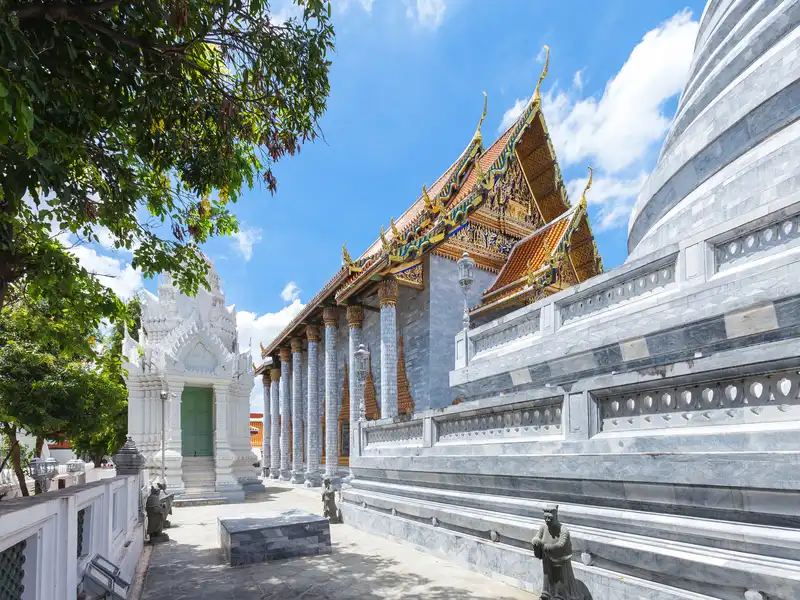
Beyond the royal viharn, the temple includes architectural elements often discussed by those who study royal monasteries, such as the Phra Pasan Chedi, which serves as an important symbol of the temple, and marble detailing that creates a restrained yet quietly elegant atmosphere. There are also palace-like buildings associated with the safeguarding of the Tripitaka, and features such as a “crown-topped” preaching throne that helps illustrate the symbolic relationship between royal ceremony, preaching, and authority. If you walk slowly and look carefully, you begin to realize that “small in area” does not mean “small in importance.” In fact, the limited space seems to have required every element to be intentionally chosen and thoughtfully designed.
From a traveler’s perspective, Wat Ratchapradit is a temple you can visit without reserving an entire day, but it does reward a little extra focus because its details do not like to be rushed. The most pleasant atmosphere is in the morning or toward late afternoon. If you want to experience a true Dhammayut rhythm, some sources note that on ordinary weekdays the royal viharn may be open mainly during morning chanting (around 09:00–09:30) and evening chanting (around 17:30–18:00), while on Buddhist holy days and weekends the temple is often open more continuously. So, if your goal is to see the murals clearly, planning your visit around those times can reduce disappointment and also gives you a chance to feel the temple as a living place of practice, not merely a stop on a route.
Walking through the temple today can feel like stepping into a scene where history is still alive. On one side is the quiet restraint of a royal monastery; on the other is the constant movement of Bangkok’s old-town tourism zone. Yet what makes Wat Ratchapradit distinctive is how it reminds you that Bangkok did not grow on entertainment alone. The city also grew through ceremony, discipline, and belief systems designed to align closely with the state since the early Rattanakosin era. Seeing murals that depict the Twelve-Month Royal Ceremonies feels like viewing a “national calendar” rendered in art—showing how the year of the capital was once paced by ritual, and how religion served as social glue in a way deeper than simply “visit, pray, and wish.”
Another angle that detail-loving visitors often enjoy is the temple’s connection to solar eclipse imagery and the broader reputation of Rama IV as an astronomer-king. Having astronomical knowledge represented within a temple space reveals a Siamese-modern relationship between religion and science that is not adversarial, but complementary: knowledge gives faith clarity, and faith gives knowledge direction. It is an atmosphere rarely found in typical tourist attractions, because it turns a temple visit into a quiet reading of an era’s ideas.
If you plan to visit, modest clothing and a softer speaking voice are especially important here, as this is a royal temple in an area where ceremonies and commemorative activities can occur regularly. On some days, certain areas may be managed differently than usual. Walking slowly, following signs, and avoiding photography in inappropriate places will help keep your visit respectful and smooth. Most of all, this is a temple best experienced with a steady mind: the calmer you are, the more you notice.
Getting There: If you are using the MRT, Sanam Chai Station is a convenient option, followed by a short walk or quick taxi ride toward Saranrom Park and the Saranrom Road area. Sam Yot Station can also work well with a short taxi connection. For an even more classic old-town feel, take the Chao Phraya Express Boat to Tha Tien or Tha Chang Pier and walk into Rattanakosin Island from there. Along the way, you will get both old-city views and a walking pace that makes the neighborhood easy to sink into without trying too hard.
If you want a “one-day Rattanakosin Island” plan, Wat Ratchapradit makes a well-balanced stop because it sits close to a park, museums, and other major temples. You might begin in Saranrom Park to warm up your legs, continue into Wat Ratchapradit to pray and view the murals, then move on to Wat Pho or the Grand Palace, and finish with food around Tha Tien or Maha Chai Road. It is not an exhausting plan, but it still gives you art, ceremony, history, and urban life in one complete day.
| Place Name | Wat Ratchapradit Sathitmahasimaram |
| Location | 2 Saranrom Road, Phra Borom Maha Ratchawang Subdistrict, Phra Nakhon District, Bangkok 10200 |
| Characteristics | Compact Dhammayut royal temple near the palace, royal viharn, murals of the Twelve-Month Royal Ceremonies and solar eclipse/astronomy, marble details and Phra Pasan Chedi |
| Period | Founded in the reign of King Rama IV (from around 1864) on the former royal coffee garden site |
| Key Evidence | Built as a Dhammayut royal temple near the Grand Palace and to fulfill the tradition of three principal temples in the capital; associated with the concept of “maha sima” and inscriptions; regarded as Rama IV’s royal temple |
| Name Origin | Originally carried a name emphasizing the Dhammayut order, later changed to “Wat Ratchapradit Sathitmahasimaram” in line with the temple’s maha-sima concept and inscription markers |
| Abbot (Latest) | Phra Phrom Wachirachan (Phunsak Woraphatthako) |
| Travel | MRT Sanam Chai / Sam Yot then a short walk or taxi; Chao Phraya Express Boat to Tha Tien / Tha Chang then walk into Rattanakosin Island; buses and taxis are convenient around Sanam Luang–Saranrom |
| Current Status | Open for worship and visits; note: some sources mention the royal viharn on weekdays may open mainly during chanting periods |
| Temple Contact (Verified) | 02-622-1030, 02-222-0855 |
| Nearby Tourist Attractions (Distance) | Saranrom Park (approx. 0.2 km) Bangkok City Pillar Shrine (approx. 0.7 km) The Grand Palace (approx. 0.8 km) Wat Phra Kaew (Temple of the Emerald Buddha) (approx. 0.9 km) Wat Pho (approx. 1.1 km) Museum Siam (approx. 1.5 km) |
| Popular Restaurants Nearby (Distance + Phone) | Supanniga Eating Room (Tha Tien) (approx. 1.2 km) – 092-253-9251 The Sixth (Tha Tien) (approx. 1.4 km) – 064-078-7278 sala rattanakosin eatery & bar (approx. 1.3 km) – 02-622-1388 The Deck by Arun Residence (approx. 1.6 km) – 083-988-8736 Thipsamai Pad Thai Pratu Phi (approx. 2.4 km) – 02-226-6666 |
| Popular Accommodations Nearby (Distance + Phone) | Chakrabongse Villas & Residences (approx. 1.2 km) – 02-222-1290 Riva Arun Bangkok (approx. 1.3 km) – 02-221-1188 sala rattanakosin Bangkok (approx. 1.4 km) – 02-622-1388 Royal Orchid Sheraton Riverside Hotel Bangkok (approx. 3.8 km) – 02-266-0123 Mandarin Oriental, Bangkok (approx. 4.6 km) – 02-659-9000 |
Frequently Asked Questions (FAQ)
Q: What is Wat Ratchapradit Sathitmahasimaram best known for?
A: It is known for being a compact Dhammayut royal temple near the Grand Palace, and for the royal viharn murals depicting the Twelve-Month Royal Ceremonies as well as solar-eclipse/astronomy-related imagery associated with Rama IV’s ideas.
Q: Why does the temple’s name include the word “mahasima”?
A: The name reflects the temple’s emphasis on a clearly defined sima boundary system for ritual space, supported by stone markers and inscriptions connected to the temple’s maha-sima concept.
Q: When should I visit if I want to see the murals inside the royal viharn?
A: Morning or late afternoon is recommended. Some sources note that on weekdays the royal viharn may open mainly during morning chanting (around 09:00–09:30) and evening chanting (around 17:30–18:00), while Buddhist holy days and weekends are often more accessible.
Q: What is the easiest way to get there by MRT?
A: Get off at MRT Sanam Chai and continue by a short walk or quick taxi ride toward Saranrom Park and Saranrom Road, or use MRT Sam Yot and take a short taxi ride. Both routes fit well with old-town walking.
Q: How much time should I plan for this temple visit?
A: For a relaxed visit, 45–90 minutes is usually enough. If you want to study architectural details and read the murals more carefully, plan about 1.5–2 hours.
 Wat Ratchapradit Sathitmahasimaram Map
 Category:
  Group:
  Last Update: 2 MonthAgo
Comment
 Nearby Attractions
| Keyword (Advance) |
 Region
|
 Phra Nakhon(