

 Home
Home Chiang Mai(












Rating: 3.8/5 (6 votes)
 |
|  Map
Map 
 Have Map
  No Map
Bangkok attractions
Attractions in Thailand
Open Days: Typically open via guided tour sessions (usually Saturdays–Sundays, and in some periods Tuesdays/Thursdays; please check the latest announcement/booking before visiting).
Opening Hours: Typically 09:30 – 13:30 (Sat–Sun) and a 13:30 session (Tue/Thu in some periods, as announced).
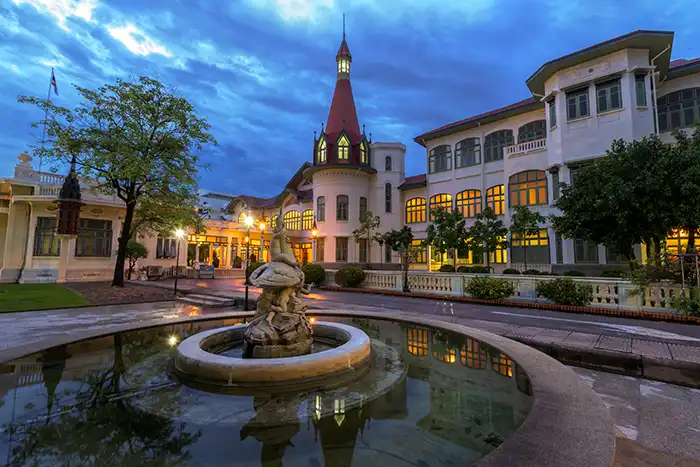
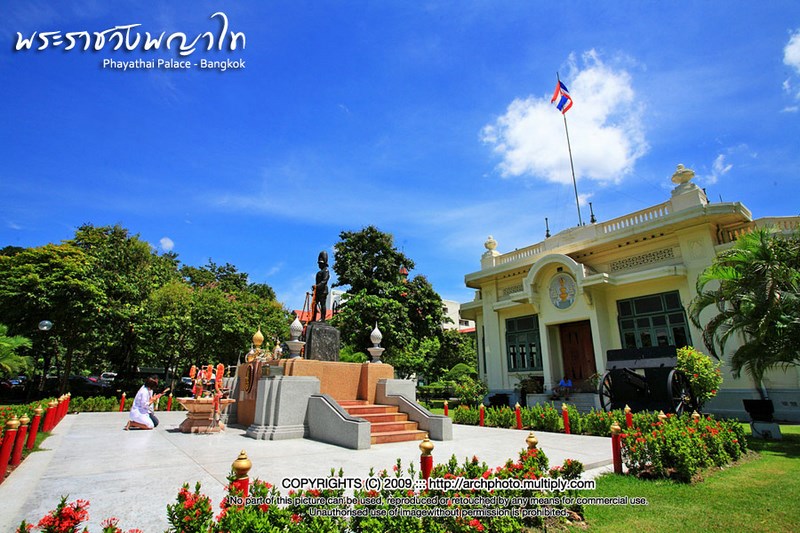
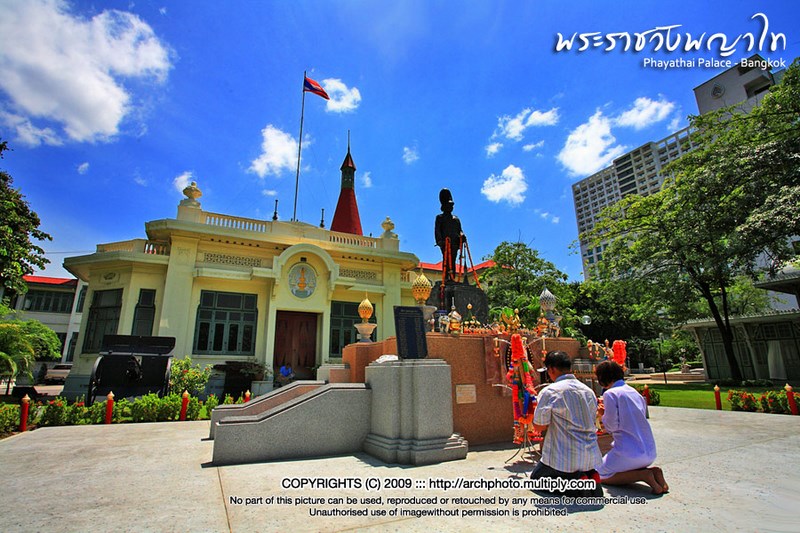
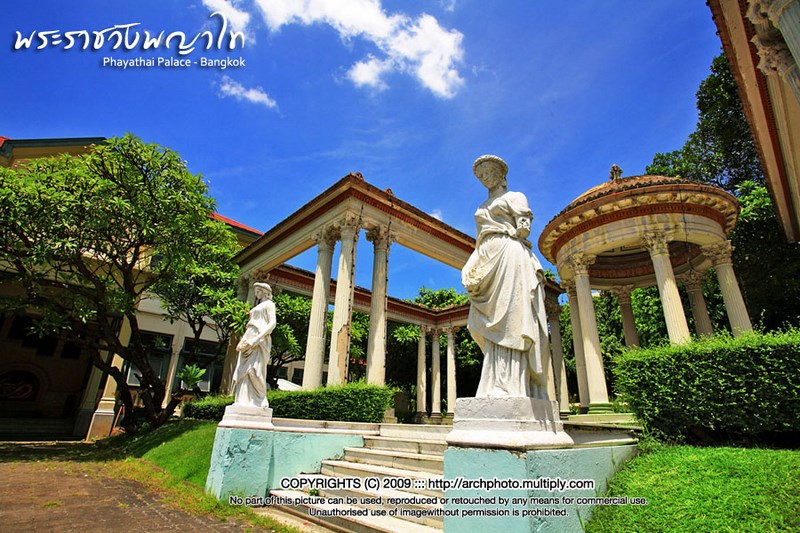
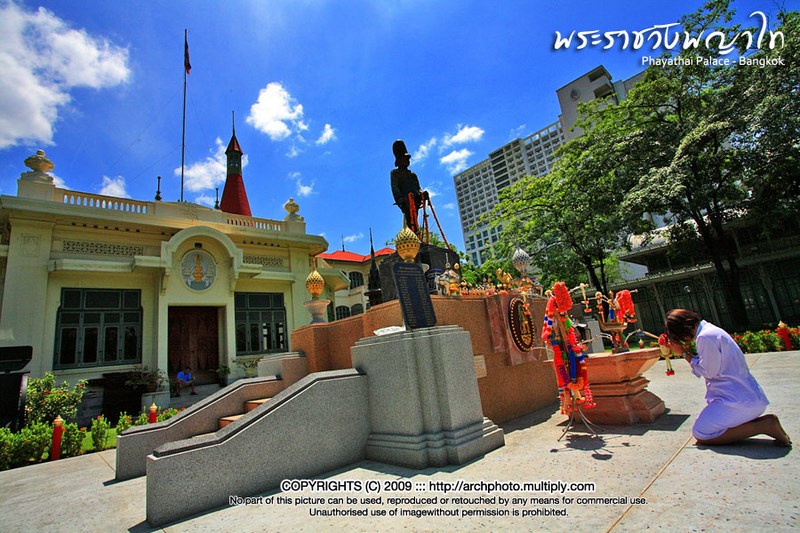
Phaya Thai Palace is one of those Bangkok places that feels a little unusual in the best way—because it’s a “palace that’s still alive in the city.” Set within the grounds of Phramongkutklao Hospital, it’s the kind of landmark many people pass around Phaya Thai–Victory Monument countless times without realizing that, inside, there is a cluster of European-style royal buildings quietly tucked away. Walking through here feels like stepping out of the nonstop rhythm of a main road and into a calmer layer of Bangkok—more restrained, more delicate, and full of architectural detail that was designed to be “royal” without needing to advertise itself.
The story begins around 1909 (B.E. 2452), during the reign of King Chulalongkorn (Rama V), when construction was initiated for a place where the King could observe rice farming, vegetable growing, and animal husbandry. In its earliest phase, this “palace” was not only about beautiful residences—it was a space that brought agriculture close to the city’s center. Land opposite the royal residence was designated for rice fields, along with a granary, and the area was used on multiple occasions for the Royal Ploughing Ceremony. That’s why Phaya Thai Palace carries a clear character of “experiment–observe–do,” and once you know that, it’s easy to see why its narrative is tied to both everyday practice and state ceremony at the same time.
Rama V, however, used Phaya Thai Palace only briefly; after the new residence was completed, he passed away just a few months later. The palace then became the residence of Queen Saovabha Phongsri (Somdet Phra Sri Patcharinthra Borommarachininat, the Queen Mother), and in the reign of King Vajiravudh (Rama VI), she was invited to reside here until her passing in 1920 (B.E. 2463). This period gradually shifted Phaya Thai Palace from a largely agricultural-and-ceremonial space toward a more clearly “royal court in the city,” both as a residence and as a place that could support important gatherings and royal activities.
After that, Rama VI dismantled the original Phaya Thai residence, leaving only Thewarat Sapharom Throne Hall, and ordered the construction of several new royal buildings. The site was then formally established as “Phaya Thai Palace.” Rama VI stayed here regularly and began experiencing illness in 1925 (B.E. 2468). In the final month of his reign, he left Phaya Thai Palace to stay at Chakraphat Phiman Hall within the Grand Palace, where he later passed away. The palace also served as the residence or lodging for several royal consorts and ladies of the court, which further underscores that Phaya Thai was not merely a beautiful architectural backdrop—it was a living space that supported real lives across multiple eras of the royal household.
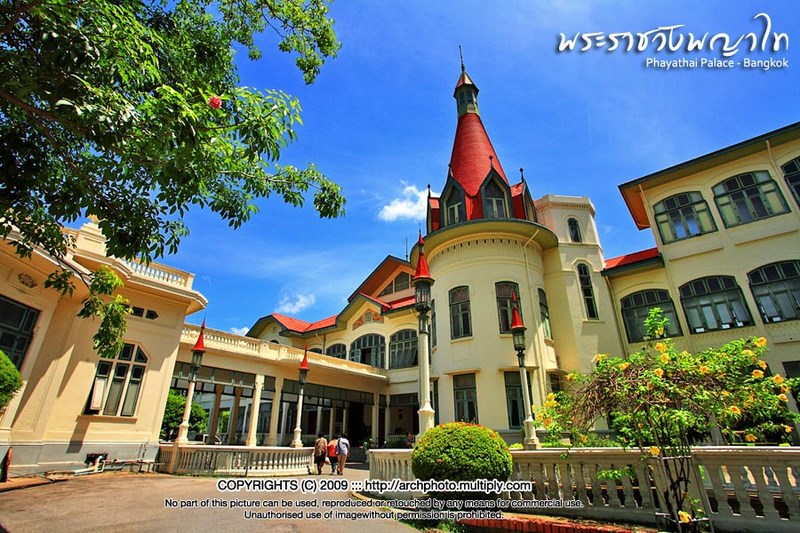
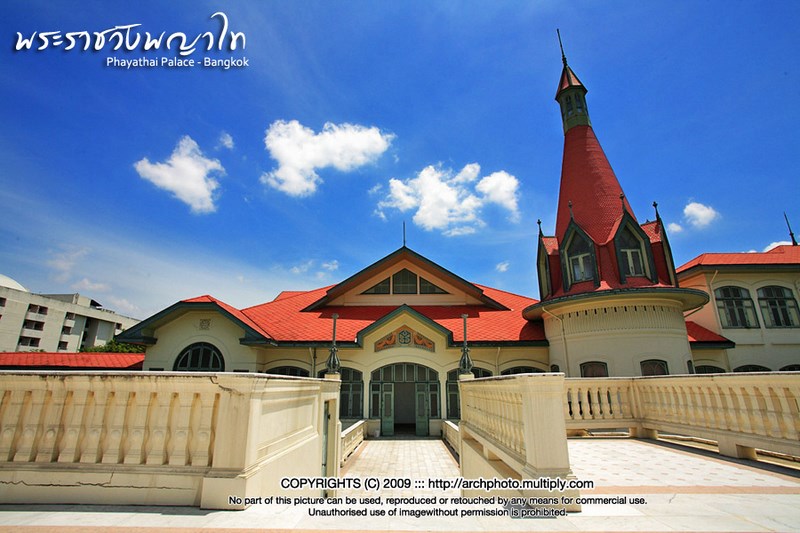
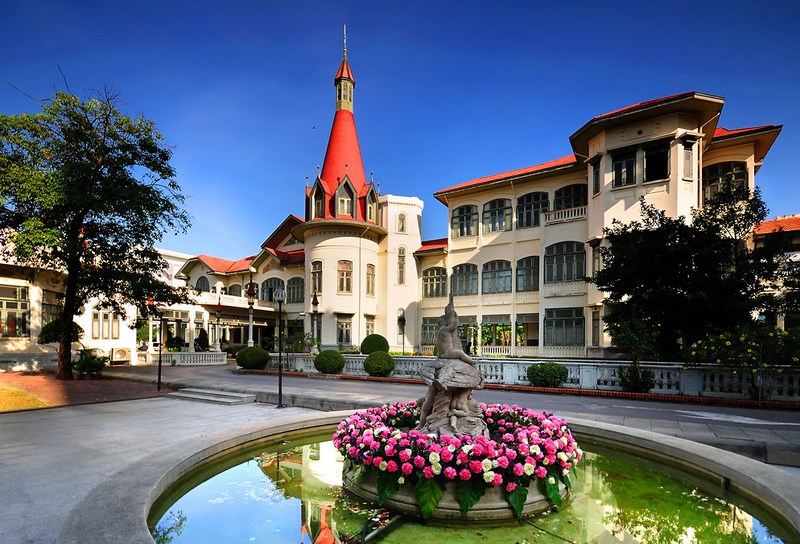
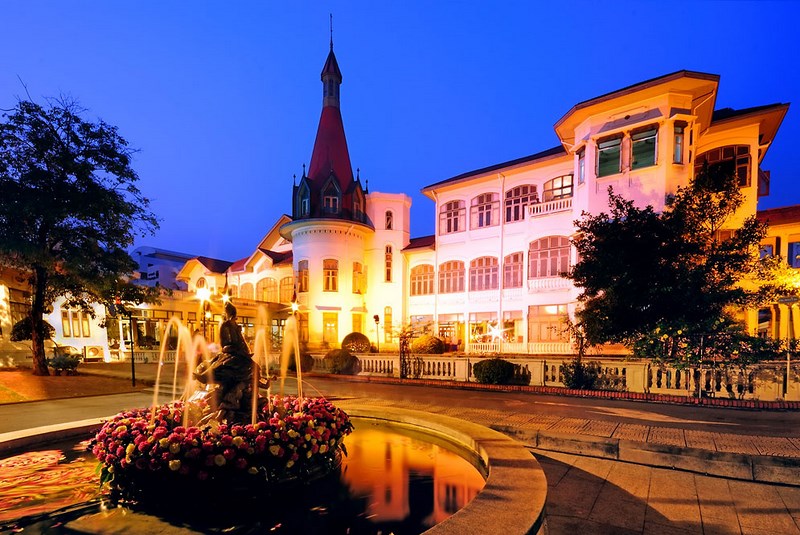
If you want the quickest “core” of what makes Phaya Thai Palace so visually memorable, it’s the group of buildings whose names are intentionally rhymed and whose European-inspired architecture stands out strongly. The signature image for many visitors is the tall tower and steep spire of Phiman Chakri Mansion, the principal building of the complex. Built in the reign of Rama VI, it is a two-story brick-and-plaster structure combining Romanesque and Gothic influences, crowned with a distinctive “red dome” that once served as a place to hoist the royal flag when the King was in residence. Inside, it is known for fresco-style paintings, floral motifs near the ceiling and on upper walls, gilded carved wooden doors, and royal monograms above doorways—details that make the visit far more than just taking photos of an impressive façade.
Nearby, you can immediately feel a different mood at Sri Suthan Niwas Hall, located to the west of Phiman Chakri. It is a two-story brick-and-plaster building, also with a dome (smaller in scale), and its style leans toward English Gothic. The interior features Art Nouveau decorative painting and Western-style oil paintings. A key detail is the second-floor connection between Sri Suthan Niwas and Phiman Chakri, which reveals that the complex was planned as an integrated environment—designed for living, receiving guests, and moving between spaces—rather than as separate “pretty buildings” placed side by side.
On the eastern side of Phiman Chakri is Vaikuntha Thep Yasathan Hall, originally two stories and later expanded to three; the added level was arranged as private royal sleeping and bathing quarters. This hall is also connected on the second floor to Udom Wanaphorn Hall. Udom Wanaphorn has a simpler overall feel, using reinforced concrete structure and Art Nouveau-style wrought-iron details, finished with white glazed tiles. Together, these buildings read like a timeline of taste—from Gothic forms that emphasize dramatic silhouettes to Art Nouveau lines that celebrate delicate craftsmanship.
Thewarat Sapharom Hall plays a different role again. It is regarded as a throne hall used for various functions—religious ceremonies for special occasions, private receptions, and even theatrical use in the past. The architectural style is often described as Byzantine, and the interior is notable for its vivid multi-colored scheme and the royal monogram “สผ” placed high near the roofline, associated with Queen Saovabha Phongsri. Standing here, you can sense that the palace was designed not only to look beautiful, but also to perform real ceremonial and cultural functions within the court.
Another layer that makes Phaya Thai Palace especially intriguing is “Dusit Thani,” a miniature model city created under Rama VI to experiment with democratic governance. Although nothing of it remains visible today, simply knowing it once existed here changes how you read the site: this palace was not only a residence, but also a place where new national ideas were tested in tangible form.
After Rama VI, Phaya Thai Palace was adapted into a first-class hotel for foreign guests as part of broader ambitions to elevate tourism and national image, and it later served as the location of one of Thailand’s earliest radio broadcasting stations. Eventually, the hotel operation ended and the palace grounds were granted for military medical use, becoming part of the institution known today as Phramongkutklao Hospital. This constant transformation gives Phaya Thai Palace a rare “multi-role” history, which is exactly why present-day conservation carries so much meaning: preserving the site means preserving multiple chapters of Thai modern history layered in one place.
Getting There If you want the most time-efficient route, take the BTS to Victory Monument Station and continue by a short taxi/ride-hail trip or a manageable walk, depending on your preference. Another option is the Airport Rail Link to Phaya Thai Station and then a short connection into the Ratchawithi area. Many city buses also pass through this district, including routes such as 8, 12, 14, 18, 28, 92, 97, 108, 509, 522, and 536 (routes and stops may change with traffic management). If driving or using a car service, allow extra time—especially during rush hour around Victory Monument and Ratchawithi Road. Most importantly, always check the latest guided-tour schedule and booking requirements before visiting, as entry is typically limited per session.
| Place Name | Phaya Thai Palace |
| Location | Ratchawithi Road, Thung Phaya Thai Subdistrict, Ratchathewi District, Bangkok |
| Highlights | A European-influenced palace complex (Romanesque/Gothic/Art Nouveau). Signature features include the tower and red dome of Phiman Chakri Mansion, plus layered history spanning royal residence, hotel era, early broadcasting, and later integration with the hospital grounds. |
| Period | Construction began in 1909 (B.E. 2452) in the late reign of Rama V; major development took place under Rama VI |
| Key Evidence | Key buildings include Phiman Chakri, Sri Suthan Niwas, Vaikuntha Thep Yasathan, Thewarat Sapharom, and Udom Wanaphorn, along with historical records of Dusit Thani (model city), the hotel phase, early radio broadcasting, and later medical use. |
| Name Origin | “Phaya Thai” is the area name in Bangkok where the palace is located, and the palace is named after the locality. |
| Travel | BTS Victory Monument + short connection by taxi/ride-hail/walk; ARL Phaya Thai + short connection to Ratchawithi; several bus routes pass nearby (e.g., 8, 12, 14, 18, 28, 92, 97, 108, 509, 522, 536). Allow extra time for traffic. |
| Current Status | Visits are typically arranged via guided tour sessions with limited capacity; check the latest schedule and booking requirements before visiting. |
| Contact Number | 02-354-7987, 087-708-1015 |
| Nearby Tourist Attractions (Approx. Distance) | Victory Monument 1 km; King Power Rangnam 2 km; Pratunam Market 3 km; Santiphap Park 3 km; Bangkok Art and Culture Centre (BACC) 4 km; Jim Thompson House 4 km |
| Popular Restaurants Nearby (Approx. Distance) | Saxophone Pub & Restaurant 2 km Tel. 02-246-5472; P’Aor Tom Yum Kung Noodle 3 km Tel. 02-612-9013; Somboon Seafood (Samyan) 5 km Tel. 02-160-5100; Krua Apsorn (Dinso) 5 km Tel. 02-685-4531; Thipsamai (Pad Thai Pratu Phi) 6 km Tel. 02-226-6666 |
| Popular Accommodations Nearby (Approx. Distance) | The Sukosol Hotel 1 km Tel. 02-247-0123; Century Park Hotel Bangkok 2 km Tel. 02-246-7800; Pullman Bangkok King Power 2 km Tel. 02-680-9999; Asia Hotel Bangkok 4 km Tel. 02-217-0808; VIE Hotel Bangkok, MGallery 4 km Tel. 02-309-3939 |
Frequently Asked Questions (FAQ)
Q: Where is Phaya Thai Palace located in Bangkok?
A: It is on Ratchawithi Road in Ratchathewi District, within the grounds of Phramongkutklao Hospital, close to the Victory Monument area.
Q: Is Phaya Thai Palace open every day?
A: Typically, visits are arranged via guided tour sessions. These are often available on Saturdays–Sundays, and in some periods also on Tuesdays/Thursdays, depending on the latest announcements and booking schedule.
Q: What architectural highlights should visitors not miss?
A: Phiman Chakri Mansion is a standout, especially its tower and red dome. Sri Suthan Niwas and Thewarat Sapharom Hall are also key highlights, each with distinctive design and historical roles.
Q: Why does Phaya Thai Palace have so many historical layers in one place?
A: Over time it served as a royal residence, was later adapted into a hotel, hosted public-facing activities including early broadcasting, and was eventually integrated into military medical use—creating multiple historical layers in one site.
Q: Is it convenient to visit by train?
A: Yes. Many visitors take the BTS to Victory Monument and then make a short connection by taxi/ride-hail or on foot. Another option is the Airport Rail Link to Phaya Thai Station and then a short connection to the Ratchawithi area.
Q: Where can I check the latest guided-tour schedule?
A: You can call 02-354-7987 or 087-708-1015 to confirm the latest tour sessions, booking requirements, and updates before your visit.
 Website: www.phyathaipalace.org
 Tel: 023547660 ต่อ 93646, 93698
 Phaya Thai Palace Map
 Category:
  Group:
  Last Update: 2 MonthAgo
Comment

Photo Gellery(9) 
 Thank you photo(6) from: IZcH
|
|
|
|
|
|
 | ● Photographer: IZcH ● Link: archphoto.multiply.com ● Ref: thaidphoto.com |
Thank you photo(3) from: Dear
|
|
|
 | ● Photographer: Dear2006 ● Link: dear2006.multiply.com ● Ref: pixpros.net |
● Copyright Photography. (800*500)
● View full size images from the photographer.
● View full size images from the photographer.
 Nearby Attractions
| Keyword (Advance) |
 Region
|
 Phra Nakhon(