

 Home
Home Chiang Mai(









Rating: 3.2/5 (6 votes)
 |
|  Map
Map 
 Have Map
  No Map
Bangkok attractions
Attractions in Thailand
Open Days: Daily
Opening Hours: 08:30 – 21:00

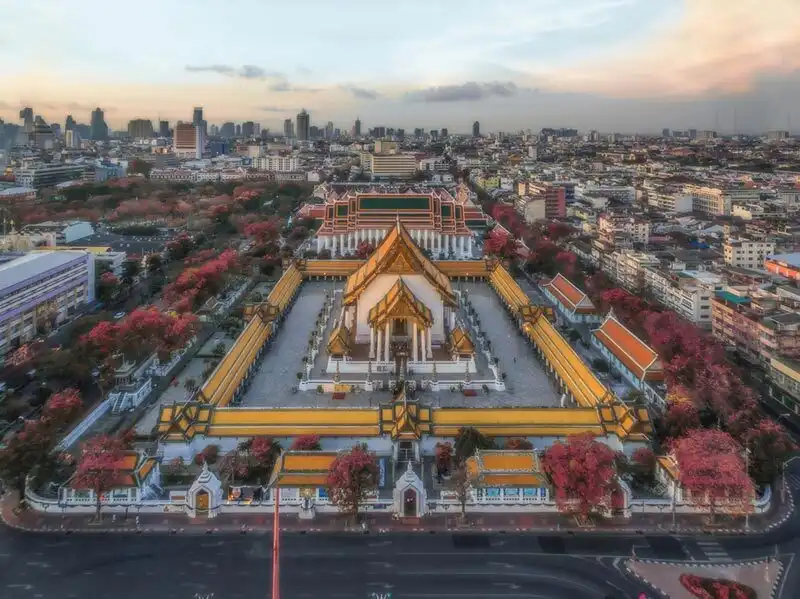
Wat Suthat Thepwararam Ratchaworamahawihan is a major royal temple on Bamrung Mueang Road in Phra Nakhon, Bangkok. Many people instantly connect it with the “Giant Swing” and the open square at Lan Khon Mueang, but once you step inside, it becomes clear this is not a temple meant for a quick stop-and-go. Wat Suthat rewards slow looking. Its beauty lives in the details, and in the early-Rattanakosin ambition to give the capital a grand, complete royal monastery—one that could stand as a center of master-level craftsmanship. Visiting here feels like reading Bangkok through the hands of artisans, through ritual space, and through the state’s way of building a city and building faith at the same time.
The story of Wat Suthat begins with the royal intention of King Rama I, who wished to create a viharn large enough to rival the great viharn of Wat Phanan Choeng, as a dignified landmark for the capital. The temple was originally given the name “Wat Maha Suthathawas,” but construction was not completed before the King passed away. In the reign of King Rama II, the work continued and the temple received a new name: “Wat Suthat Thepwararam.” The project was finally completed in the reign of King Rama III. What makes this history especially meaningful is that Wat Suthat was not a single, one-time build; it was the result of sustained royal intention across multiple reigns. The temple therefore reflects the formative energy of early Bangkok, when the new capital was being shaped to be powerful not only in governance, but also in culture and the arts.
One point that often intrigues first-time visitors even before they enter is the saying that “this temple has no stupa like other temples.” This does not mean Wat Suthat lacks important religious elements; rather, it relates to the concept of “Satta Mahasathan” as an udesika chedi—symbolic commemorative elements represented through seven significant tree types in Buddhism. This approach makes the temple feel more open and directs attention toward the viharn, the ubosot, and the principal Buddha image, instead of placing a stupa at the visual center. As a result, visitors are naturally led to read the temple through its art and its ritual layout, often without realizing it.
The core highlight you should not miss is “Phra Si Sakyamuni (Luang Pho To),” the temple’s principal Buddha image with a strong historical link to Sukhothai. The image was brought from the royal viharn of Wat Mahathat in Sukhothai. In terms of meaning, this was more than transporting a large Buddha image; it was a tangible connection between an older center of faith and artistry and the new royal capital. That is why Wat Suthat feels like more than a Bangkok temple—it stands on a long historical line stretching from Sukhothai to Rattanakosin. When you stand before the principal image, the sense of sacredness and historical weight overlap in a way you can feel without needing many explanations.
Another reason Wat Suthat is often described as an “art classroom” of the capital is the carved door panels of the viharn, widely regarded as exceptional Rattanakosin-era woodcarving. Their beauty is not only in intricate detail, but in the craftsmanship itself: the way the lines flow, the rhythm and balance of the composition, and the sense that the carving moves like a drawing on wood. The closer you look, the more you see the skill of court artisans during a time when Bangkok was establishing its own aesthetic standards. Most compelling is the note that a pair of door panels said to be from the craftsmanship of King Rama II is now preserved at the National Museum Bangkok. This makes a Wat Suthat visit easy to extend into a satisfying, story-complete route: start by seeing the temple in its living context, then go to the museum to view the preserved work up close in a setting designed for careful protection and study.
Read through the lens of the city itself, Wat Suthat also functions as a key anchor of the Giant Swing–Bamrung Mueang area, a part of old Bangkok that is genuinely walkable and always alive. Outside the walls are pedestrians, long-standing shops, Din So Road, Tanao Road, and government buildings. The moment you step inside, the city’s noise seems to drop a level, leaving calm order and sacred space. That contrast is the charm of royal temples in the old town: people come here in different ways—to worship seriously, or to appreciate craftsmanship and reset their mind in the middle of the capital.
If you want to truly “see it properly,” morning or late afternoon is ideal. The light is softer and the crowds are usually lighter than midday, which matters when you want to study carving details or spend quiet time in front of the principal image without feeling rushed. Modest dress is essential, and speaking softly is especially appropriate here because this is a royal monastery where religious activities continue as part of daily life. If you plan to take photos, follow posted signs and avoid sensitive areas so your visit remains respectful and smooth for everyone.
For trip planning, Wat Suthat fits perfectly into a Rattanakosin Island day. You can begin at the Giant Swing, walk into Wat Suthat, take your time inside, then continue on foot toward Din So Road or Tanao Road for food. After that, you can choose a classic grand-temple route to the Grand Palace and Wat Phra Kaew, or head toward Wat Pho and the Tha Tien area. If you enjoy museums, continuing to the National Museum Bangkok is a great match, because it turns the story of the “royal-handcrafted door panels” into a complete experience—from the temple space to the museum gallery.
Getting There If you take the MRT, get off at Sam Yot Station, then take a short taxi or motorbike ride toward the Giant Swing and Bamrung Mueang Road. If you enjoy walking, you can also plan a route through the old-town streets first to absorb the neighborhood atmosphere before entering the temple. Another option is taking buses that run through the Giant Swing–Bangkok Metropolitan Administration area throughout the day. If you drive, allow extra time for parking, as the old-town zone can be limited and restrictions may apply on certain days or time periods.
| Place Name | Wat Suthat Thepwararam Ratchaworamahawihan |
| Location | 146 Bamrung Mueang Road, Sao Chingcha Subdistrict, Phra Nakhon District, Bangkok 10200 |
| Highlights | Major royal temple near the Giant Swing, Phra Si Sakyamuni (Luang Pho To) brought from Sukhothai, master-level carved viharn door panels, Satta Mahasathan concept as udesika chedi |
| Period | Started in the reign of King Rama I, continued in King Rama II, completed in King Rama III |
| Key Notes | Phra Si Sakyamuni (Luang Pho To) is the principal Buddha image; the viharn door panels are celebrated Rattanakosin-era woodcarving, and a pair said to be from Rama II’s craftsmanship is preserved at the National Museum Bangkok |
| Name Origin | Originally named “Wat Maha Suthathawas” (Rama I), later renamed “Wat Suthat Thepwararam” (Rama II) |
| Abbot (Latest) | Phra Phrom Wachiramuni (Choet Jittakhutto) |
| Travel | MRT Sam Yot Station then a short taxi/motorbike ride to the Giant Swing and Bamrung Mueang Road; buses around the Giant Swing–Bangkok Metropolitan Administration area; ideal for an old-town walking route |
| Current Status | Open for worship and visits |
| Temple Contact (Verified) | 02-224-9845, 02-222-9632 |
| Admission | Thai nationals: free / Foreign visitors: 100 THB |
| Nearby Attractions (Distance) | Giant Swing (approx. 0.2 km) Bangkok Metropolitan Administration (approx. 0.4 km) Democracy Monument (approx. 1.1 km) Loha Prasat, Wat Ratchanatdaram (approx. 1.6 km) Golden Mount, Wat Saket (approx. 2.2 km) The Grand Palace (approx. 2.4 km) Wat Pho (approx. 2.6 km) |
| Nearby Restaurants (Distance + Phone) | ทิพย์สมัย (ผัดไทยประตูผี) (approx. 1.9 km) – 02-226-6666 ก.พานิช (ข้าวเหนียวมะม่วง) (approx. 1.8 km) – 02-221-3554 สุพรรณิการ์ อีทติ้ง รูม (ท่าเตียน) (approx. 2.7 km) – 092-253-9251 ศาลารัตนโกสินทร์ (อีทเทอรี่ แอนด์ บาร์) (approx. 2.8 km) – 02-622-1388 เดอะเด็ค บาย อรุณ เรสซิเดนซ์ (approx. 3.0 km) – 02-221-9158 |
| Nearby Accommodations (Distance + Phone) | วิลลา เดอ พระนคร (approx. 1.3 km) – 02-281-9922 ศาลารัตนโกสินทร์ กรุงเทพฯ (approx. 2.8 km) – 02-622-1388, 081-936-1388 จักรพงษ์ วิลล่า แอนด์ เรสซิเดนซ์ (approx. 2.9 km) – 02-222-1290 ริวา อรุณ กรุงเทพฯ (approx. 2.9 km) – 02-221-1188 ริวา สุริยา กรุงเทพฯ (approx. 4.1 km) – 02-633-5000 |
Frequently Asked Questions (FAQ)
Q: Where is Wat Suthat Thepwararam Ratchaworamahawihan located in Bangkok?
A: The temple is on Bamrung Mueang Road in Sao Chingcha, Phra Nakhon, close to the Giant Swing and Bangkok Metropolitan Administration, making it easy to continue exploring the old-town area on foot.
Q: What is the single most important highlight at Wat Suthat?
A: The main highlight is Phra Si Sakyamuni (Luang Pho To), the principal Buddha image, along with the viharn’s master-level carved door panels from the Rattanakosin period.
Q: Is it true that Wat Suthat does not have a stupa like other temples, and why?
A: It is often explained that the temple does not emphasize a stupa in the usual way because it highlights the Satta Mahasathan concept as an udesika chedi, which shifts the focus toward the viharn, ubosot, and interior arts.
Q: Do foreign visitors need to pay an admission fee?
A: Information commonly states that Thai nationals enter free of charge, while foreign visitors have an admission fee of 100 THB. It is wise to carry cash and confirm any posted notices on the day of your visit.
Q: What is the most convenient way to get there by MRT?
A: Take the MRT to Sam Yot Station, then continue by a short taxi or motorbike ride to the Giant Swing area and Bamrung Mueang Road. You can also plan an old-town walking route before entering the temple.
Q: If I want to see the viharn door panels associated with Rama II, where should I go?
A: There is information that a pair of door panels associated with Rama II is preserved at the National Museum Bangkok, so you can extend your trip from the temple to the museum to see the work up close.
 Wat Suthat and the Giant Swing Map
 Category:
  Group:
  Last Update: 2 MonthAgo
Comment

Photo Gellery(3) 
 Thank you photo(3) from: Snowboard