

 Home
Home Chiang Mai(















Rating: 4/5 (4 votes)
 |
|  Map
Map 
 Have Map
  No Map
Bangkok attractions
Attractions in Thailand
Open Days: Permanently Closed
Opening Hours: -
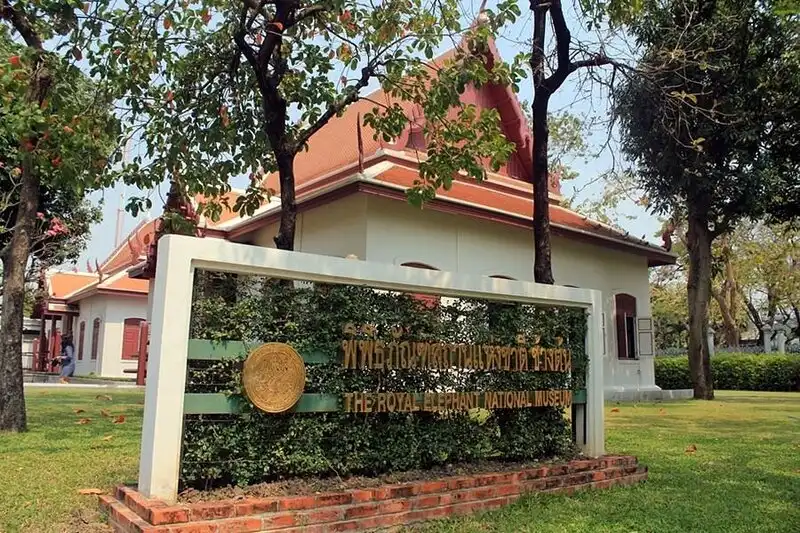
National Museum of Royal Elephants (Chang Ton) was once a small, highly specialized space in the Dusit Palace area that focused on telling the story of “royal elephants.” In this context, “chang ton” does not mean elephants in general, but significant elephants formally registered as royal elephants belonging to the monarch. In the worldview of Thai society—along with much of Southeast Asia—elephants with auspicious characteristics have long been regarded as a source of immense royal prestige and a sign of prosperity, abundance, and peace for the land and its people.
Put simply, royal elephants sit at the intersection where “belief,” “ritual,” and “the state” overlap closely. Elephants are not only working animals or symbols of the wild; they also represent royal protocol, reverence for the institution of monarchy, and the idea of auspiciousness that society hopes will translate into wellbeing for the nation. Seen through this lens, it becomes clear why a museum about royal elephants belonged in the Dusit Palace zone—because this district itself has long been a stage for state ceremonies and the political–social history of Bangkok.
According to the historical accounts passed down, this site was originally the “Royal Elephant Stable” within Dusit Palace. King Chulalongkorn (Rama V) graciously ordered its construction to accommodate significant elephants that had been formally registered and maintained within the court’s ceremonial system. In that era, the presence of auspicious elephants under royal patronage was not merely something to admire—it was widely perceived as an emblem of the land’s harmony and abundance.
As time went on, the role of the royal elephant stables in the Dusit area shifted with changing eras. During the reign of King Bhumibol Adulyadej (Rama IX), when white elephants came under royal patronage, the stables and related facilities were restored and reorganized. A new royal elephant stable was also established within the Chitralada Royal Residence grounds so that the stables would remain inside the palace precinct, closer to the royal residence. This development reinforced the idea that the stables were not merely “a building,” but part of an ongoing system of care for royal elephants and the continuation of court rituals.
Later, as the surrounding government area evolved and new parliamentary buildings were developed nearby, the original royal elephant stable building was seen as deteriorating over time. Conservation work was then carried out, and it was subsequently designated a national museum under the name “National Museum of Royal Elephants (Chang Ton),” opening to visitors as a tangible learning space about royal elephants, associated beliefs, and the place of elephants within the structure of the Thai state.
The value of a museum like this lay in how it made the seemingly distant subject of “royal elephants” accessible to the general public without requiring prior knowledge of court rituals. Even without specialized vocabulary or familiarity with ceremonial names, visitors could immediately sense the meaning of “honor” and “status” that society assigns to significant elephants. In doing so, the museum quietly reflected how natural symbols have been used to express sacredness and legitimacy of authority across different eras.
However, the National Museum of Royal Elephants (Chang Ton) is currently listed as “permanently closed” and is no longer open to the public. If you were planning to visit specifically to view exhibitions, it is best to adjust your plans early and choose alternative learning sites in the Dusit–Phra Nakhon area instead, so you do not lose time on a trip that cannot be completed.
The good news is that even though the museum has closed, Dusit remains a district where you almost always “come away with something.” The area is filled with important temples, historic buildings, and learning spaces that connect to Bangkok’s bigger picture—arts and culture, politics, and national development. You can plan this as a half-day or full-day route, then round it off with a meal in the Samsen–Dusit neighborhood, where the atmosphere is unpretentious but the flavors are taken seriously.
Getting There If you are using public transport, you can take BTS or MRT and then continue by taxi or motorcycle taxi into the Dusit area depending on the weather and time. If you are driving, allow extra time for traffic in government districts and plan ahead for parking, as many spots in Dusit have area regulations and ceremonies/events that can make parking less flexible than in typical tourist zones.
| Place Name | National Museum of Royal Elephants (Chang Ton) |
| Location | Dusit Palace area, along Uthong Nai Road, Bangkok |
| Highlights | A specialized museum focused on “royal elephants” (chang ton)—significant elephants formally registered as royal elephants, connecting belief, ritual, and royal-court history |
| Key Period / Milestones | The original building is associated with the Royal Elephant Stable within Dusit Palace (Rama V) / Later designated as a national museum (commonly cited: designated in 1988 and opened to visitors in 1992) |
| Current Status | Permanently closed (not open to visitors) |
| Fees | - |
| Contact Number | - |
| Nearby Attractions / Learning Sites (Approx. Distance) | Wat Benchamabophit Dusitvanaram (2 km) Tel. 092-939-5646 Bank of Thailand Learning Center (4 km) Tel. 02-356-7766 National Museum Bangkok (6 km) Tel. 02-224-1402, 02-224-1333 The Equestrian Statue of King Chulalongkorn (2 km) Tel. 02-250-5500 Khun Daeng Vietnamese Noodle Soup (Phra Athit) (7 km) Tel. 085-246-0111 |
| Popular Restaurants Nearby (Approx. Distance) | Krua Apsorn (Samsen Branch) (4 km) Tel. 082-292-0431 Samsen Villa (Phaya Thai Branch) (5 km) Tel. 089-795-8801 P’Aor Tom Yum Kung Noodles (Phetchaburi Soi 5) (7 km) Tel. 02-612-9013 Savoey (Tha Maharaj) (7 km) Tel. 02-055-6258 Arun Residence (near Wat Arun) (7 km) Tel. 02-221-9158 |
| Popular Accommodations Nearby (Approx. Distance) | The Siam Hotel (4 km) Tel. 02-206-6999 The Raweekanlaya Bangkok (4 km) Tel. 02-628-1111 Praya Palazzo (5 km) Tel. 02-883-2999 Centara Life Hotel Bangkok Phra Nakhon (6 km) Tel. 02-621-9999 CASA Nithra Bangkok (6 km) Tel. 02-282-3033 |
Frequently Asked Questions (FAQ)
Q: Is the National Museum of Royal Elephants (Chang Ton) still open to visitors?
A: It is currently listed as permanently closed, so it cannot be visited.
Q: If I want to learn about royal elephants and royal-court history, where should I go instead?
A: Consider alternative learning sites in the Dusit–Phra Nakhon area that are still operating, such as major temples, the National Museum Bangkok, and learning centers around Samsen.
Q: Can I plan a half-day trip in the Dusit area?
A: Yes. Focus on temples, monuments, and nearby learning sites, then finish with a meal in the Samsen–Dusit neighborhood for an easy, well-paced route.
Q: Is it convenient to get there by BTS or MRT?
A: It is reasonably convenient. Use BTS or MRT and continue by taxi or motorcycle taxi into the Dusit area depending on the weather and timing.
 National Museum of Royal Elephants (Chang Ton) Map
 Category:
  Group:
  Last Update: 2 MonthAgo
Comment
 Nearby Attractions
| Keyword (Advance) |
 Region
|
 Phra Nakhon(