

 Home
Home Chiang Mai(



















Rating: 4/5 (8 votes)
 |
|  Map
Map 
 Have Map
  No Map
Ratchaburi attractions
Attractions in Thailand
Open Days: Open Daily
Opening Hours: 08:00 – 18:00
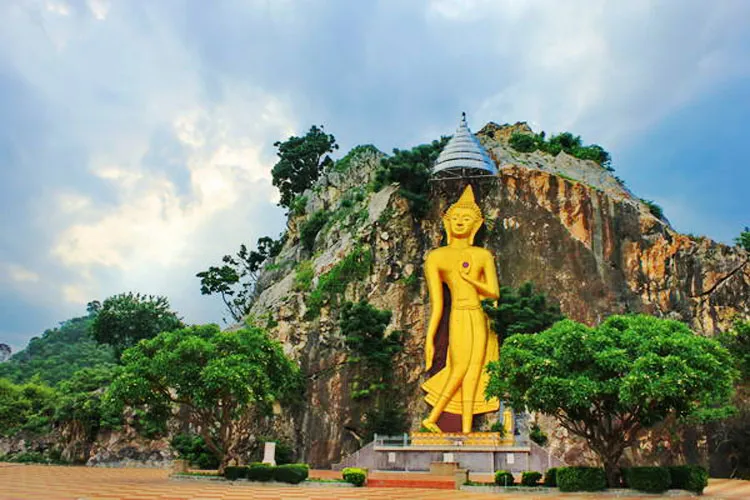
Khao Ngu Hermit Cave is an important ancient site located at the foot of the mountain within Khao Ngu Stone Park in Ko Phlapphla Subdistrict, Mueang District, Ratchaburi Province. It is regarded as one of Thailand’s significant archaeological and Buddhist artistic heritage sites. Inside the cave is a carved Buddha image on the cave wall, created in the Dvaravati style and dating back to the 11th–13th Buddhist centuries. Historians and archaeologists recognize it as important evidence of the spread of Buddhism in central Thailand in the past.
Khao Ngu Hermit Cave is especially well known for the carved Buddha image called the “Phra Phuttha Chai of Khao Ngu Hermit Cave,” a seated Buddha with pendant legs in the preaching posture. This form is rarely found in Dvaravati art. The distinction of this Buddha image has made the site an important destination for visitors interested in history, art, and cultural tourism.
The landscape of the Khao Ngu area consists of limestone mountains formed naturally through geological processes over millions of years. These limestone hills originated from sediment deposits in an ancient sea before being uplifted into mountains and eroded into numerous caves. Khao Ngu Hermit Cave is considered one of the most important caves in this mountain range.
Inside Khao Ngu Hermit Cave is a Buddha image carved on the cave wall in the Dvaravati style. Its distinctive features include a flat face, raised curved eyebrows joined in the shape of wings, bulging eyes, a broad nose, thick lips, large spiral curls of hair, and a halo shaped like a lotus bud. These are characteristic traits of Dvaravati art found in several parts of Thailand.
The Buddha image is shown seated with pendant legs in the preaching posture, a highly significant form in Buddhist art because it reflects the moment when the Buddha delivered teachings to his disciples. This posture differs from the more commonly seen meditation or Mara-victory postures in Thai art.
One of the most important pieces of evidence found in Khao Ngu Hermit Cave is a Pallava-script Sanskrit inscription located between the feet of the Buddha image. The inscription reads “Punyakarmmajara Sri Samadhigupta,” which can be interpreted as “Sri Samadhigupta is purified through merit-making.” This inscription reflects the dedication of merit and the creation of religious monuments in ancient times, and it also serves as valuable evidence for dating the art in this area.
In addition to the Dvaravati Buddha image, Khao Ngu Hermit Cave also houses several sandstone Buddha images in the Ayutthaya style, reflecting that the site continued to be used as a sacred place and a location for religious practice through different historical periods.
The area around Khao Ngu Stone Park also contains several other important ancient sites and caves, such as Chin–Cham Cave, where archaeological remains from the Dvaravati period have been discovered. Inside the cave stands a walking Buddha image, along with traces of stucco restoration from later periods.
Another important cave is Fa Tho Cave, located about 250 meters west of Khao Ngu Hermit Cave. Inside are carvings of a large reclining Buddha image. Above it are depictions of celestial beings and stucco images of trees. On the northern side of the cave are carvings of two disciples, believed to be related to the episode of the Buddha’s Parinirvana.
Fa Tho Cave is also the site of an annual worship festival held on the first waxing day of the eleventh lunar month. This is an important local tradition, drawing residents and visitors who come to make merit and pay respect to the sacred objects inside the cave.
Today, the Khao Ngu Stone Park area has been developed into a public park for recreation. It features nature walking paths, a large lake, and scenic viewpoints overlooking the limestone mountains, making it both a historical attraction and a popular leisure destination in Ratchaburi Province.
Getting There Khao Ngu Hermit Cave is easy to reach from Ratchaburi town. Take Highway 3087 on the Ratchaburi – Chom Bueng – Suan Phueng route for about 8 kilometers. At the intersection, turn right and continue for about 1 kilometer. Khao Ngu Stone Park will be on the left-hand side.
Another route is via Highway 3089 from Bang Phae Intersection heading toward Photharam District, passing Wat Nong Hoi. After about 34 kilometers, Khao Ngu Stone Park will be on the right-hand side.
| Summary | Khao Ngu Hermit Cave |
| Highlights | Dvaravati-style Buddha relief and massive limestone mountains |
| Location | Khao Ngu Stone Park, Ko Phlapphla Subdistrict, Mueang District, Ratchaburi Province |
| Nearby Attractions | 1 Fa Tho Cave 0.25 km 2 Chin–Cham Cave 0.4 km 3 Rakhang Cave 0.6 km 4 Khao Phra Bat 1 km 5 Wat Nong Hoi 5 km |
| Nearby Restaurants | 1 Khrua Lung Rong 5 km Tel. 081-944-8478 2 Ratchaburi Jar Noodle Pot 6 km Tel. 032-321-123 3 Baan Hom Tian Restaurant 7 km Tel. 032-206-179 4 Egg Noodle Restaurant 8 km Tel. 081-012-3456 5 Khao Ngu View Restaurant 1 km Tel. 089-777-8888 |
| Nearby Accommodations | 1 ณ เวลา Ratchaburi 10 km Tel. 032-919-999 2 Space 59 Hotel 7 km Tel. 032-315-999 3 Tai-Shan Suites 7 km Tel. 032-315-666 4 Westerngrand Hotel 8 km Tel. 032-337-111 5 Rachabhura Hotel 9 km Tel. 032-919-555 |
| Contact Numbers | 1 TAT Ratchaburi 032-919-998 2 Khao Ngu Stone Park 032-919-990 3 Ratchaburi Tourist Service Center 032-919-997 4 Ratchaburi Municipality 032-315-044 5 Ratchaburi Provincial Administrative Organization 032-338-000 |
Frequently Asked Questions (FAQ)
Q: Where is Khao Ngu Hermit Cave located?
A: It is located inside Khao Ngu Stone Park, Ko Phlapphla Subdistrict, Mueang District, Ratchaburi Province.
Q: When was Khao Ngu Hermit Cave created?
A: It dates to the Dvaravati period, around the 11th–13th Buddhist centuries.
Q: What is the highlight of Khao Ngu Hermit Cave?
A: Its highlight is the Dvaravati-style Buddha relief carved on the cave wall and the Pallava-script inscription.
Q: What is interesting about Khao Ngu Stone Park?
A: It features limestone mountains, a lake, ancient caves, and scenic natural viewpoints.
Q: What is the best time to visit?
A: Morning and late afternoon are the best times for walking around and taking photographs.
 Khao Ngu Hermit Cave Map
 Category:
  Group:
  Last Update: 1 DayAgo
Comment
 Nearby Attractions
| Keyword (Advance) |
 Region
|
 Muang Ratchaburi(