

 Home
Home Chiang Mai(









Rating: 3.1/5 (9 votes)
 |
|  Map
Map 
 Have Map
  No Map
Chiang Mai attractions
Attractions in Thailand
Open Days: Daily
Opening Hours: Recommended 08.00–17.00
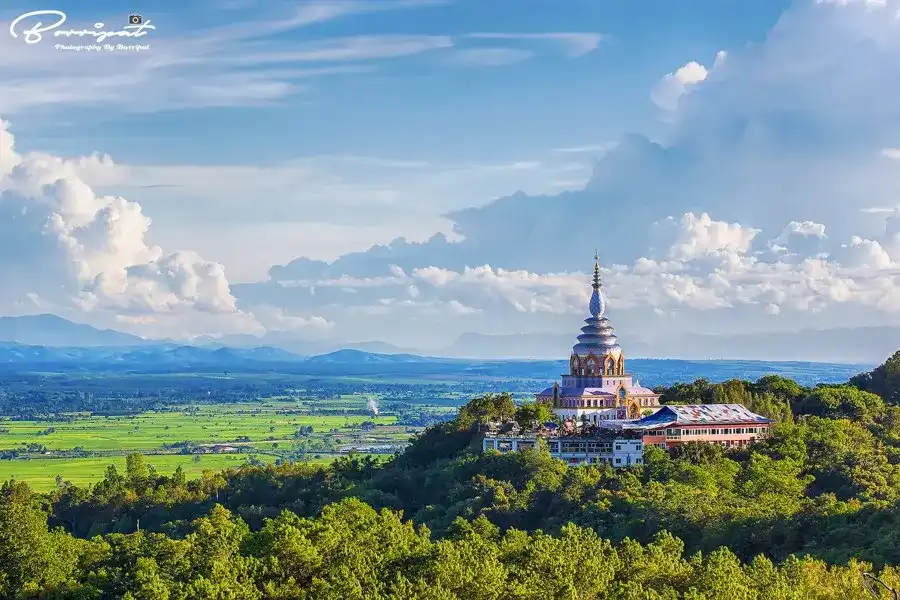
Wat Thaton Royal Temple is a temple many people remember for its striking silhouette—a hillside complex laid out in tier after tier, visible from afar as you drive into the Tha Ton riverside community along the Kok River. But if you pause and look a little longer, you’ll notice this place is more than a scenic viewpoint or a local landmark of Mae Ai District. It is a landscape that carries layered history, border-community memories, and quiet lessons in faith that teach you without needing words.
One story that makes Wat Thaton especially thought-provoking is its past as a long-abandoned temple. For hundreds of years, it was said to have remained in ruins, with only a single damaged old stupa left behind, surrounded by dense forest and with no clear evidence of which era it was built in. The silence of an abandoned temple is not emptiness; it is a space that holds the traces of people who were born here, prospered, declined, and left their imprint on the Kok River basin.
In the Suwan Dam Daeng legend, there is mention of Thai groups who migrated into the central Chiang Mai area sometime after 1700 BE and who were devoted Buddhists. Many historians also agree that river basins such as the Kok River likely hosted established communities and cultures even before Chiang Mai was founded in 1839 BE. That perspective makes standing at Wat Thaton feel like standing on ground where multiple layers of time overlap—and where each layer still speaks through what remains.
About 6 kilometers east of Wat Thaton lies Wiang Khae, an ancient town site where traces of moats can still be seen. Even if there is no definitive evidence of which period it flourished in, the simple fact that the moats are still visible is enough to suggest this region was not empty in the past. An old town near an old temple encourages you to read Mae Ai’s landscape differently—not as a corridor you pass through on the way north, but as an area that once served as a cultural center in its own right.
Moving from legend to tangible evidence, the reference you provided points to an inscription on the base of the oldest Buddha image found in Mae Ai District (at Wat Sri Bun Rueang), dated Chulasakarat 221 (1403 CE). There are also ancient bronze Buddha images discovered at abandoned temples in rice fields and along the Fang River, some preserved by local temples, some moved to Chiang Rai, and some taken to the central region during certain periods. Together, these traces suggest the area experienced centuries of prosperity, even if later upheavals scattered many objects far from their original homes.
Another key historical marker is Chulasakarat 636 (1818 CE), when Phaya Mangrai is recorded as having come to reign in Fang. Notably, there is no clear record that he built an entirely new city there, which supports the idea that Fang and nearby settlements (Wiang Chai, Wiang Khae, Mueang Ngam, and others) were already established and prosperous beforehand. Northern chronicles also describe Fang as an ancient city, with later repairs and restorations in Mangrai’s era because the area remained fertile and valuable.
Returning to Wat Thaton itself, the information you shared includes important details about local antiquities. Surveys reported ancient bronze Buddha images housed at Wat Thaton (in Sala Phuttha But Pracha San), including 5 seated images in the Maravijaya posture and 3 standing images, classified as Lanna art and estimated to be around 500–700 years old. Two of these have inscriptions at their bases. The smallest seated Maravijaya image, known locally as “Phra Fon Saen Ha,” is recorded as created in Chulasakarat 910 (1548–1549 CE). A standing alms-bowl-bearing image records donors’ names but not a year. From this, Wat Thaton is reasonably understood to have existed for many centuries.
What makes Wat Thaton special today is that it doesn’t stop at being “an old temple.” It has become the principal temple of the district, located in Ban Tha Ton, Tha Ton Subdistrict, Mae Ai District, Chiang Mai. The setting is famously scenic: a hillside complex with religious structures and buildings arranged along the slopes, spreading across tiers—often described as 9 levels. These “9 levels” are not only a physical layout; they feel like an invitation for visitors to move gradually from the fast, noisy world below into a calmer, lighter state of mind above.
Wat Thaton is a third-class royal monastery (common type), elevated from a local temple to royal temple status on 11 October 1991. The total area is approximately 425 rai (with the lower temple zone and a much larger area designated as a Buddhist park and meditation-practice zone). Much of the land is steep hillside, while the front area opens to the Kok River plain. Once you understand the scale of the grounds, it makes sense why Wat Thaton can feel more like a “hilltop spiritual town” than a temple with only a few buildings.
If you drive into Tha Ton for the first time, the moment you often feel you’ve truly arrived isn’t just a signboard—it’s the Kok River and the bridge crossing it. From the bridge, you’ll notice only a handful of resorts, hotels, and restaurants along the riverside. The most eye-catching sight, however, is Wat Thaton rising on the hill, especially the towering Guanyin (the Bodhisattva of Compassion) standing on a high cliff near the river, as if calmly watching the flow of people entering and leaving the community.
According to the details you provided, the Guanyin Bodhisattva is counted as a key landmark at Level 1 of the Wat Thaton ascent. This first level also includes Phra That Chom Khiri Sri Ping Khok, Sala Sunthon, and a Buddhist scripture school. As a whole, Level 1 feels like a welcoming threshold where sacredness, education, and community life meet in one place.
As you move upward through the temple levels, something shifts along with the widening views: your inner space can feel oddly more open. Walking uphill naturally forces deeper breathing, and deeper breathing often helps the mind loosen its grip on whatever it carried from outside. That is why many people come to Wat Thaton not only to make wishes, but to return to the breath—and to themselves—in a more sincere way.
Among the important sites you listed is the “original stupa,” an older chedi that reflects the temple’s era of abandonment. Its damaged state does not reduce its value; instead, it serves as evidence of time passing. It suggests that faith, too, can be swallowed by forest and change, and yet humans eventually return to “restore the heart” through restoring a temple.
Another major highlight is the White Buddha, known as Phra Phuttha Niranthon Chai. This large brick-and-plaster Buddha image has a lap width of about 9 meters, a soft white tone, and a Phra Sing style in the Maravijaya posture. It was built in 1983. In morning light or thin mountain mist, the White Buddha can make the world feel quieter by a beat, and its calm whiteness gently reminds visitors to be kinder and softer with themselves.
Next is Phra Sangkachai (Sangkachai Buddha), built in 1987 as a Chinese-style sculpture standing above a grotto area with a fountain nearby. Positioned at a curve in the road, it feels as if it is greeting visitors as they arrive. This detail is culturally meaningful because it reflects the borderland character of the area: multiple communities and influences have long coexisted here, and that lived mixture appears naturally in the temple’s visual language.
There is also Phra Nak Prok, a large brick-and-plaster Buddha sheltered by the naga, with a lap width of over 7 meters, built in 1987. Beneath the base is a hall used for meditation practice. This is significant experientially: it signals that Wat Thaton is not only a place to look around, but also a place intentionally designed for inner practice. Sitting beneath the Nak Prok can feel like being held under a protective canopy, quietly invited to return to your own mind with honesty.
The heart of Wat Thaton—the place many visitors most want to reach—is Phra Borommathat Ratchamongkhonlajarn Saman Chan, commonly called the Crystal Chedi. It is a square-based chedi with a rounded spire, decorated with three symbolic types of glass as you described. This is where Wat Thaton becomes deeply spiritual in meaning: the three kinds of glass are not only decoration, but a direct teaching about human states of mind.
The first is colored glass, which can resemble Benjarong-style patterns. It symbolizes ordinary people who still carry love, greed, anger, and delusion. The many colorful sections reflect the reality that most people begin with faith mixed with desire, hope, and attachment—and that’s okay. That faith is still the force that brings us to the starting point.
The second is reflective glass. From a high angle, parts of the chedi are said to reflect the chedi’s own image, using mirror-finish stainless materials. This is compared to dedicated practitioners who behave more in line with right practice than ordinary people, yet may still become attached to their own goodness. The meaning can be uncomfortably accurate for hardworking people: sometimes we use goodness as armor and end up exhausted by the need to be “good” all the time.
The third is clear glass, designed as openings you can see through within the structure. It symbolizes a liberated state that is not attached to anything. Many visitors linger here longer than they expect, because it feels like a quiet question: “What am I still holding onto?” and “How much am I truly willing to let go?”
The final peak point, both grand and contemporary in meaning, is Phra Im Talot Kan (roughly, “The Ever-Full Buddha”), a standing alms-bowl-bearing Buddha associated with Wednesday (the birth day of Somdet Phra Maha Ratchamongkhonlajarn of Wat Paknam, credited as the builder in your notes). This bronze statue is about 9 meters tall and stands prominently on the last hill of the Wat Thaton complex. Reaching it can feel like standing face-to-face with quiet steadiness—a calm figure that seems to “receive the world” without collapsing under it.
What makes Wat Thaton captivating in a way that you can stay with is that it doesn’t force excitement. Instead, it invites mindful presence. Down near the river levels, the air feels fresh and moist with water and forest scents. Higher up, earth and wind become clearer. In winter mornings when humidity is right, Wat Thaton is also known as a place to watch sea mist and breathe deeply, letting mental noise settle into the mountain silence.
The borderland identity is another layer Wat Thaton holds in its details. Tha Ton borders Shan State in Myanmar, and Thai Yai (Shan/ Tai) communities have long lived alongside local groups here. You also cited a record from 1881 when Carl Bock traveled to survey Fang and described “Tha Tong (Tha Ton)” as a tiny village of about 12 huts scattered along both banks of the Kok River, characterizing it as a distinctly “Ngiao (Thai Yai)” village. Later, in 1929, a Thai temple was built on a village open ground in the area that is now a local health station. These details reveal how the border community gradually formed its identity over time, layer by layer—much like the temple tiers themselves.
In the present day, Wat Thaton continues to function as an educational center and a place that supports meditation practice, with clear contact channels for retreats (tel. 053-459-309, meditation@wat-thaton.org). This reflects that the temple is not only for sightseeing; it also opens space for people to live and practice within the temple to train the mind in a real way.
For meditation practice, according to the information you provided, Wat Thaton offers a “Dynamic Vipassana Meditation Retreat.” Interested participants should contact the temple at least 7 days in advance. Each round can accommodate about 15 people and requires at least 7 days of practice. The contact numbers you provided are 0 5345 9468 and 0 7817 7522, which are included in the summary table and FAQ as requested.
From an experiential point of view, if you want to leave with more than photos, try walking through Wat Thaton without rushing. Choose one spot and stay with it for 10 minutes—stand quietly at a viewpoint and let your gaze follow the Kok River, noticing what your mind is trying to grasp, or sit under a tree and listen to the wind instead of the noise in your head. It’s surprisingly common for people to find answers to things they couldn’t untangle elsewhere, because a place like this gently forces you to stop fighting your thoughts and return to what is actually in front of you.
Wat Thaton is also a good place for people who are tired of having to be capable all the time. The meaning of the reflective glass at the Crystal Chedi can provoke a direct question: what kind of “goodness” are we attached to? Are we doing good for freedom, or from fear of not being good enough? And the clear glass challenges us to test how much we can let go. Even if you can release just one thing that day, the journey is already worth it.
Getting There Wat Thaton is located in Mae Ai District, Chiang Mai. A popular route is to drive north from Chiang Mai city along the main highway corridor in the Mae Rim–Fang direction, heading into Mae Ai and the Tha Ton community. As you approach Tha Ton, signage for the temple is generally clear. The road up the temple is a hillside drive in sections; use low gear at certain points and drive carefully, especially during the rainy season when surfaces can be slippery. Visitors from Chiang Rai can also reach Tha Ton via routes through the Mae Chan side, as Tha Ton is a border town that connects Chiang Mai and Chiang Rai travel relatively conveniently.
The best times to visit are early winter mornings for mist and soft sunrise light, or late rainy season into early winter for lush green mountains and a lively river. If you want the truly quiet atmosphere, arrive before crowds and take time to walk through all 9 levels without rushing. You’ll feel that this temple wasn’t made for speed; it was made for gradually returning to yourself.
| Name | Wat Thaton Royal Temple |
| Type | Third-class royal monastery, common type (elevated on 11 October 1991) |
| Location | Ban Tha Ton, Tha Ton Subdistrict, Mae Ai District, Chiang Mai |
| Area | Approx. 425 rai 2 ngan 95 sq. wah (lower temple zone approx. 45 rai; Buddhist park/meditation zone approx. 380 rai) |
| Highlights | A tiered hillside temple (9 levels) with views of the Kok River, community, rice fields, and surrounding mountains |
| Period / Historical Evidence | Long period as an abandoned temple; local antiquities and Lanna-style ancient bronze Buddha images estimated 500–700 years old; inscriptions reported (including a date corresponding to Chulasakarat 910 / 1548–1549 CE in the provided information) |
| Key Sites Inside the Temple | Guanyin Bodhisattva, original old stupa, the White Buddha (Phra Phuttha Niranthon Chai), Phra Sangkachai, Phra Nak Prok, Phra Borommathat Ratchamongkhonlajarn Saman Chan (Crystal Chedi), Phra Im Talot Kan (Ever-Full Buddha), ordination hall |
| Meditation Practice | Vipassana practice available (Dynamic Vipassana Meditation Retreat); contact at least 7 days in advance; approx. 15 participants per round; minimum 7 days |
| Recommended Time to Visit | Winter early mornings for sea mist; late rainy season to early winter for lush green scenery |
| Facilities | Parking area, multiple viewpoints across levels, walking/visiting zones by levels, meditation-practice zone (confirm specific details with the temple before traveling) |
| Travel | Drive north from Chiang Mai along the Mae Rim–Fang corridor toward Mae Ai–Tha Ton, then follow signs up the hill (hillside road in sections; drive carefully) |
| Nearby Tourist Attractions with Distance | Thanathorn Orange Farm (approx. 6 km) Tel. 089-998-9889 Doi Pha Hom Pok National Park (approx. 45–60 km) Tel. 0 2562 0760–3 or 0 2561 0777 ext. 1743, 1744 (reservations/tourist info) Fang Hot Springs (approx. 45–60 km) Tel. 0 2561 0777 ext. 1742 (park info) Wiang Khae (ancient town/moat remnants) (approx. 6 km) Tha Ton community – Kok River Bridge / riverside area (approx. 2–4 km) |
| popular restaurants nearby | Thaton Riverview Restaurant (approx. 2–4 km) Tel. 053-373-1735 Restaurant/Café at Thaton Hill Resort (approx. 1–2 km) Tel. 053-053-669, 061-351-9729 Restaurant at Saranya River House (approx. 2–5 km) Tel. 053-053-672, 089-851-7072 Khun Mai Bansuan Resort Kitchen (approx. 3–6 km) Tel. 053-053-551, 088-952-6196 Restaurant at Garden Home Nature Resort (approx. 3–7 km) Tel. 053-373-015 |
| popular accommodations nearby | Thaton Hill Resort (approx. 1–2 km) Tel. 053-053-669, 061-351-9729 Ariya Phu Ri Resort (approx. 1–3 km) Tel. 053-053-658 Saranya River House (approx. 2–5 km) Tel. 053-053-672, 089-851-7072 Khun Mai Bansuan Resort (approx. 3–6 km) Tel. 053-053-551, 088-952-6196 Garden Home Nature Resort (approx. 3–7 km) Tel. 053-373-015 |
| Fees | free |
| Contact | Temple (office/general): 053-459-309 Meditation email: meditation@wat-thaton.org Meditation (as provided): 0 5345 9468, 0 7817 7522 |
Frequently Asked Questions (FAQ)
Q: Where is Wat Thaton Royal Temple located?
A: It is in Ban Tha Ton, Tha Ton Subdistrict, Mae Ai District, Chiang Mai—a hillside temple beside the Kok River with viewpoints overlooking the community and surrounding mountain ranges.
Q: How many levels does Wat Thaton have?
A: The temple complex is commonly described as having 9 levels, with religious sites and viewpoints across the tiers for worship, rest, and reflection as you ascend.
Q: What is the must-see highlight once you reach the upper levels?
A: The key highlight is the Crystal Chedi (Phra Borommathat Ratchamongkhonlajarn Saman Chan) and the upper viewpoints that reveal the Kok River winding through rice fields and the Tha Ton community below.
Q: What do the three types of glass on the Crystal Chedi symbolize?
A: In the temple’s teaching symbolism, colored glass represents ordinary people still influenced by desire and delusion; reflective glass represents practitioners who improve but may still cling to goodness; and clear glass represents a liberated state free from attachment.
Q: What kind of historical evidence of antiquity is associated with Wat Thaton?
A: The provided information mentions ancient Lanna-style bronze Buddha images estimated 500–700 years old, with inscriptions on some bases, supporting the understanding that the temple site has existed for many centuries.
Q: How do I join the Dynamic Vipassana Meditation Retreat?
A: Contact in advance at least 7 days. According to the provided details, each round accommodates about 15 people and requires a minimum 7-day stay. Call 0 5345 9468, 0 7817 7522, or the temple office at 053-459-309.
Q: When is the best time to see sea mist at Wat Thaton?
A: It is usually best in winter or early mornings in late rainy season to early winter. Arrive early to catch soft mist and sunrise light over the Kok River valley.
Q: Are there accommodations and restaurants near the temple?
A: Yes. There are resorts and dining options in Tha Ton and nearby, such as Thaton Hill Resort, Ariya Phu Ri Resort, Saranya River House, and Thaton Riverview Restaurant. The summary table includes approximate distances and verified phone numbers.
 Wat Thaton Map
 Category:
  Group:
  Last Update: 2 DayAgo
Comment
 Nearby Attractions
| Keyword (Advance) |
 Region
|
 Muang Chiang Mai(