

 Home
Home Chiang Mai(















Rating: 4.4/5 (5 votes)
 |
|  Map
Map 
 Have Map
  No Map
Bangkok attractions
Attractions in Thailand
Open Days: Daily
Opening Hours: 05.00 – 21.00
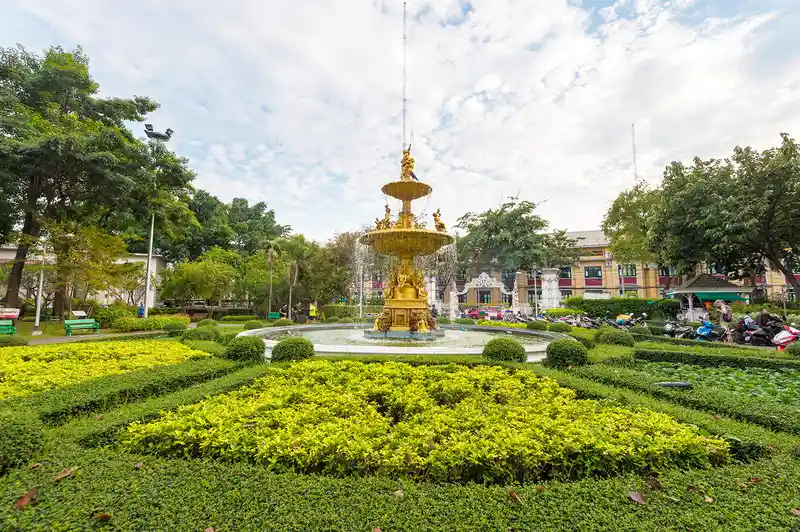
Saranrom Park, officially known as Saranrom Royal Garden, is one of Bangkok’s oldest public parks. It is located directly opposite the Grand Palace on its eastern side, along Sanam Chai Road in Phra Nakhon District. Although the park is relatively small compared to modern public parks, it holds deep historical value, having developed alongside the transformation of the royal court, political power, and urban structure of Bangkok since the early Rattanakosin period.
Originally, Saranrom Park formed part of the royal grounds of Saranrom Palace, which King Mongkut (Rama IV) ordered to be built in 1866. The palace was intended as a residence for receiving foreign dignitaries and as a temporary royal residence. Its location directly connected to the Grand Palace meant that Saranrom Park served as a leisure garden and landscaped space that enhanced the royal environment from the very beginning.
During the early reign of King Chulalongkorn (Rama V), around 1874, Saranrom Park was systematically developed and redesigned as a botanical garden in the Western style. Following the advice of Henry Alabaster, a key figure in Siam’s urban planning and landscape development, the King appointed him to design and organize the garden. Whenever the King traveled and encountered unusual or exotic plant species, he ordered them to be brought back and planted in Saranrom Park. As a result, the park became an important collection site for diverse plant species and reflected modern botanical garden concepts of the time.
During the reign of King Vajiravudh (Rama VI), Saranrom Park was used as a venue for winter fairs, cultural events influenced by Western traditions that symbolized Siam’s modernization in the early 20th century. The park thus functioned not only as a royal green space but also as a social and cultural public venue that connected the elite with the evolving city.
After the political change of 1932, the role of Saranrom Park shifted significantly. King Prajadhipok (Rama VII) granted the park to the government for use as the headquarters of the People’s Party. A space that had once belonged to the royal court thus became a political space, clearly reflecting the transition of power within the country.
Viewed more deeply than simply as a recreational park, Saranrom Park represents a tangible reflection of Bangkok’s political and spatial transformation. From a royal garden within palace grounds, to a governmental and political center after the 1932 revolution, and eventually to a public park for citizens, the same space has accommodated royal authority, state power, and everyday urban life. Opening Saranrom Park to the public was therefore not merely the creation of a green space, but a transformation of a “space of power” into a shared civic space within Thai society.
In 1960, the Cabinet passed a resolution transferring Saranrom Park to the Bangkok Metropolitan Administration for development as a public park. From that point onward, the park assumed its present role as a green oasis in the heart of Phra Nakhon, where people can relax, stroll, or take a break from visiting nearby temples and historic landmarks.
Within the context of Old Town tourism, Saranrom Park serves as an important strategic rest point. Surrounded by the heavy crowds of visitors to the Grand Palace, Wat Phra Kaew, and Wat Pho, the park acts as a buffer zone that shifts the rhythm of travel from sacred intensity and bustle to calm and shade. Many travelers choose to sit here, escape the heat, or reorganize their walking routes before continuing toward Tha Tien or the Chao Phraya riverside, making the park an integral part of the Old Town walking experience rather than a mere stopover.
Today, the atmosphere of Saranrom Park remains quiet and tranquil, offering a stark contrast to the busy surroundings of the Grand Palace. Shaded pathways wind through mature trees and ornamental plants that have grown over generations, making the park ideal for slow walks, resting, or pausing during an Old Town itinerary. In this way, Saranrom Park functions as a place of respite, gently linking Bangkok’s past with its present.
| Place Summary | A historic public park in Phra Nakhon District, formerly the royal garden of Saranrom Palace, located opposite the Grand Palace. Ideal for relaxation and leisurely walks. |
| Highlights | A historic park from the reigns of Rama IV–V, Western-style landscape design, strong links to Thailand’s political history, and a peaceful setting near the Grand Palace. |
| Nearby Attractions | The Grand Palace (0.2 km) Wat Phra Si Rattana Satsadaram (Wat Phra Kaew) (0.3 km) Wat Pho (0.6 km) Tha Tien Pier (0.6 km) National Museum Bangkok (1.4 km) |
| Nearby Restaurants | The Sixth Restaurant (0.5 km) Tel. 02 623 5166 Supanniga Eating Room Tha Tien (0.7 km) Tel. 02 946 1000 The Deck by Arun Residence (0.8 km) Tel. 02 221 9158 Elefin Coffee (0.6 km) Tel. 093 493 6999 Home Cafe Tha Tien (0.7 km) Tel. 083 095 4949 |
| Nearby Accommodations | Arun Residence (0.8 km) Tel. 02 221 9158 Sala Rattanakosin Bangkok (0.9 km) Tel. 02 622 1388 Riva Arun Bangkok (0.9 km) Tel. 02 221 1188 Royal Rattanakosin Hotel (1.9 km) Tel. 02 222 9111 Chakrabongse Villas (1.2 km) Tel. 02 222 1290 |
Frequently Asked Questions (FAQ)
Q: Is Saranrom Park open every day?
A: Yes, the park is open daily and accessible to the general public.
Q: What type of visit is Saranrom Park best suited for?
A: It is ideal for strolling, resting, or serving as a break point between visits to the Grand Palace, Wat Pho, and the Tha Tien area.
Q: Why is Saranrom Park historically significant?
A: It was originally the royal garden of Saranrom Palace and has played continuous roles in royal, political, and urban history in Bangkok.
Q: How long should I plan to spend at Saranrom Park?
A: Most visitors spend around 30–60 minutes, making it a convenient rest stop during an Old Town itinerary.
Q: What nearby places can I visit after Saranrom Park?
A: You can easily walk to the Grand Palace, Wat Phra Kaew, Wat Pho, and Tha Tien Pier.
 Saranrom Park Map
 Category:
  Group:
  Last Update: 2 MonthAgo
Comment
 Nearby Attractions
| Keyword (Advance) |
 Region
|
 Phra Nakhon(