

 Home
Home Chiang Mai(











Rating: 4.5/5 (4 votes)
 |
|  Map
Map 
 Have Map
  No Map
Bangkok attractions
Attractions in Thailand
Open Days: Open daily
Opening Hours: 06:00 – 17:00
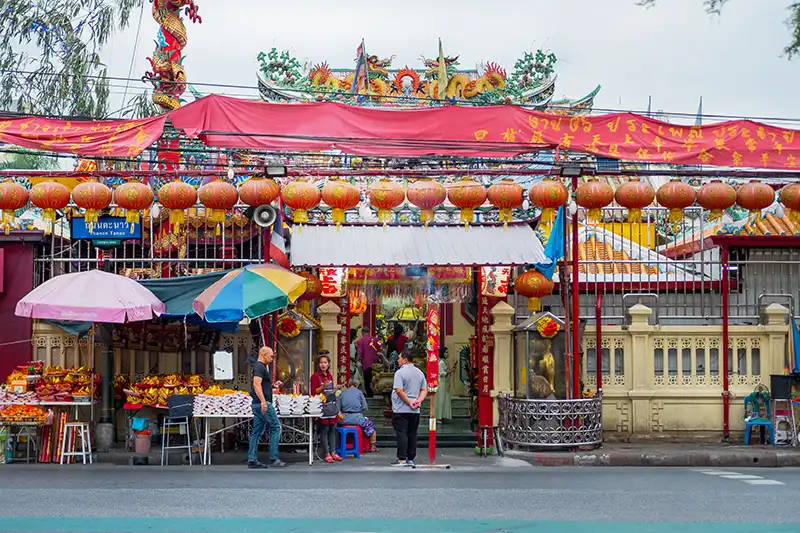
San Chao Pho Suea (Tiger God Shrine) is one of Bangkok’s most historic Chinese shrines, best known as a major center of faith near the Giant Swing area. But if you look a little deeper, this shrine is also a living piece of the old city’s history—an enduring reflection of Thai–Chinese community life that has been intertwined for generations. The shrine is located on Tanao Road, close to the intersection with Unakan Road and not far from the Giant Swing, making it easy to visit whether you are a Bangkok local looking for a brief moment of calm in the middle of the day, or a traveler who wants to experience Thai culture through real, on-the-ground spiritual practice rather than only shopping malls or cafés.
The shrine stands out immediately for its distinctive architecture, built in the style commonly found in southern China. Its tones, decorative details, and artistic elements create an atmosphere that feels both classic and deeply sacred, in the way old-city shrines often do. With an area of a little over 2 rai, the space can accommodate continuous streams of worshippers throughout the day while still maintaining a sense of order, intention, and reverence. Importantly, this is a Teochew Chinese shrine (within Taoist tradition) and is regarded as one of the oldest and most famous shrines of its kind in Thailand. For many people, it is a must-visit place for understanding Bangkok through a cultural layer that goes far beyond the modern city surface.
The principal deity of the shrine is “Xiantian Shangdi” (also commonly rendered as “Heng Tian Xiang Di” in various spellings), widely known among Thais as the “Tiger God.” Many Chinese worshippers refer to this shrine as “Tua Lao Eia” (ตั่วเล่าเอี้ย). In addition to the main deity, the shrine also enshrines other highly revered figures such as the Tiger God image, Guan Yu, and the Goddess of the Sea (often known in Thailand as Chao Mae Thapthim). This makes worship here meaningful for many different intentions—protection, warding off negativity, strengthening one’s resolve, and seeking a calmer, more harmonious life.
The shrine’s history traces back to the reign of King Rama III, with its construction dating to 1834 (B.E. 2377). It is closely associated with Wat Mahannapharam, and was originally located along Bamrung Mueang Road. Later, during the reign of King Rama V, when Bamrung Mueang Road was expanded, the shrine was relocated by royal permission through Phraya Choduk Ratchasetthi to the Samphraeng area on Tanao Road, where it remains today. Local narratives often connect the Tiger God’s legend to this neighborhood and to Wat Mahannapharam (Wat Mahannap), reflecting the long-standing relationship and shared life between Thai and Chinese communities here—a relationship that continues to be expressed through everyday worship and ritual practice to this day.
If you pay attention to the layout and atmosphere inside the shrine, you will notice that its spiritual power is not built on grandeur alone, but on continuity—generations of worship embedded in the rhythm of old Bangkok. Many visitors come with quiet, respectful manners. Some stop by before starting their workday, some come to steady their minds before making important decisions, and others bring family members for shared peace of mind. This is why San Chao Pho Suea feels like a place where “faith in everyday life” is not an abstract phrase, but something you can genuinely sense.
One of the most frequently discussed beliefs connected to this shrine involves the cultural symbolism of the tiger in Chinese tradition. Tigers are believed to possess great power, capable of subduing spirits and driving away harmful forces. For homes located near a three-way junction (a “Samphraeng”), which is traditionally believed to invite negative energies, people often hang a symbol of a “tiger holding a sword” at the entrance to ward off misfortune. This symbolic belief is closely tied to why the Tiger God is revered here—as a protector who helps keep harmful influences at bay and supports people in standing firm against fear and uncertainty.
If this is your first time visiting a Chinese shrine and you are unsure how to worship, the simplest approach is the best one: dress modestly, speak softly, avoid blocking those who are praying, and give yourself a brief moment to settle your mind before you begin. Inside, worship areas are generally arranged in an orderly manner. Many people begin by paying respect to the principal deity first, then continue to other deities according to personal faith. What matters most is not memorizing an exact sequence, but showing sincerity and respect to the shrine and to other worshippers. If you would like a quick, practical explanation of what to do, you can politely ask the staff or caretakers, especially during busy festival periods.
The best time to visit, if you prefer a calmer atmosphere and an easier flow, is in the morning when the weather is cooler and the crowds are lighter. Visiting at midday or in the afternoon is also possible, but it is wise to allow extra time on peak days—especially during Chinese festivals or major auspicious dates when worshippers arrive in large numbers. If you plan to take photos, do so respectfully: avoid flash, avoid photographing people who are praying without permission, and keep in mind that the shrine is foremost a place of worship.
Getting There Since the shrine is located in Bangkok’s old town area, a practical way to avoid driving is to take the MRT to Sam Yot Station and then continue by motorbike taxi, taxi, or a short walk to Tanao Road. The distance is not far, but Bangkok’s sun can be intense. If you travel by taxi or private car, allow extra time because traffic around the Giant Swing and Tanao Road can be heavy in certain periods, and parking may require using nearby paid parking areas or authorized spaces. A little planning can make the visit feel truly calming rather than stressful.
One of the biggest advantages of visiting San Chao Pho Suea is how easily it fits into a full old-town day trip. After worshipping, you can walk to important temples, museums, and heritage sites, or explore famous local eateries. You can even stay overnight in the Banglamphu area or along the Chao Phraya River to fully absorb the classic Bangkok atmosphere. In this way, a shrine visit becomes more than “making a wish”—it becomes a way to understand the city through history, art, people, and everyday life in one connected neighborhood.
Ultimately, if you are looking for a Bangkok attraction that offers meaningful stories, deep-rooted faith, and a true old-city atmosphere, San Chao Pho Suea deserves a place on your list. It offers more than a photo moment or a check-in; it gives you the sense that you have touched a deeper “root” of Bangkok. And sometimes, simply standing quietly for a few minutes in a shrine that has been revered for nearly two centuries can leave your mind calmer than you expected.
| Place Name | San Chao Pho Suea (Tiger God Shrine) |
| Location | 468 Tanao Road (near Unakan Road intersection and the Giant Swing area), Phra Nakhon District, Bangkok 10200 |
| Highlights | Historic Teochew Chinese Taoist shrine founded in 1834 (B.E. 2377), southern Chinese shrine architecture, principal deity is Xiantian Shangdi (widely known as the Tiger God), revered deities also include Guan Yu and Chao Mae Thapthim, major faith landmark near the Giant Swing with many nearby attractions in the old town |
| Key Timeline / Context | Founded during King Rama III (1834 / B.E. 2377) and relocated to Tanao Road during King Rama V’s era when Bamrung Mueang Road was expanded |
| Contact Number | 02-224-2110 |
| Nearby Attractions (Approx. Distance) | 1) Wat Mahannapharam Worawihan – 0.6 km – 02-226-3306 2) Wat Suthat Thepwararam – 0.9 km – 02-224-9845 3) Bangkok Metropolitan Administration (Giant Swing) – 0.8 km – 02-221-2141 4) Rattanakosin Exhibition Hall – 1.6 km – 02-621-0044 5) Bangkok National Museum – 2.7 km – 02-224-1402 6) Grand Palace – 3.0 km – 02-623-5500 |
| Nearby Restaurants (Approx. Distance) | 1) Thipsamai (Pad Thai Pratu Phi) – 1.6 km – 02-226-6666 2) Jay Fai (Pratu Phi) – 1.6 km – 02-223-9384 3) Krua Apsorn (Dinso Road) – 1.4 km – 080-550-0310 4) Mit Ko Yuan – 1.7 km – 092-434-9996 5) Mont Nom Sod (Giant Swing) – 1.4 km – 02-224-1147 |
| Nearby Accommodations (Approx. Distance) | 1) Nouvo City Hotel – 2.4 km – 02-282-7500 2) Buddy Lodge – 2.6 km – 02-629-4477 3) Villa De Khaosan – 2.7 km – 02-281-4455 4) Riva Surya Bangkok – 3.3 km – 02-633-5000 5) Riva Arun Bangkok – 3.4 km – 02-221-1188 |
Frequently Asked Questions (FAQ)
Q: Is San Chao Pho Suea open every day, and what time does it open?
A: The shrine is generally open daily, and the commonly listed opening hours are 06:00 – 17:00. During Chinese festivals or peak auspicious dates, it can be very busy, so allow extra time.
Q: What kind of shrine is San Chao Pho Suea, and who is the principal deity?
A: It is a Teochew Chinese Taoist shrine. The principal deity is Xiantian Shangdi, widely known in Thai as the Tiger God. Other revered deities enshrined here include Guan Yu and Chao Mae Thapthim.
Q: How old is San Chao Pho Suea?
A: The shrine dates back to the reign of King Rama III. It was founded in 1834 (B.E. 2377) and later relocated to Tanao Road during King Rama V’s era when Bamrung Mueang Road was expanded.
Q: What should I wear and how should I behave if it is my first visit?
A: Dress modestly, speak softly, avoid blocking worshippers, avoid flash, and take photos respectfully. If you are unsure about worship steps, you can politely ask the shrine caretakers for guidance.
Q: Is it convenient to reach the shrine by public transport?
A: Yes. You can take the MRT to Sam Yot Station, then continue by motorbike taxi, taxi, or a short walk to Tanao Road. Do allow time for heat and traffic in the old town area.
 San Chao Pho Suea (Tiger God Shrine) Map
 Category:
  Group:
  Last Update: 2 MonthAgo
Comment
 Nearby Attractions
| Keyword (Advance) |
 Facebook Fanpage
 Region
 Art, Culture and Heritage
 Historical Sites and Monuments(
 Landmarks and Memorials(
 Royal Palace(
 Art, Craft Centres, Tradition(
 Museums(
 Historical Houses and The Ancient City(
 Art Gallery(
 Educational Places
 Museum for Study(
 Library(
 University
 Temple(
 Church(
 Mosque(
 Research and Development
 Royal Project(
 Suburban Living
 Village, Community(
 Local Market(
 Floating Market(
 Nature and Wildlife
 River, Canal(
 Bays and Beaches(
 Other natural attractions(
 Entertainment and Agricultural
 Zoos and Aquariums(
 Animal camps and shows(
 Stadium(
 Farm, Parks, Gardens and Ecotourism(
 Amusement Park(
 Waterpark(
 Theater(
 Cinema(
 Shopping
 Shopping and Night Market(
 Department Store(
 Spas and Wellness
 Spas and Wellness(
 Restaurant
 Michelin Star(
 Accommodation
 Hotel(
 Call Customer Service in Tourism
 Call Customer Service in Tourism(
 Travel Articles, Recipes
 Travel Review, Food Review(
 Royal Thai Desserts, Traditional Dessert, Thai Dessert Recipes(