

 Home
Home Chiang Mai(















Rating: 4/5 (4 votes)
 |
|  Map
Map 
 Have Map
  No Map
Bangkok attractions
Attractions in Thailand
Open Days: Daily
Opening Hours: Generally open according to prayer times and mosque activities (it is recommended to call ahead)
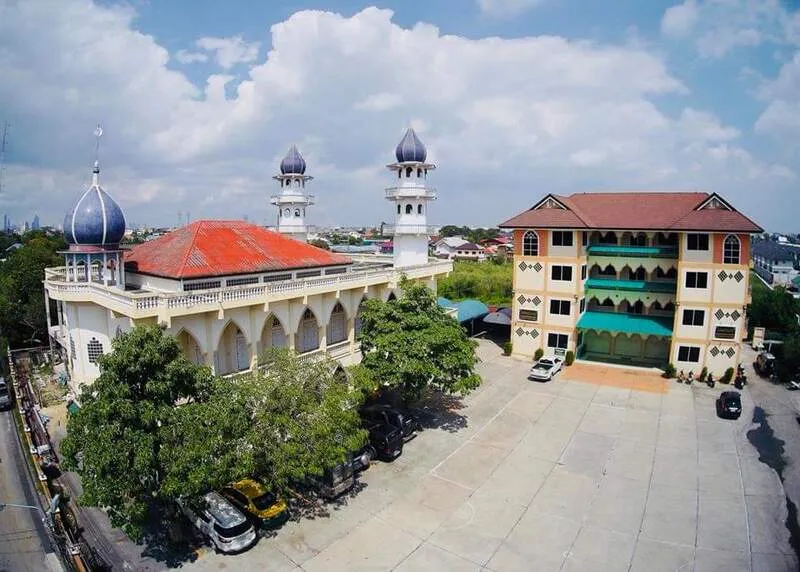
Kholideen Mosque is a long-established mosque in the Pracha Uthit area of Thung Khru, Bangkok. What makes it special is that it functions as a “community hub” just as much as it serves as a place of worship. Within the same waqf land, there is the mosque, an Islamic school, and a cemetery, which together reflect the life cycle, faith, and deep ties of the people in the community. From a typical tourist’s perspective, this mosque may not feel like a flashy city-center landmark, but for anyone who wants to understand Bangkok on a more human level, it is a meaningful destination—showing “Bangkok as a real community,” with roots, stories, and people who keep the place alive day after day.
The history of Kholideen Mosque is anchored in the concept of “waqf,” the endowment of assets for religious and public benefit. The mosque and Kholideen School were established around 1949 (B.E. 2492) through the intention of the late Haji Wahab bin Hasan, known locally as “Chaloeh,” who endowed approximately 5 rai of land to be used for the mosque, the school, and the cemetery. Later, Hajjah Sa’adah and Hajjah Halimah Maenmin—granddaughters of the late Haji Wahab bin Hasan—further endowed an additional 1 ngan of land for the mosque. These two endowments helped the community develop with clear structure and stability, with “religion” and “education” as shared pillars.
In the community’s narrative, the mosque was not created solely through the planning of a major institution. Rather, it emerged from the practical needs of local residents who wanted a place to pray closer to home and who wanted their children to learn religion and ethics in a safe and nurturing environment. The Kholideen community itself grew from the expansion of Muslim Malay-descended families who migrated and settled in nearby areas. As the population increased, traveling elsewhere for Friday prayer became less convenient. The idea of establishing their own mosque gradually strengthened, until the community collectively brought it into reality—raising funds, contributing labor, and using shared resources with care and purpose.
Once the mosque became established, it was natural for “education” to become the next major mission. For Muslim communities, religious learning is not an optional add-on—it is a foundation of daily life. Kholideen School was therefore initiated from a shared recognition of need and collective cooperation among respected elders and leaders in the area. Those remembered and often mentioned include the late Haji Abdurrazib Phodam, Haji Arun Nuchmee (who currently serves as the imam of Kholideen Mosque), Haji Arfan Phodam, the late Chamaeh Salaethim, the late Chawang Salaethim, the late Chalee Liamthong, the late Chama Liamthong, and the late Hiran Phanmachot. These names reflect how the school was never “one person’s project,” but a community effort—carrying forward hope so that education could truly endure.
In its early stage, the school’s construction relied on both faith and hands-on work. The late Haji Ishaq Boonma endowed timber for building the school, and many skilled community members helped carry out the construction, including the late Yusob Isma-ael, the late Isma-ael Isma-ael, the late Haji Yahya Chuenchom, and the late Haji Kareem Loederus, along with Doshuen Dokkrathin, Abdul Taleb, and Abdul Kade. Over time, the original school building deteriorated. At the same time, the number of students grew year after year. The need returned in a new form: a stronger building was required—one that could support more structured learning and provide greater safety for the children.
For these reasons, the mosque committee and community leaders agreed that a new school building should be constructed. The foundation stone was laid on 1 December 2009 (B.E. 2552), and construction continued steadily until the building took shape as it is today. As for teachers, the first teacher was Khru Din Siriyaman. Later teachers included the late Chalee Liamthong, Khru Somwang Saengman, Khru Ibrahim Phodam, Ajarn Abdulrazaq Nuchmee, and Khru Rofik Phodam, who is currently the head teacher. Additional teachers include Khru Saleh Salaethim, Khru Chukri Phodam, Khru Wardah Phodam, and Khru Mumina Phodam. Altogether, this shows clearly that Kholideen School is not merely a “building,” but a living chain of knowledge and responsibility passed down from one generation to the next.
If you visit Kholideen Mosque as someone interested in culture, or simply as someone who wants to discover a warmer and more grounded side of Bangkok, the most important thing is “respect for the place and the people.” Dress modestly, avoid clothing that is overly short or tight, and speak in an appropriate tone—especially during prayer times. If you wish to take photos, it is best to avoid moments of worship and always ask permission first in sensitive areas. These small considerations make the visit a positive experience for both visitors and the community.
Getting There You can reach Kholideen Mosque in several ways. If you travel by public transport, the Pracha Uthit Road corridor is the main route through the area, with buses and shared transport services running along it. There are stops near key local landmarks, such as educational institutions and supermarkets in the Pracha Uthit area. From there, you can walk into Pracha Uthit Soi 54 and follow smaller lanes according to signs or map navigation. If you come by private car or ride-hailing service, it is recommended to pin the mosque’s name on your map and check traffic conditions in advance, as Pracha Uthit Road can be congested during peak hours—especially mornings and evenings on weekdays. Allowing a little extra time makes the trip significantly more comfortable.
In terms of distinct character, Kholideen Mosque’s charm lies more in its “community wholeness” than in any single architectural highlight. The relationship between the mosque and the school keeps the area active throughout the week, not only on Fridays. The intention behind endowing land for religion, education, and the cemetery reflects long-term thinking and a strong appreciation for living together with purpose. The work of the mosque’s caretakers and committee further reinforces the community’s clear organization. In a city where life moves quickly, places like this quietly remind us of the deeper meaning of “home” and “community.”
Ultimately, if you are looking for a Bangkok destination that offers more than visual beauty, Kholideen Mosque is one of those places that tells a real story—through faith, education, cooperation, and the passing on of responsibilities from generation to generation. Visiting here is not just about “arriving at a location,” but about seeing that Bangkok still holds spaces of gentle strength, as long as we enter with respect and a sincere willingness to understand.
| Place Name | Kholideen Mosque (Kholideen Mosque) |
| Location | Pracha Uthit Soi 54, Intersection 17, Thung Khru, Bangkok 10140, Thailand |
| Mosque Highlights | Waqf land that brings together the mosque, school, and cemetery as the center of the Kholideen community; a strong community-built origin story; religious education alongside daily worship |
| Period / Era | Registered as a legal entity in 1949 (B.E. 2492); continuous community and facility development |
| Key Evidence | Community account of a waqf endowment of about 5 rai plus an additional 1 ngan; school development timeline including the new building’s foundation stone laid on 1 December 2009 (B.E. 2552) |
| Mosque Caretakers | Imam: Assoc. Prof. Dr. Adisak Nuchmee; Khatib: Somchai Phodam; Bilal: Somsak Saengwiman |
| Contact Number | 086-780-6041 |
| Current Status | Active as a mosque and community center (recommended to call ahead for special visits) |
| Getting There | Via Pracha Uthit Road → Pracha Uthit Soi 54 → Intersection 17; public transport stops are available along Pracha Uthit Road with a short walk into the soi |
| Nearby Attractions (with Distance) | Islamic College of Thailand (approx. 1.0 km) MaxValu Pracha Uthit (approx. 1.2 km) Pracha Uthit 75 (bus stop area) (approx. 1.2 km) Lotus’s / Pracha Uthit retail area (approx. 1.2 km) King Mongkut’s University of Technology Thonburi (Bang Mod) (approx. 4.0 km) |
| Popular Restaurants Nearby (with Distance + Phone) | Subaida Chuan Chim Restaurant (Branch 3, Thung Khru, Pracha Uthit 54) (approx. 2.5 km) Tel. 093-337-2554 Nisaowae Roti & Halal Cooked-to-Order (Pracha Uthit 54) (approx. 2.5 km) Tel. 092-884-9773 Nai Chat Khai Khon (Pracha Uthit 54) (approx. 2.5 km) Tel. 086-412-7875 Waanjai (Greek Yogurt) (Pracha Uthit 54) (approx. 2.5 km) Tel. 083-152-3963 Malongdaek Yum Saep Halal (Pracha Uthit 69) (approx. 3.5 km) Tel. 091-057-7713 |
| Popular Accommodations Nearby (with Distance + Phone) | Loft 17 Residence (approx. 6.0 km) Tel. 064-954-4404 The Residence KMUTT (approx. 6.5 km) Tel. 063-585-4995 KMUTT Student Dormitory (Bang Mod) (approx. 6.5 km) Tel. 0-2470-8460-3, 097-205-4526 Nova Residence (Pracha Uthit 131) (approx. 7.5 km) Tel. 086-309-8988 50 Place Mansion (Suksawat 50, Soi 1) (approx. 9.0 km) Tel. 081-860-1641, 081-928-6006 |
| Facilities | Worship area; school teaching space for the community; community-use areas (for specific on-site details, it is best to ask the mosque directly) |
Frequently Asked Questions (FAQ)
Q: When was Kholideen Mosque established?
A: The community records and recognizes its establishment and legal registration in 1949 (B.E. 2492), with earlier stages of prayer gathering and land development preceding that. The waqf endowment for the mosque, school, and cemetery is central to its origin story.
Q: Who endowed the land for Kholideen Mosque?
A: The late Haji Wahab bin Hasan (“Chaloeh”) endowed approximately 5 rai of land, and later Hajjah Sa’adah and Hajjah Halimah Maenmin endowed an additional 1 ngan.
Q: Why was Kholideen School established?
A: It was established to support Qur’an learning, religious education, and ethical development for youth in the community, driven by local leaders and supported through both building materials and volunteer labor.
Q: How should visitors prepare before visiting?
A: Dress modestly, respect prayer times, avoid loud behavior, and ask permission before taking photos—especially in sensitive areas.
Q: How can I contact Kholideen Mosque?
A: You can call 086-780-6041.
 Kholideen Mosque Map
 Category:
  Group:
  Last Update: 2 MonthAgo
Comment
 Nearby Attractions
| Keyword (Advance) |
 Region
|
 Phra Nakhon(