

 Home
Home Chiang Mai(















Rating: 4.3/5 (6 votes)
 |
|  Map
Map 
 Have Map
  No Map
Bangkok attractions
Attractions in Thailand
Open Days: Daily
Opening Hours: 09.00 – 18.00
Kudi Chin (also commonly spelled “Kadi Chin”) is a historic riverside neighborhood on the Thonburi side of the Chao Phraya River. Its charm is not only in old houses and narrow lanes, but in how vividly you can feel Bangkok’s cultural diversity in a small walkable area. Thai, Chinese, Vietnamese, Mon, and Western-descended communities have lived here for generations, alongside the everyday rhythm of three religions—Buddhism, Christianity, and Islam—still practiced as part of normal life, not just preserved as a “story on a sign.” In that sense, the neighborhood feels like a living museum you read with your feet. The slower you walk, the clearer the city becomes.
For many visitors, Kudi Chin begins with the image of a Portuguese-descended Catholic community around Santa Cruz Church. But to see the neighborhood properly, you have to treat it as layered history reaching back to the Ayutthaya era, and becoming even more significant after Ayutthaya’s second fall in 2310 BE (1767). As people scattered and searched for a new start, Thonburi—under King Taksin—became a gathering point for many groups. Kudi Chin absorbed those waves of migration, which is why Chinese roots, Portuguese-Catholic roots, and Muslim roots exist astonishingly close together in the same area.
If you follow local accounts and community-held records, Kian Un Keng Shrine is often mentioned as a key trace of the Chinese presence. Records describe that during the Thonburi period, Chinese followers who accompanied King Taksin established shrines here. There were originally two: one dedicated to Zhou Shi Gong and another to Guan Yu. Later, when King Rama I moved the capital to Bangkok, some Chinese residents relocated toward Talat Noi and Sampheng, and the shrines were left abandoned for a time. In King Rama III’s reign, the site was restored and merged into a single shrine, and Guanyin (Jao Mae Guan Im) was enshrined there—forming the Kian Un Keng Shrine people recognize today. Knowing this turns a visit into more than a quick prayer; it becomes a step onto the historical thread of people who once “set their foundations” here before us.
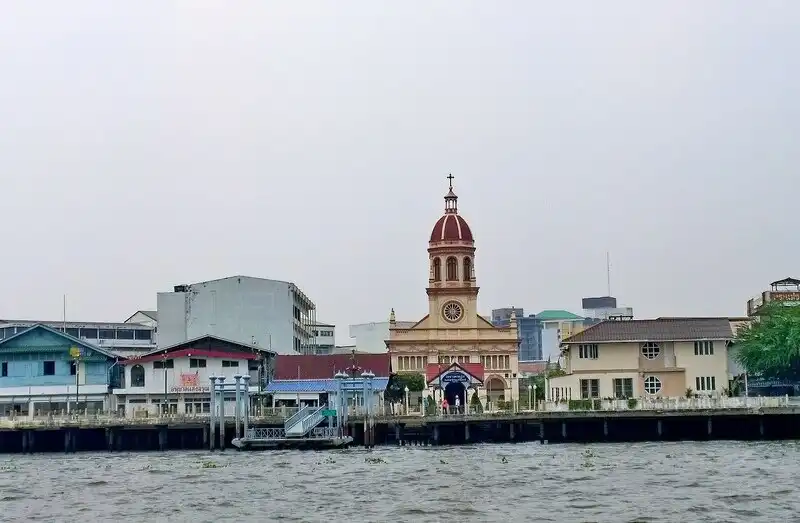
Another reason Kudi Chin stands apart from many old neighborhoods is its Catholic refugee story after Ayutthaya fell. When King Taksin regained independence and established Thonburi as the capital in 2311 BE (1768), accounts note that Father Corre, a French priest, brought groups of Christians and some Portuguese-descended people to Bangkok seeking royal protection. They later received riverside land to form a community known as “Khai Sang Ta Krut” (the Santa Cruz camp), and built Santa Cruz Church as their spiritual anchor. The important point is that the church was not only a religious building, but a place of stability for people rebuilding life from displacement. Over time, the church was renovated several times, and a major rebuild in 2456 BE (1913) created the Italian Renaissance–influenced neo-classical style seen today. That iconic dome and façade are part of why many travelers cross the river simply to see it with their own eyes.
At the same time, Muslim communities in Thonburi also grew significantly. A key center developed around the mouth of Khlong Bangkok Yai, with Ton Son Mosque—often associated with the name “Kudi Yai”—serving as a spiritual focal point. This is why Kudi Chin cannot be reduced to only a “Christian quarter” or only a “Chinese quarter.” It is a neighborhood where interfaith coexistence is genuinely present within walking distance, and that reality later inspired community-based heritage work often described by the phrase “Three Religions, Four Beliefs,” a short expression that neatly captures the human scale of coexistence in a small place.
If you like walking to understand a city rather than collecting photos, Kudi Chin is best experienced at the neighborhood’s real pace. Start by looking at the Chao Phraya River until the view settles in. Notice small paths linking homes to piers, then walk deeper into the lanes. You’ll realize the beauty here is not only in landmarks, but in the lived “home-ness” of the place: the smell of baked sweets, quiet conversations at doorways, the color of old wooden doors, and the everyday courtesy that helps people share space in a dense city.
A place that helps everything connect into a single story is Baan Kudichin Museum. It’s small, but it explains community history through real objects, photographs, and daily-life details. Many visitors like it because it’s easy to follow—without reading long academic texts, you can grasp why so many groups settled together here, and why hybrid flavors like Khanom Farang Kudi Chin became a signature of the neighborhood. In simple terms, it makes the later walk through the lanes feel meaningful, because you understand you’re walking through living history, not a photo set.
Food is another reason this trip feels worth it. Kudi Chin is famous for Khanom Farang Kudi Chin, a Portuguese-influenced baked sweet passed down through generations. There are long-standing family shops as well as small cafés that make it easy to rest by the river. The fun part is that the taste is not only “good”—it’s a language of the community, showing how cultures blended over time. If you’re going on a relaxed day, leave room to sit and snack, because some neighborhood shops open mainly on weekends or have their best batches at certain times.
Small etiquette choices make the Kudi Chin walk much better: dress modestly, especially when entering religious spaces; keep your voice at a respectful level; don’t block narrow paths in front of people’s homes; and if you want close-up photos of individuals, ask first. These aren’t rules that make travel difficult—they’re the kind of habits that make city life work. Kudi Chin is one of those places that teaches this quietly, without needing to say much.
Getting There A common approach is to start from the old-city side, cross the Chao Phraya by ferry or river boat, then walk into the community at an easy pace. Another option is to use the MRT and connect by local transport or walking from a convenient point. If you come by private car, plan parking in advance and avoid trying to drive inside the neighborhood lanes. Once you arrive, walking is best—Kudi Chin’s charm lives in the in-between details, and walking is how you truly “read” the place.
| Name | Kudi Chin (Kadi Chin) |
| Location | Wat Kanlayan Subdistrict, Thon Buri District, Bangkok (Chao Phraya River area near Khlong Bangkok Yai / Khlong Wat Kanlayan) |
| Highlights | A historic multi-ethnic community with three religions living side by side (Buddhist–Christian–Muslim), key landmarks such as Santa Cruz Church and Kian Un Keng Shrine, iconic local food like Khanom Farang Kudi Chin, and an easy one-day cultural walk along the Chao Phraya River. |
| Period | Roots trace back to the Ayutthaya era, with strong continuity in the Thonburi period and ongoing development into the present day. |
| Key Evidence | Community records and narratives connected to Kian Un Keng Shrine and settlement history, the establishment and renovations of Santa Cruz Church, and community heritage work often described as “Three Religions, Four Beliefs.” |
| Name Origin | Associated with long-standing Chinese settlement traces and religious sites in the area; “Kudi Chin/Kadi Chin” is used to refer to this historic riverside community where multiple groups have lived for generations. |
| Travel | Ferry/Chao Phraya river boats then walk into the community; MRT then connect by local transport/walking; private car requires parking planning, and walking is best once inside. |
| Current Status | A cultural tourism neighborhood where residents still live day to day; visitors should respect community etiquette and religious-site guidelines. |
| Contact Number | Baan Kudichin Museum 081-772-5184 |
| Nearby Tourist Attractions + Distance + Phone | Wat Prayurawongsawat Worawihan ~1 km Tel. 02-465-5592 Wat Pho (Wat Phra Chetuphon) ~3 km Tel. 02-225-9595 Wat Arun Ratchawararam ~3 km Tel. 02-891-2185 Museum Siam ~3 km Tel. 02-225-2777 Ton Son Mosque ~2 km |
| Popular Restaurants Nearby + Distance + Phone | Khanom Farang Kudi Chin “Lan Mae Pao” ~1 km Tel. 089-662-5299 The Deck by Arun Residence ~3 km Tel. 02-221-9158 Supanniga Eating Room (Tha Tian) ~3 km Tel. 092-253-9251 CAF KUDEEJEEN ~1 km Tel. 062-604-0907 Nuer Rai Noodle Shop (near Kudi Chin) ~2 km Tel. 086-909-0629 |
| Popular Accommodations Nearby + Distance + Phone | Arun Residence ~3 km Tel. 02-221-9158 Riva Arun Bangkok ~3 km Tel. 02-221-1188 Sala Rattanakosin Bangkok ~3 km Tel. 02-622-1388 Chakrabongse Villas ~4 km Tel. 02-222-1290 Riva Surya Bangkok ~5 km Tel. 02-633-5000 |
| Facilities | Neighborhood walking paths and riverside sections (some areas are narrow), occasional seating/cafés, and a small community museum to learn the background before exploring. |
| Fees | No entry fee for the neighborhood (some museums/activities may request a donation or have their own conditions). |
Frequently Asked Questions (FAQ)
Q: Is a one-day trip to Kudi Chin enough?
A: Yes, comfortably—especially if you focus on walking the neighborhood, visiting Baan Kudichin Museum, trying Khanom Farang, and stopping by 2–3 key religious landmarks.
Q: What time is best to visit Kudi Chin?
A: Morning to early afternoon is easier for walking and the light is good without extreme heat. Late afternoon is nice for riverside resting, but some local shops may have limited opening days or hours.
Q: What should I wear when visiting Kudi Chin?
A: Modest, respectful clothing is recommended—especially when entering churches, temples, or other religious spaces. Follow on-site guidelines.
Q: What is the biggest highlight of Kudi Chin?
A: The real highlight is its multi-ethnic, interfaith coexistence within walking distance—plus signature local food like Khanom Farang Kudi Chin that reflects cultural blending.
Q: Where should I start my walk?
A: Start from the riverside/pier area, then step into the neighborhood. Visiting Baan Kudichin Museum first helps you understand the story, and then you can continue to Santa Cruz Church and Kian Un Keng Shrine at your own pace.
 Kudi Chin Community Map
 Category:
  Group:
  Last Update: 2 MonthAgo
Comment
 Nearby Attractions
| Keyword (Advance) |
 Region
|
 Phra Nakhon(