

 Home
Home Chiang Mai(




Rating: 3.8/5 (4 votes)
 |
|  Map
Map 
 Have Map
  No Map
Phranakhon Si Ayutthaya attractions
Attractions in Thailand
Open Days: Open daily (please double-check the latest information before your visit)
Opening Hours: Around 09:00–17:00 (activity hours with elephants may vary by season)
Phra Thinang Peniat also known as the Royal Elephant Kraal of Ayutthaya, is one of the few places in Thailand where you can still see the original structure of a royal elephant enclosure standing amid a living mahout community. This is not a silent, abandoned ruin, but a living elephant village where visitors can get close to elephants, learn about history, and witness the long-standing bond between people and elephants from the Ayutthaya period up to the present day in one single place.
The kraal is located in Suan Phrik Subdistrict, Phra Nakhon Si Ayutthaya District, about 4 kilometers from the city center. From the island area (old town), follow Highway 347 at about kilometer markers 42–43, on the same route that leads to Wat Phu Khao Thong. Then turn right at the sign pointing to Phra Thinang Peniat. The road gradually winds through an elephant-keeper community before you see the large elephant enclosure and rows of full-log wooden pillars forming a striking wooden barrier in the open fields.
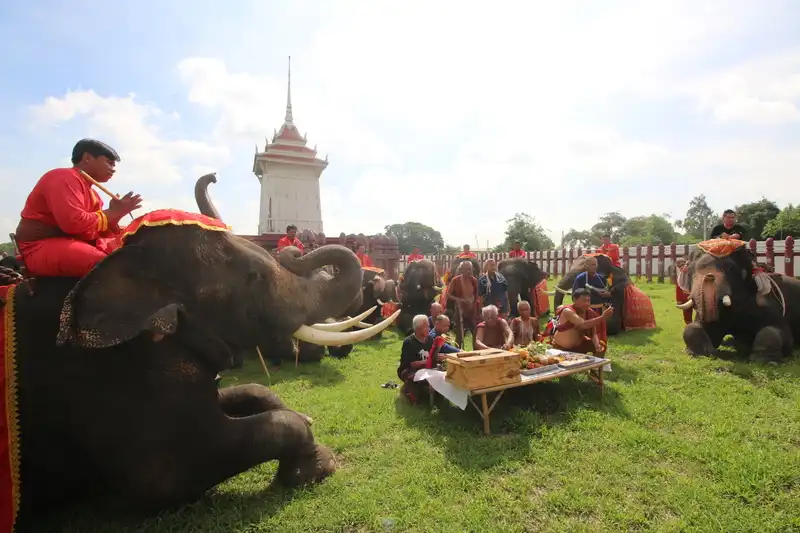
As you step into the kraal area, you can immediately feel a half-heritage, half-community atmosphere. There are old elephant pens, earth-and-brick ramparts, the sacred Pha Kam Shrine, the Royal Elephant Village, and the area of Ayutthaya Elephant Palace & Royal Kraal clustered together. Elephant calls, conversations between mahouts, and visitors feeding or taking photos with elephants all blend into one, making this place very much a “living” site rather than just a static historic ruin.
The word “peniat” in Thai refers to a pen or enclosure used to surround and drive animals, especially wild elephants, into a designated area for the royal elephant capturing ceremony. In the past, Ayutthaya was a major center for using elephants in royal affairs, warfare, and court ceremonies. Having a strong royal kraal was essential. Phra Thinang Peniat was built as a place where the king would come to sit in state and watch the capturing of wild elephants, especially those chosen to be trained as war elephants or royal elephants.
Historical records mention Ayutthaya’s Royal Elephant Kraal from the time when Ayutthaya was still the capital. This was the official site for the grand royal elephant capturing ceremony. On ceremony days, wild elephants were driven from deep forests into the kraal, using highly trained domestic elephants and skilled mahouts working together. Those selected became an important force for the army and the royal court, and many were honored with ranks and titles comparable to noblemen.
This royal tradition continued from the Ayutthaya period until the early reign of King Rama V of the Rattanakosin era, before elephant capturing was abolished due to humanitarian concerns and social changes. Phra Thinang Peniat gradually shifted its role from a “grand national ceremonial arena” to a “historic testimony” that tells the story of the relationship between Thai people and elephants in the past.
Seen from a distance, the elephant kraal appears as a large, roughly rectangular enclosure surrounded by closely spaced full-log wooden pillars forming a tall, solid wooden wall that encircles the inner ground. Some logs show clear signs of age and weathering, yet continuous restoration has kept the main structure in shape so that we can still imagine the elephant capturing ceremony that once took place here.
One particularly interesting feature is the “wing-shaped” stockade that extends from the main enclosure as two arms reaching outward. These wings were used as channels to drive elephants in and out and to separate different herds, helping to control their movement during the ceremony. Around the kraal, there are earth ramparts with brick facing rising to the top of the pillars, serving both as a defensive line and as natural stands for officials and participants to watch the ceremony in the old days.
At the back of the kraal, opposite the wings, is the location of the royal pavilion, built on a raised platform so the king could clearly see the ceremony. Over time, the pavilion deteriorated, but it underwent a major restoration around 1957, and in 1988 the Tourism Authority of Thailand provided additional funding for the Fine Arts Department to restore the kraal again, bringing the structure as close as possible to its original appearance based on available evidence.
In addition to the kraal and royal pavilion, the surrounding area also includes the sacred “Pha Kam Shrine,” where rituals related to elephants are performed, such as worship ceremonies on Thai Elephant Day, rites to ward off misfortune, and blessings for elephants before they join important national processions. The shrine clearly reflects the spiritual dimension and beliefs of the mahout community.
If you try to picture the royal elephant capturing ceremony in the past, Phra Thinang Peniat would have been filled with people and the sound of elephants. Before the ceremony day, elephant masters and mahouts ventured into the forest to find wild elephants with good physique and noble bearing, then slowly drove them over long distances until the herd was finally brought into this very kraal.
Once the wild elephants entered the kraal, the formal rituals began. Buddhist chants were recited, offerings were made to deities and sacred spirits believed to protect both elephants and participants, and then well-trained domestic elephants were brought in to gently approach and lasso the chosen wild elephants. The shouting of commands, signals from the head mahout, and the movement of numerous elephants in one enclosure turned this kraal into a “grand stage” that was both thrilling and sacred at the same time.
The king would sit in state at the royal pavilion behind the kraal to observe the key moments and personally select some elephants as special royal elephants. If an elephant showed extraordinary qualities, it could later be appointed as a war elephant or royal mount. Beyond military importance, the ceremony reflected the deep bond between humans and elephants as animals strongly tied to Thai identity and nationhood.
When the traditional royal elephant capturing ceremony officially ended during the reign of King Rama V, the role of Phra Thinang Peniat changed. However, the site was never abandoned. Instead, it became a central settlement for mahout communities and their domestic elephants, eventually forming the present-day “Royal Elephant Village” and “Ayutthaya Elephant Palace & Royal Kraal” that many visitors know today.
Even now, the kraal continues to be used for various elephant-related rituals, such as worship ceremonies at the Pha Kam Shrine on Thai Elephant Day, the “Pa Sa – Pat Rang Khwan – Pat Sanit” rites to bless elephants and mahouts before important processions, as well as special ceremonies like elephant weddings or welcome rituals for newborn twin elephants that frequently make the news. These events help keep the kraal’s role alive as a “spiritual and ceremonial center of the mahout community.”
In one sense, the Royal Elephant Kraal is like an open-air museum showcasing the glory of Ayutthaya. In another, it is a genuine living elephant village. Many elephants still work alongside humans in various roles, from tourism and ceremonial duties to cultural performances. Visitors, therefore, can see both “the past” and “the present” layered together in one place.
For travelers, a visit to Phra Thinang Peniat can be experienced in two main dimensions. The first is walking around the historic kraal itself: the elephant pens, earth ramparts, and restored royal pavilion, which together help you better understand the overall royal elephant capturing tradition. Walking slowly, observing the rows of log pillars, the wing-shaped stockade, and the open ground inside makes it easy to imagine the day when wild elephants were driven in as a grand procession.
The second dimension is witnessing the current way of life of elephants. Visitors can choose to feed elephants, take photos with them, or ride elephants on routes around the island and nearby historical sites, depending on the programs offered by local operators. Most activities start from the service area of Ayutthaya Elephant Palace & Royal Kraal and continue along important routes such as the city shrine, Bueng Phra Ram Park, and other nearby landmarks. The exact format and prices of these activities may change over time according to the operators’ policies.
During major festivals such as Songkran or Thai Elephant Day, the elephant village and kraal area become especially lively. There are water-play activities with elephants, elephants dressed in traditional costumes, and various community-led rituals. Visitors who enjoy this kind of festive atmosphere may plan their trip for long holidays, but should also be prepared for crowds and Ayutthaya’s intense heat during peak season.
Although elephant tourism often raises questions about animal welfare, visiting Phra Thinang Peniat can be a good opportunity to learn and apply your own judgment. You can choose activities you feel comfortable with, such as feeding elephants from a safe distance, observing their daily life with mahouts without necessarily riding them, or talking to mahouts about how they care for elephants each day. Watching the elephants’ physical condition and behavior with your own eyes can help you form a more complete picture when deciding which activities align with your values.
On the other hand, the continued flow of visitors to the kraal and the Royal Elephant Village helps local mahout communities earn a living and care for their elephants in the long term. At the same time, growing tourism brings up important questions about balancing economic needs, cultural heritage, and animal welfare. This is a shared issue for the community, government agencies, and visitors to think about together with nuance and care.
Getting There From Ayutthaya’s island area, drive out of the old town along Highway 347 and watch for kilometer markers 42–43, on the same route that leads to Wat Phu Khao Thong. When you see the sign for Phra Thinang Peniat, turn right onto the smaller local road. This road gradually cuts through open fields and the mahout community. As you get closer, you will see the elephant kraal structure and the Royal Elephant Village lining both sides of the road.
If you are traveling from Bangkok, you can drive via Phahonyothin Road or Asian Highway, which takes about 1–1.5 hours. Then enter Ayutthaya city and continue along Highway 347 as described above. Alternatively, you can take a van or bus to Ayutthaya, then hire a songthaew or taxi in town to reach the kraal. For those unfamiliar with the route, it is recommended to use an online map and pin “Ayutthaya Elephant Palace & Royal Kraal” or “Royal Elephant Kraal” for easy navigation.
Comfortable clothing is highly recommended for visiting the kraal: breathable tops, long trousers or long skirts to protect from sun and dust, and closed shoes or sneakers that are easy to walk in. Bring a hat, sunglasses, sunscreen, and drinking water, especially if you plan to visit in late morning or early afternoon when the sun is strongest. Always follow the instructions of mahouts and staff strictly, do not run or shout near elephants, and avoid offering unfamiliar items to them without permission.
The area around Phra Thinang Peniat offers several convenient nearby attractions. These include Wat Mae Nang Pluem, a peaceful old riverside temple on the Pa Sak River about 2 kilometers away; Hua Ro Market, known for its local noodle shops and Thai food; and Chantharakasem National Museum, which preserves important artifacts from Ayutthaya. Not far away is Wat Phu Khao Thong, with its towering chedi on an earthen mound. A popular half-day plan is to visit the Royal Elephant Kraal first, then continue on to nearby temples or museums in the same loop.
When it comes to accommodation, the area around the kraal offers both traditional neighborhoods and riverside stays near the island. Options include Baan Tye Wang, a peaceful canal-side homestay with a wooden-house atmosphere; Busaba Ayutthaya, which transforms traditional Thai houses into a stylish hostel and boutique hotel; Sala Ayutthaya, a boutique riverside hotel with stunning views over the Chao Phraya River; Ayothaya Riverside Hotel, convenient for larger groups; and Ayutthaya Retreat, a resort-like stay surrounded by Thai-style houses and gardens. These accommodations are roughly 3–6 kilometers from the kraal and can be reached easily by car or taxi.
Food lovers should not miss the local eateries around Hua Ro Market and U Thong Road, such as Pa Porn’s Old-Style Pork Noodles, the famous shredded chicken noodle shop at Hua Ro Market, and Busaba Ayutthaya Cuisine, a riverside café and Thai restaurant. There are also riverside Thai restaurants like Ruean Rotjana and many other cafés and eateries within a 5-kilometer radius of the kraal. Many visitors choose to feed the elephants at the kraal in the late morning, have noodles at Hua Ro Market, and end the day sipping coffee or enjoying dinner by the river near the old town area.
Overall, Phra Thinang Peniat is far more than just a place to “see elephants.” It is a site that gathers together the stories of Thai elephants from past to present. The historic kraal structure tells the story of the royal elephant capturing tradition and the role of elephants as a vital force for the kingdom. The living elephant village and Ayutthaya Elephant Palace & Royal Kraal reveal the daily life of a community that still cares for elephants as true family members.
A trip to the Royal Elephant Kraal is therefore both a journey into the history of Ayutthaya and a look toward the future of elephants in Thailand. It invites us to consider how we can preserve this cultural heritage while balancing conservation, tourism, and long-term elephant welfare. For anyone planning a visit to Ayutthaya and wanting to see a different side of the old capital beyond temples and ruins alone, Phra Thinang Peniat is a destination well worth adding to your itinerary.
| Name | Phra Thinang Peniat And Royal Elephant Village |
| Overview | A historic royal elephant kraal from the Ayutthaya period, originally used for royal elephant capturing ceremonies. Today it is both a heritage site and a living elephant village where rituals and tourism activities related to elephants still take place. |
| Highlights | See the real royal elephant kraal structure in its original location, learn about royal elephant capturing traditions, elephant rituals, and the lifestyle of Ayutthaya’s mahout community in one place, with both historic architecture and hands-on elephant experiences for visitors. |
| Location | Moo 3, Suan Phrik Subdistrict, Phra Nakhon Si Ayutthaya District, Phra Nakhon Si Ayutthaya Province, Thailand |
| Approximate Address | Within the Royal Elephant Village area, near Highway 347 at kilometer markers 42–43, about 4 kilometers from Ayutthaya’s island area. |
| Historical Period & Background | Originating in the Ayutthaya period, the kraal was used as the royal elephant capturing ground where wild elephants were driven in, selected, and designated as important elephants of the kingdom. The royal elephant capturing tradition was abolished in the reign of King Rama V, after which the area was restored and became both a heritage site and a mahout community. |
| Key Features & Structures | A large kraal enclosed by full-log wooden pillars, wing-shaped stockades extending from the main pen, earth-and-brick ramparts, the royal pavilion behind the kraal, and the Pha Kam Shrine used for elephant-related rituals. |
| Name Origin | The Thai word “peniat” refers to a pen or enclosed area used to corral animals, especially wild elephants driven into a ceremonial space. In the Ayutthaya context, it specifically refers to the Royal Elephant Kraal used in royal elephant-related ceremonies by the king. |
| Travel Summary | From Ayutthaya’s island area, follow Highway 347 out of town toward Wat Phu Khao Thong and look for kilometer markers 42–43. Turn right at the sign for Phra Thinang Peniat and continue along the local road for about 1 kilometer to reach the Royal Elephant Kraal. The site can be accessed by private car, taxi, or local transport. |
| Current Status | Open for visitors to see the kraal structure and surrounding grounds. It forms part of the Royal Elephant Village and Ayutthaya Elephant Palace & Royal Kraal, where elephants still live and the area is used for both rituals and tourism activities involving elephants. |
| Fees & Charges | In general, walking around the kraal area is free of charge. However, activities such as elephant rides, feeding elephants, or joining special elephant programs incur additional fees, which may change over time. Visitors should check the latest prices directly with operators before booking. |
| Facilities | Parking around the elephant village, restrooms, souvenir shops, stalls selling elephant food and drinks, guided tour and elephant ride services, and an information point operated by Ayutthaya Elephant Palace & Royal Kraal (facilities may vary over time). |
| Nearby Attractions (Distance) | Wat Mae Nang Pluem – approx. 2 km Hua Ro Market – approx. 2 km Chantharakasem National Museum – approx. 2–3 km Wat Phu Khao Thong – approx. 4–5 km Wat Chaiwatthanaram And Wat Phanan Choeng Worawihan – approx. 5–7 km (actual distance depends on chosen route) |
| Nearby Restaurants (Distance + Phone) | Pa Porn Old-Style Pork Noodles – approx. 2–3 km, Tel. 087-919-5973 Khun Pranom Shredded Chicken Noodles, Hua Ro Market – approx. 2 km, Tel. 086-399-4560 Busaba Ayutthaya Cuisine (café & Thai riverside restaurant) – approx. 3–4 km, Tel. 084-026-2657 Ruean Rotjana Riverside Restaurant – approx. 3–4 km, phone number subject to latest updates from the restaurant Many other local restaurants and cafés in the Hua Ro Market – U Thong Road area within about 5 km of the kraal |
| Nearby Accommodation (Distance + Phone) | Baan Tye Wang – approx. 3–4 km, Tel. 035-323-001 Busaba Ayutthaya (hostel / hotel on U Thong Road) – approx. 3–4 km, Tel. 061-449-4282 Sala Ayutthaya – approx. 4–5 km, Tel. 035-242-588 Ayutthaya Retreat – approx. 5–6 km, Tel. 062-760-6262 Ayothaya Riverside Hotel – approx. 4–5 km, Tel. 035-243-139 or 090-969-9231 |
| Main Contact Number | Ayutthaya Elephant Palace & Royal Kraal (Royal Elephant Kraal) Tel. 065-009-9361, and Elephantstay Project Tel. 080-668-7727 (generally reachable around 09:00–17:00; please check the latest information before calling). |
Frequently Asked Questions (FAQ)
Q: Is Phra Thinang Peniat open every day?
A: In general, the Royal Elephant Kraal and the surrounding elephant village are open daily during daytime, roughly from 09:00–17:00. However, exact opening hours may change by season or special events, so it is best to check the latest information with Ayutthaya Elephant Palace & Royal Kraal or their official channels before your visit.
Q: Is there an entrance fee to visit Phra Thinang Peniat?
A: Walking around the kraal area and observing the general atmosphere is usually free of charge. However, activities such as elephant rides, feeding elephants, or joining educational programs have separate fees, which can change over time. You should confirm the latest prices directly with the operators before booking.
Q: Are there any traditional ceremonies or rituals with elephants still held at the kraal?
A: Yes. Ceremonies are still performed, such as worship rituals at the Pha Kam Shrine on Thai Elephant Day, the “Pa Sa – Pat Rang Khwan – Pat Sanit” blessing rites for elephants and mahouts before major processions, as well as welcome rituals for baby elephants or symbolic elephant weddings on special occasions. The exact schedule of these rituals varies each year and depends on local arrangements, so you should follow local news or updates from Ayutthaya Elephant Palace & Royal Kraal.
Q: If I am concerned about elephant welfare, what kind of activities should I choose at Phra Thinang Peniat?
A: Travelers who prioritize elephant welfare can choose activities they feel comfortable with, such as feeding elephants from a safe distance, observing their daily life with mahouts without riding them, and talking to mahouts about how the elephants are cared for. Watching the elephants’ physical condition and behavior yourself can help you decide which activities best align with your personal values.
Q: How much time should I plan for a visit to Phra Thinang Peniat?
A: If you only plan to walk around the historic kraal, see the elephant village atmosphere, and briefly feed elephants, 1–2 hours is usually enough. If you also want to ride elephants, visit nearby historical sites, or stop by other attractions such as Wat Mae Nang Pluem, Hua Ro Market, and Chantharakasem National Museum, it is better to allow half a day to a full day.
Q: What is the best time of day to visit Phra Thinang Peniat?
A: Early morning and late afternoon are generally the most pleasant times, as the weather is cooler and the light is softer for photography. Midday can be quite hot and less comfortable for walking around. In the hot season, bring a hat, sunglasses, an umbrella, and water. During the rainy season, the ground may be slightly muddy, so choose footwear suitable for walking on soft or damp earth.
 Phra Thinang Peniat Map
 Category:
  Group:
  Last Update: 2 MonthAgo
Comment
 Nearby Attractions
| Keyword (Advance) |
 Region
|
 Phranakhon Si Ayutthaya(