

 Home
Home Chiang Mai(




Rating: 4.5/5 (4 votes)
 |
|  Map
Map 
 Have Map
  No Map
Phranakhon Si Ayutthaya attractions
Attractions in Thailand
Open Days: Every day
Opening Hours: 08:00–18:00 (approximate time, it is recommended to double-check before your visit)
Wat Phu Khao Thong is one of Ayutthaya’s most iconic landmarks, easily spotted from afar thanks to its large white chedi rising above the surrounding rice fields. It is a familiar sight for many travelers driving into Phra Nakhon Si Ayutthaya from the northwest. The temple is located about 2 km away from the Royal Palace and the main ruins on the island, in Thung Phu Khao Thong Village, right by Highway 309 (Ayutthaya–Ang Thong Road) — the same route used to travel towards Ang Thong Province. This makes it very convenient to include Wat Phu Khao Thong in an Ayutthaya travel route, whether you drive, cycle, or join a local tour.
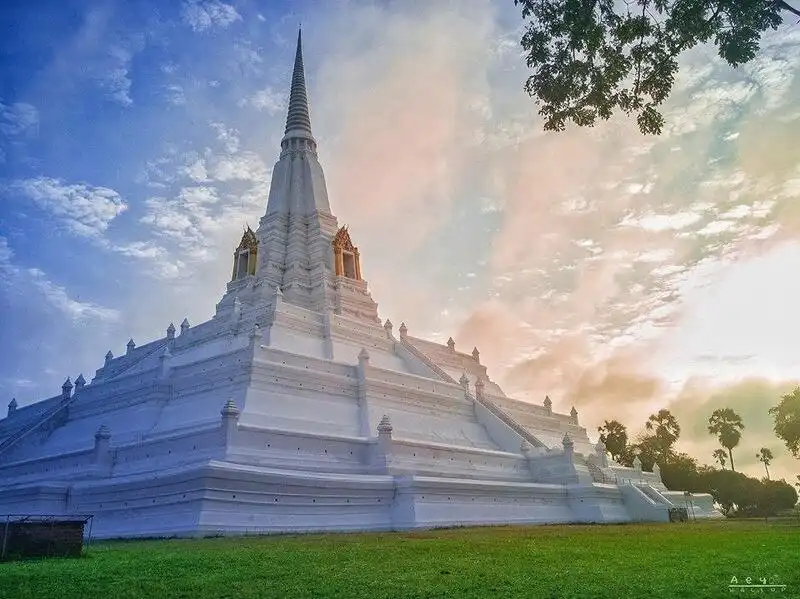
The highlight of Wat Phu Khao Thong is its massive chedi set on a high base resembling a small mountain, which is where the name “Phu Khao Thong” (“Golden Mountain”) comes from. As you walk closer, you will notice that the chedi is clearly divided into two parts: the lower base built in a Mon–Burmese style, and the upper bell-shaped Thai chedi constructed on top. This gives Phu Khao Thong a unique blended architectural style, quite different from other chedis in Ayutthaya, and it has become a favorite spot for visitors to stop and capture the atmosphere with their cameras.
According to testimonies from the “People of the Old Capital” and local folklore, this area was once an important battlefield during the Ayutthaya period when Burmese forces invaded the kingdom. In 1569 (B.E. 2112), King Bayinnaung of Hongsawadi ordered the construction of a large Mon-style stupa as a monument to his victory. Construction began with a massive base, but the chedi was left incomplete when his army later withdrew. After King Naresuan the Great reclaimed Ayutthaya’s independence in 1584 (B.E. 2127), he ordered a Thai-style chedi to be built on top of the original base as a monument to Siam’s victory at the Battle of Nong Sarai, Thung Makham Yong, and the surrounding battlefield. As a result, Phu Khao Thong has become a powerful symbol of Thailand’s struggle for independence and the reclaiming of its sovereignty.
At the same time, some historical evidence — such as inscriptions and certain academic studies — suggests that Wat Phu Khao Thong may have first been established during the reign of King Ramesuan in the late 14th century, and was later modified and expanded in subsequent periods. While there are still differing opinions about the exact founding date and original builder, scholars generally agree that Wat Phu Khao Thong is a key historical site reflecting the complex relationship and conflict between Ayutthaya and Hongsawadi. It also stands as an important example of cultural and artistic blending in the ancient era.
As you enter the temple grounds, the area at the foot of the chedi is a spacious courtyard surrounded by trees and monastic buildings. At the front, there is a car park, monks’ quarters, and various pavilions used for religious ceremonies and community events. At the base of the mound, a wide staircase leads up to the upper terrace surrounding the chedi. Visitors can walk up to enjoy the view, but should take care as the steps are quite steep. If you visit on a hot sunny day, bringing a hat and umbrella is highly recommended, as the upper terrace is very exposed.
From the lower level of the chedi, you can enjoy panoramic views of the surrounding rice fields and the houses of Thung Phu Khao Thong Village stretching out to the horizon. On clear days, the island of Ayutthaya and the distant chedis of other temples can be seen on the skyline. This vantage point helps you understand why this location was chosen as a strategic site in ancient times — it offers wide visibility over the plains and waterways used by advancing armies.
The upper portion of the chedi is a classic Thai bell-shaped design set on a series of stacked square terraces, with a lotus base and decorative moldings supporting the bell. The slender spire reaches high into the sky. On closer inspection, you can see traces of restoration carried out by the Fine Arts Department to preserve as much of the original structure as possible, including reinforcing the base, sealing cracks, and repainting only certain sections. This has helped keep the monument structurally sound without erasing its original character.
Around the mound, several other ruins are scattered across the grounds, including the remains of an ancient ordination hall with only pillars and foundation walls left, smaller satellite chedis, and traces of the former boundary walls that once enclosed the sacred precinct. Many of these sites have been excavated and landscaped so visitors can walk around safely. This makes Wat Phu Khao Thong an appealing destination for history and archaeology enthusiasts who want to see the structure of the old city from a perspective different from the main island.
At the entrance and front of the temple stands an equestrian statue of King Naresuan the Great, built to honor his achievements in restoring Siam’s independence. Locals and visitors alike often stop to pay their respects here, praying for success in their careers, examinations, government service, and the courage to face life’s challenges. As a result, Wat Phu Khao Thong has become both a historical tourism site and a popular place to seek blessings among residents of Ayutthaya and travelers from other provinces.
Beyond its ancient monuments and main chedi, Wat Phu Khao Thong is also an active monastery where monks reside and serve the surrounding community. The current abbot, Phra Khru Baidika Prathueng Kittipanyo, plays a crucial role in revitalizing the temple and Thung Phu Khao Thong. Working alongside the Fine Arts Department, the Ayutthaya Historical Park authorities, and local residents, the temple strives to balance heritage conservation with its role as a living religious center for everyday Buddhist practice.
The area around Wat Phu Khao Thong is home to a diverse local community, including Buddhist Thais, Muslims, and long-standing local families who have lived with the rice fields and waterways for generations. This “multicultural” dimension can be seen in the local food, small shops, and occasional cultural events. Visiting Wat Phu Khao Thong is therefore not only about viewing an old chedi, but also about experiencing the way of life of people closely connected to Thung Phu Khao Thong.
One of the most important traditions linking Wat Phu Khao Thong to the community is the “Honey Alms Giving Ceremony” (Tak Bat Nam Phueng), usually held on the full moon day of the 10th lunar month. This ancient rite involves offering honey to monks as a sacred “elixir” and ingredient for traditional herbal remedies. Locals believe that participating in this ceremony brings blessings for good health and longevity. During the festival, the temple grounds become particularly lively, with processions, local food stalls, and cultural performances creating a vibrant and deeply rooted atmosphere.
In addition to the honey alms tradition, Wat Phu Khao Thong hosts various annual temple fairs and major merit-making events, such as the Thung Phu Khao Thong annual festival, Kathin and Pha Pa ceremonies, and New Year chanting events. In some years, festivities continue for several days with food stalls, souvenir booths, and activity zones for both locals and visitors. While the style of entertainment may change from year to year, the core purpose remains the same: providing a space for younger generations to reconnect with their cultural roots.
For photography enthusiasts, Wat Phu Khao Thong is considered one of the best spots to watch sunrise and sunset, offering a very different view from the main island. In the late afternoon, golden light washes over the white chedi and surrounding fields. During the rice-growing season, the lower landscape alternates between lush green and golden tones, depending on the time of year, creating images that blend architecture and natural scenery in a single, striking frame.
Popular photo spots include the base of the mound, where you can capture the staircase leading up to the chedi; the terrace, where you can shoot the sweeping rice fields from above; and side angles that frame the white chedi against an open sky on clear days. At certain times, creative photo events or workshops about photographing historic sites are also held here in collaboration with local photography groups.
Facilities at the temple include a car park large enough for tour vans and private vehicles, public restrooms, shaded pavilions, and small stalls selling snacks, drinks, and simple souvenirs near the entrance. While there are no large cafes or full-service restaurants inside the temple grounds, the Thung Phu Khao Thong area and nearby roads have several eateries and cozy cafes where you can stop for a meal or coffee before or after your visit.
As with other temples in Ayutthaya, visitors to Wat Phu Khao Thong are encouraged to dress modestly. Although the temple sits in a somewhat open field and has the feel of a historical site, it is still a functioning monastery where regular religious activities take place. It is best to wear a sleeved top, trousers or a skirt that covers the knees, and comfortable walking shoes suitable for stairs. Tight, sheer, or overly revealing clothing should be avoided. This is especially important if you plan to take photos on the stairs or terraces, both for your own safety and out of respect for the sacred nature of the site.
Photography for personal travel purposes is generally welcomed at Wat Phu Khao Thong, whether you are capturing portraits, landscapes, or the monuments themselves. However, visitors should avoid climbing on restricted areas or standing on parts of the structure not designated as walkways, in order to prevent damage to the 400–600-year-old ruins. For drone usage or commercial filming, it is advisable to seek prior permission from the abbot or temple authorities and comply with both temple regulations and Fine Arts Department rules.
Getting There to Wat Phu Khao Thong: If you are driving from Bangkok, take Highway 1 and then connect to Highway 32 (Asia Road) towards Phra Nakhon Si Ayutthaya. Follow the signs into the city center. Once you reach the area around the main island, head northwest and join Highway 309 (Ayutthaya–Ang Thong Road). Continue until around kilometer marker 26, where you will see clear signs pointing left to Wat Phu Khao Thong. The road is generally in good condition, with wide lanes and light to moderate traffic, making it suitable for self-drive day trips or organized tours.
If you are starting from the island or historic ruins in central Ayutthaya, you can leave the island via local roads heading northwest, linking up with Thung Phu Khao Thong Road or Highway 309. The overall distance is not far, and it usually takes around 10–15 minutes to drive from the former Royal Palace area to Wat Phu Khao Thong, depending on traffic. Cyclists can also rent bikes in town and ride northwest through fields and old villages, making it an atmospheric way to experience Ayutthaya’s rural landscape.
For those using public transport, you can take a train or minivan to Ayutthaya and get off in the city center. From there, hire a songthaew, tuk-tuk, or motorcycle taxi to Wat Phu Khao Thong. Be sure to clearly specify your destination as “Wat Phu Khao Thong, Thung Phu Khao Thong, on the Ang Thong route” to avoid confusion with other places. Fares depend on distance and negotiation. For small groups, hiring a tuk-tuk or taxi by the hour or for a full day is often a convenient way to visit several temples outside the main island, such as Wat Phu Khao Thong, Wat Chai Watthanaram, and Thung Makham Yong, all in one trip.
| Name | Wat Phu Khao Thong (Thung Phu Khao Thong Temple) |
| Address | Thung Phu Khao Thong Village, Moo 2, Suan Phrik Subdistrict, Phra Nakhon Si Ayutthaya District, Phra Nakhon Si Ayutthaya Province 13000 |
| Type / Character | Ancient temple and major historical site of the Ayutthaya Kingdom, featuring a large chedi in the middle of rice fields. It serves as a scenic viewpoint and landscape landmark on the Thung Phu Khao Thong side of Ayutthaya. |
| Period / Date of Construction | Believed to have been founded in the early Ayutthaya period (late 14th century) and later expanded and significantly restored during the late Ayutthaya era, especially after conflicts with Hongsawadi. |
| Founder / Key Figures | Historically associated with King Bayinnaung of Hongsawadi (who ordered the construction of the Mon-style base to commemorate his victory) and King Naresuan the Great (who commanded the construction of the Thai-style chedi on top as a monument to Siam’s regained independence). |
| Abbot / Management | Phra Khru Baidika Prathueng Kittipanyo, Abbot of Wat Phu Khao Thong (information may change over time; please check the latest updates). |
| Highlights | A huge chedi rising from a high base in the middle of rice fields, combining a Mon–Burmese style base with a Thai-style upper chedi. It offers panoramic views over the fields and distant city, symbolizes the historic battlefield of Thung Makham Yong, and is a key photo spot for both architecture and landscape. |
| Important Traditions | Honey Alms Giving Ceremony (full moon of the 10th lunar month), annual Thung Phu Khao Thong temple fair, Kathin and Pha Pa ceremonies, and regular chanting and merit-making events with the surrounding community. |
| Fees / Admission | Generally free admission; donations are welcome. In some periods, a small conservation fee may be collected from certain visitor groups. Please check the latest official information before your visit. |
| Open Days | Open daily (weekdays and weekends). |
| Opening Hours | Approximately 08:00–18:00 (hours may vary depending on the season and temple activities; it is recommended to confirm before visiting). |
| Dress Code | Modest attire is recommended: sleeved tops, trousers or skirts covering the knees, and comfortable shoes suitable for walking and climbing stairs. Avoid sleeveless tops, tank tops, strapless clothing, very short shorts, and tight or see-through outfits. |
| Getting There | 1) By Car from Bangkok: Take Highway 32 (Asia Road) towards Ayutthaya, follow signs into the city, then head northwest and join Highway 309 (Ayutthaya–Ang Thong). Around km 26, follow the signposted left turn to Wat Phu Khao Thong. 2) From Ayutthaya Island: Drive or cycle northwest via local roads connecting to Thung Phu Khao Thong Road / Highway 309. The distance from the former Royal Palace area is roughly 2 km. 3) By Public Transport: Take a train or minivan to Ayutthaya, then hire a songthaew, tuk-tuk, or motorcycle taxi and clearly state your destination as “Wat Phu Khao Thong, Thung Phu Khao Thong.” |
| Current Status | Open for visitors and worshippers as usual, with ongoing conservation work. The temple functions as a historical attraction, scenic viewpoint, and active monastery hosting regular religious activities. |
| Nearby Attractions (with Distance) | 1) Wat Lokayasutharam (Reclining Buddha) – approx. 3 km 2) Wat Phra Si Sanphet (old Royal Palace zone, on the island) – approx. 4 km 3) Wat Mahathat – approx. 4.5 km 4) Ayutthaya Historical Study Center – approx. 4 km 5) King Naresuan the Great Monument, Thung Makham Yong – approx. 8 km |
| Nearby Restaurants (with Distance and Phone) | 1) KaowLaor – Local Thai restaurant, approx. 1.6 km, Tel. 092-252-2650 2) Khun Pranom Shredded Chicken Noodles (in front of Wat Phanom Yong) – Famous chicken noodle shop, approx. 1.6 km, Tel. 094-542-8535 3) Hom La Moon – Cozy cafe and restaurant, approx. 1.9 km, Tel. 094-545-7169 4) Baan Ayutthaya Rom – Relaxed riverside Thai restaurant, approx. 3–4 km, Tel. 092-935-4264 5) Ayutthaya Retreat – Restaurant and cafe inside a lush resort, approx. 3–4 km, Tel. 035-795-885 |
| Nearby Accommodation (with Distance and Phone) | 1) Baan Tye Wang Guesthouse – Riverside homestay-style guesthouse, approx. 1.5 km, Tel. 035-323-001 2) Phuttal Residence – Quiet riverside guesthouse on the Chao Phraya River, approx. 2 km, Tel. 035-242-525 3) The Park Ayutthaya Resort and Spa – Riverside resort, approx. 3 km, Tel. 098-334-4418 4) Ayutthaya Retreat – Thai-style boutique resort among large trees, approx. 3–4 km, Tel. 035-795-885 5) Baan Tai Wang and various homestays around the island (choose based on preferred location) – average distance approx. 3–5 km from Wat Phu Khao Thong |
| Facilities | Car park for private cars and vans, public restrooms, shaded pavilions and multipurpose halls, small stalls selling snacks and drinks, walking paths up and down the chedi, and viewpoints overlooking the Thung Phu Khao Thong fields. |
| Contact / Further Information | No verified contact number is currently available. It is recommended to check the latest information via the temple’s official page (if any), the provincial tourism office of Phra Nakhon Si Ayutthaya, or the Tourism Authority of Thailand website before visiting. |
Frequently Asked Questions (FAQ)
Q: Is there an entrance fee to visit Wat Phu Khao Thong?
A: In general, visitors can enter Wat Phu Khao Thong free of charge and make donations as they wish. However, at certain times, a small conservation fee may be collected from specific visitor groups. It is best to check the latest official information before your visit.
Q: What is the best time of day to go up and enjoy the view from the chedi?
A: The most pleasant times are usually between 08:00–10:00 in the morning and around 16:00–18:00 in the late afternoon. During these hours, the weather is cooler and the light is softer, ideal for climbing the steps, enjoying the views over the fields, and taking photos of both the chedi and the sky. In the rice-growing season, you’ll see green or golden paddies contrasting beautifully with the white chedi.
Q: Can visitors go up onto the chedi every day? Are there any safety concerns?
A: Visitors can normally climb the steps to the lower terrace of the chedi during opening hours. However, you should be careful of the steep stairs, uneven surfaces, and slippery conditions in the rainy season. Do not climb beyond the designated walkways or onto restricted sections, both for your own safety and to help preserve this centuries-old monument.
Q: When is the Honey Alms Giving Ceremony held at Wat Phu Khao Thong, and what is it like?
A: The Honey Alms Giving Ceremony at Thung Phu Khao Thong is usually held on the full moon day of the 10th lunar month each year (around the end of the rainy season). The event features merit-making with honey offerings, processions with offerings and decorations, and various cultural activities by the local community. The atmosphere is lively, with many locals and visitors joining to help preserve this ancient tradition, while also enjoying local food and the way of life around Thung Phu Khao Thong.
Q: How can I get to Wat Phu Khao Thong from Ayutthaya city if I do not have a private car?
A: From Ayutthaya city center, you can take a train or minivan into town and then hire a songthaew, tuk-tuk, or motorcycle taxi to the temple. Be sure to clearly state “Wat Phu Khao Thong, Thung Phu Khao Thong, on the Ang Thong route” to avoid confusion. If you are traveling in a small group, hiring a tuk-tuk or taxi by the hour is a convenient way to visit Wat Phu Khao Thong along with other outer temples in a single trip.
Q: Is there anything special to keep in mind about clothing when visiting Wat Phu Khao Thong?
A: Visitors should dress modestly, in line with general temple etiquette: sleeved tops, trousers or skirts covering the knees, and shoes that are comfortable for walking and climbing stairs, as the site involves going up and down slopes and high steps. It is best to avoid high heels, very slippery footwear, tight outfits, or sheer clothing. Dressing respectfully not only keeps you comfortable and safe but also shows respect for the sacred nature of the site and the monks residing at the temple.
 Wat Phu Khao Thong Map
 Category:
  Group:
  Last Update: 6 DayAgo
Comment
 Nearby Attractions
| Keyword (Advance) |
 Region
|
 Phranakhon Si Ayutthaya(