

 Home
Home Chiang Mai(




Rating: 3.5/5 (4 votes)
 |
|  Map
Map 
 Have Map
  No Map
Phranakhon Si Ayutthaya attractions
Attractions in Thailand
Open Days: Daily
Opening Hours: 05:30 – 21:00 (approximate hours)
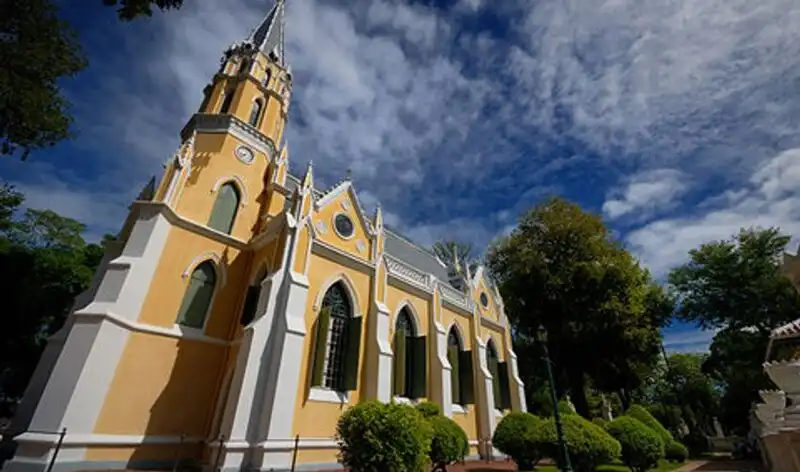
Wat Niwet Thammaprawat Ratchaworawihan is one of those places that makes a Bang Pa-In trip feel “different,” because it is not simply a temple near Bang Pa-In Royal Palace. It is a royal monastery set on an island in the middle of the Chao Phraya River, directly opposite the palace, and it offers a quietly memorable way of getting there: taking a cable car across the river to worship at the temple. From the palace side, you can clearly see a line of trees and a sharp spire rising above the landscape – a silhouette that stands apart from most Thai temples. That difference becomes the starting point of a story where Buddhism and Western art meet with surprising harmony in a Thai context.
The setting gives Wat Niwet Thammaprawat a very distinctive character. Because the temple sits on a mid-river island, the atmosphere around it feels less directly affected by nearby road traffic than temples along major streets. The river breeze sweeping across the island creates a sense of openness and, in practical terms, often makes midday heat feel more manageable. Once you step off the cable car and walk into the temple grounds, you may notice the pace of the place naturally slows down. It is not complete silence, but a calmness with “water sounds” and “wind sounds” as a gentle backdrop – ideal for those who come to worship, and equally suited to visitors who want to spend time reading the meaning of the site’s art and architecture without rushing.
This temple was built during the reign of King Chulalongkorn (Rama V) in 1876 (B.E. 2419), with a clear purpose: to serve as a place for the King to perform merit-making and royal religious rites when residing at Bang Pa-In Royal Palace. As a “palace-associated” royal monastery, Wat Niwet Thammaprawat is not merely a community temple. It reflects Siam’s modernizing vision at a time when Western influences were increasingly present – in architecture, spatial order, and the projection of a nation keeping pace with the world – while still preserving Buddhism and royal tradition as the enduring center.
What many visitors say almost immediately is that the ordination hall “looks like a Western church,” which is the simplest description once you see it in person. The ubosot (ordination hall) adopts a Western architectural language, featuring a steep, pointed roof and arched windows inspired by Gothic design. The overall impression is elegant and structured in a distinctly European way. Yet inside, the focal point remains the principal Buddha image and Buddhist symbolism. This contrast without conflict is one of the temple’s defining charms: it shows that architectural form is simply another “language” that can serve faith, without diminishing the value or essence of Buddhism.
A detail worth lingering over is the feature above the row of front windows near the principal Buddha image, where stained glass includes a portrait of King Rama V. In terms of atmosphere, stained glass works like “light that tells a story.” As sunlight filters through, colors and shadows shift with the time of day, creating an interior mood quite unlike the ordination halls most visitors are used to. At the same time, it conveys the tangible relationship between the monarchy and the support of Buddhism. For many, it does not feel like merely “visiting a place,” but like walking through living history expressed through light, color, and artistic detail.
The principal Buddha image of the temple is “Phra Phuttha Naruemon Thammo-Phat.” Worship here is not simply a checkbox on a temple itinerary, but a way of sensing the founder’s intention – to make this a temple for royal merit-making and a spiritual center during residence at Bang Pa-In. For that reason, the atmosphere inside can feel both “ceremonial” and “deeply calm” at once. Especially when there are fewer visitors, you may notice footsteps become quieter almost naturally, as if everyone collectively lowers their volume to match the space.
Another highlight with strong resonance in Thai belief is the pavilion enshrining Phra Khantharat, a standing Buddha image in the posture associated with calling for rain. In Thai cultural memory – particularly in agrarian society, where seasons and rainfall shape everyday life – this posture connects to abundance and well-being. Having Phra Khantharat within the temple grounds is therefore more than an artistic feature; it is a reminder of the relationship between faith and nature. Many worshippers pray for life to be “smooth, like rain arriving in its season,” and for their family to live in peace – phrases that reflect a distinctly Thai way of understanding happiness and stability.
Opposite the Phra Khantharat pavilion is a pavilion enshrining an ancient stone Buddha image in the Naga-Protected posture. It is commonly described as being from the Lopburi period and associated with Khmer craftsmanship. The beauty of this Naga-Protected Buddha lies in the quiet strength of the stone and the form of the naga spreading its hood to shelter the Buddha. The image is familiar to many through Thailand’s older temples, but seeing it in a temple where Western Gothic architecture is so prominent makes the “layering of eras” feel even clearer. In one place, you can encounter both an artistic language that evokes Europe and a stone tradition that draws you back toward Lopburi-era influence – at the same time.
The Naga-Protected Buddha image stands near a large Bodhi tree whose branches spread widely across the area in front of the ordination hall. In Thai temples, a Bodhi tree is more than shade; it symbolizes enlightenment and awakening. When Bodhi leaves move in the river breeze, the forecourt can feel strangely softened, making it a natural spot to sit quietly without needing to “do” anything. If you enjoy atmospheric photography, this area often gives you the Gothic-style ordination hall, Bodhi-leaf shadows, and time-shifting light all within a single frame.
Not far away is the stone garden known as “Diskul Memorial,” which gathers different types of stone such as limestone, gravel, sandstone, and slate. The area is also associated with memorial enshrinement connected to the Diskul lineage. A space like this means Wat Niwet Thammaprawat does not tell only a story of religion and architecture; it also speaks of “memory” and “remembrance” in Thai culture. Temples have long been places where people situate meanings around birth, aging, illness, death, and the continuation of virtue. Walking through the stone garden can therefore feel like walking through a chapter of history preserved with respect in a real, physical setting.
In terms of living practice, Wat Niwet Thammaprawat remains a place where people regularly make merit on major Buddhist holy days such as Magha Puja, Visakha Puja, Asalha Puja, and during the Lent (Khao Phansa) and End of Lent (Ok Phansa) periods, as well as during Kathin robe-offering ceremonies. Visiting when an event is taking place helps you see the temple as a “living place” – with orderly rituals, sermons, candlelit circumambulation, and merit-making according to individual faith. If your main goal is to appreciate the architecture and take photographs, early mornings or weekdays are often more suitable, as the site tends to be quieter and the light is particularly beautiful, especially when warm sunlight interacts with the stained glass inside the ordination hall.
Getting There Visiting Wat Niwet Thammaprawat Ratchaworawihan most commonly begins from the Bang Pa-In Royal Palace side, because that is the most convenient point to use the cable car across the Chao Phraya River to the temple island. If you drive, you can pin either the temple name or “Bang Pa-In Royal Palace” and then proceed to the crossing service point, before taking the cable car across to the temple. If you travel by train, you can get off at Bang Pa-In Station and use local hired transport to reach the palace area and the cable car point. The cable car ride itself is a highlight that adds a gentle sense of enjoyment to the trip: it is brief, but it gives a viewpoint over the Chao Phraya River that feels different from standing on a bridge or along the bank, and it is also suitable for families or older visitors because it does not require long-distance walking.
When visiting, please follow temple etiquette: dress modestly, avoid clothing that is overly short or too tight, remove shoes before entering sacred buildings, keep your voice low inside the ordination hall, and avoid using flash photography, especially in areas featuring artwork or stained glass. These small actions help preserve both the physical environment and the devotional atmosphere. If you are visiting with young children, it is advisable to supervise them carefully inside buildings, as the interior acoustics can amplify noise and may disturb other worshippers.
To plan a well-paced itinerary, Wat Niwet Thammaprawat can be visited seamlessly together with Bang Pa-In Royal Palace as a comfortable half-day trip. A common order is: palace visit → cable car to the temple → return to the palace side → continue for a meal or onward to Ayutthaya Island (the main historic area). In terms of timing, visitors who want to explore details inside the ordination hall, see the Phra Khantharat pavilion, the Naga-Protected Buddha pavilion, rest under the Bodhi tree, and visit the Diskul Memorial stone garden should allow at least 60–120 minutes so the visit does not feel rushed and the beauty of the site can be properly absorbed.
Ultimately, what makes Wat Niwet Thammaprawat Ratchaworawihan consistently memorable is how it combines “Thai temple identity” with a “Western architectural language” in a refined way, set beneath the historical context of King Rama V and the riverscape of the Chao Phraya. Visitors can worship, learn, and rest the mind in a single trip. If you appreciate places with strong stories, rich details, and a quietly distinctive travel experience, this temple is a particularly worthwhile stop in the Bang Pa-In area.
| Place Name | Wat Niwet Thammaprawat Ratchaworawihan |
| Address | Ban Len Subdistrict, Bang Pa-In District, Phra Nakhon Si Ayutthaya 13160 |
| Place Summary | A royal monastery on a mid-river island in the Chao Phraya River opposite Bang Pa-In Royal Palace, known for its cable-car crossing and a Gothic-style ordination hall with Western architecture |
| Key Highlights | Gothic-style ordination hall resembling a Western church, stained glass inside the ordination hall, principal Buddha image “Phra Phuttha Naruemon Thammo-Phat,” Phra Khantharat pavilion (rain-calling posture), ancient stone Naga-Protected Buddha image pavilion, large Bodhi tree, and the “Diskul Memorial” stone garden |
| Period | Rattanakosin (built in 1876 / B.E. 2419 during the reign of King Rama V) |
| Key Evidence | The Western-style ordination hall and stained-glass elements, the Phra Khantharat and Naga-Protected Buddha pavilions, and the Diskul Memorial stone garden |
| Name Origin | The name “Niwet Thammaprawat” conveys the sense of a residence or place connected with Dhamma and religious narratives in the Bang Pa-In Palace context |
| Abbot (Latest) | Phra Ratchawachirasarasuthee (Anek Manunyo) |
| Facilities | Cable-car crossing, internal walkways and open areas, resting spots near the ordination hall and under the Bodhi tree (other services may vary by time/season) |
| Fees | Free entry (donations welcome) |
| Current Status | Open for worship and visits |
| Contact Number (Verified) | 035-262-139 |
| Nearby Tourist Attractions (Approx. Distance) | 1) Bang Pa-In Royal Palace – 1 km – Tel. 035-261-044 2) Wat Chumphon Nikayaram Ratchaworawihan – 2 km – Tel. 035-261-822 3) Arts of the Kingdom Museum – 8 km – Tel. 035-367-100 4) Ayutthaya Historical Park – 23 km – Tel. 035-242-525 5) Chao Sam Phraya National Museum – 24 km – Tel. 035-241-587 |
| Popular Restaurants Nearby (Approx. Distance) | 1) Rak Bang Pa-In Cafe – 2 km – Tel. 094-862-9987 2) The Artisans Ayutthaya – 16 km – Tel. 061-195-9514 3) Homm Tree – 18 km – Tel. 086-402-9728 4) U-Khao Restaurant & Cafe – 20 km – Tel. 062-793-9993 5) Ruen Jarung – 20 km – Tel. 094-956-6165 |
| Popular Accommodations Nearby (Approx. Distance) | 1) sala bang pa-in – 9 km – Tel. 035-246-388 2) Krungsri River Hotel – 23 km – Tel. 035-244-333 3) Kantary Hotel Ayutthaya – 25 km – Tel. 035-337-177 4) Ayothaya Riverside Hotel – 24 km – Tel. 035-243-139 5) Centara Ayutthaya – 25 km – Tel. 035-243-555 |
Frequently Asked Questions (FAQ)
Q: Where is Wat Niwet Thammaprawat Ratchaworawihan located?
A: The temple is on an island in the middle of the Chao Phraya River in Bang Pa-In, Phra Nakhon Si Ayutthaya, directly opposite Bang Pa-In Royal Palace. Visitors commonly cross to the temple by cable car from the palace side.
Q: When was Wat Niwet Thammaprawat built?
A: It was built during the reign of King Rama V in 1876 (B.E. 2419) to serve as a place for royal merit-making and religious rites while the King resided at Bang Pa-In Royal Palace.
Q: What are the main highlights of Wat Niwet Thammaprawat?
A: The key highlights include the Gothic-style ordination hall with Western architecture, stained glass inside, the principal Buddha image “Phra Phuttha Naruemon Thammo-Phat,” the Phra Khantharat pavilion (rain-calling posture), and the ancient stone Naga-Protected Buddha image pavilion.
Q: Can I take a cable car across the river to reach the temple?
A: Yes. Visitors generally go to the Bang Pa-In Royal Palace side first and then use the cable-car service to cross the Chao Phraya River to the temple island.
Q: What are the opening hours, and is there an admission fee?
A: Commonly published information notes daily opening hours of approximately 05:30 – 21:00, and entry is free (donations are welcome).
Q: What should I wear and how should I behave inside the ordination hall?
A: Dress modestly, remove shoes before entering, keep your voice low, and avoid using flash photography to help preserve the atmosphere and interior artwork.
 Wat Niwet Thammaprawat Ratchaworawihan Map
 Category:
  Group:
  Last Update: 2 MonthAgo
Comment
 Nearby Attractions
| Keyword (Advance) |
 Region
|
 Phranakhon Si Ayutthaya(