

 Home
Home Chiang Mai(




Rating: 4.4/5 (5 votes)
 |
|  Map
Map 
 Have Map
  No Map
Phranakhon Si Ayutthaya attractions
Attractions in Thailand
Open Days: Daily
Opening Hours: 07.00 – 18.00 (generally)
Ayutthaya’s Fortifications are an often-overlooked side of the city that adds real depth to an Ayutthaya trip. When people think of the old capital, the first images are usually temples, stupas, and prangs. But if you step back and look at the city as a whole, Ayutthaya’s greatness isn’t only about religious monuments — it’s also about a carefully designed defensive system. The island city is naturally surrounded by rivers like a moat, and the walls and forts were then built to control both land and water routes in an era when warfare and trade depended heavily on waterways.
Seeing Ayutthaya through its fortifications helps you understand it as a “living city.” The walls were never just for decoration. They existed to secure vulnerable points, position artillery, and manage movement in and out of the city through key river checkpoints. This system also reflects Ayutthaya’s role as a powerful political center and a major regional port that had to handle commerce and external threats at the same time.
One useful historical note before you explore is how the walls evolved. In the early period, when the city was founded under King U Thong, the fortifications were essentially earth ramparts with wooden palisade posts on top. Later, during the reign of King Maha Chakkraphat, they were upgraded into brick-and-mortar walls, a period when the city needed stronger defenses due to intensified warfare and greater threats. Once you know this, walking past remaining wall segments or former fort sites feels less like looking at “old bricks” and more like reading the city’s transformation over time.
Historical accounts mention that numerous forts were built around Ayutthaya Island. Larger forts were commonly placed at strategic locations such as river junctions or river mouths where military and trading boats had to pass. These positions worked like “water gates” to the city — controlling them meant controlling Ayutthaya’s main lifeline. Fort names often mentioned in records include Fort Mahachai, Fort Sat Kop, Fort Phet, Fort Hor Ratchakhruet, and Fort Champaphon, among others.
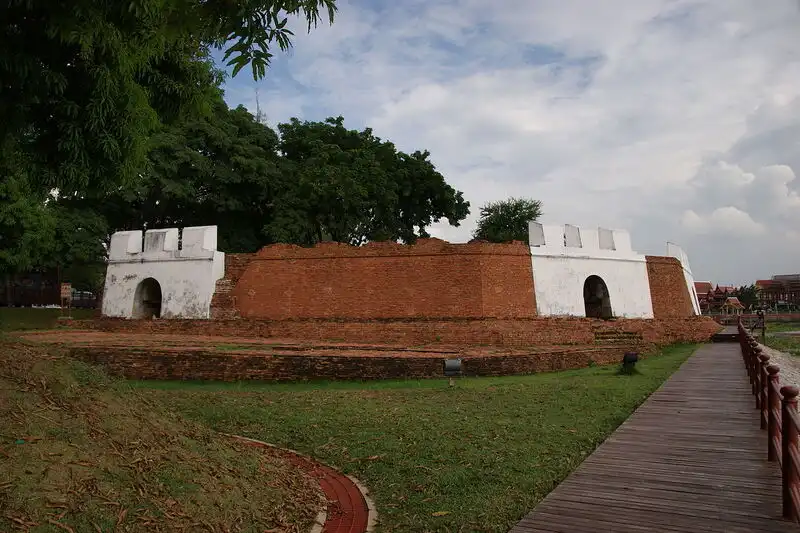
From a practical travel point of view, if you want to see a fort clearly and easily, the best real-world highlight is Fort Phet. It stands at a key river confluence and is widely regarded as one of Ayutthaya’s most important and formidable forts in the past. What you see today makes it easy to imagine why the city chose this location — and why major forts needed to “control waterways” more than roads.
When you’re standing by a riverside fort, try reading the landscape as you look. Where rivers meet, movement naturally compresses. Boats entering or leaving must slow down, choose their line, and can’t easily escape the view of people stationed above. That strategic logic explains why big forts often sat at river junctions: from one position, defenders could watch and control far more than a fort placed along a plain wall segment.
Another reason this theme is compelling is what happened after Ayutthaya fell. Many parts of the walls and forts were dismantled so the bricks could be reused to build the new capital during the early Rattanakosin period. This helps explain why, today, you tend to see remaining forts or wall segments in pieces rather than as a complete ring — and why exploring the old defenses is less about checking in at one spot and more about “reading the city” as you move along the island’s edges.
If you want to enjoy this theme more, think of it as “following the outline of the island” rather than treating it as a single site. Start at Fort Phet and then continue to nearby riverside temples and communities. You’ll quickly see how tightly the city’s settlement patterns, trade life, and defensive planning were connected to the rivers. The riverside atmosphere also makes the walk feel lighter than temple-hopping nonstop.
For photography, the strength of forts and walls is in their “lines” and “dimension” — brick textures against sky. Morning light is soft and works well for details without harsh shadows, while late afternoon light brings depth and weight to the structure. If you want your photos to tell a story, include the river in your frame whenever possible, because the core idea of Ayutthaya’s defenses was controlling waterways, not just building walls.
Getting There
If you’re driving from Bangkok, head into Phra Nakhon Si Ayutthaya and enter the Ayutthaya Island zone. Set your map pin to Fort Phet / the southeastern riverside wall area of the island. Once you arrive, it’s easy to continue as a riverside route to nearby temples and communities, since distances between major points on the island are relatively compact — ideal for a half-day or full-day plan.
If you’re not driving, an easy option is taking the train or a van to Ayutthaya town, then using a taxi/local hire car/ride-hailing app to reach the island. Hiring transport for multiple stops is often the best value, especially if you plan to combine the Fort Phet area with the island’s major temples on the same day.
Overall, “Ayutthaya’s Fortifications” is a travel theme that gives you a deeper Ayutthaya — not only something beautiful to photograph, but something that helps you understand why the city was founded here, why rivers mattered, and why Ayutthaya’s defenses were designed as a system: walls, forts, and river-control points. If you want your Ayutthaya trip to be more than just temple visits, this theme takes you further without requiring much extra effort.
| Place Summary | Ayutthaya’s fortifications refer to the city wall and forts built around Ayutthaya Island to defend both land and waterways. A practical highlight that remains clearly visible and easy to visit today is the Fort Phet area and nearby riverside wall segments. |
| Highlights | A deeper look at “Ayutthaya as a defended city,” not only a religious landscape / Learn why major forts were placed to control river junctions and entrances / Easy riverside walk with strong brick-and-river photo compositions / Simple to link with nearby attractions for a smooth route |
| Nearby Accommodations (Approx. Road Distance) | sala ayutthaya (approx. 3 km) Tel. 035-242-588 iudia on the river (approx. 4 km) Tel. 086-080-1888 krungsri river hotel (approx. 6 km) Tel. 035-244-333 centara ayutthaya (approx. 8 km) Tel. 035-243-555 classic kameo hotel ayutthaya (approx. 9 km) Tel. 035-212-535 |
| Nearby Tourist Attractions (Approx. Road Distance) | wat phanan choeng worawihan (approx. 2 km) wat putthai sawan (approx. 3 km) st. joseph’s church, ayutthaya (approx. 3 km) japanese village, ayutthaya (approx. 4 km) baan hollanda (approx. 4 km) |
| Nearby Restaurants (Approx. Road Distance) | sainaam pom phet restaurant (approx. 1 km) Tel. 035-243-354 baan pomphet (approx. 1 km) Tel. 035-242-242 grand chaopraya ayutthaya (approx. 3 km) Tel. 081-942-1666 phaekrungkao ayutthaya (approx. 4 km) Tel. 088-649-1347 sala ayutthaya eatery and bar (approx. 6 km) Tel. 035-242-588 |
Frequently Asked Questions (FAQ)
Q: What do “Ayutthaya’s fortifications” refer to?
A: It refers to the system of city walls and forts placed around Ayutthaya Island to protect both land and waterways, with major forts positioned at strategic river gates and junctions.
Q: What were Ayutthaya’s city walls made of at first?
A: In the early period, they were earth ramparts with wooden palisade posts, later upgraded to brick-and-mortar walls during the reign of King Maha Chakkraphat.
Q: Where should I go if I want to see a fort clearly?
A: The Fort Phet area is one of the most practical and visitable places because it sits at a strategic riverside position and helps you understand the overall defensive system.
Q: What time is Fort Phet generally open to visit?
A: It is commonly referenced as accessible around 07.00 – 18.00 with free entry, but it’s smart to allow flexibility in case of maintenance or temporary area management.
Q: How many hours should I plan for this fortification theme?
A: If you focus on Fort Phet and nearby riverside points, 2 – 4 hours is a good range, and you can easily extend the day by adding major temples or museums on Ayutthaya Island.
 Ancient Forts and Fortresses Map
 Category:
  Group:
  Last Update: 1 WeekAgo
Comment
 Nearby Attractions
| Keyword (Advance) |
 Region
|
 Phranakhon Si Ayutthaya(