

 Home
Home Chiang Mai(























Rating: 4.2/5 (5 votes)
 |
|  Map
Map 
 Have Map
  No Map
Ratchaburi attractions
Attractions in Thailand
Open Days: Please call ahead for confirmation (Tuesday–Sunday)
Opening Hours: 09.00–16.00
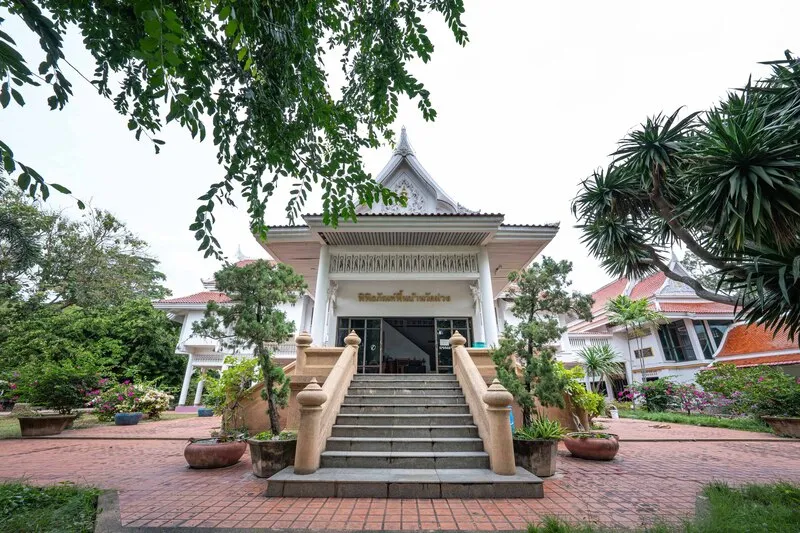
Wat Muang Folk Museum is one of the most valuable attractions in Ratchaburi in terms of history and culture. It is not merely a place for displaying old objects, but a learning center that explains the roots of the Mon community along the Mae Klong River through authentic artifacts, real palm-leaf manuscripts, language, traditions, beliefs, ways of life, and the collective memory of local people in a meaningful way. It is suitable for general travelers, cultural tourists, students, researchers, and anyone who wants to understand Ratchaburi beyond a quick sightseeing trip.
Wat Muang Folk Museum is located within Wat Muang in Ban Muang Subdistrict, Ban Pong District, Ratchaburi Province, along the Mae Klong River. This place is not just an ordinary stop on a travel route, but a space that clearly connects the past of the community with the present. As soon as visitors arrive, they can feel the atmosphere of an old temple that still serves as the center of the community, while also being home to one of the important Mon studies learning centers in Ratchaburi.
The distinctiveness of this museum lies in its deeply rooted storytelling of the local community. It is not simply about arranging old objects for display, but about presenting them in a way that helps visitors understand how the Mon people of Ban Muang once lived, how they were connected to the Mae Klong River basin, how they related to nearby communities such as Ban Pong and Photharam, and why Mon culture still plays a role in this area today. Visiting here therefore offers a different experience from walking through a general museum, because visitors are essentially reading history in the very place where those stories actually happened.
Wat Muang itself is an old temple with a history dating back to the late Ayutthaya period, according to information found in Mon-script palm-leaf manuscripts related to the temple and the local community. This point is highly significant because it makes Wat Muang more than just the backdrop of the museum; it is the heart of the entire story. The temple has long served as a spiritual center, a place for rituals, a repository of community knowledge, and a link between religion and the daily lives of the people of Ban Muang.
Looking back into the past of the Mae Klong River basin, this area was home to people from many ethnic groups living together, including Mon, Thai, Chinese, Lao, Vietnamese, Khmer, and Karen communities. Their coexistence was not separated into isolated groups; instead, there was continuous exchange of culture, language, food, traditions, and ways of life over a long period of time, eventually creating the unique identity of Ban Muang. This is why Wat Muang Folk Museum is more valuable than a typical local museum, because it serves as a key to understanding the social history of the wider area.
The core message presented by the museum is that Mon identity in Ratchaburi is not simply the story of one ethnic group, but part of the broader social and cultural structure of the Mae Klong basin. Visitors can see how the Mon language played a role in ancient documents, inscriptions, and palm-leaf manuscripts, how certain beliefs and traditions have continued within the community, and how community memory exists not only in written records but also in objects, clothing, household tools, and stories passed down through generations.
One of the museum's major highlights is its Mon-script palm-leaf manuscripts, some of which are over 300 years old. Objects of this type are extremely valuable because they are not only evidence of the age of the temple and the community, but also reflections of the linguistic, intellectual, and religious development of the Mon people in the area. Seeing such manuscripts within the context of the temple and museum, both of which are closely tied to the real community, makes the visit far more meaningful than simply looking at antiques in a glass case, because visitors are witnessing traces of memory that once played an active role in the lives of real people.
Inside the museum, the exhibitions are divided into categories that make the story easy to follow. They begin with sections explaining the Mon in legend and the Mon in history, which provide a basic understanding of who the Mon are, how they are connected to Thailand, and how they relate to the Mae Klong basin. From there, the displays move into more concrete themes such as the Mon language, Mon inscriptions, Mon traditions and culture, Mon migration, the Mon in Thailand, and the stories of cultural leaders within the local community.
The charm of the exhibitions lies in their ability to make what may seem distant feel tangible. Visitors gradually begin to see that Mon identity is not limited to rituals or festivals, but appears in every dimension of life, whether in written language, clothing, local food, household utensils, or ideas about living together within a community. Walking through the museum is therefore like slowly reassembling the larger picture of the community from the fragments that still remain.
For those who enjoy cultural travel, Wat Muang Folk Museum has a clear advantage in that its content is rich yet easy to access. Even visitors with no background knowledge of Mon history can understand the exhibitions, because the stories are connected to real ways of life and a real place. Once visitors leave the exhibition rooms and look around the temple, the river, the community, and the surrounding routes, they begin to see that what they have just read and viewed is not detached, but closely connected to the local geography and settlement patterns.
Another reason this place deserves a long and serious article is that there is still a major information gap online. Many websites provide only brief descriptions, saying that it is a Mon museum in Wat Muang, with opening hours and admission details, and then stop there. But for people who want to understand why this place matters, the museum has much more to offer. It helps explain Ratchaburi as a province with multiple layers of culture, not merely as a destination for photos, cafés, or natural attractions.
From a travel planning perspective, Wat Muang Folk Museum is highly suitable for travelers looking for a half-day or full-day trip in the Ban Pong and Photharam area. Those interested in old temples, riverside communities, arts, culture, and local food can create a very well-balanced itinerary. One can begin by exploring the museum inside Wat Muang, spending around 1 to 2 hours studying the exhibitions, and then continue with the temple grounds or nearby attractions such as Wat Khanon, Wat Khongkharam, or other sites in neighboring districts.
In terms of the actual visitor experience, this museum is best enjoyed at a slow pace. Its strength does not lie in architectural grandeur, but in the way its content gradually works on the viewer. The more one reads, observes, and reflects, the more one notices the details of each artifact and the connections between the exhibition rooms. Visitors who come mainly for photographs may not need much time, but those who truly want to absorb the stories should allow enough time, especially if they are gathering information for writing, research, or historical content creation.
What makes Wat Muang Folk Museum different from many other learning spaces is that it remains situated within a living religious and community setting, rather than being relocated and rearranged outside its original context. Visitors therefore see not only objects and documents, but also the landscape of memory itself: the temple, the river, the old community, and activities that still continue in the area today. This dimension gives the museum a much deeper and more authentic character.
In addition to the museum itself, the temple also houses a Mon studies center, which further reinforces Wat Muang's role as a local knowledge hub. This is especially meaningful for those interested in Mon studies and cultural history, because it shows that preservation is not limited to keeping old objects, but also includes passing on knowledge, explaining meanings, and transmitting the community's values to future generations.
Another interesting aspect is Mon local food, which helps visitors access culture through taste rather than only through information panels. Published information about the museum and Wat Muang notes that groups of 10 people or more can arrange in advance to try traditional Mon savory dishes and desserts, such as kaeng bon, nam pla yam, and kaeng matad. This is important because it turns a museum visit from a purely academic activity into a much more complete cultural experience.
The temple grounds also include a traditional weaving center that sells handwoven textiles and local pha khao ma cloth. This is another element that makes Wat Muang more than just a museum destination. Visitors can see the continuity of local wisdom in a living form. Weaving is an example of culture that is still alive, and the presence of a weaving center in the same area adds even greater value to the site as a cultural community.
In terms of its importance to Ratchaburi Province, Wat Muang Folk Museum functions like another gateway through which people can come to know a side of the province that is not often discussed. Ratchaburi has many attractions, yet at the same time it also has deeply layered history and culture. A place such as Wat Muang Folk Museum makes this richness much easier to see and allows travel in Ratchaburi to move beyond surface beauty toward a fuller understanding of the area's identity.
For those wondering when to visit, the answer is that the museum can be visited year-round. However, if you want a quieter atmosphere and enough time to explore in depth, morning or early afternoon is recommended. This allows sufficient time to walk through the exhibitions, read the information carefully, and slowly absorb the surrounding atmosphere. If traveling in a large group, advance coordination is advisable to ensure a smoother visit, especially if you would like a guided explanation or educational activities.
The museum's content is highly suitable for students because it can connect to many academic fields at once, including history, social studies, language, culture, art, and anthropology. At the same time, it is also ideal for general travelers who want a meaningful destination rather than just another check-in point. Even visitors who are not coming for schoolwork or research will find that learning about the way of life and worldview of the Mon community is a valuable experience in itself.
As a local museum, the existence of Wat Muang Folk Museum also reflects the important idea of preserving community memory. Without the effort to gather manuscripts, objects, tools, utensils, and oral histories, much of this knowledge could disappear with the older generation. Walking into this place is therefore like witnessing the community's attempt to preserve its roots, while also reminding visitors that cultural heritage does not survive on its own; it must be cared for, passed on, and retold.
Another interesting issue is the role of the Mae Klong River basin as an economic and cultural zone in the past. The museum shows that Ban Muang was not an isolated settlement, but grew through its relationship with waterways, trade, travel, and exchange with other communities. The importance of the river in the past was therefore not merely geographical, but structural, enabling people, language, beliefs, and culture to move and connect. This helps visitors understand the Ban Muang community in a broader context and see that Mon identity in the area was far more dynamic than many might assume.
For writers and content creators, this site offers complete raw material in terms of storytelling, imagery, and interpretive angles. It can be written about from the perspective of cultural tourism, local history, ethnic studies, or even food and handicrafts. The strength of Wat Muang Folk Museum lies in the way these multiple dimensions support one another, making it easy to develop a long article with varied content without feeling repetitive.
In terms of access, this place is not as difficult to reach as some people may think. If driving from Ratchaburi town, visitors can take Highway No. 4, turn toward Ban Pong District, and continue on Highway No. 3089 along the Khok Sung–Berk Phrai route. After crossing the Mae Klong River bridge, continue straight for about 7 kilometers, then turn into the temple area for another approximately 2.5 kilometers to reach the museum. This route is ideal for self-drive travelers because it makes it easy to stop at nearby attractions and arrange a flexible itinerary.
Getting There If using public transport, you can travel from Bangkok on the Bangkok–Kanchanaburi route and get off at Ban Pong District, then continue by local bus on the Ban Pong–Photharam route and get off in front of Wat Muang. This option is suitable for travelers who are not driving, but it is advisable to check bus schedules in advance, especially on weekdays, to make your visit easier to plan and avoid unnecessary rush.
Once at the site, visitors should dress respectfully, as the museum is located within a temple compound. Although the atmosphere is welcoming and open to visitors, respect for the place remains important. If visiting with children or student groups, care should be taken regarding proper behavior, avoiding loud noise, and being cautious not to touch exhibition objects, especially old documents and fragile artifacts.
To make the visit more worthwhile, it is recommended to spend time carefully reading and observing the details of each exhibition room. The strength of this place is not immediate visual spectacle, but value that gradually reveals itself through information and displayed objects. The more you read, the more you understand; and the more you understand, the more clearly you see the value of the community and the continuity of culture in this area.
After visiting the museum, travelers can continue to explore several other attractions in the same zone, such as Wat Khanon, which is well known for its shadow puppetry heritage and performing arts; Wat Khongkharam, an old temple with mural paintings and an attractive riverside setting; or more contemporary attractions such as Ban Pong Street Art, which is suitable for strolling and photography. Having these options not far from Wat Muang makes the museum an excellent starting point for a day trip that combines knowledge and enjoyment.
Food options are also convenient, with nearby local restaurants, made-to-order eateries, and riverside cafés in the Ban Pong and Photharam area. Visitors traveling in groups who want a more community-based experience should ask in advance about Mon local food, because this is one of the elements that adds depth to the trip and clearly distinguishes it from ordinary travel.
If you wish to stay overnight, the Ban Pong and Photharam area also offers accommodation in several price ranges, from small resorts to riverside lodgings. This makes it possible to extend a museum visit into a deeper Ratchaburi itinerary, including old temples, local markets, traditional food, and further travel into nearby districts.
In an emotional sense, Wat Muang Folk Museum is a place that allows visitors to feel how gracefully one community can preserve its own stories. A walk through the museum is therefore not just about receiving information, but also about recognizing the effort of local people to sustain their roots amid the changes of the modern world. This gives the museum a particular charm that fast-paced tourist attractions cannot offer.
For those who appreciate quiet places with meaningful content, Wat Muang Folk Museum is especially suitable. It is not a crowded tourist site, but rather a place that invites visitors to walk slowly, read slowly, and think along the way. Being in an old riverside temple while learning about the Mon community through authentic evidence gives the visit a special emotional and intellectual weight.
If asked who this museum is most suitable for, the answer is simple: anyone who wants to understand Ratchaburi more deeply. Whether you are interested in history, Mon communities, cultural attractions, student learning, research, or simply want to move from photo-based tourism toward something more meaningful, this place can answer all of those needs.
What makes this place worthy of inclusion on a Ratchaburi travel list is that it helps reveal the real meaning of the word “local.” Here, local does not simply mean the name of a district or subdistrict, but rather memory, language, faith, food, handicrafts, and stories that connect people to one another. Wat Muang Folk Museum therefore does not merely take visitors to see the past, but helps them understand how a community has shaped its own identity.
Ultimately, a visit to Wat Muang Folk Museum should not be seen as simply stopping by another museum in Ratchaburi. It should be viewed as a journey to encounter the roots of the Mon community along the Mae Klong River, which still speaks through palm-leaf manuscripts, exhibition objects, the Mon language, weaving, local food, and the atmosphere of an old temple that gently holds the memory of its people. For anyone searching for a Ratchaburi attraction that offers more than outward beauty and wanting a place with stories that linger in the mind after returning home, Wat Muang Folk Museum is one destination well worth visiting seriously.
| Name | Wat Muang Folk Museum |
| Type | Folk Museum / Mon Cultural Learning Center / Historical and Cultural Attraction |
| Location | Inside Wat Muang, Moo 5, Ban Muang Subdistrict, Ban Pong District, Ratchaburi 70110 |
| Area Overview | An old riverside temple in the Ban Muang community, in the Ban Pong zone, with convenient onward travel to Photharam and Bang Phae |
| Place Summary | A museum that gathers the history, way of life, language, traditions, and heritage of the Ban Muang Mon community, located within Wat Muang, a temple whose history dates back to the late Ayutthaya period |
| Main Highlights | Features Mon-script palm-leaf manuscripts over 300 years old, exhibition rooms on Mon legends and history, Mon language and inscriptions, Mon traditions and culture, Mon migration, Mon communities in Thailand, cultural leaders, and the interconnected communities of the Mae Klong basin |
| Site History | Wat Muang is an old temple, with information from Mon-script palm-leaf manuscripts indicating that it dates back to the late Ayutthaya period. Wat Muang Folk Museum was later established to preserve knowledge related to the Mon community and the local way of life of Ban Muang and the Mae Klong basin. |
| Museum Established | 1993 |
| Zone | Ban Pong Zone / Mae Klong Basin Zone / Easy Connection to Photharam / Easy Connection to Bang Phae |
| Current Abbot or Caretaker | Phra Khru Phatthasiritham (some sources spell it as Phra Khru Phattharasiritham), Abbot of Wat Muang |
| Open Days | Please call ahead for confirmation, as opening days vary across different sources |
| Opening Hours | 09.00–16.00 |
| Admission Fee | Free |
| Additional Points of Interest Inside the Temple | Mon Studies Center, Traditional Weaving Center, Advance arrangements for Mon local meals for groups |
| Getting There | By car from Ratchaburi town, take Highway No. 4 toward Ban Pong, then continue on Highway No. 3089 along the Khok Sung–Berk Phrai route, cross the Mae Klong River bridge, continue for about 7 km, then turn in for another 2.5 km; by public transport from Bangkok, get off at Ban Pong and continue on the Ban Pong–Photharam line, getting off in front of Wat Muang |
| Important Contact Numbers | 1) Khun Sa-nga Phrom-in 086-004-0786 2) Museum 089-885-8817 3) Museum 032-372-548 4) Abbot of Wat Muang 085-173-6252 5) Traditional Weaving Center 086-111-1367 6) Pa Sa-nga Made-to-Order Food at Wat Muang 086-882-5699 7) SOP cafe 080-227-5544 8) Khrua Hom Man Pu 098-484-9944 9) Wat Khanon Nang Yai 089-555-4195, 032-234-834 10) Wat Khongkharam 032-231770, 032-231933 11) Lollop Resort 083-030-8667 |
| Nearby Attractions with Distance | 1) Wat Khanon Nang Yai – approximately 5.2 km (Photharam Zone) 2) Ban Pong Street Art – approximately 5.7 km (Ban Pong Zone) 3) Wat Khongkharam – approximately 6.1 km (Photharam Zone) 4) Na Satta Thai Park – approximately 9.8 km (Bang Phae Zone) 5) Wat Klang Khlong Khoi – approximately 10 km (Photharam Zone) |
| Nearby Restaurants with Distance | 1) Pa Sa-nga Made-to-Order Food at Wat Muang – closest, within the Wat Muang area (Ban Muang Zone) 2) High River Café – approximately 750 m (Ban Pong Zone) 3) Khrua Thian Thong 88 – approximately 1.6 km (Ban Pong Zone) 4) Khrua Hom Man Pu – approximately 2.2 km (Ban Pong Zone) 5) SOP cafe – approximately 3.5 km (Photharam Zone) |
| Nearby Accommodations with Distance | 1) The Antique Riverside Resort – approximately 500 m (Ban Pong Zone) 2) Ratsami Resort – approximately 1.6 km (Ban Pong Zone) 3) Lollop Resort – approximately 4.2 km (Ban Pong Zone) 4) Ban Pong Inn Hotel – approximately 7 km (Ban Pong Zone) 5) Ton Pho Resort Ban Pong – approximately 11.9 km (Ban Pong Zone) |
Frequently Asked Questions (FAQ)
Q: Where is Wat Muang Folk Museum located?
A: Wat Muang Folk Museum is located inside Wat Muang, Moo 5, Ban Muang Subdistrict, Ban Pong District, Ratchaburi Province, along the Mae Klong River. It is an important learning center for the local history and Mon cultural heritage of the area.
Q: What is interesting about Wat Muang Folk Museum?
A: The museum's main highlight is its well-organized presentation of the story of the Ban Muang Mon community, including Mon legends, Mon history, Mon language, Mon inscriptions, Mon traditions and culture, migration history, and important objects such as Mon-script palm-leaf manuscripts over 300 years old.
Q: Is there an admission fee for Wat Muang Folk Museum?
A: No. Admission is free. It is a learning site suitable for general travelers, students, and educational groups interested in local history and Mon cultural heritage.
Q: What days is Wat Muang Folk Museum open?
A: The opening hours consistently found across sources are 09.00–16.00, but the opening days still vary among different sources. It is therefore advisable to call ahead before traveling, especially if visiting as a group.
Q: How much time should I allow for a visit?
A: For a general visit, you should allow around 45 minutes to 1 hour and 30 minutes. If you want to read the information in detail, take photographs, or collect in-depth material for writing or research, allowing 2 hours or more is recommended.
Q: What type of traveler is this museum best suited for?
A: It is ideal for cultural travelers, temple visitors, museum lovers, students, teachers, researchers, and travelers who want to understand Ratchaburi from a historical and community-based perspective rather than only through photo-oriented sightseeing.
Q: What else can I see inside Wat Muang besides the museum?
A: In addition to Wat Muang Folk Museum, the temple also has a Mon Studies Center and a traditional weaving center selling handwoven textiles and local pha khao ma cloth, allowing visitors to experience both history and living local wisdom.
Q: Is there anything special for group visits?
A: If you visit as a group and coordinate in advance, you can ask about traditional Mon local food. This is another highlight of the Ban Muang area and helps make the museum visit a more complete cultural experience.
Q: Where can I go after visiting the museum?
A: You can continue to several nearby attractions, such as Wat Khanon Nang Yai, Ban Pong Street Art, Wat Khongkharam, Na Satta Thai Park, and Wat Klang Khlong Khoi, all of which are within convenient driving distance for the same trip.
 Wat Muang Folk Museum Map
 Category:
  Group:
  Last Update: 3 HourAgo
Comment
 Nearby Attractions
| Keyword (Advance) |
 Facebook Fanpage
 Region
 Historical Sites and Monuments(
 Landmarks and Memorials(
 Art, Craft Centres, Tradition(
 Art Gallery(
 Educational Places
 Educational Gardens, Farm(
 University
 Places of Worship
 Temple(
 Other religious and spiritural sites(
 Research and Development
 Royal Project(
 Suburban Living
 Village, Community(
 Local Market(
 Floating Market(
 Nature and Wildlife
 National Parks and Marine Reserves(
 Mountain (Doi)(
 Dam, Reservoir, Lake(
 Waterfalls(
 Hot Springs(
 Caves(
 Flower Field(
 River, Canal(
 Other natural attractions(
 Entertainment and Agricultural
 Zoos and Aquariums(
 Animal camps and shows(
 Farm, Parks, Gardens and Ecotourism(
 Waterpark(
 Outdoor and Adventure Activities(
 Shopping
 Shopping and Night Market(
 Spas and Wellness
 Spas and Wellness(
 Travel Articles, Recipes
 Travel Review, Food Review(