

 Home
Home Chiang Mai(


























Rating: 4.5/5 (4 votes)
 |
|  Map
Map 
 Have Map
  No Map
Ratchaburi attractions
Attractions in Thailand
Open Days: The community can be explored daily / special activities should be checked with the organizers for the latest schedule before visiting
Opening Hours: The best time to walk around is from daytime to early evening / All About Arts activities usually begin from 16.00 hrs. according to the community schedule
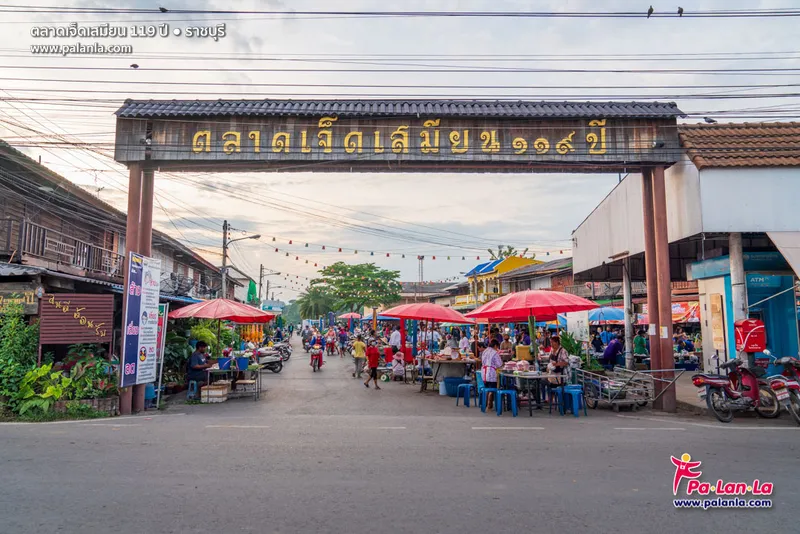
Chet Samian Market is a historic commercial community in Photharam District, Ratchaburi Province, where local life has long been connected to both Chet Samian Railway Station and the Mae Klong River within the same area. The charm of this place lies not only in its classic wooden shophouses and old-market atmosphere, but also in its historical narratives, Wat Chet Samian, the Shrine of Khun Ta Pha Khao, the Bodhi courtyard, community art activities, and famous local products such as Chet Samian preserved radish, all of which have kept the name of this community alive in people’s memories for generations.
Chet Samian Market is one of the most distinctive historic neighborhoods in Ratchaburi. Although it is not as large as some of the province’s better-known tourist markets, it has a rare authenticity that can be felt from the moment you step into the area. This is not a recreated version of the past, but a real community that is still actively lived in, with shops, homes, a temple, a shrine, a railway line, and the Mae Klong River serving as the backdrop to a local history that still breathes every day. It is precisely this simplicity that makes Chet Samian Market memorable in a way that differs from more stylized retro markets.
The location of Chet Samian Market is especially striking because it sits behind Chet Samian Railway Station, a small station on the southern railway line that every southbound train passes before reaching Ratchaburi town. The relationship between the community and the railway is therefore not merely geographic, but an essential part of the market’s identity. The front of the neighborhood connects with the railway station and community roads, while the back opens toward the Mae Klong River, which once served as a major route for transport and trade. This makes Chet Samian a community that clearly grew through the combined power of both river and rail.
Looking deeper than the old-market atmosphere, one discovers that the Chet Samian community is far older than the familiar phrase “119-year-old market” might suggest. The name “Chet Samian” appears in legends, travel literature, and various historical records. One popular story traces it back to the period following the fall of Ayutthaya, when King Taksin the Great gathered people together and had seven clerks record the names of able-bodied men, which is said to have become the origin of the place name “Chet Samian.” In another dimension, the name appears in older literary works and historical documents, showing that this area has long been recognized and mentioned by generations of people.
The antiquity of Chet Samian therefore lies not only in its buildings, but also in its place name, collective memory, and long-standing human settlement. When viewed through the history of the community, the area is seen to have originally been an agricultural riverside settlement along the Mae Klong. People built their homes along the water and used the river for travel, transport, and trade. Later, when roads and the railway were developed, the community expanded along these new routes, giving rise to a market, rows of shops, and the community structure whose original outline can still be sensed today. This is why Chet Samian Market is not just a place for taking photographs, but also an example of the transformation from a riverside community into a railway community in the Mae Klong basin.
One of the most outstanding features of Chet Samian Market is its row of old two-storey wooden shophouses, which still preserve the atmosphere of a traditional market community remarkably well. As visitors walk past these buildings, they can feel the scale and character of a historic neighborhood that has not yet been erased by modern commercial development. Aged timber, weathered façades, openings, windows, and narrow roads invite the imagination to picture the days when the market was lively with people arriving by both boat and train. The beauty of Chet Samian lies in these small details, which are immediately meaningful to those who enjoy old towns and reading history through the physical environment.
Another element that adds depth to a walk through Chet Samian Market is Wat Chet Samian, which has long served as the religious and social center of the community. The temple is significant not only as a place of worship, but also as an anchor of local memory. It helps make the original structure of the community legible when viewed together with the market and the railway station. For travelers who like to explore the broader context of a historic district, Wat Chet Samian is one of the landmarks that should not be overlooked, because it helps explain why this community has endured for so long and remained so closely connected.
Nearby stands the Shrine of Khun Ta Pha Khao, another place that reflects the beliefs and traditional relationships within the Chet Samian community. Such places may not immediately stand out to visitors who are in a hurry, but for those who want to understand the deeper meaning of the neighborhood, local shrines are important evidence of a community’s belief system, its reverence for the sacred, and its attachment to place. When the temple, shrine, station, and market all stand within walking distance of each other, Chet Samian gains the qualities of a “complete historic district” rather than merely being a food market.
The community’s Bodhi courtyard is another important point that expands Chet Samian Market from a commercial area into a space of living culture. Here, folk art created by children and elderly residents is displayed, giving the place a meaning far beyond simple decoration. It is a space where local people can tell the story of their home through art. This kind of movement allows Chet Samian Market to remain connected not only to its past, but also to the present, making it a lively place where heritage continues to grow. That is precisely what makes it different from some historic districts that may be beautiful, yet feel silent or empty of real community life.
In terms of economic history, one product that has made the name of Chet Samian widely known is Chet Samian preserved radish. In the past, Chet Samian and nearby areas were important cultivation grounds for white radish, which led to the production and processing of preserved radish for sale across the country. Although the original agricultural scale may have declined over time, the name of Chet Samian preserved radish still remains and has become a source of pride for the community. A visit to Chet Samian Market is therefore not only about photographing old wooden shophouses, but also about discovering a local product that grew from the genuine agricultural wisdom of the area.
For food lovers, preserved radish is one of the most worthwhile local products to take home. It is not merely a kitchen staple, but a food item layered with the economic and cultural history of the community. Buying preserved radish from Chet Samian feels like taking home a small edible souvenir together with the story of the place. If visitors have the opportunity to speak with sellers or local residents, they often gain an even deeper understanding of how such an ordinary ingredient in Thai cuisine is closely rooted in this area. This is the kind of detail that many travel articles mention only briefly, but when explored more fully, it makes readers want to experience the place for themselves.
Another special quality of Chet Samian Market is that the community has never tried to turn itself into an overly staged tourist attraction at the cost of losing its original identity. On the contrary, its appeal comes from preserving the real condition of the living community and then gradually adding activities that help outsiders understand it more deeply. This is especially visible in All About Arts, which has become one of the most important chapters in the revival of the old market. The activity has reinterpreted the old neighborhood through photography, painting, local performances, gatherings of regional artists, and displays of vintage household items, creating an atmosphere that feels both warm and culturally meaningful at the same time.
The significance of All About Arts lies in the fact that art is not used merely as decoration, but as a way to connect older and younger generations. Children in the community can present their work, while elderly residents can pass on local wisdom and traditional forms of performance to younger people. Visitors therefore do not remain only spectators, but become participants in the rhythm of community life itself. This is why Chet Samian Market has a quiet but profound charm. It does not rely on loud commercial entertainment, but instead draws people in through the atmosphere of a community that still matters deeply to its own residents.
The best way to experience Chet Samian Market is not to rush in, take a few photographs, and leave, but to walk slowly and read the details of the neighborhood with care. Start from Chet Samian Railway Station, which acts as the symbolic gateway to the area. From there, continue into the old market streets, observe the layout of the wooden shophouses, notice the old shops, pause at points where the community opens out toward the Mae Klong River, and then continue on to Wat Chet Samian, the Shrine of Khun Ta Pha Khao, the Bodhi courtyard, and local product shops. A walk like this allows visitors not only to “see” the market, but to truly “understand” it.
Chet Samian feels noticeably different during the day and in the evening. Daytime is ideal for understanding the neighborhood layout, studying the old architecture, and photographing the wooden shophouses in clear detail. Evening, especially on days when community activities are being held, brings a softer atmosphere, better light, and more interaction among local residents, making the cultural life of the district more visible. For travelers who enjoy places with people, conversations, performances, and a living contemporary energy woven into a historic setting, the late afternoon and evening are particularly rewarding times to visit.
Another strength of Chet Samian Market is that it appeals to many kinds of travelers. Those interested in history will appreciate the stories behind the name Chet Samian and the evolution of the community. Photography lovers will enjoy the wooden shophouses, the railway station, and the riverside views. Slow travelers will appreciate the unhurried atmosphere. Meanwhile, those interested in art and contemporary cultural expression will find real value in All About Arts and the Bodhi courtyard, where local residents are given room to express themselves. When one place can speak to so many different interests in such a natural way, it is no surprise that Chet Samian continues to attract attention without depending on passing trends.
Another thing that gives a visit here its unique flavor is the relationship between the market and the Mae Klong River. Many people remember Chet Samian through images of the railway station or the market rows facing the road, yet the river was in fact the original heart of settlement in this area. The fact that the market stands on one side of the railway while also connecting to the riverside helps tell the story of changing trade routes over time. The community was not formed by the railway alone, nor did it survive on the river alone. Rather, it grew through the ability of local people to adapt to changing transportation structures in each era.
Seen as a tourist attraction in Ratchaburi, what stands out most about Chet Samian Market is its genuine local character, which has not yet been overwhelmed by commercialized imagery. Visitors encounter age, simplicity, and ordinariness that carry real value. There is no exaggerated retro staging and no attempt to sell nostalgia beyond measure. Instead, there is an environment that can still tell the story of its own past. Travelers who enjoy community markets of this kind are often especially moved by the feeling that they are walking through a place where people still genuinely live, rather than through a space designed only for tourists.
In terms of visitor experience, Chet Samian Market works very well as part of a half-day or full-day cultural trip that also includes nearby places in Photharam District, such as Wat Chet Samian, Wat Khanon, the Photharam market area, or local cafés and restaurants nearby. In a single day, travelers can experience an old railway-side district, a riverside community, historic temples, and local food. This makes a visit to Chet Samian much more than a brief stop. It becomes part of a richer cultural route with meaningful content and an engaging rhythm from beginning to end.
For those starting from Bangkok, Chet Samian is conveniently accessible by both private car and train. For travelers who want to immerse themselves more fully in the atmosphere of the place, arriving by train is especially rewarding, because the relationship between the community and the railway can be felt immediately upon stepping off at Chet Samian Station. Those who drive can also easily continue their trip onward through Photharam and Ratchaburi, since the market lies within practical reach of both the district center and the provincial city. This makes Chet Samian a much more accessible stop than many people might initially expect.
Getting There If traveling by car from Bangkok, take Phetkasem Road toward Ratchaburi Province, then continue into Photharam District and Chet Samian Subdistrict. The total distance is suitable for a comfortable one-day trip. Visitors choosing to travel by train can use southern line services that stop at Chet Samian Railway Station. Arriving by train is especially fitting for those who want to begin their walk from the very heart of the district, as stepping off at the station effectively places them directly inside the story of the old market with almost no additional transfer required.
Although Chet Samian Market is known for its historic atmosphere and community art, the real heart of the place lies in its sense of balance. Nothing feels excessive. The historic side has not been magnified to the point of becoming a museum, while the newer cultural additions have not overwhelmed the original personality of the district. Visitors are therefore free to move at their own pace. They may focus on photography, on reading local history, on buying preserved radish to take home, or simply on sitting and watching everyday life unfold. This flexibility is one of the reasons why Chet Samian appeals to travelers who prefer places with depth rather than destinations that offer only isolated photo spots.
For those interested in understanding places through their names, Chet Samian is an especially fascinating case. Many communities in Thailand have names that people recognize without knowing where they come from. By contrast, “Chet Samian” carries with it legends, local stories, and documentary evidence that show how a single place name can preserve many layers of history at once: the layer of oral tradition, the layer of travel literature, and the layer of communal memory. This makes a trip to Chet Samian not merely an architectural experience, but also an encounter with language, history, and the cultural meaning of place names.
From the perspective of heritage conservation, a small town like Chet Samian is highly significant because it shows that preserving a historic district does not require turning everything into a large-scale tourist attraction. Community activities, art, and local storytelling can also serve as powerful tools for sustaining a place. As long as there are still residents, real daily use, and stories worth telling, an old neighborhood does not die. Visiting Chet Samian Market is therefore not only an act of leisure, but also a way of supporting a cultural space that continues trying to preserve its own continuity.
For visitors, Chet Samian Market can feel like reading a slim book filled with dense and meaningful content. The more time one gives it, the more details emerge. What may begin as a simple plan to visit an old market can become an opportunity to learn about a riverside community, discover the origin of the place name, understand the history of Chet Samian preserved radish, see how folk art still has a place in a small community, and realize that some of the most interesting historic districts are not defined by grandeur, but by the presence of people willing to look carefully. This is the quality that keeps Chet Samian Market worth visiting, studying, and returning to more than once.
If one asks who Chet Samian Market is best suited for, the answer would be travelers who want to see Ratchaburi from a deeper perspective than the usual checklist attractions. Here, Ratchaburi appears as an old community shaped by riverside trade and the railway, with historical narratives, real daily life, still-active cultural traditions, and the ongoing efforts of local people to keep their home alive. Whether someone comes to see the old market, buy preserved radish, arrive by train, or enjoy the atmosphere of community art, Chet Samian Market offers enough reasons to make the journey feel meaningful.
Ultimately, the true charm of Chet Samian Market lies not simply in the number of years attached to its age, but in the continuity of memory that still survives in the same physical space. Trains still pass through, the community still exists, the temple still serves as a center, local products are still sold, art still happens, and the Mae Klong River still forms the backdrop to all these layers of story. When these elements remain together, Chet Samian Market becomes more than just a tourist attraction in Ratchaburi. It becomes one of the cultural districts that shows how the beauty of Thai communities does not arise from grandeur, but from the enduring relationship between people, place, and time.
| Place Name | Chet Samian Market |
| Location | Historic community behind Chet Samian Railway Station, Chet Samian Subdistrict, Photharam District, Ratchaburi 70120 |
| Address | Riverside old-market community connected with Chet Samian Railway Station and Wat Chet Samian |
| Characteristics | Historic riverside and railway trading community, two-storey wooden shophouses, old-town atmosphere, local way of life, preserved radish products, and community art activities |
| Brief History | Chet Samian is an old community of Photharam with roots in an agricultural settlement along the Mae Klong River before later expanding with the railway and road network. The old market atmosphere was later revived through the All About Arts initiative, and the year 1888 is commonly used as the milestone for its 119-year market identity. |
| Name Origin | The origin of the name “Chet Samian” is explained through both local legend and older literary references. The best-known story tells of seven clerks who recorded the names of men joining the army, which later became the name of the community. |
| Highlights | 1) Historic wooden shophouses 2) Chet Samian Railway Station 3) Wat Chet Samian 4) Shrine of Khun Ta Pha Khao 5) Bodhi courtyard and community art activities 6) Famous preserved radish from Chet Samian |
| Main Activities | Walking through the old district, photographing the railway-riverside community, buying local products, and enjoying community art events such as All About Arts when scheduled |
| Getting There | By private car from Bangkok via Phetkasem Road to Photharam and Chet Samian / By southern line train to Chet Samian Station, then walk directly into the old market area |
| Current Status | A historic community and old-market district that still functions in everyday life. Visitors can explore the area throughout the day, while special community events should be checked in advance. |
| Approximate Coordinates | Latitude 13.6355684477, Longitude 99.8209771111 |
| Main Contacts | 1. Chet Samian Subdistrict Municipality Tel. 032-397-015 2. Chet Samian Subdistrict Municipality (alternate contact source) Tel. 032-397-616 3. Suan Silp Baan Din Tel. 094-495-8596 4. Suan Silp Baan Din (earlier published contact) Tel. 032-397-668 5. Suan Silp Baan Din (earlier published contact) Tel. 081-831-7041 |
| Nearby Attractions | 1. Chet Samian Railway Station – approx. 0.1 km. – Front Market / Railway Zone 2. Wat Chet Samian – approx. 0.3 km. – Historic Community Zone 3. Shrine of Khun Ta Pha Khao – approx. 0.3 km. – Historic Community Zone 4. Suan Silp Baan Din – approx. 1.2 km. – Inner Chet Samian Zone – Tel. 094-495-8596 5. Wat Khanon – approx. 10 km. – Khlong Ta Khot / Photharam Zone – Tel. 093-680-5843 |
| Nearby Restaurants | 1. Mae Boonsong Sweet Preserved Radish – approx. 0.8 km. – Chet Samian Zone – Tel. 063-215-1420 2. Baan Dol – approx. 2.5 km. – Photharam Community Side – Tel. 090-239-1999 3. Plern Dee Photharam – approx. 8 km. – Wat Khanon / Photharam Zone – Tel. 098-285-3195, 061-340-2929 4. Krua Lung Dor – approx. 9 km. – Photharam Zone – Tel. 080-541-5559 5. Rairak Cafe & Bistro – approx. 10 km. – Khlong Khoi / Photharam Zone – Tel. 098-926-9896 |
| Nearby Accommodations | 1. Baan Rao Eng Resort – approx. 1.5 km. – Chet Samian Zone – Tel. 082-195-5595 2. Pojana Homestay – approx. 2 km. – Chet Samian Zone – Tel. 092-441-4568 3. Baan Pak Chet Samian Baan Arom Dee – approx. 2 km. – Chet Samian Zone – Tel. 081-751-8819 4. Photharam126 Resort – approx. 9 km. – Riverside Photharam Zone – Tel. 064-539-0574, 062-184-9666 5. Rai Benjawan – approx. 12 km. – Nong Kwang / Photharam Zone – Tel. 032-212-925, 087-825-3993 |
Frequently Asked Questions (FAQ)
Q: Where is Chet Samian Market located?
A: Chet Samian Market is located in Chet Samian Subdistrict, Photharam District, Ratchaburi Province, behind Chet Samian Railway Station and connected to the riverside community along the Mae Klong River.
Q: What is interesting about Chet Samian Market?
A: Its highlights include historic wooden shophouses, an old trading-community atmosphere, Wat Chet Samian, the Shrine of Khun Ta Pha Khao, the Bodhi courtyard, community art activities, and famous local products such as Chet Samian preserved radish.
Q: What is the origin of the name “Chet Samian”?
A: The name is explained through both local legend and literary references. The best-known story says that seven clerks once recorded the names of men joining the army, and this later became the name of the community.
Q: When is the best time to visit Chet Samian Market?
A: Daytime is ideal for exploring the architecture and overall atmosphere of the community, while late afternoon and evening are better if you want a softer atmosphere and a chance to see community art activities, depending on the schedule.
Q: What kind of trip is Chet Samian Market suitable for?
A: It is well suited to a half-day or full-day trip, especially for travelers who enjoy old communities, photography, local history, community markets, and railway travel.
Q: What local product should not be missed when visiting Chet Samian?
A: The most famous local product is Chet Samian preserved radish, which is closely connected to the community’s history of white-radish cultivation and processing.
Q: Can I travel to Chet Samian Market by train?
A: Yes. Traveling by train is one of the most fitting ways to arrive, because once you step off at Chet Samian Railway Station, you can begin exploring the old market community almost immediately.
 Chet Samian Market Map
 Category:
  Group:
  Last Update: 2 HourAgo
Comment
 Nearby Attractions
| Keyword (Advance) |
 Facebook Fanpage
 Region
 Art, Culture and Heritage
 Historical Sites and Monuments(
 Landmarks and Memorials(
 Art, Craft Centres, Tradition(
 Museums(
 Art Gallery(
 Educational Places
 Educational Gardens, Farm(
 University
 Places of Worship
 Temple(
 Other religious and spiritural sites(
 Research and Development
 Royal Project(
 Village, Community(
 Floating Market(
 Nature and Wildlife
 National Parks and Marine Reserves(
 Mountain (Doi)(
 Dam, Reservoir, Lake(
 Waterfalls(
 Hot Springs(
 Caves(
 Flower Field(
 River, Canal(
 Other natural attractions(
 Entertainment and Agricultural
 Zoos and Aquariums(
 Animal camps and shows(
 Farm, Parks, Gardens and Ecotourism(
 Waterpark(
 Outdoor and Adventure Activities(
 Shopping
 Shopping and Night Market(
 Spas and Wellness
 Spas and Wellness(
 Travel Articles, Recipes
 Travel Review, Food Review(