

 Home
Home Chiang Mai(
























Rating: 4.2/5 (6 votes)
 |
|  Map
Map 
 Have Map
  No Map
Ratchaburi attractions
Attractions in Thailand
Open Days: Open daily
Opening Hours: Best visited during daytime
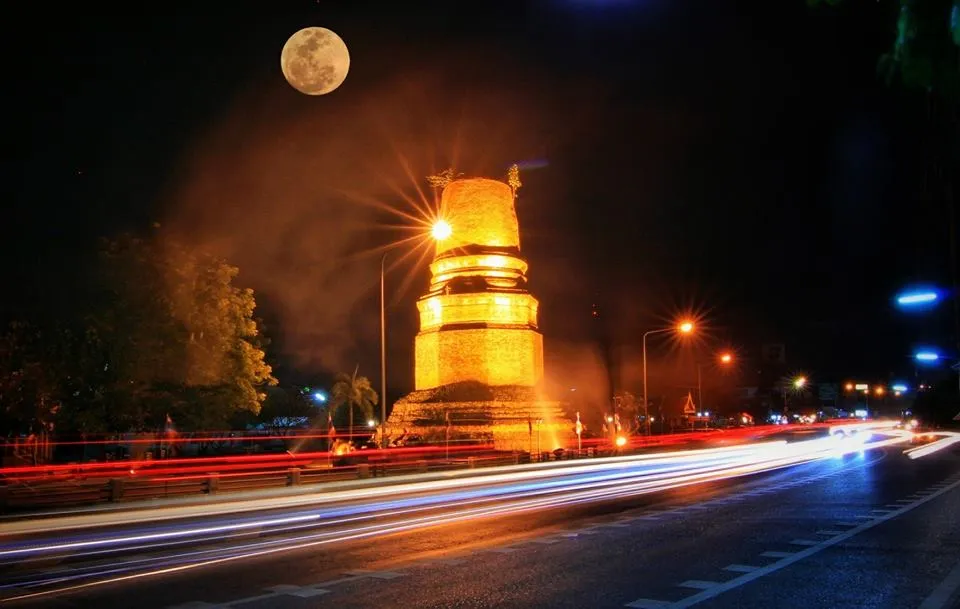
Chedi Hak is one of the important historical monuments in Ratchaburi Province, located in Chedi Hak Subdistrict, Mueang Ratchaburi District. Although the name of the site sounds simple, reflecting the collapsed condition of the chedi’s top, this monument in fact holds considerable historical value. It is an important piece of evidence for the development of art and Buddhism in the period before the establishment of Ayutthaya, and it is also one of the places that helps explain the story of Ratchaburi in the past with notable clarity.
People traveling through Chedi Hak Subdistrict often notice a large chedi standing amid the community. The structure has a broken top, which led to the familiar name “Chedi Hak,” or “Broken Chedi,” and this has remained the common name for the site to the present day. Although it may appear to be only an old brick ruin shaped by time, in archaeological terms Chedi Hak is considered highly valuable for the study of pre-Ayutthaya art.
According to historical information, the top of the chedi collapsed in 1937, leaving only the base and the bell-shaped main body standing today. Even though the monument is no longer complete, its form still clearly reflects the beauty of ancient architecture, especially its octagonal base supporting a relatively tall and slender bell-shaped structure. This characteristic makes Chedi Hak different from the Sri Lankan-style chedis more commonly seen in later periods.
The chedi was constructed of brick, using a mixture of earth and tree resin as the bonding material. This was a common building technique in ancient times before the use of cement. Although such materials may seem simple, they were durable and strong enough to support large structures for many centuries. This construction method therefore stands as clear evidence of the engineering knowledge and craftsmanship of ancient builders.
Many scholars of art history have observed that the form of Chedi Hak resembles groups of chedis found in Sankhaburi, Chai Nat Province, and some chedis in Mueang Suphan Buri District. In addition, certain features correspond to what is often described as the “Ayodhya style,” which appears in the Ayutthaya Historical Park area. These architectural characteristics suggest that Chedi Hak may have been built during a period when artistic traditions were transitioning from the pre-Ayutthaya world into the early Ayutthaya era.
During excavation and restoration work at the site, archaeologists discovered traces of a vihara facing west. This is a feature found in several religious monuments from the pre-Ayutthaya period. In addition, a large number of fragments of red sandstone Buddha images were found. Buddha images of this type were commonly produced before the establishment of Ayutthaya, so these discoveries provide substantial support for dating the monument historically.
The discovery of many antiquities in the Chedi Hak area has made the site important as an archaeological source that helps deepen our understanding of the history of the Mae Klong basin. In the past, Ratchaburi was not merely a small settlement, but an area that played a long-standing role in culture, religion, and habitation. The existence of Chedi Hak is therefore like a piece of evidence confirming the continuity of community life in this region.
Today, Chedi Hak has become a destination for history enthusiasts and those interested in archaeology who want to see evidence of the past with their own eyes. Although the site does not offer many facilities like modern tourist attractions, the experience of standing before a monument that has endured for hundreds of years is something difficult to find elsewhere.
The atmosphere surrounding the site remains simple, in keeping with the character of the local community. Visitors can spend time examining the details of the old brick structure, observing the patterns and form of the octagonal base, or photographing the chedi from different angles. Light in the morning or late afternoon enhances the texture of the brickwork and makes its surface stand out even more clearly.
A visit to Chedi Hak can also be conveniently connected with other sightseeing routes in Ratchaburi town, as the monument is located not far from several important attractions, such as Wat Mahathat Worawihan, the Ratchaburi National Museum, and Khao Ngu Stone Park. Travelers can therefore plan a half-day or full-day itinerary to explore the history of Ratchaburi in a more complete way.
Getting There is convenient from central Ratchaburi. You can drive along Phetkasem Road and then enter the Chedi Hak area, which takes only a few minutes from town. If you do not have a private car, you can also use a local taxi or a ride-hailing application from central Ratchaburi to Chedi Hak Subdistrict.
Although it is not a very large monument compared with nationally significant historical sites, the value of Chedi Hak lies in its role as archaeological evidence connecting important stages of Thai history, from the pre-Ayutthaya period to the urban development of the Mae Klong basin. Standing before this ancient brick chedi, which has endured the passage of many centuries, is therefore much like coming face to face with a page of history still visible in the landscape of Ratchaburi today.
| Name | Chedi Hak |
| Location | Chedi Hak Subdistrict, Mueang Ratchaburi District, Ratchaburi Province |
| Place Summary | An ancient brick chedi with an octagonal base and a broken शीर्ष? |
| Highlights | Ancient octagonal-based chedi, pre-Ayutthaya architecture, evidence of red sandstone Buddha images |
| Site History | A historical monument with pre-Ayutthaya artistic characteristics. The top of the chedi collapsed in 1937, and excavations revealed traces of a vihara and many fragments of red sandstone Buddha images. |
| Nearby Tourist Attractions | 1. Ratchaburi National Museum – 4 km – Tel. 032321513 2. Wat Mahathat Worawihan – 4 km – Tel. 0622388893 3. Tao Hong Tai Ceramics – 6 km – Tel. 032337574 4. Khao Ngu Stone Park – 8 km – Tel. 032391308 5. Damnoen Saduak Floating Market – 30 km – Tel. 032254544 |
| Nearby Restaurants | 1. Ko Bua Ratchaburi – 4 km – Tel. 0970411055 2. Krua Lung Yim Ratchaburi – 5 km – Tel. 0899199291 3. Inlaya Ratchaburi – 10 km – Tel. 032206179 4. The Canal Ratchaburi – 7 km – Tel. 032315575 5. Backoffice Burger – 4 km – Tel. 0894508324 |
| Nearby Accommodations | 1. Sans Hotel Ratchaburi – 4 km – Tel. 032913244 2. Space 59 Hotel – 4 km – Tel. 032315559 3. Napa Hotel Ratchaburi – 5 km – Tel. 0652292249 4. Hotel Wisma Ratchaburi – 5 km – Tel. 032326555 5. VP Resort Ratchaburi – 6 km – Tel. 0641497664 |
Frequently Asked Questions (FAQ)
Q: What is Chedi Hak?
A: Chedi Hak is an important historical monument in Chedi Hak Subdistrict, Ratchaburi Province. It is an ancient chedi with an octagonal base, and its top has been broken since 1937.
Q: In which period was Chedi Hak built?
A: Based on its artistic style, scholars assume that Chedi Hak was built before the establishment of Ayutthaya and has architectural features similar to the Ayodhya style.
Q: Why is Chedi Hak important?
A: Chedi Hak is an archaeological monument that helps explain the development of art and Buddhism in the Mae Klong basin before the Ayutthaya period.
Q: How much time should I spend visiting Chedi Hak?
A: In general, visitors spend around 20–40 minutes exploring the site, and it can easily be combined with other attractions in central Ratchaburi.
Q: How do I get to Chedi Hak?
A: From central Ratchaburi, you can drive to Chedi Hak Subdistrict within a few minutes, or use local transport or ride-hailing applications from town.
 Chedi Hak Map
 Category:
  Group:
  Last Update: 18 HourAgo
Comment
 Nearby Attractions
| Keyword (Advance) |
 Facebook Fanpage
 Region
 Landmarks and Memorials(
 Art, Craft Centres, Tradition(
 Museums(
 Art Gallery(
 Educational Places
 Educational Gardens, Farm(
 University
 Places of Worship
 Temple(
 Other religious and spiritural sites(
 Research and Development
 Royal Project(
 Suburban Living
 Village, Community(
 Local Market(
 Floating Market(
 Nature and Wildlife
 National Parks and Marine Reserves(
 Mountain (Doi)(
 Dam, Reservoir, Lake(
 Waterfalls(
 Hot Springs(
 Caves(
 Flower Field(
 River, Canal(
 Other natural attractions(
 Entertainment and Agricultural
 Zoos and Aquariums(
 Animal camps and shows(
 Farm, Parks, Gardens and Ecotourism(
 Waterpark(
 Outdoor and Adventure Activities(
 Shopping
 Shopping and Night Market(
 Spas and Wellness
 Spas and Wellness(
 Travel Articles, Recipes
 Travel Review, Food Review(