

 Home
Home Chiang Mai(






















Rating: 4.5/5 (4 votes)
 |
|  Map
Map 
 Have Map
  No Map
Ratchaburi attractions
Attractions in Thailand
Open Days: Open daily
Opening Hours: 07:00 – 17:00
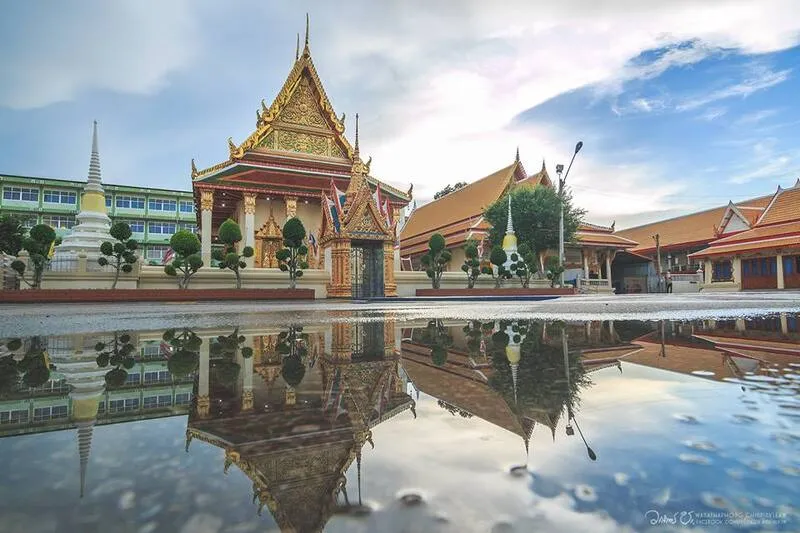
Wat Chong Lom, Ratchaburi is an old royal temple in the historic quarter of Ratchaburi. Formerly known as Wat Chang Lom, it was later renamed Wat Chong Lom and gradually became a long-standing spiritual center for local people. The temple’s greatest highlight is Luang Pho Kaen Chan, a sacred standing Buddha image in the alms-receiving posture that the people of Ratchaburi deeply revere as one of the province’s most important guardian images. For visitors looking for a major temple in the city center with convenient access, close to the museum, Wat Mahathat, and the old quarters of Ratchaburi, Wat Chong Lom is one destination that should not be overlooked.
Wat Chong Lom, Ratchaburi is an important temple located on Woradet Road, Na Mueang Subdistrict, Mueang Ratchaburi District, Ratchaburi Province, within the historic old town that forms the cultural heart of the province. The temple is not merely a place for monks and Buddhists to perform religious activities, but also a site that reflects the long continuity of Ratchaburi as an old city that developed from ancient times through the Ayutthaya period and into the Rattanakosin era. As soon as visitors enter the temple grounds, they can immediately feel the atmosphere of a living old city temple. It is not a static historical site frozen in the past, but a temple that still welcomes people every day, including worshippers making merit, devotees paying respect to Luang Pho Kaen Chan, those coming to pray before important occasions in life, and travelers wishing to understand Ratchaburi through its religious and cultural roots.
One of Wat Chong Lom’s greatest strengths is its location right in the city center. Unlike some temples that require deeper travel into local communities or outside the urban area, Wat Chong Lom stands in a district that connects easily to multiple styles of tourism in a single day. It suits those interested in temple visits, museums, old-town walks, and local food exploration. Visitors who begin their route at Wat Chong Lom can conveniently continue to Wat Mahathat Worawihan, the Ratchaburi National Museum, the old Koi Kee Market, or long-established restaurants in the city center. This makes the temple more than just a stop for worship; it serves as a gateway into the broader story of Ratchaburi itself.
According to the temple’s recorded history, Wat Chong Lom was founded in 1868 during the reign of King Mongkut. This means the temple has existed for more than 150 years. When viewed in relation to its setting, the temple also stands within a district that had long been historically significant even before its formal establishment. Its importance therefore does not lie only in its documentary age, but also in the fact that it grew together with the old urban community of Ratchaburi. A major temple located in the center of a city often indicates that the surrounding area once served as a hub of daily life, trade, administration, transportation, and local activities. Wat Chong Lom should therefore be understood as one of the city’s key social institutions, not only as a religious site in a narrow sense.
The temple’s former name was “Wat Chang Lom,” a name that sounds striking and memorable, suggesting a temple named after a real event that took place in the area. Local tradition says that to the west of the temple there was once a place where government elephants were kept. These elephants regularly passed through the area on their way to drink and bathe in the Mae Klong River, until one elephant reportedly slipped into muddy ground and fell. Local people then began calling the temple “Wat Chang Lom,” meaning the temple of the fallen elephant. This name clearly reflects an old Thai pattern of naming temples based on landscape, events, or shared local memory.
Later, around 1932, the temple was renamed “Wat Chong Lom,” a name considered more graceful and auspicious. The renaming is associated with the visit of Somdet Phra Maha Samana Chao Krom Phraya Vajirananavarorasa, who regarded the old name as inauspicious and bestowed the new one. The new name carries a softer tone and creates an image of openness, breeze, calmness, and quiet, fitting the character of a temple in an airy urban riverside environment. The name “Wat Chong Lom” was therefore not merely a change of wording, but also a symbolic redefinition of the temple’s image.
Another major turning point in the temple’s development came when it was elevated to the status of a third-class royal temple on 12 July 1989. Becoming a royal temple reflects religious importance, institutional readiness within the ecclesiastical system, and recognition from both the state and society. In the context of Ratchaburi, which has several notable temples, the elevation of Wat Chong Lom confirms that it holds a prominent role. It is not simply an ordinary community temple, but one with real historical weight and enduring public devotion.
When considering the layout of the temple grounds, Wat Chong Lom reveals the charm of an old city temple that is not grand because of massive scale, but because of atmosphere and detail. The buildings within the temple are arranged in proportions that feel close and approachable rather than overwhelming. The grounds are open enough for visitors to clearly see the main elements, while still offering peaceful corners for prayer, quiet reflection, and unhurried architectural appreciation. The appeal of this kind of temple lies in the way it blends sacred space with the daily rhythm of urban life. People can stop by easily, which helps the temple remain part of living practice rather than becoming a silent monument.
The spiritual heart of Wat Chong Lom is “Luang Pho Kaen Chan,” a sacred Buddha image in the standing alms-receiving posture that is deeply revered by the people of Ratchaburi. The image stands out from other Buddha images of the same posture in both material and form, and it is surrounded by narratives that strengthen its sacred reputation. Tourism sources describe Luang Pho Kaen Chan as being approximately 2.26 meters tall, made of bronze alloy, with the lower section carved from fragrant sandalwood. One of the distinctive features is that the alms bowl appears to be wrapped in a cloth bag, while both hands hold the rolled cloth extending from the bowl. This unique appearance makes the image instantly recognizable.
The significance of Luang Pho Kaen Chan extends far beyond artistic value. In the minds of local people, it is one of Ratchaburi’s protective Buddha images and a spiritual symbol of the city. The sacred reputation of the image has been passed down through generations by stories of prayer, vows, acts of devotion, and visits made before important journeys or life events. Many people who grew up in Ratchaburi know the name Luang Pho Kaen Chan from childhood. For travelers, hearing it described as a major sacred image of the province immediately signals that this is not just another Buddha image in an ordinary temple, but a true focus of local faith.
The history of Luang Pho Kaen Chan survives in two major narrative traditions, both of which reflect the Thai tendency to weave together history, devotion, and legend. The first account says that the image was originally created in Kanchanaburi. The story begins with a man who entered the forest and encountered a tiger. He escaped by climbing a tree and made a vow that if he survived, he would carve a Buddha image from that very tree. After safely escaping, he returned with others to cut the tree and discovered that it was fragrant sandalwood, a highly valued wood. The wood was then used to carve a Buddha image and enshrine it at Ban Kaeng Luang. Later, a great flood carried the image away along the Mae Klong River. Several temples attempted to bring it ashore but could not do so successfully. When the image drifted in front of Wat Chong Lom, however, the abbot was able to invite it ashore with ease, leading people to believe that the image had chosen to reside at this temple through spiritual power and karmic connection.
The second tradition is different and is closely tied to the former abbots of Wat Chong Lom itself. According to this version, Luang Pu Chan, the temple’s third abbot, was a skilled woodworker. He found the bronze head and upper torso of an old Buddha image and enshrined them in the temple’s earlier vihara. He then used fragrant sandalwood to carve and complete the lower section, creating the elegant standing Buddha image in the alms-receiving posture now known as Luang Pho Kaen Chan. Later, during a period when the old vihara remained flooded for a long time, it was said that Luang Pho appeared in a dream to Luang Pu Po, or Phra Ratchakhemajan, the temple’s fourth abbot, saying that his foot was in pain. When the image was examined, the wooden foot was found to have been damaged by termites. It was then repaired and moved to a more suitable place. This story adds another layer of intimacy to local faith, because the image is not remembered merely as one that floated to the temple, but as one that has remained alive in the spiritual consciousness of the community through dreams, belief, and continuing care.
Although the two traditions differ in detail, they share the same central idea: Luang Pho Kaen Chan came to Wat Chong Lom through merit and spiritual destiny, whether by floating from another region or by being completed by a talented abbot of the temple itself. Both stories allow people to view the image as more than a work of art. In other words, Luang Pho Kaen Chan is not simply a precious object in the temple, but a sacred narrative that developed alongside the identity of Wat Chong Lom and the city of Ratchaburi.
In Buddhist art, the alms-receiving posture carries deep symbolic meaning because it refers to the image of the Buddha going out on alms round to benefit living beings. It conveys simplicity, calmness, compassion, and the closeness of Buddhism to ordinary life. For an urban community facing the pressures and speed of daily existence, this posture can be especially moving. Many people therefore come to pay respect to Luang Pho Kaen Chan in the hope of receiving blessings for peace, stability, and smoothness in life.
Beyond Luang Pho Kaen Chan, the temple contains other features that enrich the visit. One of them is the four-gabled vihara that houses the sacred image, giving the worship space both dignity and accessibility. The temple also contains the ordination hall, two Buddha images in the Mara-victory posture, and the “chedi of jars,” built in 1902 during the period of Phra Kru Bai Dhammachoto, a former abbot. These elements show that the importance of Wat Chong Lom does not rest on Luang Pho Kaen Chan alone. The entire temple possesses historical and artistic layers worth exploring carefully.
Another culturally significant feature is the Chinese gateway of Wat Chong Lom, which has been noted as an example of Teochew Chinese craftsmanship and as important evidence of the relationship between the Chinese community and the city of Ratchaburi. This gateway is not merely decorative. It is a social trace showing that the temple area and its surrounding community were once linked to Chinese households and trade networks. The presence of Chinese art within a Thai temple reflects the identity of Ratchaburi very well, because the city has never been culturally uniform. Instead, it has long been shaped by the coexistence of different communities and ways of life.
In terms of temple administration, the current abbot of Wat Chong Lom is Phra Mongkhon Wachirawutthachan (Prakop Panyathipo), who also holds a role within the monastic administration of Ratchaburi Province. Information about the abbot is not a minor detail. It is an important part of understanding the temple as an institution, because it reflects continuity in management, conservation, and religious activities. When a temple has a clearly identified leader who remains active, it is a strong sign that the temple continues to function as a living religious center rather than merely existing as a site for sightseeing.
Looking back at the succession of monks connected to Wat Chong Lom, one can see that the temple’s importance has been carried through many respected abbots and senior monks, especially those linked to the stories of Luang Pho Kaen Chan, such as Luang Pu Chan and Luang Pu Po. Their presence in the temple’s memory means that Wat Chong Lom does not preserve only the history of buildings, but also the history of the people who created, protected, restored, and passed on the meaning of the temple to later generations.
In the dimension of daily life, Wat Chong Lom has long served as a spiritual center for the people of Ratchaburi. Making merit, paying respect, offering alms to monks, or simply stopping by for a moment of peace on an ordinary day are all practices that still take place here. This matters because a temple that continues to be used in real life has a very different energy from one that survives only as a historical monument. Some people come specifically to worship Luang Pho Kaen Chan. Others come because they are exploring the city and feel that they should pay respect to one of the province’s most sacred images before leaving. Still others visit on family occasions, such as starting a new job, moving house, taking an important exam, or seeking blessings for smoother life circumstances. In quiet ways, the temple continues to connect outer life with inner life.
Another point worth mentioning is the connection between Luang Pho Kaen Chan and ceremonial life in Ratchaburi. Tourism information records traditions in which the image has been invited to important provincial festivals, and there were also occasions when military units in the area invited the image to be enshrined temporarily for public worship. This further reinforces its status as more than the principal image of a single temple. It is a symbol of faith that helps unite the people of the city. When a Buddha image can be moved beyond temple boundaries into public ceremonial space, it indicates a level of importance that is difficult to deny.
For travelers, Wat Chong Lom has the major advantage of being easy to visit. It requires no complicated planning, and it does not take a full day to appreciate its character. With around 30 minutes to an hour, visitors can pay respect to Luang Pho Kaen Chan, walk around the vihara, observe architectural details, take photographs from attractive angles, and continue on to nearby attractions. Those who want a quieter atmosphere should consider visiting in the morning or late afternoon, when the light is softer, the weather is less intense, and the mood feels more personal than during midday.
Getting to Wat Chong Lom is very convenient. Travelers driving from Bangkok can use Phetkasem Road toward Ratchaburi and then continue into Mueang Ratchaburi District before heading to Woradet Road. The total distance from Bangkok is a little over 100 kilometers, depending on the starting point and traffic conditions. Visitors traveling by train can get off at Ratchaburi Railway Station and continue by local transport to the temple without difficulty. Those arriving by van or bus can also get off in the city and continue by local transport. One of the main advantages is that the temple lies within the old urban area rather than along a confusing rural route, making it suitable both for well-planned visits and spontaneous stops during a city trip.
Getting There
If you want to make the most of your visit, a practical route would be to begin at Wat Chong Lom, continue to the Ratchaburi National Museum, which is very close by, then visit Wat Mahathat Worawihan, and finally explore the old quarters and local restaurants in the city. This makes a one-day Ratchaburi trip far more meaningful, because it turns the day into a broader reading of the city through its temple, museum, food, and long-established community.
Visitors planning to worship Luang Pho Kaen Chan should dress respectfully, avoiding clothing that is too short or overly tight, and should maintain a calm manner inside the vihara. Although the temple stands in the city and is easy to access, its core identity remains that of a sacred place. Photography is possible in many areas, but it should be done appropriately without disturbing people who are praying or taking part in religious activities. For those traveling with elderly family members, this temple is also easier to access than hilltop temples or temples requiring long walks through extensive grounds.
From the perspective of cultural tourism, Wat Chong Lom stands apart from larger, more famous temples that impress mainly through grand scale or dramatic scenery. The distinct value of this temple is deeper. It tells the story of Ratchaburi through devotion, narrative, and architecture. Those who prefer temples with meaning rather than spectacle will likely find Wat Chong Lom especially memorable, because visiting here is not just about seeing something beautiful, but about standing in a place where generations of local people have left their hope, reverence, and shared memory.
When considered together with the status of Luang Pho Kaen Chan as one of Ratchaburi’s most revered Buddha images, it becomes even clearer that Wat Chong Lom gives the word “Ratchaburi” a deeper emotional dimension. A city may have markets, food, rivers, and art, but the presence of a major temple to which people across the city remain spiritually connected is what gives the city a true cultural core. Wat Chong Lom fulfills that role, and Luang Pho Kaen Chan stands at the center of that shared feeling.
To summarize clearly, Wat Chong Lom, Ratchaburi, is an old city temple with value in three major dimensions: historical value through its foundation and the evolution of its name; artistic value through Luang Pho Kaen Chan, the vihara, the Chinese gateway, and other historic features; and spiritual value through the continuous devotion of local people. The temple is therefore well suited to visitors who wish to worship, seek blessings, learn local history, or experience the old quarter of Ratchaburi in a deeper way.
For those planning a trip to Ratchaburi and looking for a place that genuinely reflects the identity of the city, Wat Chong Lom is one of the clearest answers. It offers not only a beautiful temple setting, but also stories, devotion, cultural roots, and the rhythm of local life all in one place. After paying respect to Luang Pho Kaen Chan, walking through the temple, and looking out toward the old district nearby, it becomes easy to understand why this temple has remained in the hearts of local people for so long.
| Place Name | Wat Chong Lom Royal Temple, Ratchaburi |
| Address | 90 Woradet Road, Na Mueang Subdistrict, Mueang Ratchaburi District, Ratchaburi 70000 |
| Place Summary | A third-class royal temple in the old quarter of Ratchaburi, it is one of the province’s important temples and the enshrinement site of Luang Pho Kaen Chan, a standing Buddha image in the alms-receiving posture that is deeply revered by local people. |
| Highlights | Luang Pho Kaen Chan, the four-gabled vihara, the former name Wat Chang Lom, the Teochew-style Chinese gateway, the jar chedi, and its location near the old town and many major landmarks |
| History | Founded in 1868, originally named Wat Chang Lom, later renamed Wat Chong Lom around 1932, and elevated to royal temple status in 1989 |
| Main Sacred Features | Luang Pho Kaen Chan, a standing Buddha image in the alms-receiving posture approximately 2.26 meters high, the ordination hall, two Buddha images in the Mara-victory posture, the jar chedi, the Chinese gateway, and the bell tower |
| Name Origin | Originally called Wat Chang Lom after an elephant reportedly fell in the area near the temple, then later renamed Wat Chong Lom to give it a more auspicious meaning |
| Current Abbot / Temple Caretaker | Phra Mongkhon Wachirawutthachan (Prakop Panyathipo) |
| Open Days | Open daily |
| Opening Hours | 07:00 – 17:00 |
| Fees | No admission fee |
| Facilities | Temple courtyard, worship areas, parking in the surrounding city area, walkways within the temple, and many shops and restaurants within walking distance |
| Getting There | By car from Bangkok, take Phetkasem Road into Ratchaburi city, then continue to Woradet Road; by train, get off at Ratchaburi Railway Station and continue by local transport; vans and buses also stop in the city, from where local transport to the temple is easy to find |
| Current Status | Open for visits and worship as usual |
| Temple Contact Number | 032-321-537 |
| Zone | Ratchaburi Old Town Zone / Ratchaburi City Center / Historic Riverside District |
| Nearby Attractions with Distance | 1. Ratchaburi National Museum – approximately 0.16 km – Woradet Road / Old Town Zone 2. Wat Mahathat Worawihan – approximately 0.16 km – Historic City Center Zone 3. D Kunst Art Museum – approximately 0.16 km – Old Town / Arts and Culture Zone 4. Koi Kee Old Market – approximately 0.8 km – Old Commercial and Local Food Zone 5. Ratchaburi City Pillar Shrine – approximately 1.2 km – Sacred City Landmark Zone |
| Popular Restaurants Nearby with Distance | 1. Thanks – approximately 0.64 km – Café / Old Town Zone 2. Kam Cheng Noodles – approximately 0.48 km – Old Town Classic Eatery Zone – Tel. 032-323-278, 093-264-9856 3. R-tee Kopee – approximately 0.64 km – Breakfast / Vintage Café Zone 4. Mai Thai – approximately 0.8 km – City Restaurant Zone 5. Den Thai Ice Cream – approximately 1.1 km – Sanam Ya Market / Dessert Zone – Tel. 081-001-9339 |
| Popular Accommodations Nearby with Distance | 1. Vanilla River – approximately 0.7 km – Riverside / Old Town Zone – Tel. 092-262-8264 2. HOP INN Ratchaburi – approximately 0.75 km – City Center / Easy Access Zone – Tel. 02-659-2899 3. Numsin Hotel – approximately 0.88 km – Traditional City Center Zone – Tel. 032-337-551 4. SANS Hotel Ratchaburi – approximately 0.89 km – City Center / Dining and Leisure Zone – Tel. 032-913-244, 098-398-8896 5. Western Grand Hotel Ratchaburi – approximately 1.1 km – Old Phetkasem Road / Commercial Zone – Tel. 032-313-888, 086-752-0082 |
Frequently Asked Questions (FAQ)
Q: What time does Wat Chong Lom, Ratchaburi open?
A: The latest verified information states that the temple is open daily from 07:00 to 17:00.
Q: What is the main highlight of Wat Chong Lom?
A: The temple’s most important highlight is Luang Pho Kaen Chan, a sacred standing Buddha image in the alms-receiving posture that the people of Ratchaburi deeply revere as one of the province’s most important sacred images. The temple also features a four-gabled vihara, a Chinese gateway, and the charming atmosphere of an old city temple.
Q: What is the history of Wat Chong Lom?
A: Wat Chong Lom was founded in 1868 and was originally known as Wat Chang Lom. It was later renamed Wat Chong Lom and eventually elevated to the status of a third-class royal temple. It remains one of the historically important temples of Ratchaburi.
Q: Who is Luang Pho Kaen Chan?
A: Luang Pho Kaen Chan is a standing Buddha image in the alms-receiving posture, approximately 2.26 meters tall, enshrined at Wat Chong Lom. It is widely known for its sacred reputation and for the legends connected to it, making it one of the most important sacred images in Ratchaburi Province.
Q: How do I get to Wat Chong Lom?
A: If traveling from Bangkok, you can drive along Phetkasem Road into Ratchaburi city and continue directly to Woradet Road. If traveling by train, get off at Ratchaburi Railway Station and continue into the city by local transport. Vans and buses also arrive in the city center, where local transport to the temple is easy to find.
Q: Is there an entrance fee for Wat Chong Lom?
A: In general, there is no admission fee. Visitors may enter the temple during opening hours, but respectful dress and appropriate behavior are recommended at all times.
Q: What places can I visit after Wat Chong Lom?
A: It is very convenient to continue your trip to nearby places such as the Ratchaburi National Museum, Wat Mahathat Worawihan, Koi Kee Old Market, and several long-established local restaurants in the city center, since they are all located in the same general area or within a short distance.
 Wat Chong Lom Map
 Category:
  Group:
  Last Update: 59 MinuteAgo
Comment
 Nearby Attractions
| Keyword (Advance) |
 Region
|
 Muang Ratchaburi(