
Bueng Bua
Rating: 3.8/5 (5 votes)
Search By |
Map Map Map Have Map Have Map No Map No Map

Prachuap Khiri Khan attractions

Attractions in Thailand

Open Days: Open daily according to the operating hours of Khao Sam Roi Yot National Park and depending on the availability of boat rides and visitor activities in the area
Opening Hours: The most popular times to visit are from morning to late morning and in the afternoon, when the light is beautiful, the weather is not too hot, and the conditions are ideal for birdwatching
 
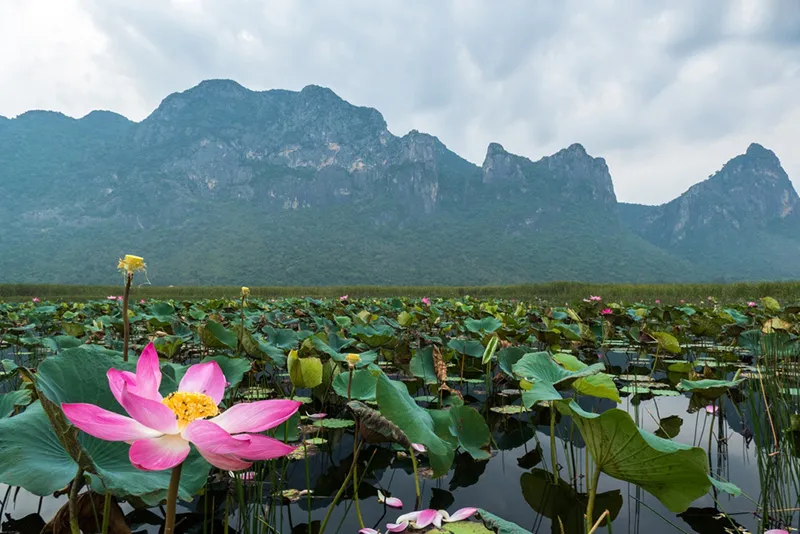
Thung Sam Roi Yot, also widely known among travelers as Bueng Bua, is a vast freshwater wetland within Khao Sam Roi Yot National Park in Prachuap Khiri Khan Province. Its highlights include the scenic wetland landscape set against a backdrop of limestone mountains, the richness of aquatic plants and birdlife, and the peaceful atmosphere that makes it ideal for boat rides, birdwatching, and nature photography.
 
Thung Sam Roi Yot is one of the most important natural landscapes in Prachuap Khiri Khan Province and serves as the ecological heart of Khao Sam Roi Yot National Park in a way that many visitors may not yet fully understand. Although the park is often associated with Phraya Nakhon Cave, limestone mountains, or beautiful seaside beaches, in reality it is the freshwater wetland of Thung Sam Roi Yot that forms one of the key elements making this national park so distinctive and different from typical coastal parks.
 
Thung Sam Roi Yot is located on the western side of Khao Sam Roi Yot National Park, between the Southern Railway line and the Sam Roi Yot mountain range. Its geographical character is a low-lying plain that remains flooded with freshwater throughout the year, creating a highly fertile wetland. This makes the area extremely rich in aquatic plants, waterbirds, aquatic animals, and many other forms of life. A landscape like this is not merely a scenic viewpoint, but an ecosystem that plays a major role in the health and balance of the wider region.
 
From a visual perspective, Thung Sam Roi Yot has a very distinctive charm compared with other natural attractions. The sight of a broad freshwater marsh stretching into the distance, lined with reeds, grasses, and diverse wetland plants, with unusual limestone peaks rising behind it, gives the area a calm, soft, and deeply layered landscape. Many first-time visitors therefore feel that its beauty is not immediately dramatic like that of a beach or a mountain summit, but rather a quiet beauty that gradually reveals itself through atmosphere, silence, and the sense that nature is continuing at its own rhythm.
 
Another name that is often more familiar to the public than “Thung Sam Roi Yot” is “Bueng Bua,” which is an important tourist point within the same area. The name Bueng Bua comes from the image of a water body covered with lotus plants and a wooden boardwalk extending into the marsh toward a viewing pavilion. This allows visitors to experience the wetland much more closely. In tourism terms, Bueng Bua has become the iconic image of Thung Sam Roi Yot, while in geographical and ecological terms, the entire area is a large freshwater wetland that forms an essential part of Khao Sam Roi Yot National Park.
 
The importance of Thung Sam Roi Yot is not limited to its role as a tourist attraction. It is also connected to the significance of Khao Sam Roi Yot National Park as Thailand’s first marine national park, established in 1966. Wetland areas such as Thung Sam Roi Yot are therefore part of the broader natural composition that makes this park remarkable, bringing together sea, beaches, limestone mountains, caves, and freshwater wetlands in a single protected area. This diversity is what makes Khao Sam Roi Yot one of the most valuable natural regions in the lower western part of Thailand.
 
From an ecological point of view, Thung Sam Roi Yot is a large freshwater habitat that functions like a home for countless living creatures. The plant life in the area not only creates beautiful scenery, but also provides food, shelter, and nesting grounds for a large number of birds. Waterbirds in particular, both resident species and migratory species, depend on the area according to the season. Wetlands like this therefore have value far beyond being a place for photographs, because they are truly systems that sustain life.
 
The birdlife of Thung Sam Roi Yot is one of the main reasons the area is frequently mentioned by both nature travelers and birdwatchers. Khao Sam Roi Yot National Park is regarded as one of Thailand’s important birdwatching destinations, and the freshwater wetland here plays a very clear role in supporting a wide variety of species. These include waterbirds, some shorebirds during certain periods, and migratory birds that use the wetland as a resting and feeding ground. Throughout the year, visitors may see birds flying over the water, perching among the marsh plants, or feeding along the edges of the wetland.
 
In addition to birds, Thung Sam Roi Yot is also home to many aquatic animals, including fish, small freshwater creatures, and other life forms living among the wetland plants and in the shallow water. This ecosystem creates a relatively complete food chain and is one of the major reasons why birds continue to make use of the area so consistently. As long as the water, plants, and aquatic life remain in balance, the wetland will continue to hold high biological value.
 
The vegetation of Thung Sam Roi Yot plays an important role both in terms of beauty and ecological function. Reeds, grasses, and other aquatic plants help filter the water, reduce wind intensity in some parts of the wetland, and create the complexity that many animal species need for survival. These plants also contribute to the softness and calm beauty of the landscape and allow the atmosphere of the wetland to change attractively with the seasons. At some times, the water may appear broad and open, while at others the dense plant cover makes the area resemble a vast green field.
 
Another charm of Thung Sam Roi Yot is that it is a place one can keep looking at for a long time. Many visitors discover that it is not a destination where they need to rush to see everything, but a place where the longer they remain, the more detail they begin to notice—birds moving among the reeds, the swaying of marsh plants in the wind, changing patterns of light across the water, and the distant outlines of mountains. All of this combines into an experience very different from fast-paced travel.
 
For those who enjoy photography, Thung Sam Roi Yot offers tremendous potential. It provides both wide panoramic landscape views and intimate natural details at the level of individual plants and birds. The wooden boardwalk stretching into the marsh is one of the most recognizable images of the area. Morning and evening offer especially beautiful light, making them ideal for photographing broad views, waterbirds, and the reflections of marsh water against the mountain backdrop. On calm days with clear skies, the images captured here can be so stunning that they require almost no further editing.
 
In terms of the visitor experience, one of the things many people find most memorable is the opportunity to take a boat or use a local punting service to explore the area more closely than from the roadside. Activities like these allow visitors to experience the ecosystem from a lower, more immersive perspective, better understand the scale of the wetland, and observe birds and aquatic plants from angles that differ from those seen from the boardwalk. Boat trips also help connect tourism with the community, because some of the boat operators are local residents who have lived with this wetland for a long time.
 
From the perspective of local community life, provincial information also indicates that people living near Thung Sam Roi Yot have long had a deep connection with the wetland, particularly as a water source, a freshwater fishing area, and part of everyday life. The wetland is therefore not simply something that visitors come to admire, but a resource that local people have valued and relied on for generations. A strong article should therefore present Thung Sam Roi Yot not only as “beautiful,” but as a living landscape tied to real people.
 
Compared with other natural attractions in Prachuap Khiri Khan, Thung Sam Roi Yot is unique in that it is not directly the sea, not simply a mountain, and not a cave. Instead, it is a wetland that functions as a meeting point between several ecosystems. Travelers visiting Prachuap who want to see nature in a broader way than only bays or beaches should make time to stop here, because Thung Sam Roi Yot completes the province’s natural picture in a remarkable way.
 
The best times to visit Thung Sam Roi Yot are generally from morning to late morning and in the late afternoon, when the light is beautiful, the weather is not too hot, and many forms of wildlife, especially birds, are more active than during the harsh midday heat. If birdwatching or serious nature photography is the goal, visiting early in the day provides a clear advantage. At the same time, late afternoon offers a gentler and more romantic mood, making it ideal for general travelers who simply want to enjoy the scenery in a relaxed way.
 
Reaching Thung Sam Roi Yot is relatively easy compared with many large natural attractions in Thailand, because the main visitor area can be reached conveniently by car and there is reasonably clear guidance from the Tourism Authority of Thailand, the national park, and provincial agencies. Most travelers use Bueng Bua as their primary reference point because it has the nature boardwalk and serves as an easy starting point for first-time visitors.
 
Getting There to Thung Sam Roi Yot generally begins by entering Khao Sam Roi Yot National Park via the Bueng Bua side or the birdwatching center, which lies in the western wetland zone of the park. If coming from Hua Hin or Pran Buri, visitors can drive along Phetkasem Road and then turn toward the Sam Roi Yot route. Travelers who want a closer experience of the wetland may also ask local people about boat punting or small boat rides in the area. It is advisable to check current conditions and park opening times in advance. A commonly published contact number for Khao Sam Roi Yot National Park is 032-821-568, and official channels also provide a government call center during business hours.
 
For first-time visitors, the most important advice is to bring a hat, sunglasses, drinking water, and sun protection, because much of the area is open and exposed. If your main purpose is birdwatching, bringing binoculars or a zoom lens will make the experience much better than relying on a phone alone. Visitors should also respect the natural environment by avoiding loud noises, not littering, and not trying to get too close to birds or aquatic animals. The essence of visiting Thung Sam Roi Yot is to experience nature as it continues in its own rhythm.
 
In the end, Thung Sam Roi Yot is not simply another tourist attraction in Prachuap Khiri Khan, but a place that vividly explains the meaning of abundance and ecological richness. Here there is freshwater, wetland vegetation, many bird species, aquatic animals, local community life, and a landscape more beautiful than any short description can fully express. Standing on the wooden boardwalk over the marsh or looking across the water toward the limestone mountains immediately makes it clear why this area remains one of the most important natural destinations in Thailand and one that deserves careful conservation.
 
Place Name Thung Sam Roi Yot (Bueng Bua), Khao Sam Roi Yot National Park
Location Wetland area on the western side of Khao Sam Roi Yot National Park, Sam Roi Yot District, Prachuap Khiri Khan Province
Reference Address on Shore Bueng Bua, Khao Sam Roi Yot National Park, Sam Roi Yot Subdistrict, Sam Roi Yot District, Prachuap Khiri Khan Province 77120
Highlights A vast freshwater wetland within Khao Sam Roi Yot National Park, with a nature boardwalk, beautiful limestone mountain scenery, and one of Thailand’s major birdwatching areas
Type of Place A low-lying freshwater marsh with standing water throughout the year, rich in aquatic plants, resident birds, migratory birds, and many species of aquatic animals
History / Background An important part of Khao Sam Roi Yot National Park, established in 1966, and one of the wetland areas that contributes ecological diversity to Thailand’s first marine national park
Natural Importance A habitat for many bird species, both resident and migratory, and also home to aquatic animals and wetland plants within a freshwater ecosystem
Travel Drive into Khao Sam Roi Yot National Park via the Bueng Bua / birdwatching center side. Visitors can walk along the nature boardwalk, and during some periods local punt boats or small boat services may also be available
Current Status Still one of the park’s key nature attractions, ideal for birdwatching, photography, and learning about wetland ecosystems
Contact Number Khao Sam Roi Yot National Park Tel. 032-821-568
Nearby Accommodations 1. BaanRukTalay Sam Roi Yot Beach – about 11 km Tel. 064-639-8242, 096-915-4246, 032-825-168
2. The Green Beach Resort – about 12 km Tel. 082-232-9935
3. Dolphin Bay Resort – about 14 km Tel. 032-825-190, 095-775-7357
4. Long Beach Inn – about 14 km Tel. 086-064-5841, 032-559-068
5. Sam Roi Yot 302/4 (National Park Accommodation) – about 15 km Reservation through the National Park booking system
Nearby Attractions 1. Bueng Bua Birdwatching Center – 1 km
2. Khao Sam Roi Yot National Park – 1 km
3. Khao Daeng Viewpoint – about 8 km
4. Sam Phraya Beach – about 14 km
5. Phraya Nakhon Cave – about 20 km
Nearby Restaurants 1. Krua Chom Talay Sam Roi Yot – about 13 km Tel. 032-559-364
2. Jim Daeng Seafood – about 12 km Tel. 093-248-9911
3. Cafe Loma – about 14 km Tel. 032-825-190, 095-775-7357
4. La a Natu Bed & Bakery – about 18 km Tel. 032-689-941, 032-689-942, 092-254-7424
5. Pa Euang-Pa Ing – about 21 km Tel. 085-182-2161, 087-167-0401
 
Frequently Asked Questions (FAQ)
Q: Where is Thung Sam Roi Yot located?
A: Thung Sam Roi Yot is located on the western side of Khao Sam Roi Yot National Park in Prachuap Khiri Khan Province. It is a large freshwater wetland situated between the Southern Railway line and the Sam Roi Yot mountain range.
 
Q: Are Thung Sam Roi Yot and Bueng Bua the same place?
A: Bueng Bua is a major visitor area within Thung Sam Roi Yot, and it is the name many travelers commonly use for the wetland.
 
Q: What is Thung Sam Roi Yot famous for?
A: It is famous for being a vast freshwater wetland with beautiful limestone mountain scenery, rich aquatic vegetation, waterbirds, and aquatic animals, as well as being one of Thailand’s important birdwatching destinations.
 
Q: When is the best time to visit Thung Sam Roi Yot?
A: The best time is from morning to late morning or in the late afternoon, when the weather is not too hot, the light is beautiful, and the conditions are suitable for birdwatching and nature photography.
 
Q: Is it possible to take a boat ride at Thung Sam Roi Yot?
A: During some periods, visitors can use local punt boats or small sightseeing boats, but it is best to ask the park or local providers in advance for current details.
 
Q: Who is Thung Sam Roi Yot suitable for?
A: It is suitable for people who enjoy nature, birdwatching, scenic photography, and peaceful travel, as well as for families who want children to learn about real wetland ecosystems.
 Bueng Bua Map
Nature and Wildlife Category: Nature and Wildlife
Last UpdateLast Update: 21 HourAgo


Comment

Comment


Keyword (Advance)
   
Email :
Password :
  Register | Forgot password
 

Facebook Fanpage Facebook Fanpage


Region Regionhttps://www.lovethailand.org/

Art, Culture and Heritage Art, Culture and Heritage

Historical Sites and Monuments Historical Sites and Monuments(3)

Landmarks and Memorials Landmarks and Memorials(1)

Royal Palace Royal Palace(1)

Art, Craft Centres, Tradition Art, Craft Centres, Tradition(1)

Art Gallery Art Gallery(1)

Educational Places Educational Places

Museum for Study Museum for Study(1)

Educational Gardens, Farm Educational Gardens, Farm(1)

University University

Places of Worship Places of Worship

Temple Temple(19/192)

Other religious and spiritural sites Other religious and spiritural sites(7)

Research and Development Research and Development

Royal Project Royal Project(1)

Suburban Living Suburban Living

Village, Community Village, Community(8)

Local Market Local Market(2)

Floating Market Floating Market(1)

Nature and Wildlife Nature and Wildlife

National Parks and Marine Reserves National Parks and Marine Reserves(6)

Mountain (Doi) Mountain (Doi)(7)

Dam, Reservoir, Lake Dam, Reservoir, Lake(6)

Waterfalls Waterfalls(10)

Caves Caves(14)

River, Canal River, Canal(1)

Bays and Beaches Bays and Beaches(19)

Islands Islands(5)

Other natural attractions Other natural attractions(3)

Entertainment and Agricultural Entertainment and Agricultural

Animal camps and shows Animal camps and shows(1)

Farm, Parks, Gardens and Ecotourism Farm, Parks, Gardens and Ecotourism(2)

Waterpark Waterpark(2)

Outdoor and Adventure Activities Outdoor and Adventure Activities(2)

Shopping Shopping

Shopping and Night Market Shopping and Night Market(5)

Travel Articles, Recipes Travel Articles, Recipes

Travel Review, Food Review Travel Review, Food Review(1)