

 Home
Home Chiang Mai(




Rating: 4.5/5 (6 votes)
 |
|  Map
Map 
 Have Map
  No Map
Prachuap Khiri Khan attractions
Attractions in Thailand
Open Days: Southern dusky leaf monkeys can be observed around Ao Manao and the foothills of Khao Lom Muak every day, depending on the visiting hours allowed within Wing 5
Opening Hours: The best times to visit are usually from early morning to late morning and again in the late afternoon, when the weather is not too hot and the monkeys are more likely to be active
The Southern Dusky Leaf Monkey is a member of the monkey family, easily recognized by the pale rings around its eyes that resemble a pair of spectacles. Visitors can see these monkeys around Khao Lom Muak and Ao Manao within Wing 5 in Prachuap Khiri Khan Province. What makes this place especially appealing is the chance to observe a rare wild animal against the striking backdrop of limestone mountains beside the sea, making it ideal for travelers who enjoy nature, wildlife, and peaceful travel experiences.
The Southern Dusky Leaf Monkey is one of the wild animals that leaves a strong impression on visitors to Prachuap Khiri Khan. Many people know the province for its beautiful beaches, curved bays, limestone mountains, and the quiet atmosphere of a coastal town. For those who look more deeply into the details of nature, however, the southern dusky leaf monkey adds another layer of charm to the area. It offers not only a sense of delight and fascination, but also an opportunity to learn about ecosystems up close in a place that is relatively easy to reach.
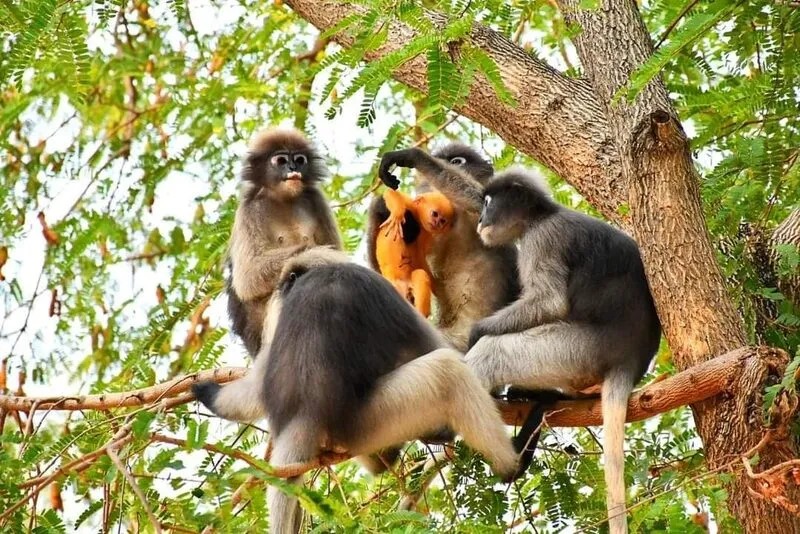
This animal is known in English as the Dusky Leaf Monkey, with the scientific name Trachypithecus obscurus. It is an Old World monkey species whose behavior differs quite a bit from macaques or other monkeys that tourists are more familiar with. The most distinctive feature of the southern dusky leaf monkey is the pale ring around the eyes, which makes it look as if it is wearing glasses. Its face is grayish, its hands and feet are dark, almost black, and its tail is very long in proportion to its body. These features make it easy to recognize at a glance as something different from an ordinary monkey.
The natural habitat of the southern dusky leaf monkey is found in tropical forests in southern Thailand, including limestone mountains and the forest canopy in areas with sufficient humidity. These monkeys spend most of their lives in trees, moving skillfully from branch to branch. Their main diet consists of leaves, flowers, young fruits, and seeds. They do not naturally depend on food provided by humans, and unlike some monkey species, they do not have cheek pouches for storing food temporarily.
In Prachuap Khiri Khan Province, the best-known place to observe southern dusky leaf monkeys is around the foothills of Khao Lom Muak and Ao Manao, within Wing 5 in Mueang Prachuap Khiri Khan District. It is not located in Wing 53, as some incorrect online information sometimes suggests. This area is a tourist zone under the care of the Royal Thai Air Force and is one of the major natural landmarks of Prachuap, because it combines the sea, mountains, and wildlife in one place.
What makes the southern dusky leaf monkeys at Khao Lom Muak particularly special is the setting in which they are seen. They are not found in deep jungle or inside a zoo, but rather among limestone mountains surrounded by the sea and the green landscape of Ao Manao. This kind of scenery gives visitors a rather unusual experience, because animals that many people assume can only be found in dense forests can instead be seen in a coastal tourist area that is easy to access and visually outstanding in the lower western region of Thailand.
Khao Lom Muak itself is a very famous limestone mountain in Prachuap Khiri Khan, known both as a viewpoint and as the destination of an official mountain-climbing activity that Wing 5 opens to the public only during selected periods according to formal announcements. Ao Manao, meanwhile, is a beautiful curved beach in the same area and is open to visitors. This landscape of mountain meeting sea creates a more diverse ecosystem than an ordinary beach and is one of the reasons why the dusky leaf monkeys are able to continue living here.
In terms of behavior, the southern dusky leaf monkey has a rather gentle rhythm of life compared with the monkeys that people usually know. They do not behave in a noisy or aggressive way like long-tailed macaques at some tourist attractions. They live and feed in groups, leap through the treetops, and spend part of their time resting so that their digestive system can process their fibrous, leaf-based diet. For this reason, the species clearly reflects the relationship between plant-eating animals and forest ecosystems, rather than that of animals that rely on scraps from humans.
When fully grown, the body fur of the southern dusky leaf monkey is usually dark gray or muted gray, as visitors can observe around Khao Lom Muak. The contrast of the light rings around the eyes gives the face a gentle and somewhat friendly expression, which is why the monkeys have become one of the “stars” of Ao Manao. Many visitors initially come for the beach, but in the end they are often even more impressed by the chance to see these monkeys, because it is such an unexpected experience to encounter an animal like this fairly closely in a coastal tourist area.
Another reason the southern dusky leaf monkeys in Prachuap Khiri Khan are so interesting is that they add much more depth to the tourism experience around Ao Manao and Khao Lom Muak. Even without the monkeys, the area would still be a beautiful seaside viewpoint. But once wildlife with distinctive features and a story of living among mountains and the coastline becomes part of the experience, the place shifts from being merely a “scenic viewpoint” to becoming a genuine “nature learning destination.” Many parents therefore enjoy bringing children here, because it becomes an opportunity to explain wildlife, the behavior of plant-eating animals, and the importance of not disturbing animals in nature.
The user’s original text mentioned that the monkeys come down to drink water, sunbathe, and sleep in trees at night. This broadly fits the behavior of leaf-eating primates that live in the forest canopy. For a general audience, however, it helps to explain more clearly that dusky leaf monkeys depend quite heavily on continuous tree cover and quiet surroundings. The fact that they continue to live around Khao Lom Muak suggests that the area still retains the basic elements of a suitable habitat, including trees, food sources, and a sufficient level of safety. It is therefore not only the mountain surrounded by the sea that matters, but also the balance between nature and human use of the area.
When discussing the history of the place, it is important to distinguish between the “history of the monkey species” and the “history of the tourist site.” The dusky leaf monkey itself is a wild animal that lives according to natural ecological conditions. The place where tourists go to see it, however, is Khao Lom Muak and Ao Manao, an area that has long been important in local history and has been connected with the Royal Thai Air Force for many years. Ao Manao is also recognized by the Tourism Authority of Thailand as one of the important seaside attractions of Prachuap, while Khao Lom Muak is known for its officially organized mountain-climbing activity managed by Wing 5 during certain periods of the year.
Looking at the place as a whole, the real uniqueness of the southern dusky leaf monkeys in Prachuap lies not only in the number of monkeys or how close they can be seen, but also in the setting in which they appear. Visitors can begin the day by walking along Ao Manao, admiring the beautiful curved beach, enjoying the orderly and clean atmosphere of the military area, stopping by Chao Pho Khao Lom Muak Shrine, and then quietly watching for the monkeys moving around nearby. This type of route offers the sea, mountains, history, and wildlife all in one day, something that is not easy to find in many ordinary tourist sites.
Even so, observing southern dusky leaf monkeys should always be based on the principle of not disturbing wildlife. Some visitors may want very close-up photos, try to call the monkeys over, or offer food to bring them nearer. These behaviors are not appropriate in the long run, because they can make the animals dependent on human food and alter their natural behavior. A good article should therefore always emphasize that “dusky leaf monkeys can be adorable without being touched,” and that the best experience is to watch them quietly from a proper distance.
For families traveling with children, seeing southern dusky leaf monkeys in their real environment is an excellent starting point for building an understanding of wildlife. Children can see that each species eats different food, moves in different ways, and depends on a particular environment of its own. When this is combined with the limestone mountain landscape of Khao Lom Muak beside the sea, both children and adults can more easily understand how one natural area may contain several overlapping components at once: beaches, trees, mountains, and wild animals.
Another major strength of writing an article about southern dusky leaf monkeys is that it connects with the interests of several groups of readers at the same time. The first group is people searching for things to do in Prachuap Khiri Khan. The second is those interested in wildlife and nature. The third is people already planning to visit Ao Manao or Khao Lom Muak and wanting to know what else they can see there. This gives the topic strong SEO potential, because one article can satisfy several search intents if it covers the animal, the place, and the travel information thoroughly.
If asked when the best time is to see the monkeys, the safest answer is when the weather is not too hot, such as from morning to late morning or in the late afternoon. At these times there are usually fewer tourists, and the monkeys are more likely to be active and visible. That said, wildlife sightings can never be guaranteed one hundred percent. Visitors should think of seeing the monkeys as a “bonus from nature” rather than an expectation like in a zoo. If they do see them, it is fortunate. Even if they do not, visiting Ao Manao and Khao Lom Muak is still worthwhile because of the area’s own natural and scenic value.
In the broader tourism context, the southern dusky leaf monkey gives Prachuap Khiri Khan a different image from that of an ordinary seaside town. Rather than offering only beaches or sunrise and sunset views, the province also has wildlife living alongside its natural landscape in an engaging way. Travelers who enjoy experiences deeper than simple check-ins therefore tend to remember this place very well. Seeing dusky leaf monkeys at Khao Lom Muak is not just about photographing an animal, but about witnessing nature still existing alongside the town and its tourism spaces in a delicate but visible balance.
For those planning a one-day trip in the Ao Manao area, this article should clearly show that watching the monkeys can easily be combined with other activities. One can begin by entering Ao Manao, walking along the beach, taking photos with Khao Lom Muak, stopping by Chao Pho Khao Lom Muak Shrine, watching the monkeys nearby, and then continuing on to enjoy seafood or drive into Prachuap town. This route is especially suitable for travelers who do not want physically demanding activities but still want nature, wildlife, and good food in a single day.
Getting There to see the southern dusky leaf monkeys generally starts with entering Wing 5 in the Ao Manao area of Mueang Prachuap Khiri Khan District. If coming from Prachuap town, it is only a short drive away and easy to reach by car. Ao Manao is the main reference point for the trip. Visitors interested in climbing Khao Lom Muak should check advance announcements from Wing 5, because the mountain is not open every day in the same way as the beach area.
Visitors should prepare a hat, drinking water, and a camera or phone with adequate zoom, along with comfortable walking shoes. If hoping to photograph the monkeys, it is better to rely on zoom rather than moving too close. Flash should not be used, and food should never be handed directly to the animals. This approach helps preserve both good photo opportunities and the monkeys’ natural behavior. Most importantly, visitors should remember that this area is a tourist destination shared by the general public and military personnel, so proper manners and strict compliance with the site’s rules are essential.
In the end, the southern dusky leaf monkeys at Khao Lom Muak and Ao Manao are one of the finer, more subtle charms of Prachuap Khiri Khan. They make visiting the area about more than beautiful beaches and delicious seafood, because they allow travelers to see that nature is still very much alive here—in the mountains, the bay, the trees, and the rare wild animals themselves. If approached with understanding and respect, what visitors take home will not be only photographs of the monkeys, but also the feeling that, for a moment, they witnessed the fragile balance of nature in a Thai coastal town at very close range.
| Place Name | Southern Dusky Leaf Monkey at Khao Lom Muak – Ao Manao |
| Location | Around Khao Lom Muak and Ao Manao, within Wing 5, Ko Lak Subdistrict, Mueang Prachuap Khiri Khan District, Prachuap Khiri Khan Province |
| Reference Address on Shore | Ao Manao, Wing 5, Ko Lak Subdistrict, Mueang Prachuap Khiri Khan District, Prachuap Khiri Khan Province 77000 |
| Highlights | Observe southern dusky leaf monkeys in a real natural setting around limestone mountains beside the sea at Khao Lom Muak and Ao Manao, where wildlife, sea, and mountains come together in one place |
| Type of Attraction | A semi-natural wildlife viewing site within the tourist zone of Wing 5, near Ao Manao and Chao Pho Khao Lom Muak Shrine |
| History / Background | Khao Lom Muak and Ao Manao are major landmarks of Prachuap town under the care of the Royal Thai Air Force, known both for their distinctive landscape and for wildlife that has adapted to living in the area |
| Animal Species | Southern Dusky Leaf Monkey (Dusky Leaf Monkey / Trachypithecus obscurus) |
| Distinctive Features | Pale eye-rings like spectacles, gray face, dark hands and feet, long tail, no cheek pouches, and a mostly plant-based diet |
| Travel | Drive into Wing 5 near Ao Manao, then walk around the foothills of Khao Lom Muak and the area near Chao Pho Khao Lom Muak Shrine |
| Current Status | Still one of the most popular places in Prachuap Khiri Khan to observe southern dusky leaf monkeys and an important part of the Ao Manao – Khao Lom Muak travel route |
| Nearby Accommodations | 1. Fah Chom Kluen Ao Manao – about 1 km Tel. 032-661-088-9, 032-611-017 ext. 60464–60465 2. Prachuap Grand Hotel – about 5 km Tel. 032-601-111, 061-442-5282 3. Hadthong Hotel – about 5 km Tel. 032-601-050, 032-611-111, 092-236-1111 4. Golden Beach Boutique Resort – about 4 km Tel. 032-601-626, 032-551-199 5. Tri-Shawa Resort – about 9 km Tel. 085-494-5454, 089-925-4199, 085-240-4029, 032-662-037 |
| Nearby Attractions | 1. Ao Manao – 1 km 2. Chao Pho Khao Lom Muak Shrine – 1 km 3. Khao Lom Muak – 1 km 4. Waghor – about 12 km 5. Ao Prachuap – about 6 km |
| Nearby Restaurants | 1. Krua Fah Chom Kluen – about 1 km Tel. 081-193-9321 2. Rab Lom Restaurant – about 6 km Tel. 081-621-1586 3. Kor Kla Coffee&Bar – about 4 km Tel. 032-601-626, 032-551-199 4. Milano Home Garden Cafe & Restaurant – about 6 km Tel. 092-269-5924 5. Rest & Roll Cafe – about 4 km Tel. 089-919-2898 |
Frequently Asked Questions (FAQ)
Q: Where can visitors see southern dusky leaf monkeys in Prachuap Khiri Khan?
A: The most popular place to see them is around Khao Lom Muak and Ao Manao within Wing 5, Mueang Prachuap Khiri Khan District.
Q: What kind of animal is the southern dusky leaf monkey?
A: It is a member of the monkey family, known in English as the Dusky Leaf Monkey, with distinctive pale rings around the eyes and a mainly plant-based diet.
Q: What do southern dusky leaf monkeys eat?
A: Their main diet consists of leaves, flowers, young fruits, and seeds. They should not be fed by tourists.
Q: When is the best time to see southern dusky leaf monkeys?
A: The best times are from morning to late morning or in the late afternoon, when the weather is not too hot and the monkeys are more likely to be active.
Q: Is Khao Lom Muak in Wing 5 or Wing 53?
A: Khao Lom Muak and Ao Manao are located within Wing 5 in Prachuap Khiri Khan Province.
Q: How should visitors behave when watching the monkeys?
A: They should observe from an appropriate distance, not feed the monkeys, not use flash, not make loud noise, and not try to approach or touch the animals.
 Southern Dusky Leaf Monkey Map
 Category:
  Group:
  Last Update: 24 HourAgo
Comment
 Nearby Attractions
| Keyword (Advance) |
 Facebook Fanpage
 Region
 Art, Culture and Heritage
 Historical Sites and Monuments(
 Landmarks and Memorials(
 Royal Palace(
 Art, Craft Centres, Tradition(
 Art Gallery(
 Educational Places
 Museum for Study(
 Educational Gardens, Farm(
 University
 Places of Worship
 Temple(
 Other religious and spiritural sites(
 Research and Development
 Royal Project(
 Suburban Living
 Village, Community(
 Local Market(
 Floating Market(
 National Parks and Marine Reserves(
 Mountain (Doi)(
 Dam, Reservoir, Lake(
 Waterfalls(
 Caves(
 River, Canal(
 Bays and Beaches(
 Islands(
 Entertainment and Agricultural
 Animal camps and shows(
 Farm, Parks, Gardens and Ecotourism(
 Waterpark(
 Outdoor and Adventure Activities(
 Shopping
 Shopping and Night Market(
 Travel Articles, Recipes
 Travel Review, Food Review(