

 Home
Home Chiang Mai(




Rating: 3.8/5 (4 votes)
 |
|  Map
Map 
 Have Map
  No Map
Phetchaburi attractions
Attractions in Thailand
Open Days: Daily
Opening Hours: 06:00 – 18:00 (best light: 07:00 – 09:00 and 16:00 – 18:00)
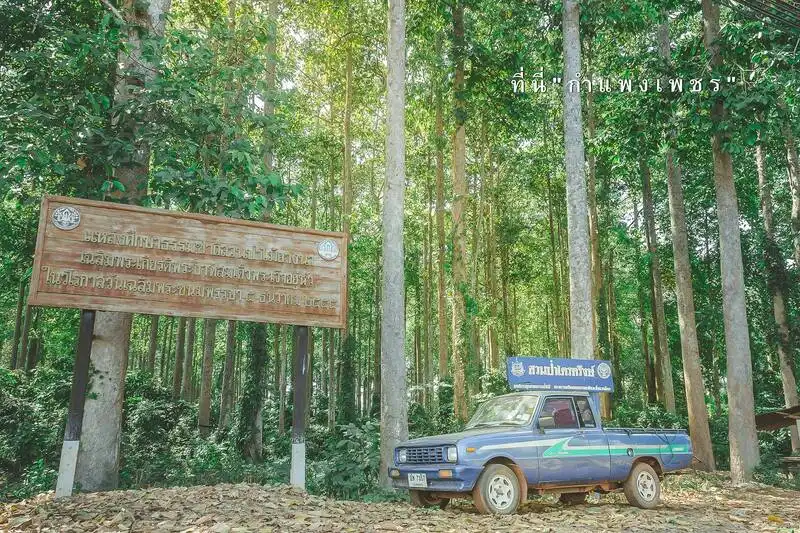
Yang Na Forest, Ban Nong Chang Tai is a striking roadside corridor of towering yang na trees along Phetkasem Road (Highway 4) in Tham Rong Subdistrict, Ban Lat District, Phetchaburi. It offers a rare “big-forest-by-the-road” atmosphere for central Thailand, defined by the trees’ slender height and dense shade that recalls an older, more natural Phetchaburi landscape. It works well as a short stop on the way, but safety—especially parking and walking near traffic—must come first.
Yang Na Forest, Ban Nong Chang Tai (Tham Rong Subdistrict, Ban Lat District, Phetchaburi) is the local name for a dense stretch of mature yang na woodland lining both sides of Phetkasem Road around Ban Nong Chang Tai. The area lies within a national reserved forest and is regarded as an important natural asset of Tham Rong. The visual that makes people slow down is the long line of massive trunks flanking the road, creating the feeling of driving through a green tunnel. Its appeal is not a newly built landmark, but the presence of genuine large trees still standing beside one of the region’s main routes, with the forest often described locally as having trees that are several hundred years old.
If you mostly picture Phetchaburi as Cha-am beaches, coastal viewpoints, or Kaeng Krachan, this stretch reveals a different side: a province that still retains fragments of lowland forest structure and large canopy trees close to communities. Yang na is a large dipterocarp (Dipterocarpaceae) and one of Thailand’s valuable timber species. Seeing many large yang na trees in one place is not only scenic; it is a sign that the area once had strong ecological richness and enough forest continuity to support long-term growth of large trees.
The biggest advantage of this roadside forest is accessibility. It sits right on a major highway, so you do not need a hike or a climb to reach a “green” view. You can stop briefly while traveling between Phetchaburi city, Ban Lat, and the Tham Rong area. That convenience comes with an important condition: road safety and respectful shared use of space. This is not a fenced park designed for leisurely strolling; it is a roadside forest edge that remains part of the area’s living landscape and a familiar visual marker for travelers.
Photographers usually prefer early morning or late afternoon. Angled light brings texture to the bark, and canopy shadows paint patterns across the grass and roadside edge, creating depth without staging anything. On days with post-rain humidity or a faint morning mist, the atmosphere can feel remarkably soft—almost like passing through a miniature old-growth corridor—despite being on a major provincial route.
For nature lovers, the forest is more than “big trees.” Mature yang na provides heavy shade that cools the ground layer and supports small-scale roadside ecology. Birds, insects, and other small organisms can use the canopy and edges as shelter and habitat. If you listen carefully in the morning, you may hear bird calls from above or notice insect activity along the forest margin—small signals that this roadside forest is still alive and functioning.
Yang na (Dipterocarpus alatus) is nationally recognized for both ecological and economic value. It typically occurs in lowland forests and near waterways, helping form the structural backbone of forest ecosystems. Where large yang na trees remain in numbers, it often indicates the landscape has maintained some degree of natural continuity and land use patterns that did not erase all large trees over the last several decades.
In Tham Rong, this forest resource also connects with the broader rural identity of the area, which includes the Phetchaburi River, local hills, and other iconic resources such as toddy palms that define Phetchaburi’s culinary and cultural reputation. That means you can build a coherent “rural Phetchaburi” day trip: pause for the yang na corridor, continue to local learning spaces such as palm-based communities, then return to the city for Phetchaburi sweets or heritage stops like Phra Nakhon Khiri. The route becomes a single story that links nature, food, and local identity.
Historically, the current understanding of this area emphasizes its role as a remaining yang na forest stretch along Phetkasem Road and as a visible “forest image” within a reserved forest zone close to settlements. Reserved-forest status helps explain why large trees have persisted even amid development and traffic. Because it is a roadside forest edge known mainly through travel and local communication, details may circulate as both local narrative and informal description. The best approach for visitors is simple: observe respectfully, avoid activities that could damage the ground layer, and contact the local authority if you want clearer guidance on safe viewing points for the day and time you plan to go.
The main practical challenge is parking. Phetkasem Road carries continuous traffic, so treat this stop like a serious travel plan: choose a safe pull-off or a community-accepted parking spot, avoid sudden stops, do not park on curves, do not block local entrances, and never cross lanes abruptly. This matters because the forest’s beauty is never worth a roadside accident. With a safe parking plan, the visit becomes a short, refreshing pause that genuinely improves a long drive.
If you are photographing, a useful technique is to frame the trunks as leading lines that guide the eye along the roadway or the roadside verge, emphasizing length and continuity. Another approach is a slightly upward angle to communicate the trees’ height, which is central to their visual power. Avoid standing too close to the roadway, and if you want a person-in-frame for scale, choose a location that is clearly safe and does not obstruct traffic.
Many people treat this as a “pass-by” spot, but it becomes more meaningful if you take a few minutes to read the landscape: observe bark texture, fallen leaves and seasonal debris, the undergrowth that survives in shade, and the soundscape in the morning. This turns a quick photo stop into a deeper nature experience with almost no extra effort.
Responsible travel here is straightforward but important: do not litter, do not trample vegetation, and do not leave glass or plastic that can persist in the roadside edge. If you bring drinks or snacks, carry everything out. Never discard cigarette butts or spark sources, especially in the dry season when leaf litter builds up. Places like this do not have constant on-site supervision, so visitor behavior has an outsized impact.
Another reason this place matters is that it functions as shared visual memory for Phetchaburi residents and frequent highway travelers. Across Thailand, roadside big trees have gradually disappeared with widening roads and development. Seeing a long corridor of mature yang na trees still standing is a reminder that older landscapes can survive when communities and agencies protect them. By prioritizing safety and cleanliness, you help keep the forest corridor as a learning point and a restful green pause for future travelers.
If you have more time, extend your route to nearby attractions in Ban Lat and Phetchaburi city. The area is easy to connect by main roads, so you can choose heritage stops like Phra Nakhon Khiri (Khao Wang), explore caves in Khao Yoi, or focus on local food—especially items that highlight toddy-palm sweetness and traditional sweets. A day that links “yang na forest – local food – old town” makes this stop feel like part of a larger Phetchaburi story rather than a standalone roadside moment.
Getting There Drive along Phetkasem Road (Highway 4) through the Ban Nong Chang Tai area in Tham Rong Subdistrict, Ban Lat District, Phetchaburi. The yang na corridor runs on both sides of the road. For recommended safe pull-off/viewing points, contact Tham Rong Subdistrict Administrative Organization (SAO) at 032-491-467.
| Place Summary | A mature yang na (Dipterocarpus alatus) roadside forest corridor along Phetkasem Road near Ban Nong Chang Tai, Tham Rong Subdistrict, Ban Lat District, Phetchaburi, located within a national reserved forest area; ideal for a short nature-and-photo stop. |
| Highlights | Towering yang na trees with deep shade, strong “green tunnel” visuals, excellent leading-line compositions for photos, a refreshing roadside pause that reflects the rural natural landscape of Tham Rong. |
| Location | Ban Nong Chang Tai, Tham Rong Subdistrict, Ban Lat District, Phetchaburi (along Phetkasem Road / Highway 4) |
| Contact (Local Authority) | Tham Rong SAO: 032-491-467 |
| Nearby Attractions | 1) Phra Nakhon Khiri (Khao Wang) (approx. 20 km) 2) Wat Khao Bandai It (approx. 18 km) 3) Khao Yoi Cave (approx. 25 km) 4) Phetchaburi Old Town / Riverside Market Area (approx. 20 km) 5) Hat Chao Samran Beach (approx. 40 km) |
| Popular Restaurants Nearby | 1) Tanote Restaurant (approx. 7 km) Tel. 082-252-4990 2) Viewtalcafe (approx. 8 km) Tel. 088-839-6669 3) Pleyuan Restaurant (approx. 16 km) Tel. 089-081-2559 4) La-Or (approx. 16 km) Tel. 061-417-7460 5) Lod Chong Ban Soom Mai Phai (approx. 20 km) Tel. 081-981-2668 |
| Popular Accommodations Nearby | 1) Sun Hotel Petchaburi (approx. 22 km) Tel. 032-400-130, 088-190-1111 2) Royal Diamond Hotel Phetchaburi (approx. 22 km) Tel. 032-411-061 3) i Tara Resort & Spa (approx. 42 km) Tel. 032-472-222 4) Fisherman’s Resort (approx. 45 km) Tel. 032-508-001 5) Super Resort (Ban Lat) (approx. 10 km) Tel. 080-009-8883 |
Frequently Asked Questions (FAQ)
Q: Where is Yang Na Forest, Ban Nong Chang Tai in Phetchaburi?
A: It is along Phetkasem Road (Highway 4) around Ban Nong Chang Tai in Tham Rong Subdistrict, Ban Lat District, Phetchaburi. The yang na corridor is visible on both sides of the road as you drive through.
Q: What time is best for photography?
A: 07:00 – 09:00 and 16:00 – 18:00 are best because angled light adds texture and depth, and the overall look is softer than midday.
Q: Is there an entrance fee?
A: No. It is a natural roadside corridor, but you should prioritize safe parking and avoid disturbing local use of the area.
Q: Is this rubber plantation (rubber tree) or yang na?
A: This is “yang na” (Dipterocarpus alatus), a large dipterocarp tree, not rubber tree (Hevea brasiliensis). They are different species with different forms and uses.
Q: How can I find a safe viewing/parking point?
A: Contact Tham Rong SAO for guidance on appropriate pull-off points and local conditions at 032-491-467.
 Tel: 032491467
 Yang Na Forest Map
 Category:
  Group:
  Last Update: 17 HourAgo
Comment
 Nearby Attractions
| Keyword (Advance) |
 Region
|
 Muang Phetchaburi(