

 Home
Home Chiang Mai(




Rating: 4.3/5 (4 votes)
 |
|  Map
Map 
 Have Map
  No Map
Phetchaburi attractions
Attractions in Thailand
Open Days: Daily
Opening Hours: 08:00 – 17:00 (Recommended: confirm any activities/entry conditions with the site before visiting.)
Tham Rong (Wat Tham Rong and the Tham Rong Community, Ban Lat District, Phetchaburi) offers a deeper, more grounded side of Phetchaburi. It is not simply a roadside cave stop, but a limestone landscape where faith, community life, and Palmyra palm (tanot) wisdom connect in one place. The first thing you notice is how close it is – Tham Rong sits not far from Phetkasem Road, and a short turn off the main route brings you into a different rhythm: slower, quieter, and filled with local details. This visit does not feel like “a quick stop,” but like stepping into a living place you can genuinely understand.
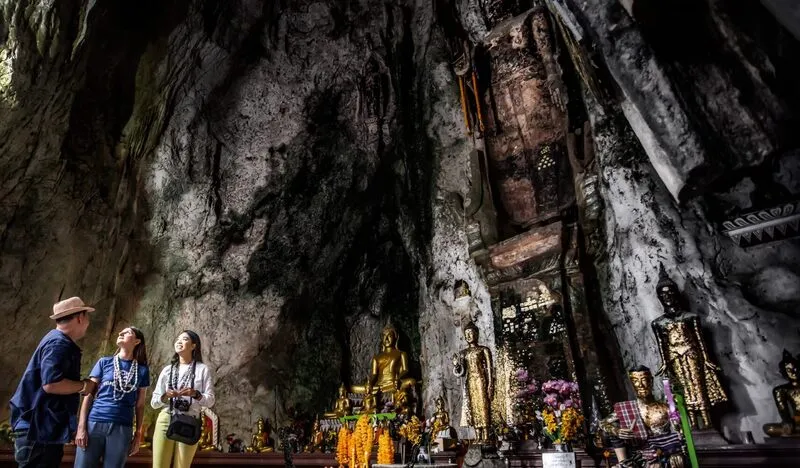
Tham Rong is a limestone hill with an important cave chamber known locally as “Tham Luang Pho Dam.” Inside, Luang Pho Dam – an ancient Buddha image revered by the community – is enshrined. The image is often described in local narratives as Dvaravati-period art with an age of around 800+ years. In community temples, sacredness is rarely created by promotion; it grows from long relationships between people and place – returning to make merit, coming to pray, bringing elders to pay respect, and letting children learn temple manners while walking through the cave quietly. These repeated acts create meaning, and that is why Tham Rong is more than a hollow in a mountain – it is a space where community life has truly gathered for generations.
Because the cave sits within a temple setting, what visitors should bring is not only a camera, but a respectful attitude. Wat Tham Rong is a local temple in Ban Tham Rong, Tham Rong Subdistrict, Ban Lat District, Phetchaburi, and it functions as a community anchor – a center of faith and an everyday meeting point for important occasions. Walking within the temple area should be done with modest clothing, an appropriate voice level, and care not to disturb those making merit or performing religious activities. The charm of Tham Rong is its calmness as a place that still belongs to the community, not a staged tourist set.
Geographically, Tham Rong reflects a defining feature of Phetchaburi: limestone mountains and cave systems scattered across many areas. Caves in limestone typically form as slightly acidic rainwater seeps through cracks in the rock over long periods, slowly dissolving and widening passageways that once carried underground water. Minerals carried by dripping water then deposit over time, creating stalactites and stalagmites in places where drops fall or flow. Each cave develops its own character. Tham Rong may not be marketed as the most “spectacular,” but its beauty lies in balance – balanced for gentle walking, balanced for worship, and balanced for continuing into community learning within the same day.
One reason many people love cave visits is that a cave naturally slows you down. Light drops, temperature changes, and the floor can become uneven or slightly damp, forcing you to walk more carefully than on flat ground. As the body regulates its pace, the mind often settles as well. This is why caves across Thailand easily become places of contemplation and faith – the environment organizes behavior without needing many signs. Tham Rong offers that same experience, and because it is paired with a temple, the calmness and courtesy become “natural rules” that allow everyone to share the space smoothly.
Beyond nature and faith, Tham Rong has a layer of local storytelling that gives it a distinct personality. A well-known legend about the name “Tham Rong” says that a local ruler once visited this area. A young woman offered water in a bowl, with a blade of thatch grass floating on the surface. The ruler was pleased and bestowed a “thamrong” – a ring – as a gift in return. Villagers later called the settlement “Ban Thamrong,” which gradually shifted in pronunciation to “Tham Rong.” Stories like this are not only about documentary proof; they explain how locals feel that the place has carried meaning long before any visitor arrived, adding a shared cultural memory to the experience.
As a community-based learning tourism destination, Tham Rong is strongest in its collective effort to preserve local life – traditional homes, livelihoods, and especially wisdom tied to Palmyra palm (tanot), a key symbol of Phetchaburi. Here, tanot is not preserved as a display piece. It is preserved through real work: climbing palms, collecting sap, boiling palm sugar, making khanom tan (palm cakes), and turning these practices into hands-on learning experiences for visitors. When you walk past lines of palms, see their shadows stretching across the fields, and listen to how producers think and plan their days, you understand that tanot is not just an economic plant – it is a life structure that shapes work rhythms, food culture, and community pride.
A memorable image along the community route is making sweets and food from tanot products – from palm sugar to khanom tan and other local dishes built around the fragrant sweetness unique to Phetchaburi. Some homes, such as “Ban Yi Tanot,” are often mentioned as learning stops where visitors can observe real processes, from preparing ingredients to achieving the aroma and texture that locals have perfected over time. Another side of the community is elder groups who weave palm leaves into different forms. What looks simple at first actually reflects precision, patience, and skills formed over a lifetime. This kind of travel is not only about buying souvenirs – it is about seeing the value of real labor and recognizing that wisdom lives in people’s hands.
Tham Rong also offers a clear look at Phetchaburi craftsmanship without requiring complicated interpretation. Wat Tham Rong has an ordination hall noted for beautiful stucco patterns, reflecting local artisanship and the aesthetic tradition for which Phetchaburi is famous. Seeing stucco work in a community temple helps you realize that Thai sacred art does not exist only in large city temples; it is distributed across villages, built with the same devotion. This is why Tham Rong suits travelers who want nature, worship, and local artistry in one trip, without rushing or traveling far.
Another charm of Tham Rong is its atmosphere of “courteous travel.” You can take time to walk around the limestone hill, enjoy the views, then gently shift into community learning – such as visiting Uncle Thanom’s palm grove, where palms are planted in neat rows like an orchard, speaking with real palm producers, or cycling along a local route that has been recognized for community road-safety efforts. Altogether, Tham Rong works well for families, cultural travelers, and anyone seeking Phetchaburi’s “secondary route” beyond the usual seaside plan.
Preparation for a temple-and-cave visit should focus on practical readiness. Shoes with good grip reduce risk if the ground is uneven or slippery. A flashlight or phone light is useful for dim areas, especially if you want to see details inside the cave. While walking, avoid touching fragile surfaces, do not scratch or write on rock, do not leave litter, and avoid loud behavior. This is a temple and a living community where people still work and practice daily life. Respect is part of travel quality and helps the place remain sustainable.
Getting There Tham Rong is in Tham Rong Subdistrict, Ban Lat District, Phetchaburi, and it is not far from Phetkasem Road (Highway 4), making it suitable for a half-day or one-day trip from Phetchaburi town or from the main route through the province. The most convenient option is a private car: follow Highway 4 and turn onto local roads toward Tham Rong Subdistrict using signs or navigation. At Wat Tham Rong, park where arranged and walk respectfully within the temple area. Without a private car, a practical approach is to reach Phetchaburi town or Ban Lat first, then hire a local ride and specify “Wat Tham Rong (Tham Luang Pho Dam), Tham Rong Subdistrict,” and clearly arrange a return pickup time.
If you want to see Phetchaburi beyond the familiar images of desserts or a gateway to the sea, Tham Rong is a strong answer. In one place, you gain a limestone hill, a cave rooted in long-standing faith, and a community actively preserving Palmyra palm heritage. The value here is not flashiness, but local reality – still alive, still working, and ready to be learned with respect.
| Place Summary | A limestone hill and key cave site in Phetchaburi within a temple-and-community context, highlighting Luang Pho Dam devotion, Palmyra palm (tanot) heritage, and Phetchaburi stucco craftsmanship – ideal for polite, nature-and-culture travel. |
| Name | Tham Rong (Wat Tham Rong / Tham Luang Pho Dam / Tham Rong Community) |
| Address | Ban Tham Rong, Moo 3, Tham Rong Subdistrict, Ban Lat District, Phetchaburi, Thailand |
| Highlights | A limestone hill close to Highway 4 for easy access / Tham Luang Pho Dam and local devotion / Ordination hall with Phetchaburi-style stucco artistry / Community-based learning tourism centered on Palmyra palm (tanot) wisdom |
| Period | Luang Pho Dam is commonly described locally as Dvaravati-period art (several centuries old); the temple is a long-standing community temple. |
| Key Evidence | Luang Pho Dam enshrined in Tham Luang Pho Dam (a cave within a limestone hill), plus an ordination hall featuring Phetchaburi-style stucco patterns |
| Name Origin | Local legend links the name to “Ban Thamrong,” from a “thamrong” (ring) bestowed by a ruler, later shifting in pronunciation to “Tham Rong.” |
| Temple Abbot / Steward | Phra Khru Sunthorn Watcharakit, Ph.D. (Abbot of Wat Tham Rong) |
| Travel | By car: Highway 4 (Phetkasem Road) → Ban Lat / Tham Rong Subdistrict → Wat Tham Rong. Without a car: reach Phetchaburi town or Ban Lat first, then hire a local ride (arrange the return pickup time). |
| Current Status | Open for visits and activities subject to temple/community conditions. Recommended: confirm before traveling. |
| Contact | Tham Rong Subdistrict Administrative Organization: 032-491467 / Community Enterprise: 099-246-9099 |
| Nearby Attractions (Approx. Distance) | 1) Phra Nakhon Khiri (Khao Wang) (Approx. 14 km) 2) Phra Ram Ratchaniwet (Ban Puen Palace) (Approx. 13 km) 3) Wat Mahathat Worawihan, Phetchaburi (Approx. 12 km) 4) Tham Khao Luang, Phetchaburi (Approx. 18 km) 5) Phetchaburi Riverside Market / Old Town Area (Approx. 12 km) |
| Popular Restaurants Nearby (Approx. Distance + Phone) | 1) Krua Tanot (Tanote Restaurant) (Approx. 2 km) Tel. 082-252-4990 2) Krua Kamnan Chob (Approx. 9 km) Tel. 065-942-6496 3) Krua Nai Baan by Nai Pan (Approx. 10 km) Tel. 061-368-1072 4) Krua Khun Lor (Approx. 12 km) Tel. 081-012-9919 5) Krua Tanot (Tham Rong Community Area) (Approx. 2 km) Tel. 082-252-4990 |
| Popular Accommodations Nearby (Approx. Distance + Phone) | 1) Ban Rai Sathon Tham Rong Homestay (Approx. 2 km) Tel. 099-246-9099 2) Ban Thong Chomphu Homestay (Approx. 2 km) Tel. 032-491467 3) Tham Rong Hotel (Approx. 3 km) Tel. 099-246-9099 4) Super Resort Ban Lat (Approx. 14 km) Tel. 080-009-8883 5) Ken Inn Phetchaburi (Approx. 12 km) Tel. 089-116-4557 |
Frequently Asked Questions (FAQ)
Q: Where is Tham Rong located?
A: It is in Ban Tham Rong, Moo 3, Tham Rong Subdistrict, Ban Lat District, Phetchaburi, within Wat Tham Rong and a limestone hill area near Phetkasem Road (Highway 4).
Q: What are the highlights of Tham Rong?
A: Key highlights include Tham Luang Pho Dam as a local center of devotion, Phetchaburi-style stucco artistry at the temple, and a community learning route strongly linked to Palmyra palm (tanot) heritage.
Q: Why is Luang Pho Dam important?
A: Luang Pho Dam is an ancient Buddha image revered by the community and enshrined in Tham Luang Pho Dam, making the site both a place of worship and a gateway to local history and cultural meaning.
Q: What should I prepare before visiting Tham Rong?
A: Dress modestly, wear shoes with good grip, bring a flashlight or phone light for dim areas, and follow temple etiquette: keep your voice low, do not litter, and avoid touching fragile cave surfaces.
Q: Who is Tham Rong best for?
A: It suits travelers seeking a deeper Phetchaburi experience: culture-and-community travelers, worshippers, and anyone interested in learning Palmyra palm (tanot) wisdom in a real working community.
Q: Can I visit the cave and community route in one day?
A: Yes. A half-day to one-day plan works well: start with worship and cave viewing, then continue to tanot learning stops and local food experiences before returning to Phetchaburi town or nearby attractions.
 Tham Rong Map
 Category:
  Group:
  Last Update: 2 DayAgo
Comment
 Nearby Attractions
| Keyword (Advance) |
 Facebook Fanpage
 Region
 Art, Culture and Heritage
 Historical Sites and Monuments(
 Landmarks and Memorials(
 Royal Palace(
 Art, Craft Centres, Tradition(
 Museums(
 Educational Places
 Educational Gardens, Farm(
 University
 Places of Worship
 Temple(
 Other religious and spiritural sites(
 Research and Development
 Royal Project(
 Suburban Living
 Village, Community(
 Floating Market(
 National Parks and Marine Reserves(
 Mountain (Doi)(
 Dam, Reservoir, Lake(
 Waterfalls(
 Hot Springs(
 River, Canal(
 Bays and Beaches(
 Islands(
 Other natural attractions(
 Entertainment and Agricultural
 Farm, Parks, Gardens and Ecotourism(
 Theater(
 Outdoor and Adventure Activities(
 Travel Articles, Recipes
 Travel Review, Food Review(