

 Home
Home Chiang Mai(






Rating: 3.8/5 (6 votes)
 |
|  Map
Map 
 Have Map
  No Map
Lop Buri attractions
Attractions in Thailand
Open Days: Every day
Opening Hours: 08:00 - 16:30
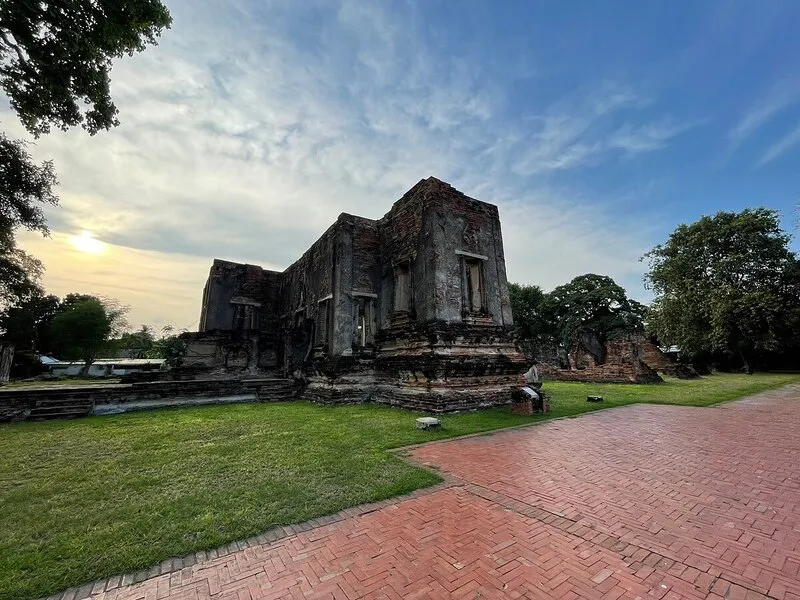
Kraison Siharat Pavilion, also known as the Cool Pavilion, is an important historical site in Lopburi from the reign of King Narai the Great. It stands on an island in the middle of Thale Chup Son, which was originally a large natural depression later transformed into a lake and royal garden. The site is significant both as a retreat for the king and as a place connected with the history of astronomy in Thailand.
Kraison Siharat Pavilion, also known as the Cool Pavilion and the Thale Chup Son Royal Residence, is an important historical site in Thale Chup Son Subdistrict, Mueang Lopburi District, Lopburi Province. It is located about 3 kilometers from the old city area and around 4 kilometers from downtown Lopburi. This pavilion served as another royal residence of King Narai the Great, who played a major role in elevating Lopburi into a major center of politics, administration, diplomacy, and culture during the late Ayutthaya period.
The distinction of Kraison Siharat Pavilion lies not only in its age as a historical monument, but also in its location on an island in the middle of Thale Chup Son. In the past, the surrounding area was a broad natural basin. During the rainy season, water flowing down from the hills would gather here until it resembled a large lake. Later, during the reign of King Narai the Great, the area was extensively improved. Embankments of brick were built, water gates were installed, and water-control systems were developed in order to turn the natural landscape into a lake and royal garden that served both practical and aesthetic purposes.
From the perspective of urban planning, Kraison Siharat Pavilion was not an isolated structure separated from the wider context of Lopburi. Instead, it formed part of a larger urban system that King Narai the Great developed step by step. In that era, Lopburi was not defined only by Narai Ratchaniwet Palace. It also included important infrastructure such as water sources, water supply systems, transport routes, reception areas for foreign envoys, and leisure spaces for the royal court. Thale Chup Son therefore functioned both as part of the city’s water system and as an element of the royal landscape of power in the Ayutthaya court.
Evidence from the Fine Arts Department explains that King Narai the Great ordered French engineers to take part in improving the Thale Chup Son area. They filled land, built brick embankments, and created sluice gates and drainage gates to regulate water overflow into Sa Kaeo Reservoir. Clay pipes were also buried to form a water supply system from Sa Kaeo to Lopburi city. Details like these show that Thale Chup Son was not important only as a leisure landscape, but was also deeply connected with the city’s water-management technology.
The Kraison Siharat Pavilion itself was built as a royal retreat for relaxation amid water and natural surroundings. This was in keeping with the concept of royal gardens in the Eastern world, where peace, coolness, open views, and the separation of royal private space from the bustle of the city were highly valued. When one considers the alternative name “Cool Pavilion,” it clearly conveys the atmosphere of the place, as this was a space designed to be cool, calm, and ideal for rest.
In another dimension, Kraison Siharat Pavilion holds great importance in the history of Thai astronomy. Records from the Fine Arts Department and heritage agencies indicate that the Thale Chup Son Royal Residence area was open and unobstructed, allowing a full view of the sky from all directions, with enough space to install astronomical instruments. The site thus became the place where King Narai the Great and European astronomers observed a lunar eclipse on 11 December 1685. This event has been recognized as a major milestone in the introduction of Western astronomical knowledge into Siam.
The importance of Kraison Siharat Pavilion is therefore connected with several historical dimensions at once: the political history of Lopburi, the engineering history of water management, and the scientific history of Siam. If visitors look at this place merely as a ruined brick structure in the middle of a community, they may see only the outer shell of the past. But when viewed through the broader context of Lopburi during the reign of King Narai, the site becomes one of the key places that explains why Lopburi was once such an advanced and outward-looking city in the late Ayutthaya period.
In terms of artistic style, Kraison Siharat Pavilion is classified as a work of the late Ayutthaya period. Although today the monument survives mainly as traces of brick-and-mortar foundations, these remains still make it possible to understand how the structure was positioned in relation to the water and the open surrounding space. Building a royal pavilion in the middle of a lake reflects a deliberate design that allowed those staying there to enjoy the breeze, admire the scenery, and use the entire surrounding landscape as part of the experience within the royal residence.
The name “Thale Chup Son” itself also carries intriguing cultural meaning. Some interpretations connect it with Brahmanical beliefs and the Ramayana, including royal explanations about the belief in Vishnu incarnating as Rama and the idea of dipping an arrow into sacred waters. Although the meaning of the name includes elements of legend and cultural interpretation, it further reinforces the fact that this place was more than an ordinary body of water. It was a landscape where power, belief, and historical memory came together.
When considering the role of Kraison Siharat Pavilion within Lopburi’s network of important sites, it should be viewed together with Narai Ratchaniwet Palace, Ban Wichayen, Phra Prang Sam Yot, and Wat Phra Si Rattana Mahathat. These places collectively form the historical urban landscape that clearly reflects Lopburi in the age of King Narai. Kraison Siharat Pavilion is therefore another essential piece of the puzzle that helps complete the story of the city, especially in relation to court life, leisure spaces, and the reception of new knowledge from the Western world.
Today, Thale Chup Son has become much shallower than it once was. Some parts of the area have become residential communities and public-use spaces. Even so, many important traces still remain, including the line of the historical monument, remnants of water gates, and the broader spatial context that still allows visitors to imagine the past. Those who come here therefore do not see only the ruins of an old structure, but also experience the “layers of time” superimposed in the same place, from the late Ayutthaya era to present-day Lopburi.
The charm of visiting Kraison Siharat Pavilion lies in the fact that it is not a large tourist attraction crowded with visitors all the time. The atmosphere is relatively peaceful, making it suitable for those who enjoy historical travel that involves slow walking, careful observation of the site, and thoughtful connections between the visible remains and the stories behind them. If visitors come with some background knowledge of King Narai, Lopburi, and Siam’s contact with the West, the experience becomes far richer and more meaningful.
For travelers planning a 1-day trip in Lopburi, Kraison Siharat Pavilion can easily be included in the same route as Narai Ratchaniwet Palace, Ban Wichayen, Phra Prang Sam Yot, and Wat Phra Si Rattana Mahathat. All of these sites are located in Mueang Lopburi District and help illuminate one another. Moreover, beginning at the royal palace in the city center and then continuing out to Thale Chup Son makes it easier to understand the relationship between the “center of power” and the “leisure and water-management landscape.”
Getting There to Kraison Siharat Pavilion is convenient from downtown Lopburi or from the area around Narai Ratchaniwet Palace. From there, continue toward Thale Chup Son Subdistrict along local roads within Mueang Lopburi District. The site is not far from the city and can be reached easily by private car or local hired transport. Visitors using digital maps can rely on the coordinates of the historical site and plan onward connections to other nearby heritage attractions within the same trip.
Although Kraison Siharat Pavilion no longer survives in the complete form it once had in the past, its value remains remarkably clear. It is important as a late Ayutthaya historical monument, as a royal retreat of King Narai, as a place tied to hydraulic engineering, and as one of the early sites associated with modern astronomical study in Siam. Anyone who is seriously interested in Lopburi’s history should not overlook Kraison Siharat Pavilion, because it is one of the places that opens a deeper and more complete perspective on the story of Lopburi.
| Name | Kraison Siharat Pavilion (Cool Pavilion / Thale Chup Son Royal Residence) |
| Place Summary | A late Ayutthaya historical site associated with King Narai the Great, located in the middle of the Thale Chup Son area in Mueang Lopburi District. It is significant for its royal garden setting, water-management system, and role in Thai astronomical history. |
| Highlights | A royal pavilion in the middle of Thale Chup Son, used as a retreat by King Narai the Great and associated with lunar eclipse observation in the Ayutthaya period. |
| History / Period | Late Ayutthaya period, built during the reign of King Narai the Great, probably before 1685 |
| Address | Thale Chup Son Subdistrict, Mueang Lopburi District, Lopburi Province 15000 |
| Coordinates | 14.8120599672, 100.64501199 |
| Getting There | From Lopburi Provincial Hall, head northeast. At the Narai Circle, take Exit 1 onto Highway 1, then turn left into Soi Chup Son 1 for about 650 meters, and turn right. The pavilion will be on the left. |
| Open Days | Every day |
| Opening Hours | 08:30 – 16:30 |
| Fees | Adults 10 Baht, Children 10 Baht |
| Facilities | There is a restroom construction project in the Kraison Siharat Pavilion area according to the announcement of the 4th Regional Office of Fine Arts, Lopburi. |
| Zones | 1. Thale Chup Son Royal Residence 2. Drainage Weir 3. Thale Chup Son Embankment 4. Khlong Pak Chan and Water Gate |
| Current Status | Open to tourists and the general public |
| Nearby Tourist Attractions with Distance | 1. Narai Ratchaniwet Palace Approx. 4 km 2. Ban Wichayen Approx. 4 km 3. Phra Prang Sam Yot Approx. 5 km 4. Wat Phra Si Rattana Mahathat, Lopburi Approx. 5 km 5. San Phra Kan Approx. 5 km |
| Popular Restaurants Nearby with Distance | 1. Tam Jai Chan Branch 1 Approx. 0 km Tel. 094-870-8332 2. Nang Yen Fresh Coffee, Phra Thinang Yen Approx. 0 km Tel. 064-826-6322 3. Look Moo Made-to-Order Restaurant Approx. 900 m Tel. 094-791-8000 4. Baan Khun Mor Approx. 1.5 km Tel. 080-571-3944, 086-388-4689 5. Café Amazon RM1124, PTTRM Lopburi-Thale Chup Son Approx. 1.5 km Tel. 084-438-5614 |
| Popular Accommodations Nearby with Distance | 1. Lopburi Inn Hotel Approx. 1.4 km Tel. 036-614-790 2. Benjatara Boutique Place Resort Approx. 1.6 km Tel. 036-422-608 3. The Charlotte Smart Hotel Approx. 2.6 km Tel. 064-979-2905 4. KP Place Lopburi Approx. 3 km Tel. 099-939-7119 5. YSW Hotel Lopburi Approx. 2.7 km Tel. 064-939-6447, 036-680-839 |
| Main Contact Number | 036-413-779 |
Frequently Asked Questions (FAQ)
Q: Where is Kraison Siharat Pavilion located?
A: Kraison Siharat Pavilion is located in Thale Chup Son Subdistrict, Mueang Lopburi District, Lopburi Province. It is about 3 kilometers from the old city and around 4 kilometers from downtown Lopburi.
Q: Does Kraison Siharat Pavilion have another name?
A: Yes. It is commonly known as the Cool Pavilion or the Thale Chup Son Royal Residence, names that are widely used alongside Kraison Siharat Pavilion.
Q: In which period was Kraison Siharat Pavilion built?
A: The pavilion was built in the late Ayutthaya period during the reign of King Narai the Great and is believed to have been constructed before 1685.
Q: Why is Thale Chup Son important?
A: Thale Chup Son is important both as a royal garden and as part of Lopburi’s water-management system during the reign of King Narai the Great, with embankments, water gates, and connected water systems leading to Sa Kaeo and the city.
Q: How is Kraison Siharat Pavilion connected to the history of astronomy?
A: This site was used by King Narai the Great and European astronomers to observe a lunar eclipse on 11 December 1685, and it is recognized as an important site in the history of modern astronomy in Thailand.
Q: Can visitors still visit Kraison Siharat Pavilion today?
A: Yes. Kraison Siharat Pavilion is still open to tourists and the general public, although what remains today are mostly brick ruins and the surrounding historical landscape rather than the original complete structure.
Q: Which places should be visited together with Kraison Siharat Pavilion?
A: It is recommended to visit Narai Ratchaniwet Palace, Ban Wichayen, Phra Prang Sam Yot, Wat Phra Si Rattana Mahathat, and San Phra Kan together with Kraison Siharat Pavilion to gain a fuller understanding of Lopburi’s history during the reign of King Narai.
 Tel: 036413779, 03641 2510
 Kraison Siharat Pavilion Map
 Category:
  Group:
  Last Update: 14 HourAgo
Comment
 Nearby Attractions
| Keyword (Advance) |
 Region
|
 Muang Lop Buri(