
 Home
Home Chiang Mai(






Rating: 3.5/5 (4 votes)
 |
|  Map
Map 
 Have Map
  No Map
Lop Buri attractions
Attractions in Thailand
Open Days: Local tradition held according to the community’s Bun Phra Wet or Thet Mahachat schedule
Opening Hours: According to local announcements
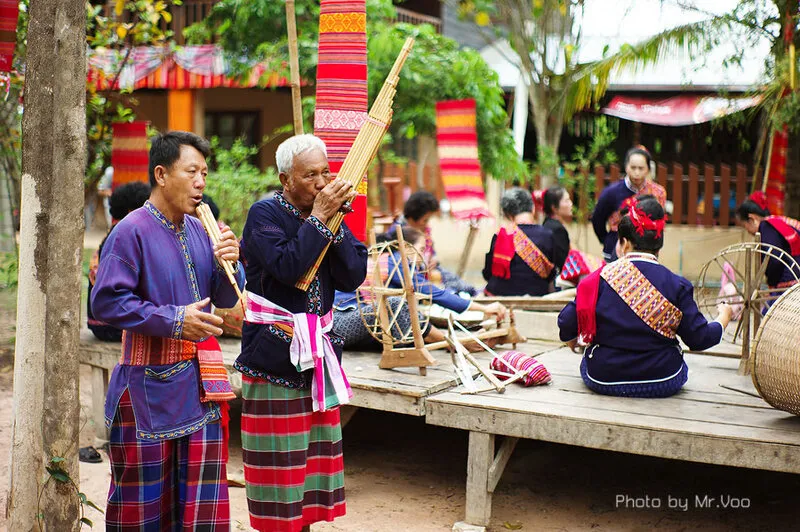
Sai Krajard Tradition A Thai Phuan tradition in the Mahachat Sermon festival that reflects generosity, faith, and deeply rooted community life The Sai Krajard tradition is one of the most important traditions of the Thai Phuan people, carrying great value in religious, social, and cultural terms. It is not merely an activity in which people bring items to one another within the community, but a system of relationships that closely connects the entire village to a major merit-making event at the temple. This tradition is usually held during the waning phase of the 11th lunar month, around mid-October, which falls in the post-Buddhist Lent season when many communities schedule their Mahachat Sermon festival. Whenever a village organizes the Mahachat Sermon, the whole community enters a lively period of welcoming guests, preparing offerings, cooking food, socializing, and making merit together.
The distinctive charm of the Sai Krajard tradition lies in the fact that it is truly a community tradition. Every step, from the day before the event to the day of Sai Krajard and the sermon day itself, reflects how Buddhist faith is not separated from daily life, but is woven into routine activities, hospitality, food sharing, and close relationships between households. The Thai Phuan people therefore do not view a merit festival as merely a temple ritual, but as a shared undertaking of the whole village in which every household must take part.
In the context of this tradition, the phrase “Sai Krajard” means bringing items to contribute to the household that is preparing sermon offerings and food for the Mahachat Sermon festival. These items may include bananas, sugarcane, money, pomelos, incense, candles, or other useful goods depending on what each household prepares. Bringing such items is not only a material contribution, but also an expression of kindness and shared participation in communal merit-making. The host household then welcomes guests with prepared food, and when the guests leave, they are given sticky rice bundles in return, an act known as “Khuen Krajard” or returning the basket, creating a cycle of giving and reciprocation filled with goodwill.
From the perspective of cultural history, the Sai Krajard tradition reflects the roots of Thai Phuan society, which places importance on kinship, cooperation, and linking merit-making with social relationships. The Thai Phuan are an ethnic group with a distinct language, traditions, and way of life. Many communities have continued to preserve their old customs in admirable ways. The Sai Krajard tradition is therefore not merely one element of the Mahachat Sermon festival, but an important piece of evidence of a living cultural system that is still being passed on in actual community life.
The importance of this tradition is also clearly seen in its connection with the Mahachat Sermon festival, which is considered a major Buddhist merit event and is highly respected by villagers. When a village decides to hold the Mahachat Sermon, the temple sends sermon manuscripts to other temples in order to invite monks from those temples to join in the recitation. The preparations therefore do not take place only within the temple grounds, but spread throughout the homes of the villagers across the entire community. The day before the sermon is called “Wan Tang” or the setup day, which is also the Sai Krajard day, and it is a particularly vibrant day for the community.
One day before the Sai Krajard day, villagers call it “Wan Ton Sao,” which is a preparation day of great social significance. The host household asks young women in the village whom they know well to come help with work at the house, whether making sweets, wrapping sticky rice, or preparing food to welcome guests. One of the important activities is pounding rice flour or making kanom jeen, which requires many hands and a lot of time. Working together is therefore not merely about labor, but also a chance for conversation, laughter, and creating an atmosphere of familiarity within the community.
The phrase “Ton Sao” itself reflects the social structure of Thai Phuan communities in an interesting way. It does not mean only inviting young women to help with the work, but also serves as part of a cultural space that allows young men and women in the village to meet and talk naturally. On the night of Wan Ton Sao, young men often visit the homes of the young women they admire, while inside the house there is continuous activity involving making sweets and preparing things for the merit event. This creates both an atmosphere of working together and an opportunity for courtship at the same time.
This gives the Sai Krajard tradition dimensions beyond religious ritual alone, because it is also a social space that allows people to draw closer in an appropriate way. Under the awareness and supervision of the elders in the community, parents, especially on the young woman’s side, traditionally do not obstruct such conversations during this time because they are considered part of a custom that takes place within the framework of a merit-making event and the decorum of the village. The Sai Krajard tradition therefore becomes both a space of faith and a space of human connection, where affection, admiration, and relationships can develop alongside religious devotion.
The next morning is the full “Sai Krajard day.” Villagers from other households bring items to the homes of people they know. Each host household prepares food to welcome guests properly. As guests travel from house to house to make their contributions throughout the day, the entire village remains constantly active. People come and go, greet one another, talk, and share meals together. Every household involved in the event follows similar practices, creating an image of a community that opens both homes and hearts in a deeply impressive way.
A small detail, such as the fact that guests are expected to eat food at every host household they visit, clearly reflects the cultural dimensions of courtesy and respect. Eating is not just about satisfying hunger, but about formally accepting the host’s goodwill. The hosts themselves take pride in caring for their guests and expressing kindness through the food they have prepared. This cycle of visiting and hospitality helps strengthen relationships among people year after year.
When guests depart, the host gives them sticky rice bundles to take home. This act is called “Khuen Krajard” or returning the basket, and it is another core part of the tradition because it shows that receiving and giving proceed in balance. No one is solely a giver or solely a receiver. Everyone has a role within the same system of kindness. Returning the basket is therefore not simply a social courtesy, but a reciprocal gesture that sustains relationships in a gentle and beautiful way.
The following day after Sai Krajard day is the “sermon day,” which is the main day of the merit event. Villagers prepare food trays to take to the temple, and the items that guests brought on the previous day are arranged into sermon offerings and presented to the monks. It is at this point that one can clearly see that the Sai Krajard tradition is not a social feast separate from religion, but an integral part of merit preparation that unites home, temple, and community into a complete whole. The items contributed by community members do not end with mutual visits and hospitality, but are elevated into acts of offering and direct support of Buddhism.
Viewed in terms of cultural structure, the Sai Krajard tradition is a clear example of how a community uses social mechanisms to support religious activities in a systematic way. Merit-making does not rest on the burden of one household alone, but distributes responsibility through the contribution of goods, shared labor, and cooperation at every level. This allows the Mahachat Sermon festival, which is a major temple event, to take place through the collective strength of the whole community, rather than relying on temple resources alone.
This tradition also reflects a distinctive characteristic of Thai Phuan society in its emphasis on harmony and kinship-like relationships. Even though not everyone who comes to make Sai Krajard offerings is related by blood, the way people treat one another resembles that of close relatives who regularly visit and support each other. Everyone knows one another to some extent, and all understand that coming together for the event is a way of preserving the bonds of the community. The Sai Krajard tradition therefore serves as a highly effective and gentle way of connecting people to one another.
In terms of atmosphere, the Sai Krajard tradition has the charm of a warm community merit festival filled with cultural detail. Visitors do not encounter only formal ritual, but also homes opened to receive guests, the aroma of food being cooked, the sounds of conversation among people of different generations, the teasing and laughter of young men and women, the shared preparation of sweets and gifts, and the lively movement of the whole village. The beauty of this tradition lies not only in large ceremonies or major ritual moments, but in the small scenes that together form a complete picture of communal life.
Another interesting aspect is that the Sai Krajard tradition helps preserve knowledge of local food. During Wan Ton Sao and Sai Krajard day, villagers work together to make sweets, wrap sticky rice, and prepare many kinds of food. Knowledge of selecting ingredients, wrapping techniques, boiling methods, serving practices, and timing preparations to accommodate many guests are all skills that require experience and are passed from one generation to the next. As long as the tradition continues, this culinary knowledge continues with it.
From the perspective of youth, the Sai Krajard tradition also plays an important role in allowing younger generations to learn the roots of their community through direct participation. Children and young people who grow up helping on Wan Ton Sao, seeing adults welcome guests, observing the returning of the basket, and accompanying their families to the temple on sermon day gradually absorb the meanings of giving, gratitude, cooperation, and Buddhist faith in a natural way. This is cultural learning that does not require a classroom, but arises directly from lived experience.
The Sai Krajard tradition is also highly valuable in preserving Thai Phuan identity, because it is one of the customs that clearly reflects the language, beliefs, and social system of this ethnic group. Specific terms such as “Wan Tang,” “Wan Ton Sao,” and “Khuen Krajard” all contribute to the unique character of the tradition. The more the community continues to use these original terms and follow the traditional practices, the more Thai Phuan cultural identity remains alive in contemporary society.
In terms of present-day importance, the Sai Krajard tradition remains meaningful even though society has changed greatly. In an era when people live increasingly hurried lives and relationships between neighbors have weakened, traditions of this kind become even more valuable as spaces that bring people back together, allow them to talk, and encourage cooperation once again. They remind us that the strength of a community does not come only from administrative structures, but also from a shared culture that allows people to continue feeling that they belong together.
In addition, the Sai Krajard tradition has potential as a form of cultural capital for quality cultural tourism. If communicated properly and with respect for the context of the community, this tradition can allow visitors to see the real way of life of the Thai Phuan, understand the relationship between home and temple, appreciate the role of local food in merit festivals, and recognize how religious faith can become a mechanism for creating warmth in society. However, tourism presentation should be grounded in respect and should not reduce the tradition to a mere staged display detached from its original meaning.
What makes the Sai Krajard tradition especially beautiful is that it teaches the value of giving without the need for direct preaching. Every step of the tradition becomes a social lesson: villagers bring items to help the host, the host feeds the guests, the guests accept the host’s goodwill by sitting down to eat, the host returns the basket with sticky rice bundles, and all of those items are then arranged as sermon offerings for the temple. Everything circulates around the principle of sharing, making it a powerful way of cultivating moral values through real practice in community life.
When considered as a whole, the Sai Krajard tradition is therefore remarkably complete in cultural terms, because it unites religious faith, community cooperation, the transmission of local culinary wisdom, systems of hospitality, relationships between young men and women, and preparation for a major merit event within a single cycle. One tradition thus performs many functions at once, and each of those functions carries meaning for the preservation of Thai Phuan community life.
For those interested in learning about Thai culture, the Sai Krajard tradition is an important example showing that local merit-making festivals in Thailand do not hold meaning only in religious terms, but also serve as finely structured systems of communal living. Simply observing how people bring items for Sai Krajard or how sticky rice bundles are returned may seem like minor details, but in truth these details reveal the community’s way of thinking about generosity, gratitude, and the careful maintenance of relationships.
This tradition therefore deserves to be remembered as a living cultural heritage, not merely as a story from the past. Each time Sai Krajard is practiced, the Thai Phuan community reaffirms its own values once again, declaring that community still matters, that faith still carries meaning, and that kindness among people is something worth preserving in the modern world. The faster the world changes, the more important traditions become that slow the pace of life enough for people to look at one another again, share meals together, and make merit together.
Getting There If you would like to learn about the Sai Krajard tradition, you should first check which Thai Phuan community plans to hold the Mahachat Sermon festival that year. This is because the tradition is directly tied to the Mahachat Sermon festival and does not follow a fixed schedule like an ordinary tourist attraction. Interested visitors should contact local cultural offices, local administrative organizations, or temples in Thai Phuan communities before traveling. Once the schedule is confirmed, they can then plan their journey into the area, dress politely, respect community customs, and remain open to learning about the context of the merit event in an appropriate way. This will ensure that the trip becomes a genuine cultural learning experience rather than merely a brief stop for sightseeing.
| Summary | The Sai Krajard tradition is a Thai Phuan tradition held alongside the Mahachat Sermon festival during the post-Buddhist Lent season. Villagers bring items to contribute to the host households before those items are arranged as sermon offerings and presented to the temple the next day. |
| Highlights | Its distinctive feature lies in the way it blends Buddhist merit-making with the social life of the Thai Phuan community, including Wan Ton Sao, Sai Krajard day, Khuen Krajard, and the preparation of sermon offerings on sermon day. |
| History / Period | It is a traditional folk custom of the Thai Phuan people that has long been passed down together with the Mahachat Sermon festival and reflects a way of life that closely connects home, temple, and kinship networks. |
| Cultural Group | Thai Phuan |
| Period | During the waning phase of the 11th lunar month, around mid-October, generally in the post-Buddhist Lent season |
| Open Days / Opening Hours | A local tradition held according to the community’s Mahachat Sermon schedule, with timing based on local announcements |
| Key Rituals | Wan Ton Sao for preparing sweets, wrapping sticky rice, and cooking food; Sai Krajard day when villagers bring items to the host households; Khuen Krajard with sticky rice bundles returned to guests; and sermon day when the items are arranged as sermon offerings and presented to the temple |
| Social Significance | It creates a space for the whole community to work together, gather, and allows young men and women to meet and talk within the framework of a merit-making event |
| Getting There | Visitors should first check which Thai Phuan community plans to hold the Mahachat Sermon festival that year, then ask the temple or local authorities for details before traveling |
| Current Importance | It remains an important tradition for preserving Thai Phuan identity, maintaining community relationships, and linking Buddhist merit-making with everyday life |
| Visitor Information | Visitors should dress politely, respect community customs, and participate with an understanding that this tradition is a merit-making event with deep religious and cultural meaning |
Frequently Asked Questions (FAQ)
Q: What is the Sai Krajard tradition?
A: It is a Thai Phuan tradition held during the Mahachat Sermon festival, in which villagers bring items to contribute to host households, and the hosts welcome guests with food before returning sticky rice bundles when the guests leave.
Q: When is the Sai Krajard tradition held?
A: It is generally held during the waning phase of the 11th lunar month, around mid-October, and usually takes place during the post-Buddhist Lent season when the community organizes the Mahachat Sermon festival.
Q: What is Wan Ton Sao?
A: Wan Ton Sao is the day before Sai Krajard day. It is the time when villagers help prepare the event by making sweets, wrapping sticky rice, pounding rice flour or preparing kanom jeen, and it also provides an opportunity for young men and women in the community to meet and talk.
Q: What does Khuen Krajard mean?
A: Khuen Krajard means returning the basket, which refers to the host giving sticky rice bundles to departing guests as a gesture of reciprocity and goodwill within the community.
Q: How is the Sai Krajard tradition related to the Mahachat Sermon festival?
A: It is part of the preparation for the Mahachat Sermon festival because the items villagers bring for Sai Krajard are later arranged as sermon offerings and presented to the monks at the temple the following day.
Q: Why is the Sai Krajard tradition important to the Thai Phuan community?
A: It is important both religiously and socially because it brings the community together in collective merit-making, preserves Thai Phuan identity, and passes on generosity, kindness, and cultural ways of life from one generation to the next.
Q: How should visitors prepare if they want to learn about the Sai Krajard tradition?
A: Visitors should check the schedule with the community or temple before traveling, dress politely, and participate with respect for the context of the merit event so that the experience remains appropriate and meaningful.
 Category:
  Group:
  Last Update: 7 HourAgo
Comment
 Nearby Attractions
| Keyword (Advance) |
 Facebook Fanpage
 Region
 Historical Sites and Monuments(
 Landmarks and Memorials(
 Royal Palace(
 Museums(
 Historical Houses and The Ancient City(
 University
 Places of Worship
 Temple(
 Other religious and spiritural sites(
 Research and Development
 Royal Project(
 Suburban Living
 Village, Community(
 Floating Market(
 Nature and Wildlife
 National Parks and Marine Reserves(
 Mountain (Doi)(
 Dam, Reservoir, Lake(
 Waterfalls(
 Hot Springs(
 Caves(
 Flower Field(
 Entertainment and Agricultural
 Zoos and Aquariums(
 Farm, Parks, Gardens and Ecotourism(
 Outdoor and Adventure Activities(