

 Home
Home Chiang Mai(






Rating: 2.8/5 (9 votes)
 |
|  Map
Map 
 Have Map
  No Map
Lop Buri attractions
Attractions in Thailand
Open Days: Every day
Opening Hours: 08.30 – 16.30 hrs.
Sap Champa Ancient City is an important archaeological site in Lopburi Province that reveals a much deeper layer of the region’s history beyond the better-known inner-city heritage of Lopburi. This ancient city is located in Moo 7, Sap Champa Subdistrict, Tha Luang District, on elevated ground along the edge of the Central Plain where it connects with the Northeastern Plateau. This type of landscape is highly significant because it suggests that the area was suitable for settlement, community control, and regional connections in the past. Sap Champa Ancient City is therefore not merely the remains of an ancient site in a natural setting, but important evidence of the transition from prehistoric human communities to a more complex urban society.
The significance of Sap Champa Ancient City lies in the fact that it preserves evidence of continuous human occupation over a very long period. Scholars have found traces of settlement here dating back to prehistoric times, including stone bracelets, bracelet cores, human bones, and a variety of pottery forms dating to around 3,000 – 2,500 years ago. These discoveries make Sap Champa Ancient City different from many archaeological sites that preserve only traces of settlement from the historical period, because Sap Champa shows the continuous development of human communities in this area, from an early settlement to a society with clearer economic patterns, belief systems, and social organization.
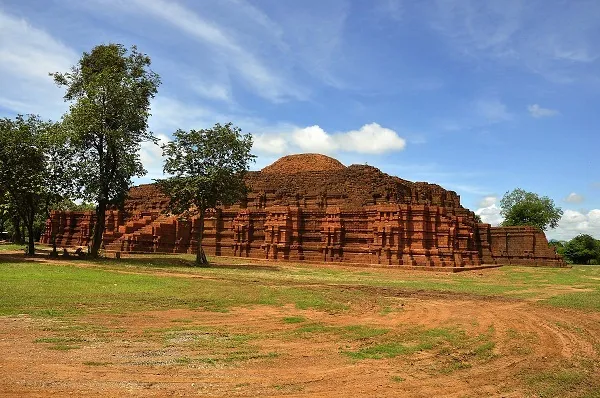
As time passed, this community gradually developed into an urban center. One of the key pieces of evidence is the existence of moats and earthen embankments surrounding the settlement, a pattern found in many important ancient cities of Dvaravati culture and other early urban networks in Central Thailand. Sap Champa Ancient City was therefore not simply a naturally inhabited area, but a community with organized planning and spatial management. Within the city are also 3 earthen mounds, which are believed to be the remains of ancient structures or sacred areas. This point is especially important because it means Sap Champa is not only a place where ancient objects were excavated, but an archaeological urban landscape in which traces of city planning can still be read on the ground today.
Sap Champa Ancient City first became widely known in academic circles in February 1970, when a joint survey by the Fine Arts Department and the Plant Pest Control Unit of the Ministry of Agriculture and Cooperatives explored the forested area of Ban Sap Champa and discovered a large ancient city enclosed by moats and embankments. From that point onward, the site attracted continuous attention from both Thai and foreign scholars. Subsequent studies helped clarify the history of Sap Champa, especially in terms of prehistoric settlement, the reception of Indian cultural influences, and its later development into an ancient city that played an important role in the wider region.
What makes Sap Champa Ancient City especially remarkable is the range of artifacts discovered there. Finds include stone bracelets, pottery sherds, Sanskrit inscriptions, fragments and heads of Buddha images, fragments of votive tablets, Buddha hands, Dharma wheels with pillars, recumbent deer sculptures, tools, utensils, and metal ornaments. Many of these objects are now preserved at King Narai National Museum in Lopburi. This strongly reinforces the fact that Sap Champa is not merely an area with traces of an old city, but one of the key sources of information for the history of Lopburi and Central Thailand as a whole. These artifacts help explain the daily life, beliefs, religion, and artistic development of this ancient community in considerable detail.
Another factor that gives Sap Champa Ancient City major historical importance is the discovery of Sanskrit inscriptions and artistic remains reflecting Indian cultural influence. Scholars have proposed that around the 12th – 13th Buddhist centuries, this ancient community received Indian influence in many aspects, including religion, belief, language, script, and art, before developing into a more complex urban center. This helps make Sap Champa one of the key places for understanding that the reception of external cultural influences in ancient Thailand did not occur only in major centers, but also spread into ancient urban communities in river basins and transitional regional zones.
When considered as a whole, Sap Champa Ancient City was not merely a community that left behind physical remains, but a city that reflects the formation of an early society in a very real way. Around the city, moats were dug and embankments constructed as defensive or enclosing earthworks, showing systematic land organization. This also suggests that the community had a sufficiently developed political structure to mobilize labor and resources in order to build such large-scale works. Local information has even suggested that this community may have had a ruler or king governing the city, making Sap Champa far more significant as an ancient city than an ordinary small settlement.
In terms of religion and art, finds such as Dharma wheels with pillars, recumbent deer, Buddha images, votive tablets, and other sculptural fragments are especially meaningful because they show that Sap Champa did not receive only script and language, but also Buddhist belief and artistic worldview. In particular, the remains associated with Dvaravati culture make Sap Champa Ancient City one of the important sites for the study of early Buddhism in Central Thailand. These remains also give Sap Champa the status of a deeply meaningful learning site, rather than just a place for casual sightseeing or superficial appreciation of ancient ruins.
One thing visitors should understand from the beginning is that Sap Champa Ancient City is not a tourist attraction defined by towering architecture such as prangs or palaces. Its value lies in its “archaeological landscape.” Visitors should look for the moats, embankments, layout of the city, and the 3 earthen mounds within the site, because these are the heart of Sap Champa. If approached in the same way as visiting temples or monumental ancient structures, the site may appear quiet and simple. But if viewed as a place to read the land itself, Sap Champa reveals itself as an archaeological site of exceptional depth, because every part of the landscape forms part of its past story.
The atmosphere of Sap Champa Ancient City today is calm, simple, and surrounded by nature, making it more suitable for reflective cultural learning than for rushed sightseeing. Another appealing aspect is that the site is closely linked with Sap Champa Museum and the Sirindhorn Champi Forest. This means that a visit to Sap Champa is not only about looking at earthen mounds or ancient moats, but about understanding the historical landscape together with exhibitions and the local natural environment nearby. Seen from this perspective, Sap Champa is an especially suitable destination for travelers who enjoy cultural tourism at a slower pace and value a peaceful atmosphere.
Another element that makes a visit to Sap Champa Ancient City more complete is Sap Champa Museum, which serves as the main center for explaining the meaning of the site. It presents the history of its discovery, archaeological evidence, and interpretive information that helps general visitors understand the area more easily. For those without a background in archaeology, beginning with the museum before going out to read the actual ancient city landscape will make the moats, embankments, and mounds in the real site much more meaningful than simply walking through the area without context.
Getting There to Sap Champa Ancient City can be based on the same route used for Sap Champa Museum. If traveling by car from Bangkok, take Highway No. 1 through Saraburi and Phra Phutthabat into Lopburi Province. From Lopburi town, use Phahonyothin Road, then turn onto Highway No. 2338 and continue straight to Sap Champa Museum. From there, you can connect directly to the ancient city area. Travelers using public transportation or trains can first arrive in Lopburi town and then continue by local transport to Tha Luang District and Sap Champa Subdistrict. This approach is useful for advance planning, because Sap Champa Ancient City is not within the inner old-city cluster of Lopburi, but in another zone that requires clearer route planning before departure.
In terms of trip planning, Sap Champa Ancient City is well suited to being arranged as a combined historical and nature trip within the same area. It should first be linked with Sap Champa Museum and the Sirindhorn Champi Forest, then extended to nearby attractions in Tha Luang District such as Wat Sap Champa, Sap Phai Waterfall, and Tao Ton Waterfall. This type of trip allows visitors to experience archaeology, culture, and nature in one journey, which differs significantly from visiting inner Lopburi, where the focus is more on monumental historical sites such as prangs and palaces.
Visitor information that can currently be confirmed is based on Sap Champa Museum, which serves as the site’s main visitor service center. It is open every day from 08.30 – 16.30 hrs., there is no admission fee, and parking is available. Group visits should be arranged in advance by formal request. This information is very useful for real travel planning, because it shows that visiting Sap Champa is not a case of arriving at a site with no supporting infrastructure, but rather entering a learning destination that already has a certain level of visitor facilities in place.
The present-day importance of Sap Champa Ancient City therefore operates on several levels at once. In archaeological terms, it is a major source of evidence for prehistoric settlement and the development of an early city. In terms of religious history, it reflects the reception of Indian culture and Buddhism very clearly. In the field of public education, Sap Champa is a place that allows general visitors to access the story of the past through both the real landscape and the museum. In terms of tourism, Sap Champa represents another dimension of Lopburi that stands in clear contrast to the province’s more familiar landmarks in the urban center.
For those interested in early Thai history, Sap Champa Ancient City is one of the places most worth getting to know, because it shows that Lopburi’s significance did not begin only in later historical periods. Its roots reach back into prehistoric communities, the formation of a moated ancient city, and the early reception of influences from the outside world. For general travelers, Sap Champa offers knowledge, peace, and a travel experience that feels distinctly different. Anyone wishing to understand Lopburi more deeply than through its familiar images will find that Sap Champa Ancient City is one of the most important answers.
| Summary | An ancient Dvaravati city and important archaeological site in Lopburi, featuring moats, embankments, and earthen mounds that reflect continuous settlement from prehistory into the urban era. |
| Highlights | Moated ancient city, evidence dating back 3,000 – 2,500 years, Sap Champa inscriptions, Dharma wheels with pillars and recumbent deer, and a site linked with Sap Champa Museum and the Sirindhorn Champi Forest. |
| History / Period | Evidence of prehistoric settlement from around 3,000 – 2,500 years ago, later receiving Indian cultural influence around the 12th – 13th Buddhist centuries before developing into an ancient city. |
| Current Caretaker | The main visitor service point is Sap Champa Museum, while area management is connected with the local administrative organization in Sap Champa. |
| Address | Moo 7, Sap Champa Subdistrict, Tha Luang District, Lopburi Province. The main visitor service point is referenced through Sap Champa Museum, Moo 1, Sap Champa Subdistrict, Tha Luang District, Lopburi 15230. |
| Coordinates | 26WP+4JC, Sap Champa Subdistrict (referencing the main visitor service point for the area) |
| Getting There | From Bangkok, take Highway No. 1 through Saraburi and Phra Phutthabat into Lopburi. From Lopburi town, use Phahonyothin Road, then turn onto Highway No. 2338 and continue straight to Sap Champa Museum before connecting into the ancient city area. |
| Open Days / Opening Hours | Every day / 08.30 – 16.30 hrs. |
| Admission Fee | Free admission |
| Facilities | Parking is available, and group visits are supported with advance written arrangements. |
| Zones | Ancient city area, 3 earthen mounds, Sap Champa Museum area, and the Sirindhorn Champi Forest area. |
| Nearby Attractions | 1. Sirindhorn Champi Forest — in the same area as Sap Champa Ancient City and Sap Champa Museum 2. Sap Champa Museum — the main interpretation and visitor service point for Sap Champa Ancient City 3. Wat Sap Champa — located in Sap Champa Subdistrict, Tha Luang District, Lopburi Province 4. Sap Phai Waterfall — an important natural attraction in Tha Luang District 5. Tao Ton Waterfall — a natural attraction in Tha Luang District that can be included in the same trip as Sap Champa |
| Main Contact Number | 036-788101, 081-6677339, 094-2762921 |
| Additional Tourism Contact | TAT Lopburi Office: 036-461992 |
Frequently Asked Questions (FAQ)
Q: How old is Sap Champa Ancient City?
A: Sap Champa Ancient City preserves evidence of settlement dating back to the prehistoric period around 3,000 – 2,500 years ago, and later developed into an ancient city that received Indian cultural influence around the 12th – 13th Buddhist centuries.
Q: What is the most important feature of Sap Champa Ancient City?
A: Its key significance lies in the combination of moats and embankments, 3 earthen mounds, prehistoric evidence, Sap Champa inscriptions, and Dvaravati artifacts such as Dharma wheels with pillars, recumbent deer, and fragments of Buddha images.
Q: Is Sap Champa Ancient City still open to visitors?
A: Based on the latest information, there is no evidence that the site has been permanently closed, and the main visitor service point, Sap Champa Museum, still provides complete opening-hour and contact information.
Q: What should visitors pay special attention to at Sap Champa Ancient City?
A: Visitors should focus on the moated city layout, the 3 earthen mounds within the site, and then continue to Sap Champa Museum to better understand the inscriptions, octagonal pillars, and important artifacts connected with the ancient city.
Q: How is Sap Champa Ancient City related to Dvaravati culture?
A: Its artistic, religious, and inscriptional evidence has led scholars to regard Sap Champa as an important city within the Dvaravati cultural network and the Pa Sak Basin.
Q: What time does Sap Champa Ancient City open, and is there an entrance fee?
A: The confirmed visitor information comes from Sap Champa Museum, the main service point for the site, which is open every day from 08.30 – 16.30 hrs. and has free admission.
 The Ancient City of Sap Champa Map
 Category:
  Group:
  Last Update: 7 HourAgo
Comment
 Nearby Attractions
| Keyword (Advance) |
 Region
|
 Muang Lop Buri(