

 Home
Home Chiang Mai(




Rating: 4.6/5 (5 votes)
 |
|  Map
Map 
 Have Map
  No Map
Chai Nat attractions
Attractions in Thailand
Open Days: Open Daily
Opening Hours: 08:30 – 17:00 (Please check again before visiting)
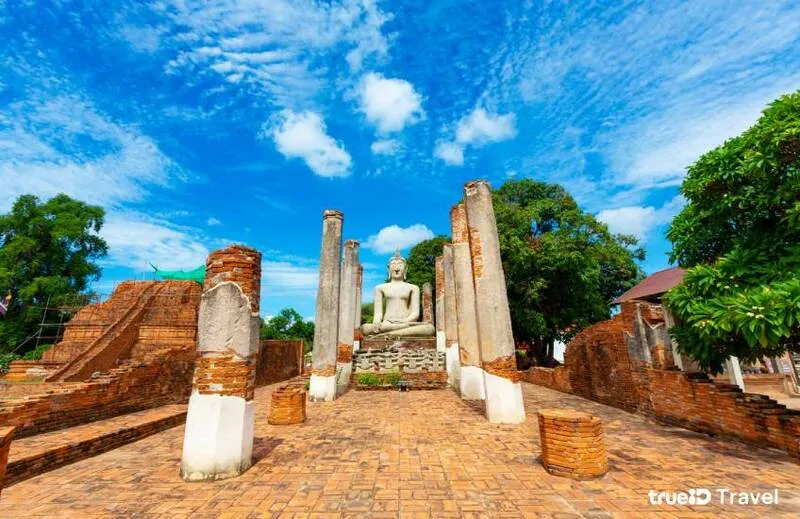
Wat Mahathat in Sankhaburi District, Chainat Province, is an important ancient temple associated with Phraek or the old city of Sankhaburi. It was formerly known as Wat Phra That or Wat Hua Mueang. Its most outstanding feature is the 3 starfruit-bud prangs in Lopburi style, which are rare to find. Within the temple grounds are also important ancient structures, Buddha images from several periods, Luang Pho Mo or Luang Pho Lak Mueang, and a museum that preserves antiquities. This makes the temple both a place of worship and a deeply meaningful learning site for the history of Sankhaburi.
Wat Mahathat in Chainat Province is one of the most important ancient temples in Sankhaburi District and has long been regarded as the historical center of the old city of Sankhaburi. The temple is located in Village No. 8, Phraek Si Racha Subdistrict, on the bank of the Noi River within the former old-city area of Sankhaburi. This location means that Wat Mahathat is not merely an old temple for worship, but also a monument reflecting the structure of the city, the prosperity of the community, and the artistic development of the central river basin over many centuries.
The former names of Wat Mahathat were “Wat Phra That” and “Wat Hua Mueang,” both of which carry significant historical meaning. The name “Wat Phra That” suggests that the temple may once have been associated with the enshrinement of sacred relics or the spiritual center of the city. The name “Wat Hua Mueang” evokes the image of a temple located in an important administrative and ceremonial part of the old city. For this reason, Wat Mahathat was not merely a local community temple, but a temple of city-level importance and a true sacred landmark of Phraek Si Racha or the city of Sankhaburi.
Although clear evidence regarding the original builder and exact date of construction has not survived, the Fine Arts Department has assessed the architectural style within the temple and suggested that Wat Mahathat was likely built in the early Ayutthaya period and served as the principal temple of the city. It is assumed that the ruler of the city at that time may have played a role in its construction. At the same time, many local tourism sources and historical references also agree that Wat Mahathat was an ancient temple closely tied to the city of Phraek or Sankhaburi and may even have roots earlier than the Ayutthaya period. This overlap of evidence makes the temple particularly interesting in academic terms, as it suggests that the sacred space may have continued from a pre-Ayutthaya phase and was later expanded, restored, or reshaped in subsequent eras.
The significance of Wat Mahathat becomes even clearer when considering the historical record that in B.E. 2444, King Chulalongkorn (Rama V) visited the area and left a written royal note about it. This royal journey was not merely a ceremonial event, but also reinforced the place of Wat Mahathat as a destination with historical importance and a strong cultural landscape within the old city of Sankhaburi.
Within Wat Mahathat are several groups of ancient remains that reveal the complexity of the temple layout in the past. The Fine Arts Department states that the front eastern side of the temple contains the ancient monument zone, while the western side continues to serve contemporary uses, including pavilions, multi-purpose areas, and a museum building. This arrangement gives Wat Mahathat a particular charm, because it is a “living temple” that is still in active use while preserving important traces of the past within the same grounds. Visitors therefore experience both the present life of the temple and the layered memory of the old city beneath the passage of time.
The most outstanding feature of Wat Mahathat is the 3 starfruit-bud prangs, sometimes called “Phu Mafueang Prangs.” These 3 brick-and-stucco towers stand on square bases in the form of a base platform. Their forms resemble the ridged segments of a starfruit, a style that is uncommon and highly distinctive in artistic terms. These 3 prangs are recognized as examples of Lopburi-period art and are among the key reasons Wat Mahathat holds such an important place in the art history of Chainat Province. The Fine Arts Department restored this prang group in B.E. 2526 in order to preserve this important ancient monument.
The beauty of the starfruit-bud prangs lies not only in their age or elegant alignment, but also in the relationship between their form and the Lopburi artistic influence that reflects the transmission of Khmer culture into central Thailand. Those interested in art history can see that the prangs are not merely buildings, but evidence of exchanges of power, belief, and aesthetics between states and communities in the past.
In addition to the starfruit-bud prang group, the temple also contains a large principal chedi. Although parts of it are now damaged and its original form cannot be seen completely, it still conveys the former grandeur of this important sacred monument. In front of the principal chedi to the east stands the ordination hall. Further north is the main vihara laid out in parallel, and at the rear of the vihara there is a cloister surrounding the principal chedi. Such a layout suggests that Wat Mahathat in the past must have been a major center of religious activity for the city.
The Fine Arts Department also notes that there are 2 rows of subsidiary chedis within the temple grounds. The first row consists of 7 octagonal-based chedis aligned east to west. Another row contains 3 structures, the first being a starfruit-bud prang and the other 2 being the cores of octagonal chedis. These remains show that the temple grounds were laid out in an ordered and meaningful manner, not constructed randomly, but organized as a sacred space with a clear hierarchy.
Another important element within the temple is its ancient Buddha images, which can be broadly divided into 2 main groups: Lopburi-style and early Ayutthaya-style works. The presence of Buddha images from different periods within the same temple demonstrates that Wat Mahathat was not frozen in a single era, but remained active, inherited, and transformed across many centuries. This allows visitors to appreciate the artistic development of Buddhist sculpture in the central river basin in a particularly meaningful way.
Among the important Buddha images in the temple, one especially revered by the people of Sankhaburi is Luang Pho Mo, also known as Luang Pho Lak Mueang. The Fine Arts Department states that this image is enshrined at the rear of the cloister on the western side of the principal chedi group. Local tourism information also agrees that local residents come here to make vows, pray for blessings, and request holy water for healing according to traditional belief, which is why the image became known as “Luang Pho Mo,” or the doctor monk. This role shows that Wat Mahathat is not important only archaeologically, but also as a center of living faith connected to the daily lives of local people.
Within the temple there is also a museum preserving ancient objects and antiquities. This museum is another reason why Wat Mahathat has high value as an educational destination, because visitors do not see only ruined structures or Buddha images from the outside, but can also understand the broader context of the old city of Sankhaburi through objects, artifacts, and traces preserved in the same place. For those seriously interested in local history, the temple museum makes the visit much more complete.
In terms of atmosphere, Wat Mahathat differs from more general temple attractions because the age of the place is still clearly visible. Although parts of the temple continue to serve contemporary purposes, the main structures still strongly reflect the character of an old city by the Noi River and the sacred center of the ancient Sankhaburi community. Visiting Wat Mahathat should therefore not be rushed, because each area carries a different meaning, from the starfruit-bud prangs to the principal chedi, main vihara, cloister, Buddha images, and museum, all of which are parts of the same historical story.
When viewed within the overall travel route of the area, Wat Mahathat can be considered the heart of touring old Sankhaburi, because it connects naturally with Wat Phra Kaeo, Wat Phraya Phraek, Wat Song Phi Nong, and other temples in the district. Travelers who truly wish to understand Sankhaburi should begin at Wat Mahathat and then expand their perspective to the surrounding ancient temples. This approach makes it much easier to understand both the hierarchy of the religious sites and the structure of the old city than visiting each place separately.
As a tourism destination, Wat Mahathat has strong potential because it appeals to worshippers, history enthusiasts, photographers, and cultural travelers alike. Those who enjoy paying respects can come to worship Luang Pho Mo. Those interested in ancient sites can admire the starfruit-bud prangs and the subsidiary chedis. Those interested in art history can observe traces of both Lopburi and early Ayutthaya styles in one place. And those who want a deeper travel experience can use Wat Mahathat as the first gateway to understanding the entire old city of Sankhaburi.
Another reason Wat Mahathat is so interesting is that it still retains a contemporary life together with the local community. It is not merely an ancient ruin cut off from people, but still has pavilions, activity areas, and living functions in some parts. This gives Wat Mahathat the charm of a place layered with time, where visitors can see both past and present existing together within the same space. That is why a visit to Wat Mahathat should be made mindfully and respectfully.
Traveling to Wat Mahathat is convenient. From Chainat town, the distance is about 20 kilometers. Take Highway 340 to the junction leading into Sankhaburi District. From the clock tower area near the Sankhaburi District Office, turn left and continue for about 500 meters to reach the temple. This route is most convenient by private car, as it also allows visitors to continue on to Wat Phra Kaeo and other attractions in Sankhaburi within the same day.
For those who want to experience Chainat in a deeper way than simply stopping for photos or passing through, Wat Mahathat is a destination worth serious time and attention. It is not just an old temple, but a repository of the memory of Sankhaburi. Whether viewed through architecture, Buddha images, antiquities, local stories, or traces connected to the Thai royal court in the reign of Rama V, Wat Mahathat still stands today as a place where history can be genuinely felt and understood.
Ultimately, the value of Wat Mahathat lies not only in its role as a travel destination, but also in its place as a cultural heritage site belonging to the people of Chainat and to Thailand as a whole. Visiting the temple should therefore be done with understanding, without climbing on the ancient remains, littering, or making excessive noise, and with the intention of learning as much as possible about the meaning of the place. The more people understand its value correctly, the greater the chance that important monuments like this will be cared for properly in the future.
Getting There If traveling from Chainat town, take Highway 340 toward Sankhaburi District. When you reach the clock tower area near the Sankhaburi District Office, turn left and continue for about 500 meters. Wat Mahathat will be on your route in Phraek Si Racha Subdistrict by the Noi River, and it can be conveniently combined with visits to Wat Phra Kaeo and other ancient temples in the old Sankhaburi zone.
| Name | Wat Mahathat |
| Location | Village No. 8, Phraek Si Racha Subdistrict, Sankhaburi District, Chainat Province 17140 |
| Address / General Position | Located in the center of old Sankhaburi by the Noi River, around 20 km from Chainat town and around 500 meters from the Sankhaburi clock tower |
| Highlights | 3 Lopburi-style starfruit-bud prangs, principal chedi and subsidiary chedis, Lopburi and early Ayutthaya Buddha images, Luang Pho Mo or Luang Pho Lak Mueang, and a museum preserving antiquities |
| Brief History | Formerly known as Wat Phra That or Wat Hua Mueang, this ancient temple was closely associated with the city of Phraek or Sankhaburi. It holds historical and artistic significance, and King Rama V visited the site in B.E. 2444. |
| Period / Estimated Age | Important monuments reflect both Lopburi and early Ayutthaya art, while the Fine Arts Department suggests that the temple had an important phase of development in the early Ayutthaya period. |
| Key Evidence | 3 starfruit-bud prangs, principal chedi, main vihara, cloister, subsidiary chedis, Luang Pho Mo, temple museum, and official registration as an ancient monument by the Fine Arts Department |
| Name Origin | Originally called Wat Phra That or Wat Hua Mueang before later becoming known as Wat Mahathat, reflecting its position as a major sacred center of the city. |
| Current Monastic Supervisor / Abbot | Phra Khru Sitthichai Rangsan |
| Current Status | An active temple as well as an ancient monument site, with an archaeological zone at the front and functional temple areas in other sections |
| Travel | From Chainat town, take Highway 340 to the Sankhaburi junction. From the clock tower area, turn left and continue დაახლოებით 500 meters. |
| Zone | Old Sankhaburi Zone / Historical Tourism Zone by the Noi River |
| Contact Number | No clearly verified public contact number for the temple was found, so it is omitted for accuracy. |
| Nearby Tourist Attractions | 1. Wat Phra Kaeo, Sankhaburi – about 3 km – Old Sankhaburi Zone 2. Wat Phraya Phraek – about 1 km – Sankhaburi Historical Zone 3. Wat Song Phi Nong – about 2 km – Ancient Temple Zone of Sankhaburi 4. Wat Chan, Sankhaburi – about 2 km – Old Sankhaburi Zone 5. Wat Khositaram (Luang Pho Khuai) – about 10 km – Sankhaburi Faith Tourism Zone |
| Nearby Restaurants | 1. DNA Cafe & Restaurant – about 1 km – Sankhaburi Zone – Tel. 081-267-0453 2. Lapassarin Cafe – about 1 km – Sankhaburi Town Zone – Tel. 082-642-3919, 098-223-2916 3. Po Ped Yang Sankhaburi – about 1 km – Sankhaburi Zone – Tel. 095-847-4128 4. UMB Farm Cafe' Chainat – about 3 km – Sankhaburi Zone – Tel. 081-455-0575 5. Krua Chef Pong – about 6 km – Sankhaburi Zone – Tel. 082-167-4189 |
| Nearby Accommodations | 1. 88/8 Resort Chainat – about 6 km – Sankhaburi Zone – Tel. 098-238-3888, 098-628-3888 2. Song Rao Guesthouse – about 7 km – Sankhaburi Zone – Tel. 085-947-8921 3. Baan Suan Premnattra Resort – about 8 km – Sankhaburi / Route Zone – Tel. 092-984-5448, 088-273-6133 4. 111 Resort and Spa – about 18 km – Chainat Town Zone – Tel. 093-221-1022, 056-410-883 5. Accommodations in Chainat Town Area – about 20 km – Town Zone – Advance booking is recommended during travel seasons |
Frequently Asked Questions (FAQ)
Q: Where is Wat Mahathat in Chainat located?
A: Wat Mahathat is located in Village No. 8, Phraek Si Racha Subdistrict, Sankhaburi District, Chainat Province, in the center of the old city of Sankhaburi and by the Noi River.
Q: What was the original name of Wat Mahathat?
A: Wat Mahathat was originally called Wat Phra That or Wat Hua Mueang, reflecting its importance as a major temple associated with the city of Phraek or Sankhaburi.
Q: What is the most outstanding feature of Wat Mahathat?
A: Its most outstanding feature is the 3 Lopburi-style starfruit-bud prangs, which are important ancient monuments with a distinctive and rare form.
Q: What important Buddha images are found at Wat Mahathat?
A: The temple houses Buddha images in both Lopburi and early Ayutthaya styles, including Luang Pho Mo or Luang Pho Lak Mueang, which is highly revered by local people.
Q: Has Wat Mahathat been registered as an ancient monument?
A: Yes. Wat Mahathat was officially registered as an ancient monument by the Fine Arts Department on 8 March 1935.
Q: Is there a museum inside Wat Mahathat?
A: Yes. The temple has a museum that preserves antiquities and important historical objects from the area.
Q: How do I get to Wat Mahathat?
A: From Chainat town, take Highway 340 to the Sankhaburi junction. At the clock tower area, turn left and continue for about 500 meters to reach the temple.
Q: What other places can I visit together with Wat Mahathat?
A: You can combine your visit with Wat Phra Kaeo, Wat Phraya Phraek, Wat Song Phi Nong, and Wat Khositaram in the same trip, especially if you are interested in the old city of Sankhaburi.
 Wat Mahathat Map
 Category:
  Group:
  Last Update: 15 HourAgo
Comment
 Nearby Attractions
| Keyword (Advance) |
 Region
|
 Muang Chai Nat(