

 Home
Home Chiang Mai(




Rating: 4.3/5 (4 votes)
 |
|  Map
Map 
 Have Map
  No Map
Chai Nat attractions
Attractions in Thailand
Open Days: Open Daily
Opening Hours: 08:00 – 18:00
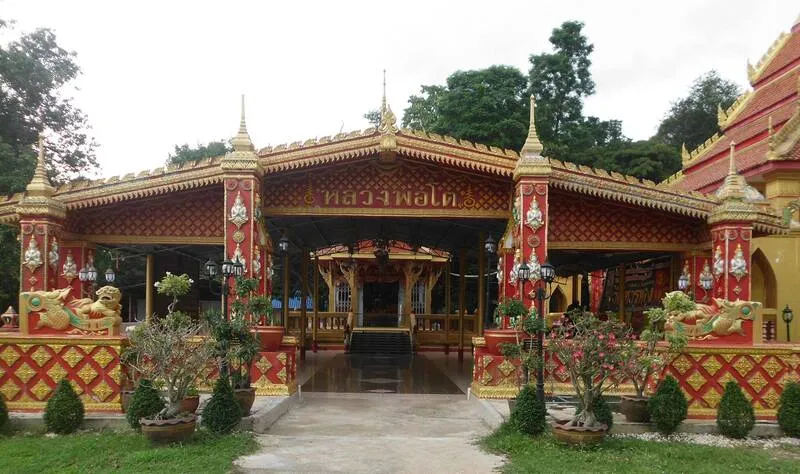
Wat Wihan Thong is an ancient temple located in Village No. 7, Thiang Thae Subdistrict, Sankhaburi District, Chainat Province. It stands within the walls of the ancient city of Sankhaburi and lies along the southern side of the Noi River, an important river of Thailand’s central plains since ancient times. The location of this temple is therefore closely connected to the settlement patterns of communities in the past, as riverside areas were essential for transportation, trade, and daily life for centuries.
Sankhaburi was one of the important ancient cities of the Noi River basin. A large number of historical and archaeological remains show that this area once supported a major community in the past. Within the old city walls, many ancient temples are scattered in different locations, reflecting the prosperity of religion and culture in earlier times. Wat Wihan Thong is therefore one of the important elements within the sacred landscape of this ancient city.
In the past, Wat Wihan Thong became an abandoned temple, like many other ancient temples in Sankhaburi, due to changes in settlement patterns and the relocation of local communities. As a result, many temples were left deserted for a long time. It was not until the early Rattanakosin period that local people joined together to restore the temple, and monks began residing there again around B.E. 2453. This restoration brought Wat Wihan Thong back to life as an important religious center for the local community.
The most important ancient structure within the temple is the ordination hall, built of brick and stucco and especially distinctive because of its shape, which resembles a Chinese junk. This architectural form is quite rare among Thai temples and is one of the main features that makes Wat Wihan Thong different from other temples in the same area. The structure of the ordination hall was restored from the original building, while still preserving its traditional architectural form clearly.
This junk-shaped ordination hall closely resembles the ordination hall of Wat Mahathat in Sankhaburi District, another important ancient temple of the old city. However, the ordination hall of Wat Wihan Thong is more complete in several respects, allowing the architectural form of the building to be seen more clearly. Some scholars therefore regard this hall as a good example of early Ayutthaya temple architecture that still survives in central Thailand.
The junk-like form of the ordination hall reflects the relationship between religion and the way of life of people in the past. Since rivers served as the main transportation routes of Thai society from ancient times, boats became symbols of travel, trade, and contact between communities. Constructing a religious building in this form may therefore carry symbolic meaning related to crossing beyond suffering in Buddhist belief.
Brick-and-stucco construction was a technique widely used in traditional Thai architecture, especially during the Ayutthaya period. Buildings were often erected on large brick bases for stability, after which walls and other structural elements were built according to the desired architectural form. This technique allowed buildings to survive for long periods, even through changes in environment and the passage of time.
Beyond the ordination hall, the surrounding temple grounds also reflect the character of old riverside communities, which were ideal places for settlement in the past because they could use the river at the same time as a water source, a food source, and a transportation route. The Noi River therefore played a highly important role in the development of the ancient city of Sankhaburi.
When the urban structure of ancient Sankhaburi is considered, it becomes clear that religious sites were often positioned in ways that connected closely with the city plan. Many temples stood near transportation routes or important water sources, reflecting the role of temples as social and cultural centers of their communities. Wat Wihan Thong was therefore not only a place for religious ceremonies, but also a space that reflected the social structure of the past.
Today, Wat Wihan Thong remains an active temple with resident monks and continues to serve as a place for religious activities for the community of Thiang Thae Subdistrict. It is also a historical learning site for those interested in the story of ancient Sankhaburi. Visitors who come to this area often choose to tour several ancient temples nearby together, in order to study the development of this old city more completely.
Getting There If traveling from Chainat town, take Highway 340 toward Sankhaburi District. Once you reach the district area, continue toward Thiang Thae Subdistrict, which is part of the old city of Sankhaburi. Then drive on to Village No. 7, where Wat Wihan Thong is located. The temple stands not far from the Noi River and can easily be connected with visits to Wat Mahathat, Wat Song Phi Nong, and Wat Phra Kaeo, making it suitable for a one-day historical travel route.
| Name | Wat Wihan Thong |
| Location | Village No. 7, Thiang Thae Subdistrict, Sankhaburi District, Chainat Province |
| Highlights | A brick-and-stucco ordination hall shaped like a Chinese junk, an ancient monument within the walls of old Sankhaburi, and a historic temple connected to the history of the ancient city of Sankhaburi |
| Brief History | Originally an abandoned temple within the walls of ancient Sankhaburi, later restored and revived with resident monks around B.E. 2453 |
| Period / Estimated Age | Believed to date back to the Ayutthaya period |
| Current Monastic Supervisor / Abbot | Phra Khru Wihan Thong (abbot title as identified locally) |
| Nearby Tourist Attractions | 1. Wat Mahathat, Sankhaburi – about 1 km 2. Wat Song Phi Nong – about 1 km 3. Wat Phra Kaeo, Sankhaburi – about 2 km 4. Wat Phraya Phraek – about 2 km 5. Chao Phraya Dam – about 15 km |
| Nearby Restaurants | 1. Lapassarin Cafe – 1 km – Tel. 082-642-3919 2. D Na Restaurant, Sankhaburi – 1 km – Tel. 082-642-3919 3. DNA Cafe & Restaurant – 2 km – Tel. 081-267-0453 4. UMB Farm Cafe – 3 km – Tel. 081-455-0575 5. Krua Chef Pong – 6 km – Tel. 082-167-4189 |
| Nearby Accommodations | 1. 88/8 Resort Chainat – 7 km – Tel. 098-238-3888 2. Baan Suan Premnattra Resort – 9 km – Tel. 092-984-5448 3. Pornphana & Fah Sai Resort – 10 km – Tel. 095-331-1112 4. Chainat Resort – 15 km – Tel. 056-411-234 5. Chainat Thani Hotel – 20 km – Tel. 056-411-987 |
| Important Phone Numbers | 1. Sankhaburi District Office – 056-481-134 2. Thiang Thae Subdistrict Administrative Organization – 056-481-333 3. Sankhaburi Police Station – 056-481-191 4. Sankhaburi Hospital – 056-481-158 5. TAT Call Center – 1672 |
Frequently Asked Questions (FAQ)
Q: Where is Wat Wihan Thong located?
A: Wat Wihan Thong is located in Village No. 7, Thiang Thae Subdistrict, Sankhaburi District, Chainat Province, within the walls of the ancient city of Sankhaburi.
Q: What is the highlight of Wat Wihan Thong?
A: Its main highlight is the brick-and-stucco ordination hall shaped like a Chinese junk, a rare architectural form among Thai temples.
Q: In which period was Wat Wihan Thong built?
A: Based on its architectural character, the temple is believed to date back to the Ayutthaya period before later becoming abandoned and then restored around B.E. 2453.
Q: What places can be visited together with Wat Wihan Thong?
A: Visitors often combine it with Wat Mahathat, Wat Song Phi Nong, and Wat Phra Kaeo, all located within the old city area of Sankhaburi.
Q: Why is Sankhaburi important?
A: Sankhaburi is an important ancient city of the Noi River basin, with many ancient temples and monuments reflecting the history of the region.
 Wat Wihan Thong Map
 Category:
  Group:
  Last Update: 18 HourAgo
Comment
 Nearby Attractions
| Keyword (Advance) |
 Region
|
 Muang Chai Nat(