

 Home
Home Chiang Mai(




Rating: 3.6/5 (5 votes)
 |
|  Map
Map 
 Have Map
  No Map
Chai Nat attractions
Attractions in Thailand
Open Days: Open Daily
Opening Hours: 08:00 – 17:00
Wat Sing Satit, Chainat is an old temple of great significance to the history of Wat Sing District in Chainat Province. It is also one of the temples that clearly reflects the development of communities along the Chao Phraya River basin in central Thailand. This temple is not merely a place for Buddhist ceremonies, but also forms part of the foundation of the names of the local community, subdistrict, and Wat Sing District as they are known today. The story of Wat Sing Satit is therefore not simply the history of one temple, but a part of local history connected with the settlement of people in this area for a very long time.
Wat Sing Satit is located in Wat Sing Subdistrict Municipality, Wat Sing District, Chainat Province. In the past, this area was dense natural forest and was home to many wild animals. When people began to settle here and establish a village, the community was called “Ban Sing” according to the nature of the area, which had once been forest with many dangerous animals. Later, when the community grew and a temple was built there, the temple came to be called “Wat Sing” after the name of the village.
As time passed and the community became more developed, the village name became the name of the subdistrict, and later it was officially adopted as the name of the district, which is “Wat Sing District,” a name that remains in use today. Wat Sing Satit is therefore considered a temple directly connected with the origin of the area’s administrative name, because it has stood alongside the community since the earliest period of settlement.
According to local historical information, Wat Sing Satit was built around 1832, during the early Rattanakosin period. At that time, communities in central Thailand were often located near water sources such as rivers, canals, or fertile agricultural land, since water was an essential factor for life, whether for farming, transportation, or trade. The Ban Sing community likewise developed within the context of a river-based society.
In the past, Thai temples played a much broader role than simply serving as places for religious ceremonies. Temples were also centers of education, meeting places for the community, and spaces used for important village events, whether merit-making ceremonies, traditional festivals, or community gatherings. For this reason, having a temple in a village was considered extremely important to the development of local society. Wat Sing Satit therefore played an essential role in shaping the way of life of people in Wat Sing District from the earliest times.
Later, as the town and community became more prosperous, Wat Sing was renamed “Wat Sing Satit” to make the name more formal and to reflect the status of the temple as a community center. Around 1940, the name was shortened to “Wat Sing Satit.” However, in the present day, the form “Wat Sing Satit” is still found in many sources, meaning that both versions of the name continue to appear in documents and in everyday local usage.
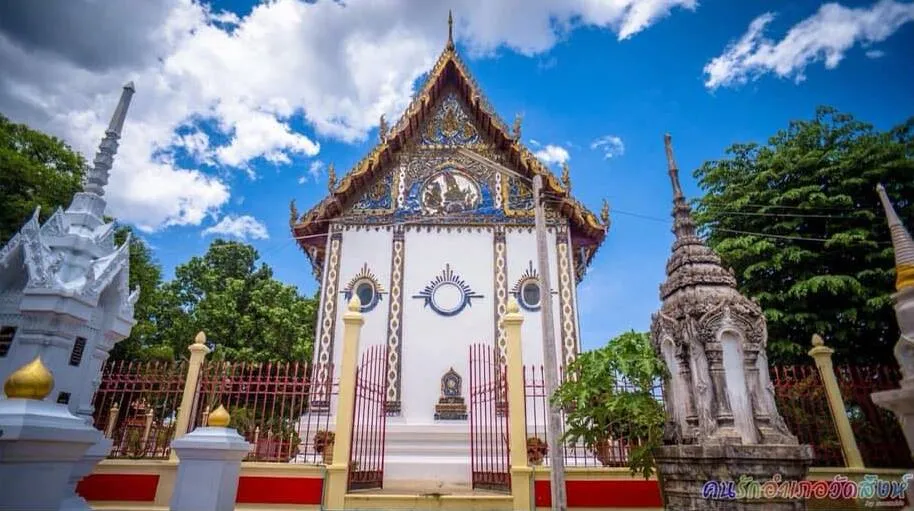
The most outstanding feature of Wat Sing Satit is its old ordination hall, built in 1932. This ordination hall is an ancient architectural form known as a “Maha Ut Ubosot,” a type of ordination hall not commonly found in ordinary temples. The key characteristic of a Maha Ut hall is that it has only one entrance and exit, without side windows like a typical ordination hall. This design is associated with Buddhist beliefs and certain ritual practices that emphasize sacredness and the stillness of the interior space.
The ordination hall of Wat Sing Satit also has an important artistic highlight, namely its gable decorated with beautifully crafted stucco patterns. These patterns reflect the workmanship of artisans in the past, who showed remarkable precision and attention to detail. The stucco work is valuable not only for its beauty, but also because it reflects Thai artistic traditions of that period as well as the religious beliefs embedded in the various motifs.
In addition to the ordination hall, the surrounding area is enclosed by a crystal wall, an important element of traditional Thai temple architecture. The crystal wall serves to separate the sacred monastic area from the outside space and also helps emphasize the importance of the ordination hall as the central building of the temple. Looking at the ordination hall, the enclosing wall, and the surrounding grounds as a whole, it becomes clear that the entire architectural layout was designed with balance and in accordance with the principles of traditional Thai temple planning.
For those interested in Thai temple architecture, the ordination hall of Wat Sing Satit is a very interesting example because it has preserved its traditional form very well. Even though many decades have passed, the main structure of the hall remains in good condition and continues to serve as the center of the temple’s religious activities to this day.
The surroundings of Wat Sing Satit are shady and peaceful, in keeping with the character of an old temple in a provincial community. Large trees throughout the grounds create a cool and pleasant atmosphere. Once visitors enter the temple, they can immediately feel a calmness very different from the busyness of the city. This atmosphere makes Wat Sing Satit an ideal place for making merit, paying respect to sacred images, or simply finding peace of mind.
Today, Wat Sing Satit continues to serve as the center of religious and cultural activities for the community in Wat Sing District. Various merit-making events and local traditions are commonly held at this temple, whether annual merit ceremonies, Buddhist holy day observances, or other community activities. The temple therefore still plays an important role in bringing people in the area together.
For travelers interested in cultural tourism, Wat Sing Satit is definitely a place worth visiting. In addition to paying respect and making merit, visitors can also learn about local history and the architecture of an ancient Thai temple. Walking around the Maha Ut ordination hall and closely observing the stucco gable decorations helps one better appreciate the beauty of Thai artistic heritage from the past.
If you have the opportunity to visit Chainat Province, stopping at Wat Sing Satit is an experience not to be missed, because this temple is not only a place of worship but also a site that tells the story of the origins of the Wat Sing community and clearly reflects the cultural roots of the area.
Seen as a whole, Wat Sing Satit is much more than just an old temple in Chainat. It is a symbol of community history passed down through many generations, in terms of religion, art, and the way of life of local people. Visiting this temple is therefore like taking a journey back to experience the stories of the past that still remain alive in the present.
Getting There
Traveling to Wat Sing Satit, Chainat is quite convenient because the temple is located in Wat Sing Subdistrict Municipality, Wat Sing District, which is the main community area of the district. The journey from Chainat town covers approximately 20–25 kilometers. You can take the Chainat–Wat Sing road toward Wat Sing District. Once you arrive in the district area, continuing on to Wat Sing Satit is not difficult, because the temple is close to the main community and can be easily found through online map systems.
For those traveling from Bangkok, you can use the Asian Highway (Highway No. 32) heading toward Chainat Province, then continue into Chainat town and travel onward to Wat Sing District via local provincial roads. This route takes approximately 3–4 hours. Travelers can also use Google Maps or other navigation apps to search for “Wat Sing Satit,” which helps make the journey easier and more accurate.
If traveling by public transportation, visitors can take a bus from Bangkok to the Chainat bus terminal, then continue by local transport or hired vehicle to Wat Sing District. The journey is not long because the distance between Chainat town and Wat Sing District is relatively short. Once in the district area, local hired transport can be used to continue on to Wat Sing Satit.
For travelers arriving by private car, a visit to Wat Sing Satit can also be combined conveniently with other important attractions in Chainat Province, such as Wat Pak Khlong Makham Thao, Wat Song Sawoei, Chao Phraya Dam, and Chainat Bird Park, all of which are among the province’s major attractions. Planning a one-day multi-temple pilgrimage route is therefore another popular activity among visitors to Chainat.
Upon arriving at the temple, visitors will find that the surrounding area still preserves the peaceful and simple atmosphere of a local community. As a result, visiting Wat Sing Satit is not only a journey to pay respect or admire ancient architecture, but also an opportunity to experience the way of life of the Wat Sing community, which has preserved its traditional identity very well.
| Name | Wat Sing Satit |
| Location | Wat Sing Subdistrict, Wat Sing District, Chainat Province |
| Brief History | An old temple of Wat Sing District, built around 1832. It played an important role in the settlement of the community and is closely connected with the origin of the district name Wat Sing. |
| Highlights | An ancient Maha Ut ordination hall, beautiful stucco gable decorations, and strong ties to the historical name of Wat Sing District. |
| Abbot | Phra Athikan Saran Kantasilo |
| Opening Hours | Open Daily 08:00 – 17:00 |
| Nearby Tourist Attractions | 1. Wat Pak Khlong Makham Thao – 6 km. 2. Wat Song Sawoei – 8 km. 3. Wat Phikun Ngam – 12 km. 4. Chao Phraya Dam – 18 km. 5. Chainat Bird Park – 20 km. |
| Nearby Restaurants | 1. Krua Wat Sing Restaurant – 2 km. Tel. 056-401-221 2. Baan Suan Wat Sing Restaurant – 3 km. Tel. 056-401-889 3. Krua Rim Nam Chainat – 15 km. Tel. 056-411-888 4. Baan Imsuk Restaurant – 18 km. Tel. 056-410-229 5. Chainat Garden Restaurant – 20 km. Tel. 056-411-201 |
| Nearby Accommodations | 1. Chainat Thani Hotel – 20 km. Tel. 056-411-403 2. 111 Resort Chainat – 19 km. Tel. 056-414-229 3. Chainat Park Resort – 21 km. Tel. 056-417-777 4. Chao Phraya Resort – 22 km. Tel. 056-415-909 5. Chainat Resort – 23 km. Tel. 056-411-566 |
Frequently Asked Questions (FAQ)
Q: Where is Wat Sing Satit located?
A: Wat Sing Satit is located in Wat Sing Subdistrict, Wat Sing District, Chainat Province. It is an old temple of historical importance to the area.
Q: When was Wat Sing Satit built?
A: Wat Sing Satit was built around 1832 and has been one of the important temples of the Ban Wat Sing community since the past.
Q: What is the highlight of Wat Sing Satit?
A: The highlight of the temple is its ancient Maha Ut ordination hall, which has beautiful stucco gable decorations and represents a type of architecture not commonly found in ordinary temples.
Q: How is Wat Sing Satit connected to the name of Wat Sing District?
A: The area was originally called “Ban Sing.” When the temple was built, it became known as “Wat Sing.” The temple name was later adopted as the name of the subdistrict and district, resulting in the present name “Wat Sing District.”
Q: How do I get to Wat Sing Satit?
A: You can travel from Chainat town for about 20–25 kilometers toward Wat Sing District via the Chainat–Wat Sing road, and you can use Google Maps to search for Wat Sing Satit directly.
Q: What places can I visit together with Wat Sing Satit?
A: You can continue your trip to Wat Pak Khlong Makham Thao, Wat Song Sawoei, Chao Phraya Dam, and Chainat Bird Park, all of which are important attractions in Chainat Province.
 Wat Sing Sathit Map
 Category:
  Group:
  Last Update: 20 HourAgo
Comment
 Nearby Attractions
| Keyword (Advance) |
 Region
|
 Muang Chai Nat(