

 Home
Home Chiang Mai(




Rating: 3.8/5 (4 votes)
 |
|  Map
Map 
 Have Map
  No Map
Chai Nat attractions
Attractions in Thailand
Open Days: Open Daily
Opening Hours: Please check with the temple before visiting
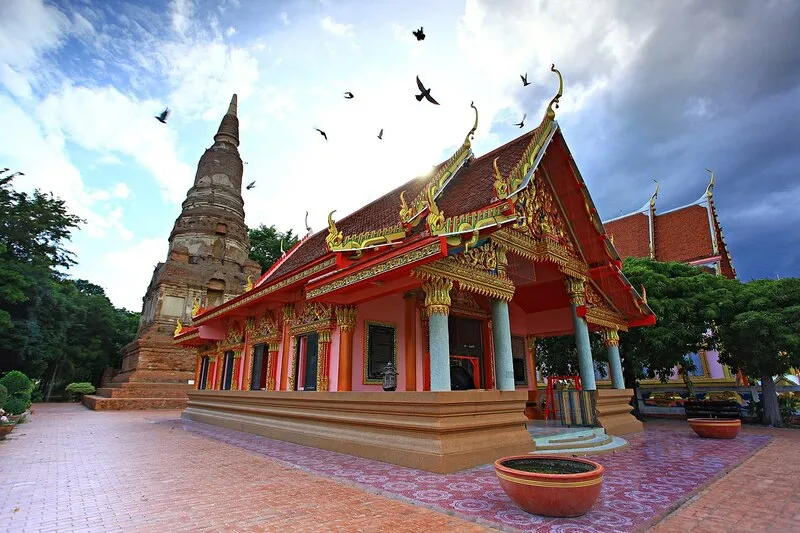
Wat Phra Kaeo in Sankhaburi District, Chainat Province, is an important ancient temple built in the same period as Wat Mahathat in the old city of Sankhaburi. Originally known as Wat Pa Kaeo, it served as a meditation center for monks of the Aranyavasi tradition. The temple’s most outstanding feature is its principal chedi, a tall monument around 600–700 years old, reflecting a blend of several artistic traditions and embodying profound Buddhist symbolism. Within the temple grounds are also Luang Pho Chai, a red laterite Buddha image believed to be about 800 years old, and Luang Pho Phloi, a stucco Buddha image that local residents respectfully enshrined here. For this reason, the temple is both a valuable center of historical learning and an important site of religious and artistic heritage in Chainat Province.
Wat Phra Kaeo in Chainat Province is an ancient temple of great importance to the history of Sankhaburi District and Chainat Province. It is located in Village No. 10, Ban Bang Nam Phra, Phraek Si Racha Subdistrict, around 2 kilometers south of Sankhaburi town center. The temple stands outside the old city to the south and is not far from Wat Mahathat. Today, the surrounding area is open countryside and rice fields, creating a peaceful and shady atmosphere that gives the site the enduring presence of an ancient monument standing against the passage of time. Even from a distance, the tall principal chedi immediately draws the eye and makes visitors realize that this is not just an ordinary temple, but a place layered with historical and artistic depth far beyond what first appears on the surface.
The temple was originally called “Wat Pa Kaeo.” This former name corresponds to its historical role as a place of practice for monks of the forest-dwelling tradition, or those devoted to insight meditation. In other words, it was a temple focused on peace, simplicity, and spiritual cultivation. The term Aranyavasi implies residence or practice in an area removed from the busier life of the city, and when considering the temple’s location outside the old city of Sankhaburi, this interpretation becomes even more convincing. Wat Phra Kaeo is therefore not merely an old monument, but also cultural evidence of how ancient Buddhist communities distinguished between temples inside the city and those outside it, each serving different religious purposes.
Traditional accounts state that Wat Phra Kaeo was built in the same era as Wat Mahathat, around B.E. 1900, or approximately the late 19th Buddhist century. At that time, Sankhaburi was highly significant within the upper central river basin. Wat Phra Kaeo should therefore be understood as part of the religious and political landscape of the old city, rather than simply as a solitary temple standing amid rice fields today. If one imagines the area in earlier centuries, the surroundings would likely have been much livelier, connected to waterways and nearby communities, and perhaps used continuously by monks, ascetics, or pilgrims as a center of practice.
The key turning point that transformed Wat Pa Kaeo into “Wat Phra Kaeo” was the discovery of a tiny Buddha image, about the size of a fingertip, inside the chedi. The image was made of glass and displayed multiple colors, producing a beautiful sparkling effect when struck by light. Because of this, local people came to call the temple “Wat Phra Kaeo.” The new name therefore came directly from a sacred object actually found within the ancient monument, not merely from symbolic naming. This story is one of the temple’s most distinctive features, because it binds together history, faith, and local memory in a particularly vivid way.
Later, the Fine Arts Department officially registered Wat Phra Kaeo as an ancient monument on 8 March 1935. This recognition reinforced the fact that the temple is important not only at the community level, but also at the national level. The registration formally acknowledged Wat Phra Kaeo as a heritage site of historical and artistic value worthy of preservation and study. For travelers interested in cultural tourism, this is significant because it confirms that the temple is not only a place of worship, but also an archaeological learning site supported by official evidence.
The most remarkable feature of Wat Phra Kaeo is its principal chedi, often described as one of the most beautiful and intriguing chedis in Sankhaburi. The chedi is a tall structure on a square base, built of brick and stucco, standing on a plinth, base layers, and a shrine base with a recessed profile. Around the main body are high-relief stucco Buddha images on all 4 sides. The beauty of the chedi lies not only in its height or age, but in the way each part of its form is carefully composed and imbued with spiritual meaning, so much so that some have praised it as the “queen of chedis” in this area.
Many scholars believe that this chedi was built around the 18th–19th Buddhist centuries, making it approximately 600–700 years old. What makes it especially fascinating is that its form does not belong exclusively to a single artistic school. Instead, it reflects a combination of Lopburi-style tall chedis and late Dvaravati forms, while certain features also recall influences from Sukhothai, Srivijaya, and early Ayutthaya art. This is one reason why the principal chedi of Wat Phra Kaeo holds exceptional value for the study of Thai art history, as it demonstrates the transmission and blending of cultural influences from several regions into Sankhaburi.
A close examination of the structure reveals that ancient builders did not create the chedi solely as a reliquary or sacred monument, but also embedded Buddhist teachings into every architectural element. The square base is interpreted as representing the Four Noble Truths, the foundation of Buddhism. Above that is an octagonal tier symbolizing the Noble Eightfold Path. The 12 umbrella-ring sections are understood to represent Dependent Origination, the chain of causes and conditions. The total height of 37 meters has also been interpreted as symbolizing the 37 Factors of Enlightenment. These ideas make Wat Phra Kaeo much more than just a place to admire ancient architecture; it is a site where visitors can, quite literally, read Dhamma through architecture.
This symbolic interpretation gives a visit to Wat Phra Kaeo much greater depth than merely appreciating physical beauty. Those who walk around the chedi attentively begin to see that its height, balance, and layered form were not accidental, but the result of a design that closely ties architecture to Buddhist doctrine. For those who come with a learning-oriented perspective, Wat Phra Kaeo becomes a kind of “textbook of Dhamma built in brick and stucco,” something that is not easily found in ordinary tourist attractions.
In the past, the area around the principal chedi was once surrounded by many subsidiary chedis, numbering in the dozens. Today, however, many of them have disappeared or collapsed, leaving only traces of the former grandeur. This very change makes the surviving remains even more valuable, because each part that still stands serves as a witness to time and as a shared heritage that future generations must help preserve.
Besides the principal chedi, Wat Phra Kaeo also houses an important Buddha image deeply revered by local people: Luang Pho Chai, enshrined in the vihara in front of the square chedi. Luang Pho Chai is a red laterite Buddha image believed to be around 800 years old. Its antiquity makes it another major piece of evidence showing the long continuity of religion and art in the Sankhaburi area. People who come to Wat Phra Kaeo do not come only to admire the ancient monument, but also to pay their respects and pray before Luang Pho Chai with sincere faith.
Behind Luang Pho Chai is an ancient carved lintel attached close to the vihara wall. Its imagery is especially intriguing: it depicts an elephant lying on its back upon a pedestal, while at the top is a deity, interpreted by some as Indra or Shiva, pouring sacred water that flows down toward the elephant below. This composition gives the lintel value not only as a work of art, but also as an object of symbolic interpretation, reflecting the absorption of diverse artistic traditions into central Thailand.
Another important Buddha image is Luang Pho Phloi, a stucco Buddha image with a lap width of about 2 meters. It was originally enshrined at Wat Thap Yan in Thiang Thae Subdistrict, Sankhaburi District. After that temple became abandoned, the people of Bang Nam Phra joined forces to bring the image here by ox cart and raft across the Noi River, eventually enshrining it at Wat Phra Kaeo. Because it was transported across the water, villagers affectionately call it “Luang Pho Loi.” This story reflects the bond between sacred images and the community, while also showing the collective faith of local residents in preserving their spiritual heritage.
Looking at Wat Phra Kaeo as it appears today, one immediately notices that it differs clearly from larger and more commercial temple attractions. It does not stand within a dense settlement or bustling market area, but instead rises amid rice fields beside an irrigation canal. This calm simplicity is precisely what gives the temple its distinctive charm, making visitors feel as if they have stepped back in time to experience an ancient monument in a more natural and historical setting. Seeing the tall chedi standing alone in the fields makes it easy to understand why Wat Phra Kaeo is especially suited to educational and heritage-focused travel rather than hurried sightseeing.
Wat Phra Kaeo also has a meaningful spatial relationship with Wat Mahathat, being located only about 3 kilometers away. A visit to Wat Phra Kaeo should therefore not be separated from learning about the old city of Sankhaburi as a whole. With thoughtful route planning, travelers can visit Wat Mahathat, Wat Phra Kaeo, and other important sites in Sankhaburi in a single day, helping them better understand the development of both the city and its religious architecture.
As a travel destination, Wat Phra Kaeo is especially suitable for those interested in history, art, archaeology, and local culture, rather than for those simply seeking quick entertainment. Its appeal does not lie in a large number of activities, but in the depth of meaning that requires time, close observation, and concentration. When standing near the chedi, one can study the details of the base, examine the stucco Buddha images on each side, sit quietly in the vihara of Luang Pho Chai, and imagine the people hundreds of years ago who created this remarkable site. Experiences like this make a visit to Wat Phra Kaeo meaningful far beyond a simple check-in stop.
Traveling to Wat Phra Kaeo from Sankhaburi town is fairly convenient, as the temple lies only about 2 kilometers to the south. Visitors using private cars can easily follow the local roads into Phraek Si Racha Subdistrict. According to historical travel information, bus routes running from Bangkok to Sankhaburi and Chainat once passed through this area, making travel by public transport at least possible in principle, though onward local transport would still be needed to reach the temple itself. In practice, however, a private car is the most convenient option, especially for those wishing to combine Wat Phra Kaeo with Wat Mahathat, Wat Khositaram, and other sites in Sankhaburi.
For travelers who seriously wish to study Chainat’s historical monuments, Wat Phra Kaeo is one site that should not be overlooked. It brings together the history of the city, the art of several eras, Buddhist concepts embodied in architecture, and community narratives all within one place. Viewed within the wider context of Chainat Province, which contains many temple and cultural attractions, Wat Phra Kaeo stands out through its very specific identity: an ancient temple set amid open fields, still bearing clear traces of its former grandeur.
The value of Wat Phra Kaeo therefore lies not only in its age, but also in its role as an open-air history classroom for Sankhaburi. Visitors can see here how religion, art, and local ways of life are deeply interconnected. From Wat Pa Kaeo in the past to Wat Phra Kaeo as it is known today, the temple continues to function as a place of faith, memory, and learning right up to the present.
From a conservation perspective, Wat Phra Kaeo is a heritage treasure belonging to the people of Chainat and to Thai society as a whole. Visiting the temple should therefore be done with respect: no climbing on the ruins, no littering, no loud disturbance, and with an emphasis on learning the site’s true value rather than simply seeking photo spots. The more visitors understand the significance of places like this, the greater the chance that such heritage will be preserved properly for the future.
Getting There If starting from Sankhaburi town, head south into Phraek Si Racha Subdistrict for about 2 kilometers and you will reach Wat Phra Kaeo in the Ban Bang Nam Phra area. The temple is located not far from Wat Mahathat and can easily be included in a historical sightseeing route within the same area. Travelers coming from Bangkok can use the Asian Highway and connect into Sankhaburi, or take public transportation to Sankhaburi first and then continue locally to the temple. In practice, a private car is the most convenient option for those wishing to visit several sites in Sankhaburi within the same day.
| Name | Wat Phra Kaeo |
| Location | Village No. 10, Ban Bang Nam Phra, Phraek Si Racha Subdistrict, Sankhaburi District, Chainat Province 17140 |
| Address / General Position | Located outside the old city of Sankhaburi to the south, around 2 km from Sankhaburi town center and around 3 km from Wat Mahathat |
| Highlights | Principal chedi approximately 600–700 years old, Buddhist symbolism embedded in the architecture, Luang Pho Chai the red laterite Buddha image, Luang Pho Phloi, and the atmosphere of an ancient monument amid rice fields |
| Brief History | Built in the same period as Wat Mahathat around B.E. 1900, originally called Wat Pa Kaeo and associated with the Aranyavasi tradition. It later became known as Wat Phra Kaeo after a tiny glass Buddha image was discovered inside the chedi. |
| Period / Estimated Age | Late 18th–19th Buddhist centuries / principal chedi approximately 600–700 years old |
| Key Evidence | Principal chedi, stucco Buddha images on all 4 sides, Luang Pho Chai, ancient lintel behind Luang Pho Chai, Luang Pho Phloi, and official registration as an ancient monument by the Fine Arts Department |
| Name Origin | Originally called Wat Pa Kaeo. Later, a small multicolored glass Buddha image was found inside the chedi, leading local people to call it Wat Phra Kaeo. |
| Current Monastic Supervisor / Abbot | Phra Khru Wichit Chayathon (Surat Akkathammo) |
| Current Status | An important temple and ancient monument in Sankhaburi District, open for visits and worship. Visitors should enter respectfully and be mindful of the archaeological site. |
| Travel | About 2 km south of Sankhaburi town center. Easy to reach by private car and suitable for combining with a visit to Wat Mahathat on the same day. |
| Zone | Old Sankhaburi Zone / Historical and Ancient Temple Tourism Zone of Chainat |
| Contact Number | Wat Phra Kaeo: 089-270-5325 |
| Nearby Tourist Attractions | 1. Wat Mahathat, Sankhaburi – about 3 km – Old Sankhaburi Zone 2. Wat Phraya Phraek – about 4 km – Sankhaburi Historical Zone 3. Wat Song Phi Nong – about 4 km – Ancient Temple Zone of Sankhaburi 4. Wat Chan, Sankhaburi – about 5 km – Old Temple Zone in Sankhaburi District 5. Wat Khositaram (Luang Pho Khuai) – about 12 km – Faith Tourism Zone of Sankhaburi |
| Nearby Restaurants | 1. DNA Cafe & Restaurant – about 5 km – Sankhaburi Zone – Tel. 081-267-0453 2. Krua Chef Pong – about 6 km – Near Wat Luang Pho Khuai / Sankhaburi Zone – Tel. 082-167-4189 3. UMB Farm Cafe' Chainat – about 6 km – Sankhaburi Zone – Tel. 081-455-0575 4. Lapassarin Cafe – about 5 km – Sankhaburi Town Center Zone – Tel. 082-642-3919, 098-223-2916 5. Po Ped Yang Sankhaburi – about 5 km – Sankhaburi Zone – Tel. 095-847-4128 |
| Nearby Accommodations | 1. 88/8 Resort Chainat – about 7 km – Sankhaburi Zone – Tel. 098-238-3888, 098-628-3888 2. Song Rao Baan Phak – about 7 km – Sankhaburi Zone – Tel. 085-947-8921 3. Baan Suan Premnattra Resort – about 9 km – Sankhaburi / Route Zone – Tel. 092-984-5448, 088-273-6133 4. 111 Resort and Spa – about 18 km – Chainat City-Sankhaburi Connecting Zone – Tel. 093-221-1022, 056-410-883 5. Accommodations in Chainat Town Area – about 20–25 km – Town Zone – Advance booking recommended during travel seasons |
Frequently Asked Questions (FAQ)
Q: Where is Wat Phra Kaeo in Chainat located?
A: Wat Phra Kaeo is located at Village No. 10, Ban Bang Nam Phra, Phraek Si Racha Subdistrict, Sankhaburi District, Chainat Province, about 2 kilometers south of Sankhaburi town center.
Q: In which period was Wat Phra Kaeo built?
A: Wat Phra Kaeo is believed to have been built in the same era as Wat Mahathat, around B.E. 1900, or approximately the late 19th Buddhist century.
Q: Why is it called Wat Phra Kaeo?
A: The temple was originally called Wat Pa Kaeo. Later, a tiny multicolored glass Buddha image was discovered inside the chedi, and local people began calling it Wat Phra Kaeo.
Q: What is the most outstanding feature of Wat Phra Kaeo?
A: Its most outstanding feature is the principal chedi, around 600–700 years old, which combines several artistic traditions and contains Buddhist symbolism within its structure.
Q: Who is Luang Pho Chai?
A: Luang Pho Chai is a red laterite Buddha image enshrined in the vihara in front of the chedi. It is believed to be around 800 years old and is one of the temple’s most revered sacred images.
Q: Has Wat Phra Kaeo been registered as an ancient monument?
A: Yes. Wat Phra Kaeo was officially registered as an ancient monument by the Fine Arts Department on 8 March 1935.
Q: What is the best way to visit Wat Phra Kaeo?
A: Wat Phra Kaeo is best visited as a historical and educational destination rather than a rushed sightseeing stop. Visitors should take time to study the chedi, the vihara of Luang Pho Chai, and the artistic value of the ancient monument carefully.
Q: What other places can be visited together with Wat Phra Kaeo?
A: You can plan a trip that includes Wat Mahathat, Wat Phraya Phraek, Wat Song Phi Nong, and Wat Khositaram in the same itinerary, especially if you are interested in old temples and the ancient city of Sankhaburi.
 Tel: 056424435
 Wat Phra Kaeo Map
 Category:
  Group:
  Last Update: 18 HourAgo
Comment
 Nearby Attractions
| Keyword (Advance) |
 Region
|
 Muang Chai Nat(