

 Home
Home Chiang Mai(




Rating: 4/5 (7 votes)
 |
|  Map
Map 
 Have Map
  No Map
Chai Nat attractions
Attractions in Thailand
Open Days: Open Daily
Opening Hours: 08:00 – 18:00
Wat Pak Khlong Makham Thao, Chainat is an old temple of great importance in the fields of history, religion, art, and culture in Chainat Province. It is located in Village No. 1, Makham Thao Subdistrict, Wat Sing District, at the mouth of Khlong Makham Thao, where the Tha Chin River branches off from the Chao Phraya River. This location made the area significant from the past as a water transportation route linking people, communities, and ways of life throughout the Chao Phraya basin. The temple is therefore not only a religious site for Buddhist ceremonies, but also a landmark that clearly reflects the continuity of local history in Wat Sing District and Chainat Province.
The name “Wat Pak Khlong Makham Thao” comes from the geography and environment of the area in the past. It is said that there was once a large old tamarind tree standing by the Chao Phraya River in front of the temple, so local people called the area “Makham Thao,” meaning “old tamarind.” Since the temple stands at the mouth of a canal connecting important waterways, the place eventually came to be known in a straightforward way that matched its geography as “Wat Pak Khlong Makham Thao.” The name may sound simple, but it carries strong meaning in local memory because it is tied to the area’s natural setting, community history, and the riverside way of life that depended on waterways as the main foundation of living for many generations.
Viewed from a historical perspective, a riverside community such as Makham Thao was not merely an ordinary rural settlement. Rather, it developed alongside waterways that were used in the past for trade, official travel, and connections between towns. A temple located in such a position naturally served more than a narrow religious role. It functioned as a spiritual center, a school for children in earlier times, lodging for travelers, a meeting point for the community, and the venue for important annual traditions. Wat Pak Khlong Makham Thao should therefore be recognized as a spiritual and social center of the Chao Phraya riverine community, not merely as a temple for worship or a site for faith-based tourism.
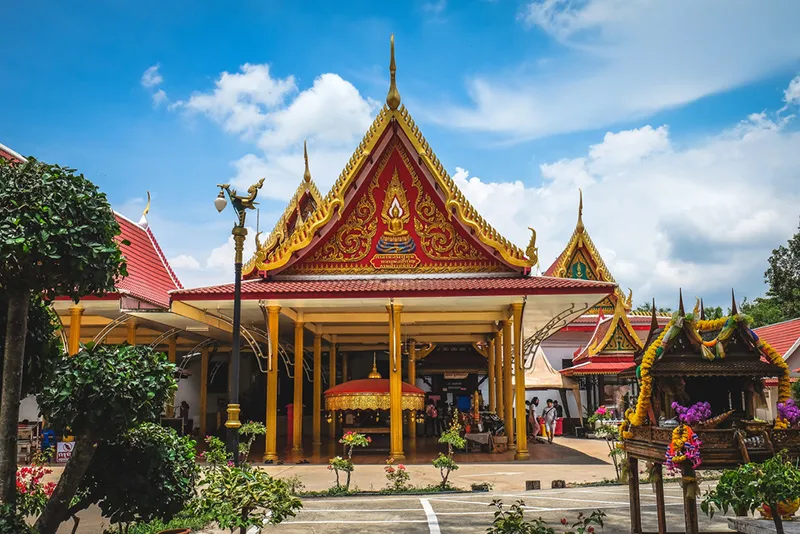
The temple still gives the impression of a peaceful, shady, and distinctive old riverside temple. Visitors who step inside can immediately feel an atmosphere quite different from that of temples in urban areas. The grounds remain calm, quiet, and lined with large shade trees. Combined with the riverside setting of the surrounding community, this gives the temple a charm that feels unhurried and serene. Many visitors come not only to pay respect to Luang Pu Suk, but also to experience the atmosphere of an old temple that still preserves the clear aura of the past.
The feature that makes Wat Pak Khlong Makham Thao most prominent and widely known is the name of Luang Pu Suk Kasaro, the revered monk who has long been a center of faith for people across Thailand. Luang Pu Suk was a senior monk held in the highest esteem in Thai Buddhism and is regarded as one of the most famous meditation masters and sacred monks of the central region. The devotion people feel toward him has been passed down for so long that when the name Wat Pak Khlong Makham Thao is mentioned, many people immediately think of Luang Pu Suk, and when Luang Pu Suk is mentioned, many people think back to this temple as well.
Luang Pu Suk’s birth name was “Suk.” He was born in 1847 in Ban Makham Thao in this same area, which means he truly grew out of the roots of the local community. His identity as a son of the area made the bond between Luang Pu Suk and the villagers especially strong, because he was not an outsider. He was someone who grew up, learned, and lived within this riverine culture from childhood before entering the monkhood and receiving broad reverence in later years.
In the eyes of the faithful, the story of Luang Pu Suk is not limited to an ordinary life history. It is also embedded in people’s memories through oral accounts, legends, and stories passed from one generation to another. Many believe that he possessed profound spiritual power, deep compassion, and the ability to help people with kindness. Yet what made him enduringly respected was not only the supernatural dimension attributed to him. It was also his strict observance of monastic discipline, his exemplary conduct, and his dedication to developing both the temple and the community. These qualities are what allowed the name of Luang Pu Suk to remain firmly alive in Thai memory until today.
Throughout the period when Luang Pu Suk resided at Wat Pak Khlong Makham Thao, the temple was greatly developed and flourished both physically and spiritually. People from various places traveled to see him to listen to his teachings, seek his guidance, and make merit at the temple. As a result, the temple became a gathering place filled with genuine spiritual devotion. Its growth during that time was therefore not accidental, but the direct result of the deep respect that both the local community and people from outside held for Luang Pu Suk.
Even though Luang Pu Suk passed away in 1923, devotion toward him did not diminish. On the contrary, it became even stronger and spread more widely through stories, worship, and the continued transmission of his legacy. Many devotees believe that coming to pay respect to him at Wat Pak Khlong Makham Thao is like reconnecting with the original source of that faith, making their devotion more meaningful than worship through images or amulets alone, because this is the very place where he once lived, developed the temple, taught the Dharma, and spent his life.
The reputation of Luang Pu Suk is also closely tied to the world of Thai amulets. Amulets created by him are highly prized by both collectors and devotees, for reasons that combine perceived sacred power, historical value, and distinct artistic identity. Many Luang Pu Suk amulets are therefore not merely religious objects, but cultural evidence that reflects Thai religious devotion in a particular era. Those interested in amulets often speak of him with deep respect and regard him as one of the legendary sacred monks of the country.
According to popular belief, amulets and sacred objects blessed by Luang Pu Suk are believed to offer loving-kindness, protection, safety from danger, and auspiciousness in life. Although such beliefs are personal, there is no denying that they are an important force behind the enduring recognition of his name. More importantly, devotion to Luang Pu Suk is not confined to objects alone. It is also connected to living mindfully, holding firmly to goodness, and relying on the Dharma as a guide in life, following the example people perceive in him.
When entering the important areas inside the temple, visitors usually begin by paying respect to Luang Pu Suk, whether through his statue, wax figure, or places associated with his life. The sight of people arriving with calm determination to bow before him shows that this is not simply an ordinary tourist attraction, but a sacred space in the feelings of many. Some come to pray for blessings, some come to set their minds in remembrance of him, some come to study history, and others come to experience the atmosphere of an old temple of national renown. Whatever the reason, the shared feeling is one of reverence while being in this place.
Another highly significant feature of Wat Pak Khlong Makham Thao is Luang Pu Suk’s traditional Thai-style kuti, which remains an important symbol helping visitors imagine the time when he was still alive. A kuti of this style reflects both vernacular architectural design and the simplicity of monastic life in the past. Those who see it often feel that the place still preserves the traces of former times in a very tangible way, whether in its atmosphere, structure, or the arrangement of objects connected with Luang Pu Suk.
Beyond the kuti, the photographs, personal belongings, and statues of Luang Pu Suk preserved by the temple are important elements that prevent his history from becoming merely words in documents. Instead, they allow visitors to see and experience his story in visible form. The preservation of these items therefore has great value, both for the study of the temple’s history and for passing devotion from one generation to the next.
Wat Pak Khlong Makham Thao is also significant in the dimension of Thai art, especially the mural paintings inside the ordination hall, which are connected with His Royal Highness Prince Chumphon Khet Udomsak, another major figure in Thai history. These paintings depict the life of the Buddha, and evidence indicates that they were created in 1890 as an offering to Luang Pu Suk during the construction of the ordination hall. What makes this mural series special is the way it weaves together art, religion, and the history of an important historical figure, giving the temple a depth far beyond that of a typical amulet temple or sacred pilgrimage site.
For those interested in Thai history, the relationship between Luang Pu Suk and Prince Chumphon Khet Udomsak is another aspect that gives Wat Pak Khlong Makham Thao its special appeal. This connection shows that the temple was not important only at the community level, but also had ties to major national figures. That relationship adds historical weight to the temple and makes visitors feel that they are entering a space layered with meaning in religion, faith, royal history, and Thai art.
In scenic terms, Wat Pak Khlong Makham Thao leaves a strong impression through its natural identity as a riverside temple. The grounds are clearly shaped by the river landscape, from the direction of the breeze and the humidity in the air to the rows of trees and the atmosphere of the surrounding community. When visitors spend time walking slowly through the temple, they often discover that its greatest charm lies not in grand structures alone, but in the harmony between the temple, nature, and community life, something that is becoming increasingly rare in the modern world.
The temple’s location can be easily found through online map systems in Makham Thao Subdistrict, Wat Sing District. Official provincial sources provide a map link for travel, making it much more convenient for those who wish to come and pay respects. In practical terms, having an easily searchable location helps Wat Pak Khlong Makham Thao become more accessible to younger travelers and pilgrims from other provinces, unlike in the past when reaching a riverside temple often depended on local directions or familiarity with the area.
If one looks at the timeline of Luang Pu Suk’s life, it clearly reflects the development of a revered monk in Thai society, from his birth in a riverside community in 1847, to his ordination in youth, his studies in the Dharma and various traditions, the building of his reputation through strict practice and compassion, and the period when he resided at and developed Wat Pak Khlong Makham Thao into a center of devotion, before his passing in 1923. This timeline not only records the sequence of his life, but also helps visitors understand that the spiritual devotion accumulated in this temple did not appear suddenly. It slowly formed over many decades.
When speaking of Luang Pu Suk amulets, people are often interested in important versions and well-known forms in the collecting world, whether powder amulets, metal amulets, or sacred objects such as takruts and other ritual items. This popularity makes Wat Pak Khlong Makham Thao a destination for both devotees and students of amulet history at the same time. Many who travel here therefore do not see the visit only as a prayer journey, but also as a way of tracing the origin of a sacred heritage that has played a major role in Thai culture for a long time.
Even so, the temple’s value is not limited to amulets or a reputation for mystical power. Its deeper value lies in being an old temple where the beliefs of the people are still connected to a living historical space. Those who are not especially interested in amulets can still come to learn about Luang Pu Suk, admire the temple’s artistic heritage, and experience the atmosphere of a riverside community that still preserves its traditional identity. Many visitors therefore find that what they take back is not only an impression of sacredness, but also a sense of fulfillment from encountering a richer cultural dimension than they had expected.
In terms of community life, Wat Pak Khlong Makham Thao continues to serve as a center of social relationships in the area. Merit-making ceremonies and important Buddhist festivals often bring the temple back to life with people once again. Villagers gather to make merit, listen to sermons, and meet one another at the temple just as they did in the past. Such scenes show that the role of temples in Thai society has not disappeared. It has merely adapted over time. Wat Pak Khlong Makham Thao therefore remains both a sacred place, a learning site, and a social space for the community in the truest sense.
Moreover, its identity as a riverside temple gives a special emotional and mnemonic dimension to a visit here. Those familiar with central Thai river communities can immediately sense that places like this possess a very particular character. The aura of the water, the openness of the wind, and the placement of the temple buildings all reflect a culture that grew directly from life on the river. For this reason, the temple is not only a temple of Chainat Province, but also a representative image of the cultural heritage of the Chao Phraya basin on a broader scale.
For travelers planning a cultural itinerary in Chainat, Wat Pak Khlong Makham Thao is a place that deserves more time than a quick stop for worship. The more time one spends walking through it, the more layers of meaning become visible, including the life of Luang Pu Suk, local beliefs, murals inside the ordination hall, the connection with Prince Chumphon, and the complete charm of an old riverside temple that still retains its spirit. In this sense, Wat Pak Khlong Makham Thao is a destination that serves travelers, learners, and the faithful all at once.
Those who enjoy visiting temples often look for places that offer both peace and meaning. Wat Pak Khlong Makham Thao is one of the temples that possesses both. It offers not only fame, but also strong historical substance. Visitors therefore do not merely feel that they have come to pray or ask for blessings, but rather that they have stepped into a space that preserves the stories of people and devotion across many eras. This feeling is precisely what leads many people to return to this temple again and again throughout their lives.
Viewed as a whole, Wat Pak Khlong Makham Thao is a place that gathers many kinds of value in one location. It is an old temple, a center of devotion to Luang Pu Suk, a site of important artistic heritage, a place tied to major historical figures, and a landmark of cultural tourism in Chainat. All of these qualities make the temple remarkably complete in itself and help explain why it continues to be loved by many different groups of people.
From the perspective of cultural travel writing, Wat Pak Khlong Makham Thao is not a place that should be told through only one lens. If one writes only about its sacredness, the historical depth is lost. If one writes only about its history, the living force of present-day devotion may disappear. If one writes only about amulets, the beauty of the riverside old temple and the temple’s role in the community can be overlooked. To truly understand this place, it must be seen as a whole, and this is why the more one studies Wat Pak Khlong Makham Thao, the more one realizes it holds more detail than first expected.
For all of these reasons, Wat Pak Khlong Makham Thao is far more than just a famous temple in Chainat. It is a place that helps people reflect on the meaning of faith, memory, and Thai cultural heritage at the same time. A visit here may begin with a simple intention to pay respect to Luang Pu Suk or to see an old temple, but once one spends time within the actual space, many people come to realize that they are standing amid living history, a history that exists not only in documents, but in the place itself, in its atmosphere, in its objects, in its people, and in the devotion that remains alive there every day.
Getting There If you are traveling from Chainat town to Wat Pak Khlong Makham Thao, the approximate distance is around 25 kilometers. You can head toward Wat Sing District and continue into Makham Thao Subdistrict. Official provincial information notes the entrance area around kilometer markers 36–37 on the local route, making travel by private car quite convenient. Visitors traveling from Bangkok can use the Asian Highway route into Chainat and then continue directly toward Wat Sing District. Using an online map pin makes the temple easy to reach, and it is especially suitable for those planning a day trip or combining this visit with other important temples in Wat Sing District and nearby areas.
| Name | Wat Pak Khlong Makham Thao |
| Location | Village No. 1, Makham Thao Subdistrict, Wat Sing District, Chainat Province |
| Highlights | An old temple renowned for Luang Pu Suk Kasaro, the famous sacred monk, and for mural paintings associated with Prince Chumphon Khet Udomsak |
| Abbot | Phra Khru Si Chayodom |
| Nearby Tourist Attractions | 1. Wat Song Sawoei — 3 km. 2. Wat Phikun Ngam — 12 km. 3. Chao Phraya Dam — 20 km. 4. Wat Thammamun Worawihan — 25 km. 5. Chainat Bird Park — 28 km. |
| Nearby Restaurants | 1. Krua Baan Suan Wat Sing — 4 km. Tel. 056-401-221 2. Krua Rim Nam Wat Sing — 6 km. Tel. 056-401-889 3. Baan Imsuk Restaurant — 18 km. Tel. 056-410-229 4. Krua Rim Khuean Chainat — 20 km. Tel. 056-411-888 5. Chainat Garden Restaurant — 25 km. Tel. 056-411-201 |
| Nearby Accommodations | 1. Chainat Thani Hotel — 25 km. Tel. 056-411-403 2. 111 Resort Chainat — 24 km. Tel. 056-414-229 3. Chainat Park Resort — 27 km. Tel. 056-417-777 4. Chao Phraya Resort — 28 km. Tel. 056-415-909 5. Chainat Resort — 26 km. Tel. 056-411-566 |
Frequently Asked Questions (FAQ)
Q: Where is Wat Pak Khlong Makham Thao located?
A: Wat Pak Khlong Makham Thao is located in Village No. 1, Makham Thao Subdistrict, Wat Sing District, Chainat Province.
Q: Who was Luang Pu Suk?
A: Luang Pu Suk Kasaro was a famous sacred monk who resided at Wat Pak Khlong Makham Thao and is revered by people throughout Thailand.
Q: What is interesting inside Wat Pak Khlong Makham Thao?
A: Inside the temple, you can see the wax figure of Luang Pu Suk, his traditional Thai-style kuti, and mural paintings inside the ordination hall associated with Prince Chumphon Khet Udomsak.
Q: What time is Wat Pak Khlong Makham Thao open to visitors?
A: The temple is open daily for worship from 09:00–11:00 and 14:00–17:00.
Q: How do I get to Wat Pak Khlong Makham Thao?
A: You can travel from Chainat town for about 25 kilometers by using Highway 3183 toward Wat Sing District.
 Wat Pak Khlong Makham Thao Map
 Category:
  Group:
  Last Update: 34 MinuteAgo
Comment
 Nearby Attractions
| Keyword (Advance) |
 Region
|
 Muang Chai Nat(