

 Home
Home Chiang Mai(




Rating: 4/5 (5 votes)
 |
|  Map
Map 
 Have Map
  No Map
Chai Nat attractions
Attractions in Thailand
Open Days: Wednesday – Sunday (closed on Monday, Tuesday, and public holidays)
Opening Hours: 09:00 – 16:00
Chainat Muni National Museum is one of the most important museums in Chainat Province and is ideal for visitors who want to understand the history of Chainat through authentic antiquities. Inside, the museum displays art objects from the Dvaravati period to the Rattanakosin period. Located within the grounds of Wat Phra Borommathat Worawihan, it is a destination where visitors can explore both the museum and one of the city’s most important historic temples in a single trip.
Chainat Muni National Museum is situated within the grounds of Wat Phra Borommathat Worawihan in Chainat Subdistrict, Mueang Chainat District, Chainat Province. It is one of the most valuable centers of learning in the province for history, archaeology, and Buddhist art. For travelers visiting Chainat who want more than just taking photos or paying respects at sacred places, this museum offers a deeper understanding of the city. Each object on display is not merely an old artifact, but evidence reflecting the transitions of society, beliefs, artistic traditions, and the way of life of people in the upper Chao Phraya River basin over many centuries.
What makes Chainat Muni National Museum different from ordinary small museums is that it grew out of the serious collection efforts of a visionary senior monk before later being developed into a cultural heritage institution under the Fine Arts Department. This background gives the museum dimensions of faith, knowledge, and national heritage preservation all in one place. When visitors enter the building, they do not simply encounter display cases, but rather the outcome of a determined effort to preserve local history and keep it alive for future generations.
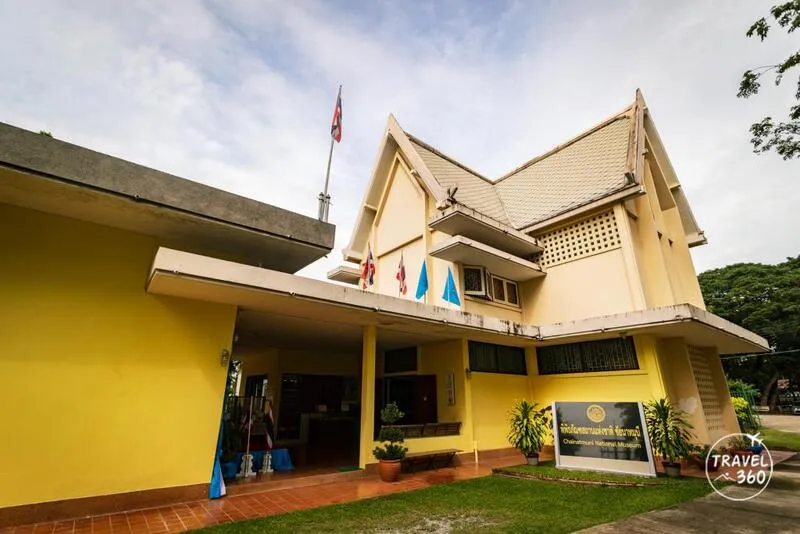
The museum itself is a two-story Thai-applied style building set within the atmosphere of Wat Phra Borommathat Worawihan, an important royal temple of Chainat. Viewing a museum in the grounds of such an ancient temple gives visitors a very different experience from visiting a museum standing alone elsewhere, because everything is naturally connected: the sacred relic stupa, the old chedis, the landscape of the temple, and the antiquities displayed inside the museum. Together, these elements complement one another and make a visit here feel like “reading history through a real place” rather than merely looking at old objects.
The history of Chainat Muni National Museum began with the interest and dedication of Phra Chainat Muni, also known as “Nuwam Sutatto,” the former ecclesiastical governor of Chainat Province and former abbot of Wat Phra Borommathat Worawihan. He collected antiquities, art objects, and historical evidence found in Chainat Province and nearby areas and preserved them in the temple museum. His work was not simply the collecting of old items, but an act of recognizing the value of traces from the past at a time when Thai society had not yet widely appreciated local museums as much as it does today.
Because Phra Chainat Muni systematically gathered and preserved these antiquities, many important objects were saved from disappearing over time. Many pieces reflect the continuity of Thai art and culture in the Chao Phraya River basin, from the Dvaravati, Lopburi, and Ayutthaya periods through to the Rattanakosin era. Later, he donated these antiquities as part of the national heritage for the benefit of historical and archaeological study. The Fine Arts Department then developed the museum building and named it “Chainat Muni National Museum” in honor of him as the founder of this important learning center.
The museum building was constructed as a permanent structure in 1966 and has continued to welcome visitors ever since. Since then, Chainat Muni National Museum has served as both a place of preservation and a public educational space for school students, university students, scholars, tourists, and anyone interested in history. It is regarded as a tangible body of historical evidence for Chainat because the displayed objects are not only notable works of art, but also utensils, ornaments, tools, and Buddhist art that reveal the way of life of people in this region in remarkable detail.
From a tourism perspective, Chainat Muni National Museum has great charm because it appeals to several types of visitors at once. Those who enjoy relaxed travel can admire the elegant Thai-applied building and take photographs in the atmosphere of Wat Phra Borommathat Worawihan. Meanwhile, those who are interested in history will find that the museum contains more substance than expected, including the sequence of Thai art, changes in amulet forms, Sangkhalok ceramics, ornaments, and everyday objects from different periods, all of which help visitors better understand the broader development of culture in central Thailand.
The displays inside are divided into two floors. The upper floor focuses on Buddha amulets from various periods, from Dvaravati to Rattanakosin. These amulets are valuable not only as sacred or devotional objects, but also as artistic and cultural evidence reflecting the development of Buddhism in each era. Visitors can observe differences in the forms of the amulets, including the proportions of the Buddha image, the details of the decorative niches, ornamental patterns, and the materials used, all of which are important for understanding the history of Thai art.
The ground floor displays Sangkhalok-style Buddha images, tools, utensils, and ornaments from the Dvaravati period to the Rattanakosin period. The atmosphere on this floor makes visitors feel closer to the lives of people in the past than merely viewing objects for their beauty, because the tools and everyday items reveal how people in each era lived, what materials they used, how they produced things, and what aesthetic tastes they had. In addition, the Buddha images and Sangkhalok wares also reflect religious beliefs, trade, and connections with other regions.
One of the museum’s greatest strengths is that visitors can clearly see the “continuity” of Thai art within one compact space. As one moves from objects of the Dvaravati period to works of the Lopburi, Ayutthaya, and Rattanakosin periods, both change and continuity become visible, whether in the facial features of Buddha images, the materials used in everyday objects, or the concepts of sacredness embedded in art. This kind of presentation helps even non-specialists gradually understand history without feeling distanced from it.
A visit to Chainat Muni National Museum is therefore best enjoyed at an unhurried pace. Begin by taking in the exterior of the building to appreciate its Thai-applied architecture designed in harmony with the temple setting. Then continue with the exhibits on the ground floor to understand the world of objects and daily life in the past, before going upstairs to see Buddha amulets and Buddhist art that reflect dimensions of faith, belief, and artistic subtlety. This way of viewing allows visitors to experience the museum both as a tourist destination and as a place of learning at the same time.
Another reason the museum is especially interesting is its location within Wat Phra Borommathat Worawihan, one of Chainat’s most important historical sites. The temple is a second-class royal monastery and an ancient temple closely tied to the city. It houses a U-Thong-style sacred relic chedi containing relics of the Buddha. A visit to Chainat Muni National Museum should therefore not be seen separately from Wat Phra Borommathat Worawihan, but rather as part of the same experience, because the two places explain each other perfectly. The temple provides the religious and historical context of the site, while the museum provides the material and evidential context.
For cultural travelers, beginning with paying respect to the sacred relic inside the temple and then continuing on to the museum creates a satisfying emotional continuity in the visit. It begins with serenity and devotion in the temple grounds, before moving into an exploration of the past through the objects displayed inside the museum building. This makes Chainat Muni National Museum not a dry or detached experience, but a living learning space with context and strong ties to the surrounding community.
For those interested in local history, Chainat is often viewed only through a few well-known places such as Wat Phra Borommathat, Chao Phraya Dam, or Chainat Bird Park. However, Chainat Muni National Museum completes that picture more fully by showing that Chainat is valuable not only as a transit town or an agricultural province, but also as a place with deep roots in art, culture, and Buddhism. The antiquities preserved in the museum are concrete witnesses to these stories.
From the perspective of travel writing, Chainat Muni National Museum is also a destination with far more “content” than many people might expect. It does not end with opening hours or ticket prices. There are many further angles to explore, including its founding history, the role of Phra Chainat Muni, its connection with Wat Phra Borommathat Worawihan, the museum’s highlight antiquities, and its value as an educational attraction for families and lovers of art and culture. If all of these aspects are woven together carefully, an article about this place can become far more powerful than a simple destination guide and has strong potential to compete well in search results.
For travelers who want to plan a one-day trip in Mueang Chainat, Chainat Muni National Museum is an excellent starting point because it is conveniently connected to other major attractions. After visiting the museum and Wat Phra Borommathat Worawihan, visitors can continue on to Chao Pho Chainat Shrine, Wat Thammamun Worawihan, Chainat Bird Park, or Chao Phraya Dam without difficulty. This kind of itinerary suits both general tourists and those who want a historically focused trip without needing several days.
In terms of the visitor experience, guests should allow at least 45 minutes to 1.5 hours for the museum. Those who enjoy reading details and studying the displayed objects carefully may spend even longer. Allowing enough time ensures that the visit does not feel rushed and makes it easier to notice the differences in artistic styles from one period to another. It is also worth setting aside additional time to explore Wat Phra Borommathat Worawihan itself, since the temple is important enough that it should not be treated as only a brief stop.
Although the museum is not as large as the national museums in major cities such as Bangkok or Ayutthaya, its charm lies in its compactness and specialization. Visitors can understand the museum’s content without becoming overly tired, while also enjoying the calm atmosphere of a secondary city that is peaceful, uncrowded, and ideal for slow, thoughtful travel. This is an important advantage for travelers who prefer quality experiences rather than simply collecting a large number of destinations.
What makes Chainat Muni National Museum worthy of inclusion in a Chainat travel plan is not only the age of its antiquities, but the way it helps visitors see Chainat from a deeper perspective. What may seem to many like merely a pass-through province is revealed as a city layered with stories, religious roots, artistic continuity, and the efforts of earlier generations who refused to let this heritage disappear. For anyone wishing to explore Chainat beyond the surface, Chainat Muni National Museum is one destination that should not be overlooked.
As for visiting information, Chainat Muni National Museum is currently open from Wednesday to Sunday, 09:00–16:00, and closed on Monday, Tuesday, and public holidays. Those planning a visit should check the opening schedule again before traveling, especially during festival periods or long holidays. The latest published admission fees indicate that Thai visitors pay 10 baht and foreign visitors pay 50 baht, which is very reasonable considering the educational value and the overall experience the museum offers.
Getting There Chainat Muni National Museum can be reached by using the same route as Wat Phra Borommathat Worawihan, since the museum is located within the same grounds. If traveling from Bangkok, take Highway No. 32, the Asian Highway, toward Chainat Province, then continue into Mueang Chainat and head to Wat Phra Borommathat Worawihan. Private car travel is the most convenient option, as it allows visitors to continue on easily to other major attractions in the city. From central Chainat, the museum is only a short drive away, making it especially suitable for a half-day trip combined with the temple and nearby restaurants.
For those who want the fullest and most rewarding visit, it is best to begin in the morning at Wat Phra Borommathat Worawihan, then enter the museum later in the morning. After that, visitors can stop for lunch in the city before continuing on to nearby attractions such as Chao Pho Chainat Shrine, Wat Thammamun Worawihan, or Chainat Bird Park. This type of itinerary makes it possible to experience Chainat in a single day through religion, history, and leisure in a balanced way.
Ultimately, Chainat Muni National Museum is not merely a place that stores antiquities, but a space that gathers the memory of Chainat into the form of art objects, Buddha amulets, Buddha images, utensils, and ornaments from many historical periods. Each piece tells us that a city is not built from a single set of stories, but from people, beliefs, the accumulation of knowledge, and the effort of earlier generations who refused to let history disappear. If you are looking for a place in Chainat that offers more than visual beauty alone, Chainat Muni National Museum is truly a worthwhile answer.
| Place Name | Chainat Muni National Museum |
| Location | Within the grounds of Wat Phra Borommathat Worawihan, Moo 6, Chainat Subdistrict, Mueang Chainat District, Chainat Province 17000 |
| Summary | An important archaeological and art museum in Chainat Province, located within Wat Phra Borommathat Worawihan, ideal for visitors interested in history, art, and cultural tourism. |
| Highlights | A two-story Thai-applied style building displaying Buddha amulets, Sangkhalok Buddha images, tools, utensils, and ornaments from the Dvaravati to the Rattanakosin period. |
| History of the Place | The museum began with the collection of antiquities by Phra Chainat Muni (Nuwam Sutatto), former ecclesiastical governor of Chainat Province and former abbot of Wat Phra Borommathat Worawihan, before the collection was donated as national heritage and the museum was formally developed in 1966. |
| Exhibition Zones | 1) Upper floor: Buddha amulets from the Dvaravati to the Rattanakosin period 2) Ground floor: Sangkhalok Buddha images, tools, utensils, and ancient ornaments 3) Surrounding area: Can be combined with a visit to Wat Phra Borommathat Worawihan in the same trip |
| Open Days | Wednesday – Sunday |
| Opening Hours | 09:00 – 16:00 (closed on Monday, Tuesday, and public holidays) |
| Admission Fee | Thai visitors 10 baht, foreign visitors 50 baht (it is advisable to check the latest announcement before traveling) |
| Supervising Authority | Under the 4th Regional Office of Fine Arts, Lopburi, Fine Arts Department |
| Temple Where the Museum Is Located | Wat Phra Borommathat Worawihan |
| Latest Abbot of Wat Phra Borommathat Worawihan | Phra Rajawachirakitjathon |
| Getting There | Use the same route as Wat Phra Borommathat Worawihan. From Bangkok, take Highway No. 32 to Chainat Province, then continue into the old city area of Chainat. The museum is easy to combine with other attractions in the historic district. |
| Current Status | Open to visitors as usual |
| Main Contact Number | Chainat Muni National Museum: 056-405-621 |
| Nearby Attractions with Approximate Distance | 1. Wat Phra Borommathat Worawihan – 0.1 km 2. Chao Pho Chainat Shrine – 3 km 3. Wat Thammamun Worawihan – 6 km 4. Chainat Bird Park – 8 km. Tel. 056-476-624 5. Chao Phraya Dam – 15 km. Tel. 056-411-559 ext. 302 |
| Nearby Restaurants with Approximate Distance | 1. Samrab Kab Khao Riverside Chainat – 3 km. Tel. 086-969-9924, 056-410-919, 095-634-5303 2. Sponge Chainat – 3 km. Tel. 056-011-362 3. Jod Yen Jeab – 5 km. Tel. 056-489-110, 087-196-3557 4. Im Aroi Pla Mae Nam – 6 km. Tel. 056-426-759, 086-931-2448 5. Ton Takhob Restaurant – 13 km. Tel. 056-405-150 |
| Nearby Accommodations with Approximate Distance | 1. Chaophayathara Riverside Hotel – 4 km. Tel. 056-410-800, 096-778-4457 2. Suwanna Riverside Hotel – 5 km. Tel. 056-477-798, 090-561-4898 3. Check-in Resort Chainat – 8 km. Tel. 095-636-2992 4. Nara Premium Resort – 9 km. Tel. 095-165-1199 5. Fantasy Resort Chainat – 10 km. Tel. 092-093-5555, 088-429-6025 6. Sky View Resort Chainat – 11 km. Tel. 095-939-3558 |
Frequently Asked Questions (FAQ)
Q: Where is Chainat Muni National Museum located?
A: Chainat Muni National Museum is located within the grounds of Wat Phra Borommathat Worawihan in Chainat Subdistrict, Mueang Chainat District, Chainat Province.
Q: What can visitors see at Chainat Muni National Museum?
A: The museum displays Buddha amulets, Sangkhalok Buddha images, tools, utensils, and ancient ornaments from the Dvaravati period to the Rattanakosin period.
Q: On which days is Chainat Muni National Museum open?
A: It is open from Wednesday to Sunday, 09:00 – 16:00, and closed on Monday, Tuesday, and public holidays.
Q: How much is the admission fee for Chainat Muni National Museum?
A: The latest published information states that Thai visitors pay 10 baht and foreign visitors pay 50 baht. It is advisable to check the latest announcement before traveling.
Q: Who is Chainat Muni National Museum suitable for?
A: It is suitable for people interested in history, archaeology, Buddhist art, students, families, and travelers seeking cultural tourism in Chainat.
Q: What places can be visited together with Chainat Muni National Museum?
A: Visitors can combine the trip with Wat Phra Borommathat Worawihan, Chao Pho Chainat Shrine, Wat Thammamun Worawihan, Chainat Bird Park, and Chao Phraya Dam in the same itinerary.
Q: Why is Chainat Muni National Museum important?
A: It is a significant center for preserving and displaying important antiquities of Chainat Province. The museum began from the collection efforts of Phra Chainat Muni (Nuwam Sutatto) before being developed into a national museum.
 Tel: 056411467
 Chai Nat Muni National Museum Map
 Category:
  Group:
  Last Update: 8 HourAgo
Comment
 Nearby Attractions
| Keyword (Advance) |
 Facebook Fanpage
 Region
 Historical Sites and Monuments(
 Landmarks and Memorials(
 Art, Craft Centres, Tradition(
 Educational Places
 Museum for Study(
 Places of Worship
 Temple(
 Other religious and spiritural sites(
 Nature and Wildlife
 Mountain (Doi)(
 Dam, Reservoir, Lake(
 River, Canal(
 Other natural attractions(
 Entertainment and Agricultural
 Zoos and Aquariums(
 Animal camps and shows(
 Waterpark(