

 Home
Home Chiang Mai(


























Rating: 3.5/5 (8 votes)
 |
|  Map
Map 
 Have Map
  No Map
Ratchaburi attractions
Attractions in Thailand
Open Days: Open daily
Opening Hours: Monday - Friday 08:00 – 16:30 / Saturday - Sunday and public holidays 08:00 – 17:00
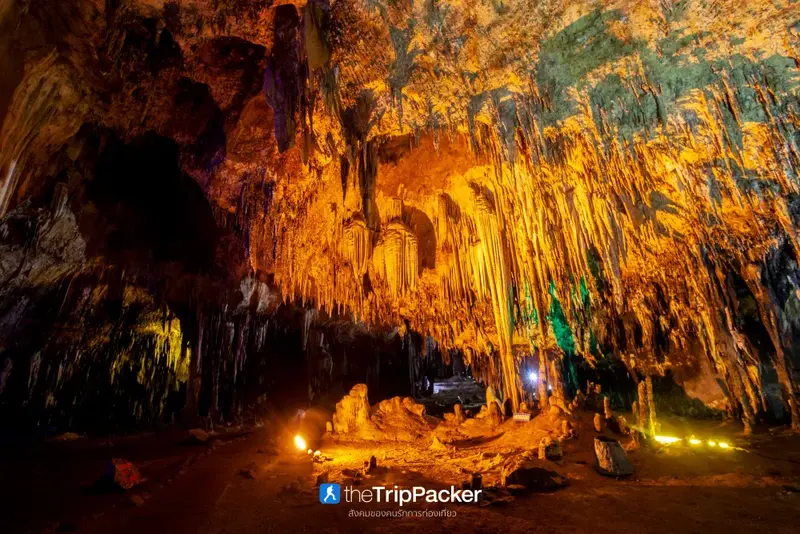
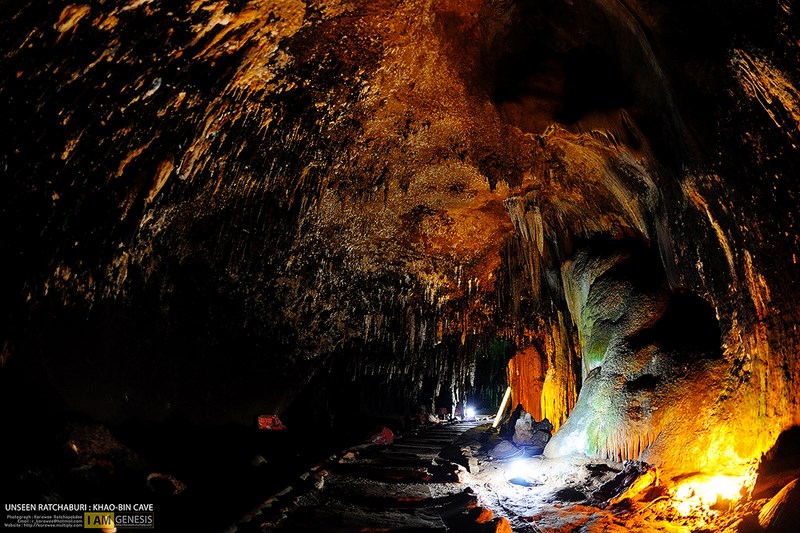
Khao Bin Cave is one of the most famous natural attractions in Ratchaburi Province. It is located in Village No. 11, Hin Kong Subdistrict, Mueang Ratchaburi District, within the Khao Bin mountain range and inside a national reserved forest. The cave covers an area of a little over 5 rai and extends about 300 meters from the entrance to its deepest point. This makes it a large cave that allows visitors to walk down and experience the wonders of nature beneath the mountain at close range. Khao Bin Cave is not simply a place to admire beautiful stalactites and stalagmites. It is also a destination that brings together natural value, tourism appeal, and local beliefs in one place.
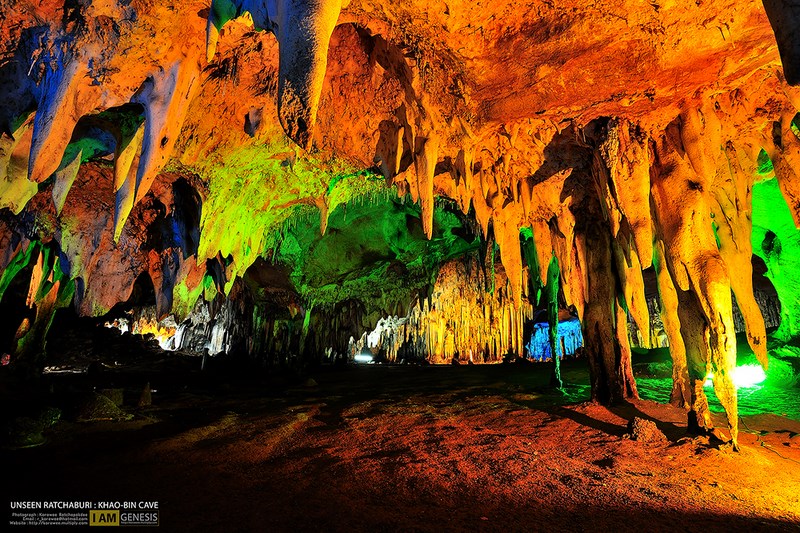
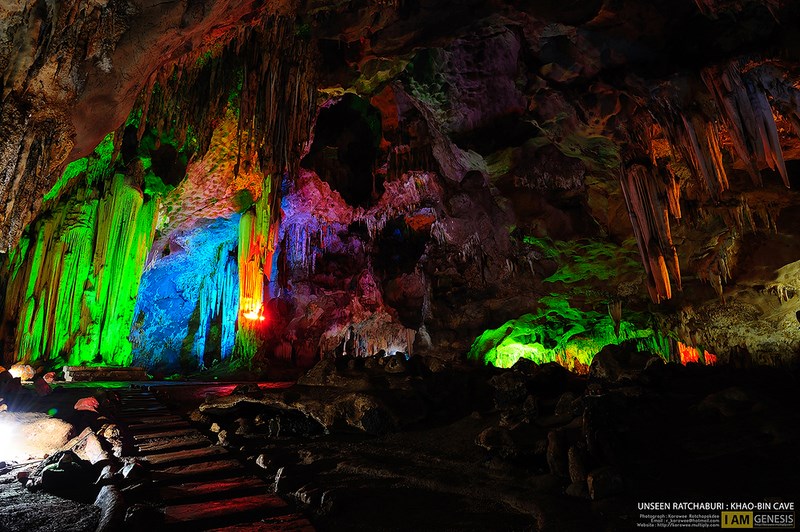
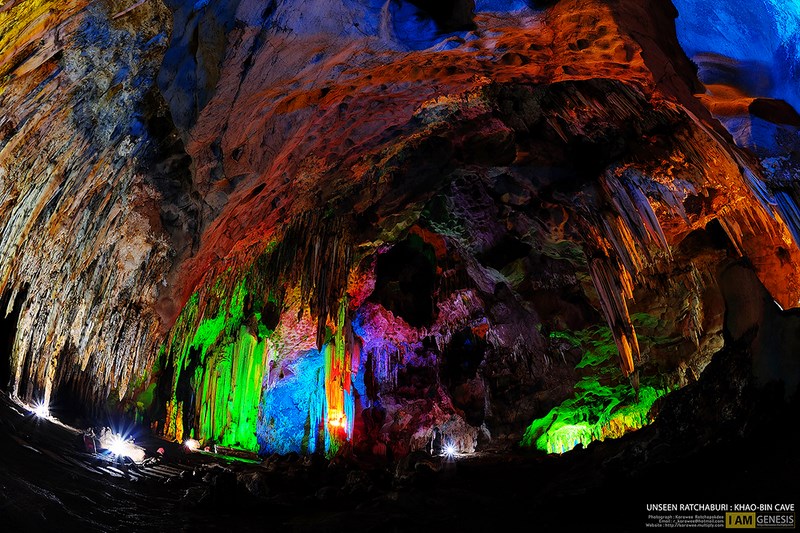
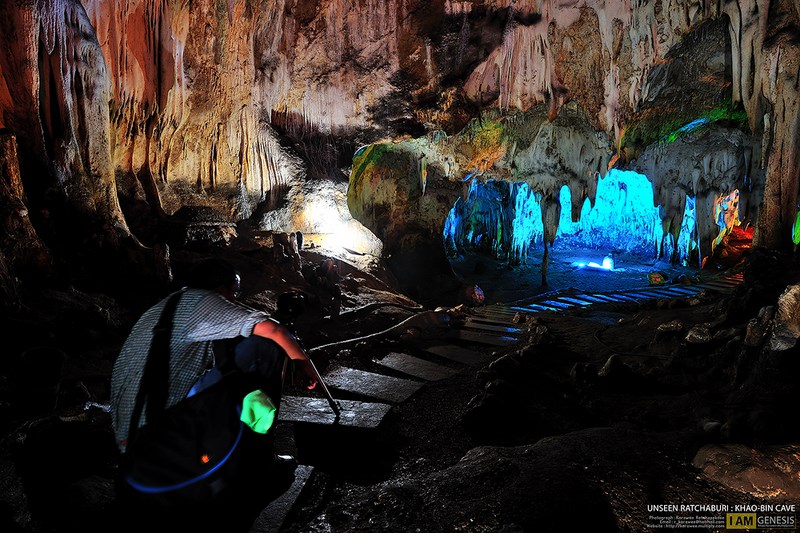
What sets Khao Bin Cave apart from many other tourist caves is its well-organized interior walkway and the carefully arranged lighting that highlights key groups of stalactites and stalagmites, making their natural forms stand out more clearly. Many sources describe it as one of the earliest caves in Thailand to feature a serious interior light display designed to enhance the visitor experience. As travelers gradually walk deeper into each chamber, they feel as if they are moving from the outside world into a mysterious realm that nature has spent hundreds of thousands, or even millions, of years creating.
The name of Khao Bin Cave is also part of its lasting charm. Some explanations connect the name “Khao Bin” with stalactites and stalagmites whose shapes resemble birds or a great eagle spreading its wings. Another interpretation suggests that the name may have evolved from the word “Khao Bin” in a slightly different sense. Even so, the image most people associate with the cave today is tied to the imagination of rock formations that look like living creatures flying across the darkness and moisture of the underground world. This gives the name Khao Bin Cave layers of meaning in language, local storytelling, and visual imagination.
In terms of tourism history, Khao Bin Cave was opened as a tourist attraction by the Royal Forest Department in 1980, and it was later developed into one of Ratchaburi’s important natural attractions. This development did not mean turning the cave into an overly commercialized site. Instead, it focused on organizing walkways, resting points, lighting, and access so that ordinary visitors could safely enjoy the beauty inside. Because of this, Khao Bin Cave became a natural learning site where city residents, travelers from other provinces, and local students could clearly appreciate the value of limestone landscapes.
The geological character of Khao Bin Cave comes from its formation as a limestone cave created by the dissolution of rock through slightly acidic natural water. Over a very long period, water gradually eroded cracks, fissures, and cavities inside the mountain, enlarging them into the chambers and halls seen today. The stalactites and stalagmites, which are the stars of this cave, were formed by water droplets carrying minerals, especially calcium carbonate, that slowly accumulated above and below. Over time, these deposits became stone pillars, draperies, columns, and unusual shapes that invite endless interpretation.
As soon as visitors step inside the cave, they immediately notice how different the environment is from the outside world. Natural light slowly disappears and is replaced by spot lighting. The sounds around them soften, while temperature and humidity become noticeably different. This atmosphere is one of the main reasons cave travel feels unlike visiting mountains, waterfalls, or temples. A cave is a place that requires the eyes, the imagination, and a sense of quiet in order to fully appreciate its beauty. Because Khao Bin Cave is divided into chambers with names that evoke celestial realms, the Himmapan forest, and the world of the gods, walking through it becomes more than simply looking at rocks. It becomes like reading a story that nature has written through mineral forms and time itself.
Khao Bin Cave is generally described as being divided into 8 main chambers: Siwa Sathan, Akan Tukha Hall, Than Anodat, Sakuna Chat Cave, Thewa Sapha Samo Son, Kinnara Thatsana, Phruetsa Himmaphan, and Uthayan Thawai Thep. These names are not given merely for beauty. They also reflect the way people try to interpret the rock shapes and the atmosphere inside the cave through literary language. The name of each chamber becomes a frame through which visitors see the same place from different perspectives. Some see sacredness, some see the imagination of the Himmapan world, and others see the pure grandeur of nature.
The first chamber many visitors remember is Siwa Sathan, which often gives a calm and almost sacred impression. The name of this chamber guides visitors to notice the graceful presence of stone pillars or drapery-like formations standing out in the darkness. When the lights strike the rock surfaces, their roughness, shine, and layered lines become even more dimensional. Some parts resemble altars, others resemble pillars, and still others look like natural towers. This makes the chamber feel like a ceremonial opening into the underground world, both gentle and awe-inspiring.
Visitors then pass into Akan Tukha Hall, which can be compared to a reception hall or welcoming area. The name suits the character of this space, as it helps people gradually adjust to the path inside the cave. The cave walls surrounding the hall reveal layers of rock, moisture, and traces of erosion that have worked together continuously over immense periods of time. Walking through Akan Tukha Hall is therefore like slowly becoming acquainted with the mood of Khao Bin Cave, realizing that it offers not only striking beauty but also subtle surface details and spatial depth that reward careful observation.
Than Anodat is another chamber that reflects the cave’s coolness and humidity very well. Its name evokes a sacred stream in a mythical world, and when combined with certain sections of the cave floor that hold pools of water or shimmer with moisture, it makes visitors feel as if they are standing beside a stream in an otherworldly land. The highlight of this chamber is the way lighting brings out reflections across the rock surfaces. Some areas resemble frozen waterfalls, while others look like curtains of stone flowing down from the ceiling. This beauty makes Than Anodat one of the chambers that deserves especially detailed description, because it shows the power of both geology and imagination at the same time.
Deeper inside, visitors reach Sakuna Chat Cave, a chamber often linked to the origin of the name Khao Bin because some stalactites or rock masses suggest the image of birds with outstretched wings. These forms may not have the sharp outlines of sculptures carved by human hands, but that is precisely where their charm lies. They leave room for each visitor to interpret them in a personal way. For one person, the image may be a bird ready to soar. For another, it may be a mythical creature, a stone curtain, or a wing-shaped rock. This is the kind of cave beauty that offers no single fixed answer, and it is an important reason why no two visits feel exactly the same.
The next chamber is Thewa Sapha Samo Son. Its name suggests grandeur and a feeling of standing inside the assembly hall of heavenly beings. This chamber often has a higher ceiling or a more open space than other sections, so when lights shine upward from below, the shadows greatly intensify the magnificence of the stalactites, stalagmites, and stone pillars. This is one of the points where many visitors feel the cave’s overall grandeur more than any specific detail, because the entire space possesses strong natural architectural power, as if nature had created a vast stone sanctuary in the heart of the mountain without the work of any human craftsman.
Kinnara Thatsana is a chamber that often shifts the visitor’s emotions from overwhelming grandeur to the delicate grace of stalactite and stalagmite forms. Many people see lines and contours that resemble the shapes of mythical beings from classical literature, or at least sense the refined layering of rock and stone draperies that look as though they had been carefully sewn together. Khao Bin Cave also contains a small pool of water that local people believe to be sacred, adding another dimension of belief to the visit. This means that touring the cave is not only a natural experience but also one touched by cultural meaning and local faith.
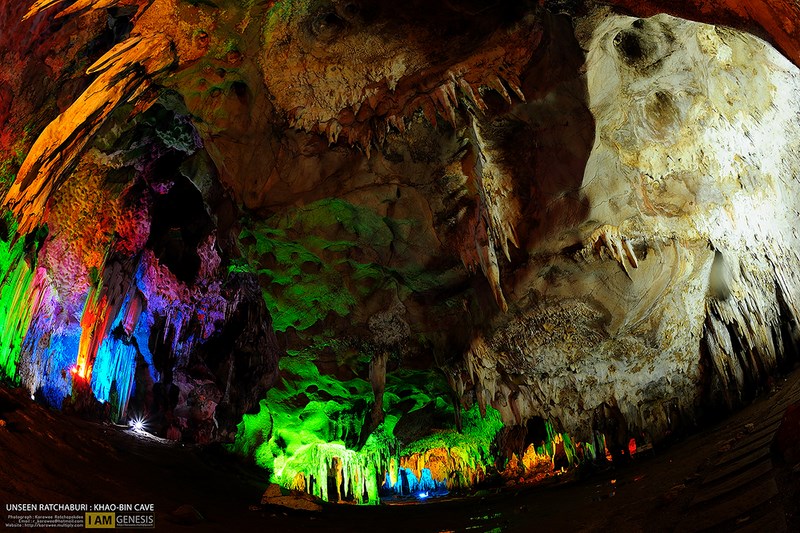
The chamber called Phruetsa Himmaphan evokes the image of forests in the mythical Himmapan world. When looking closely at certain groups of stalactites, visitors may see shapes resembling trees, branches, shrubs, or whole clusters of vegetation arranged in a hidden underground garden. The beauty of this chamber does not lie only in grandeur but also in its dreamlike quality. Some rocks have creamy white surfaces, others are orange-brown, and some contain layered patterns from mineral deposits. Together these create a remarkable variety of color and texture. If viewed from just the right angle under the lighting, it becomes clear that nature can create an underground “landscape” as beautiful as any garden or forest above ground.
The final stage of the cave walk is often described as Uthayan Thawai Thep, a name that immediately suggests a grand conclusion to the entire route. This chamber is ideal as the emotional closing point of the article because it is where visitors often feel that all the beauty of Khao Bin Cave gathers before them at once: stone pillars, rock curtains, water droplets, darkness, silence, and carefully placed lighting that makes the forms seem to float against a black background. This atmosphere gives the visit a strong and memorable ending, far beyond the experience of an ordinary check-in spot.
Another feature that makes Khao Bin Cave memorable is the sacred water pool or small basin inside the cave. Scientifically, it can be explained by the underground water system within the limestone cave. However, in the cultural understanding of the local community, such a pool is often treated with respect and linked to auspicious beliefs. Rather than reducing the cave’s natural value, this belief helps reveal how human beings relate to nature. Local people do not see the cave merely as rock or an empty mountain hollow, but as a place with life, power, and a presence worthy of reverence.
Beyond its interior beauty, Khao Bin Cave also holds value as an example of natural tourism development that uses imagination as a bridge between visitors and the real landscape. The naming of the chambers, the lighting that reveals the details of the rocks, and the organized pathway that gradually leads visitors deeper inside make the cave tour feel like the unfolding of a literary journey. Visitors begin at the simple cave entrance and gradually absorb increasing levels of grandeur, strangeness, and mystery until they reach the end of the route.
From a practical tourism perspective, Khao Bin Cave suits people who love nature, photography enthusiasts, and families looking for an educational attraction in Ratchaburi Province. Photographers enjoy capturing the interplay of light and rock textures, while those interested in knowledge can study how stalactites and stalagmites are formed. Families traveling with children can use the cave as a large natural classroom that makes the subject of limestone mountains and cave systems much easier to understand. All of this makes Khao Bin Cave a very flexible attraction, not limited only to adventure seekers or serious nature travelers.
However, visiting a cave requires more caution than walking through an open-air attraction because some sections of the path may be damp and slippery, especially during the rainy season or in periods of high humidity. Shoes with good traction make the visit much safer than flat-soled footwear. Inside the cave, some parts may also feel rather warm and humid. Even though there is no direct sunlight, the moisture and the effort of continuous walking in an enclosed space can make the atmosphere feel close. Visitors traveling with small children or elderly family members should walk slowly, avoid rushing, and pause for short rests when needed.
Another important part of cave etiquette is to avoid touching stalactites and stalagmites unnecessarily, because oils from human skin can affect the long-term accumulation of minerals. The formations seen today were not created quickly. They developed extremely slowly compared with a human lifetime. Keeping a respectful distance, observing with the eyes, and following the site’s rules are therefore the best ways to help preserve this beauty so that future generations can experience it in the same way we do now.
Getting There Khao Bin Cave is not far from Ratchaburi city. Driving out of town along Highway 3087 on the Ratchaburi–Chom Bueng–Suan Phueng route is the most convenient option. The distance is about 20–22 kilometers, and at around kilometer marker 20, there is a left turn leading about 1.6 kilometers further in. This route makes Khao Bin Cave especially suitable for a half-day or full-day trip combined with other attractions in Ratchaburi, such as Chom Phon Cave, Khao Ngu Stone Park, or Wat Nong Hoi. For travelers without a private car, the trip may require taking local transport toward the Chom Bueng area and then hiring onward transport into the site, so some advance planning is recommended.
The best time to visit Khao Bin Cave is usually in the morning through late morning, or in the late afternoon before closing time, because the outside weather is not too hot and there is enough time to walk through the cave comfortably. On weekdays, especially in the morning, the atmosphere is often calmer than on weekends, making the cave easier to enjoy in full. Weekend visits, however, have the advantage of a livelier mood and suit family outings well. In all cases, visitors should check the latest opening hours before leaving, especially during long holidays or festival periods when operating hours may be adjusted.
Seen as a whole, Khao Bin Cave is not simply another beautiful cave in Ratchaburi. It is a place that brings together many different points of interest: limestone geography, the process of stalactite and stalagmite formation, the development of nature-based tourism, a distinctive interior lighting system, and local beliefs about sacred water. Together, these elements make a visit to Khao Bin Cave much more meaningful than simply walking in, looking at beautiful rocks, and leaving. It becomes an experience that reveals how nature can create grandeur, delicacy, and imagination all within the same space.
For anyone looking for a Ratchaburi attraction that offers beauty, visual uniqueness, and an atmosphere different from more ordinary tourist sites, Khao Bin Cave remains an excellent choice. It is easy to reach, affordable to enter, and distinctive enough to stay in the memory long after the visit ends. If you allow yourself enough time to walk slowly through each chamber, observe the shapes of the rocks, and reflect on the stories connected to the place, you will discover that Khao Bin Cave offers more than beautiful photographs. It also offers the feeling that nature has its own art, and that this art can be magnificent without any human hand carving it at all.
| Place Name | Khao Bin Cave |
| Location | Village No. 11, Hin Kong Subdistrict, Mueang Ratchaburi District, Ratchaburi Province, within a national reserved forest |
| Summary | A large limestone cave in Ratchaburi Province with a depth of about 300 meters. Inside are beautiful stalactites and stalagmites divided into several important chambers, making it ideal for nature-based tourism and family visits. |
| Highlights | Magnificent stalactites and stalagmites, interior lighting display, sacred water pool, organized walking route, and one of Ratchaburi’s best-known cave attractions |
| History | Opened as a tourist attraction by the Royal Forest Department in 1980 and later developed with walkways and lighting systems to accommodate visitors |
| Name Origin | One explanation says the name comes from stalactites and stalagmites shaped like birds in flight, while another suggests it may have evolved from the word “Khao Bin” in a slightly different form |
| Main Zones / Chambers | 1) Siwa Sathan 2) Akan Tukha Hall 3) Than Anodat 4) Sakuna Chat Cave 5) Thewa Sapha Samo Son 6) Kinnara Thatsana 7) Phruetsa Himmaphan 8) Uthayan Thawai Thep |
| Opening Hours | Monday - Friday 08:00 – 16:30 / Saturday - Sunday and public holidays 08:00 – 17:00 |
| Admission Fee | Adults 20 THB / Children 10 THB |
| Getting There | From Ratchaburi city, take Highway 3087 on the Ratchaburi - Chom Bueng - Suan Phueng route for about 20 - 22 km. At around kilometer marker 20, turn left and continue about 1.6 km. |
| Current Status | Open to visitors during official hours, with interior walkways and lighting. It is advisable to check the latest opening hours before visiting during long holidays. |
| Nearby Attractions | 1. Chom Phon Cave approximately 9 km 2. Wat Nong Hoi approximately 15 km 3. Khao Ngu Stone Park approximately 24 km 4. Ratchaburi National Museum approximately 24 km 5. Wat Mahathat Worawihan, Ratchaburi approximately 25 km |
| Nearby Restaurants | 1. Mangkon Jar Noodle Restaurant - Ratchaburi, Chedi Hak Branch, approximately 20 km, Tel. 089-254-6456 2. Inlaya Ratchaburi approximately 25 km, Tel. 096-879-4875 3. Inlaya Ratchaburi approximately 25 km, Tel. 032-206-179 4. Khrua Lung Rong approximately 30 km, Tel. 064-150-6840 5. For more dining choices, the Mueang Ratchaburi - Chedi Hak area is recommended |
| Nearby Accommodations | 1. Navela Hotel approximately 22 km, Tel. 032-206-599, 032-206-899 2. Space 59 Hotel approximately 24 km, Tel. 032-315-559 3. Western Grand Hotel Ratchaburi approximately 26 km, Tel. 032-337-777 4. Tai-Shan Suites approximately 23 km, Tel. 032-206-889 |
| Contact Numbers | 1. Khao Bin Cave 032-391-397, 032-391-737, 032-391-738 2. TAT 032-471-005, 032-471-006 3. Tourism Hotline 1672 |
Frequently Asked Questions (FAQ)
Q: Where is Khao Bin Cave located?
A: Khao Bin Cave is located in Village No. 11, Hin Kong Subdistrict, Mueang Ratchaburi District, Ratchaburi Province, within a national reserved forest, and it is quite easy to reach from Ratchaburi city.
Q: What time does Khao Bin Cave open?
A: Monday - Friday, it is open from 08:00 – 16:30. On Saturday - Sunday and public holidays, it is open from 08:00 – 17:00, though it is best to check again before traveling.
Q: How much is the entrance fee for Khao Bin Cave?
A: The entrance fee is 20 THB for adults and 10 THB for children, based on the latest information published by tourism sources and the official site page.
Q: What is interesting about Khao Bin Cave?
A: Its highlights are the large stalactites and stalagmites, the 8 beautifully named chambers, the interior lighting display, and the sacred water pool believed in by local residents.
Q: How long does it take to visit Khao Bin Cave?
A: In general, the visit takes about 30 - 45 minutes. If you explore in detail, take photographs at many spots, or stop to listen to explanations, it may take longer.
Q: Is Khao Bin Cave suitable for children and elderly visitors?
A: Yes, it can be visited, but proper shoes with good grip are recommended, and visitors should walk carefully because the cave is humid and some sections may be slippery.
Q: When is the best time to visit Khao Bin Cave?
A: Morning or late afternoon is the best time, because the weather outside is not too hot and the cave can be explored more comfortably. Weekdays are usually quieter than weekends.
 Tel: 032391397, 032391737-8
 Khao Bin Cave Map
 Category:
  Group:
  Last Update: 1 DayAgo
Comment

Photo Gellery(6) 
 Thank you photo(6) from: Genesis
|
|
|
|
|
|
 | ● Photographer: Korawee Ratchapakdee ● Link: flickr.com/photos/gnskrw ● Ref: facebook.com/noi.sft |
● Copyright Photography. (800*500)
● View full size images from the photographer.
● View full size images from the photographer.
 Nearby Attractions
| Keyword (Advance) |
 Facebook Fanpage
 Region
 Art, Culture and Heritage
 Historical Sites and Monuments(
 Landmarks and Memorials(
 Art, Craft Centres, Tradition(
 Museums(
 Art Gallery(
 Educational Places
 Educational Gardens, Farm(
 University
 Places of Worship
 Temple(
 Other religious and spiritural sites(
 Research and Development
 Royal Project(
 Suburban Living
 Village, Community(
 Local Market(
 Floating Market(
 National Parks and Marine Reserves(
 Mountain (Doi)(
 Dam, Reservoir, Lake(
 Waterfalls(
 Hot Springs(
 Flower Field(
 River, Canal(
 Other natural attractions(
 Entertainment and Agricultural
 Zoos and Aquariums(
 Animal camps and shows(
 Farm, Parks, Gardens and Ecotourism(
 Waterpark(
 Outdoor and Adventure Activities(
 Shopping
 Shopping and Night Market(
 Spas and Wellness
 Spas and Wellness(
 Travel Articles, Recipes
 Travel Review, Food Review(