

 Home
Home Chiang Mai(










Rating: 3.6/5 (8 votes)
 |
|  Map
Map 
 Have Map
  No Map
Bangkok attractions
Attractions in Thailand
Open Days: Every day
Opening Hours: Viewable all day (public area / nearby viewpoints)
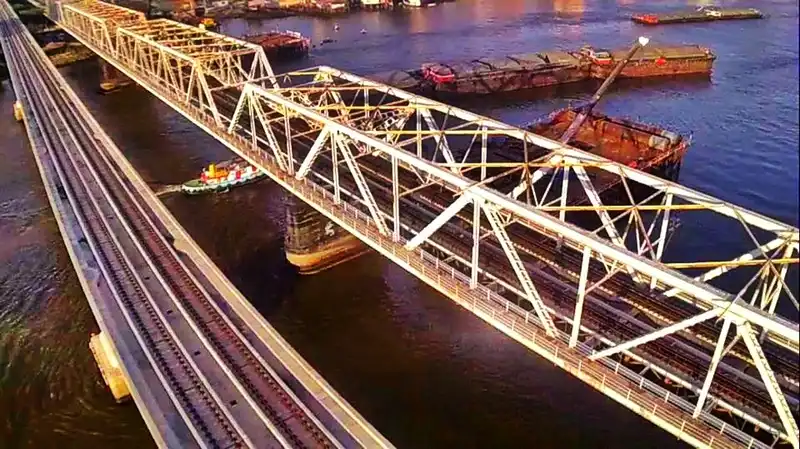
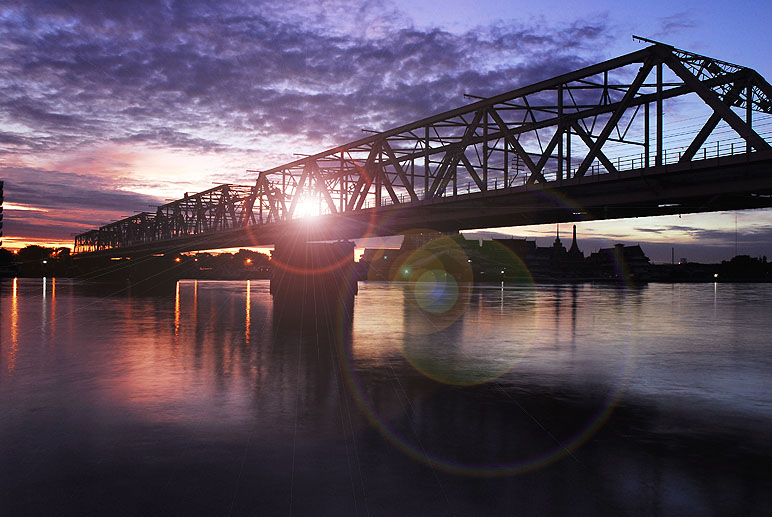
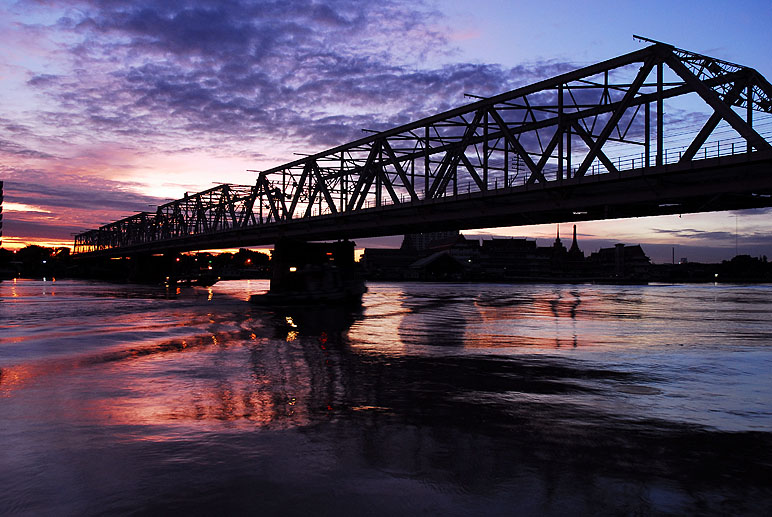
Rama VI Bridge is a landmark many Bangkokians have “seen in passing” but rarely stop to truly read—despite the fact that it stands as one of Thailand’s most important milestones in infrastructure history. This is the country’s first railway bridge spanning the Chao Phraya River. Its importance isn’t just its age, but its role as a “railway link” that made train routes on both sides of the river connect seamlessly—something it still does today, carrying real train traffic in a way many newer bridges simply cannot replace.
If you want to read Rama VI Bridge like someone who understands cities, start with its position: it connects the Bang Sue area with Bang Phlat / Bang O. This riverside zone reflects Bangkok’s expansion across multiple eras—from the rail era, when the city’s logic was built around trains, to the road era, when bridges and elevated structures began shaping how the metropolis spread. Rama VI Bridge is not just “a way across the water”; it’s evidence of how Bangkok once imagined connectivity in a time when long-distance movement still depended heavily on rail.
The construction timeline reads like a clear chapter of Thailand’s modernization. The construction contract was signed in April 1922, work began in December 1922, and the foundation stone ceremony took place on 6 April 1923 under Prince Krom Phra Kamphaeng Phet Akarayothin. These are not merely dates—they point to a period when Siam was accelerating its transport network so governance, trade, and inter-regional travel could function with greater efficiency in concrete, everyday terms.
Another layer that makes this bridge especially interesting is the story of contractors and the global economy at the time. The Rama VI Bridge project was built by a French contractor, and international currency conditions and economic terms shaped the bidding competition in a meaningful way. The multi-million-baht construction cost in that era also signals how this was seen as a “national-scale” investment rather than a local beautification project. At its core, Rama VI Bridge was built to make the country “physically connected,” not to simply look impressive.
The bridge was completed toward the end of the 1920s, and the first ceremonial train crossing took place on 1 January (by today’s calendar counting, this corresponds to 1927 BE 2470). The name “Rama VI Bridge” was granted to honor King Rama VI, tying the structure directly to Thailand’s railway-era history. That naming gives the bridge a dual identity: it is both a functioning transport structure and a symbol of its era at the same time.
During World War II, Rama VI Bridge was heavily targeted by air raids because rail infrastructure is strategically vital for movement and logistics. Eventually, the central span was destroyed on 7 February 1945. This episode makes one thing very clear: a bridge is never just a static object. It is a crossroads of power, economy, and national security—especially in moments of crisis.
After the war, Rama VI Bridge was repaired during 1950–1953 and reopened on 12 December 1953. The post-repair reopening wasn’t merely about “getting trains running again”; it was a declaration that the country was returning to stability and moving forward by restoring essential infrastructure. Reading Rama VI Bridge through this lens becomes a way of reading Thai history through steel, rails, and the Chao Phraya River itself.
Today, Rama VI Bridge functions primarily as a railway bridge, and its beauty lies in “truth” rather than staging. The steel truss pattern you see is not decorative—it is the honest structure carrying real load. A passing train brings the bridge to life in a rhythm you can feel. If you enjoy photography or city storytelling content, this is one of those places where engineering and history speak clearly without needing heavy filters.
Getting There If you want to visit Rama VI Bridge in the “city-reading” mode, it’s best to take the MRT/BTS and then use a taxi or ride-hailing app to reach safe riverside viewpoints or public areas near the bridge. Morning or late afternoon gives softer light, making the steel structure and the river surface more defined. Avoid standing in risky spots or interfering with traffic flow, because the areas near the bridge remain active transport zones with constant movement of people and vehicles.
If you want to make the trip feel complete, Rama VI Bridge works better as a “story spine” than a final stop. You can continue to Krung Thep Aphiwat Central Terminal to see Thailand’s modern rail era, then head to Rot Fai Park or the Chatuchak area to add public space and contemporary city life. Finish with nearby museums such as MOCA Bangkok or the Children’s Discovery Museum. This turns “bridge-viewing” into something bigger: understanding how Bangkok grew on rails and water.
| Name | Rama VI Bridge |
| Location | A railway bridge over the Chao Phraya River connecting Bang Sue with Bang Phlat / Bang O, Bangkok |
| Highlights | A historic steel truss bridge; Thailand’s first railway bridge across the Chao Phraya River; still in active railway use |
| Period / Context | Construction began in 1922–1923; first ceremonial crossing in early 1927 (BE 2470); damaged in World War II and reopened after repairs in 1953 |
| Current Status | Primarily a railway bridge; best viewed and photographed from safe public areas and riverside viewpoints nearby |
| Nearby Attractions | Krung Thep Aphiwat Central Terminal (approx. 3 km) Tel. 1690 Wachirabenchathat Park (Rot Fai Park) (approx. 5 km) Tel. 02-537-9221 Museum of Contemporary Art (MOCA Bangkok) (approx. 6 km) Tel. 02-016-5666 Children’s Discovery Museum Bangkok (approx. 6 km) Tel. 02-245-4743 JJ Mall (approx. 7 km) Tel. 02-618-3333 |
| Nearby Restaurants | Or Tor Kor Market (food zone) (approx. 7 km) Tel. 02-279-8729 Food Court @ Union Mall (approx. 8 km) Tel. 02-512-5000 After You Dessert Cafe (near Chatuchak / Lat Phrao area) (approx. 8 km) Tel. 02-318-4488 S&P (near Chatuchak / Lat Phrao area) (approx. 8 km) Tel. 1344 Chatuchak Cafe (Centara Grand at Central Plaza Ladprao) (approx. 9 km) Tel. 02-541-1234 |
| Nearby Accommodations | Centara Grand at Central Plaza Ladprao Bangkok (approx. 9 km) Tel. 02-541-1234 The Bazaar Hotel Bangkok (approx. 9 km) Tel. 02-056-9999 The Quarter Ladprao by UHG (approx. 9 km) Tel. 02-513-2020 Best Western Chatuchak (approx. 7 km) Tel. 02-666-1700 The Legacy Hotel Bangkok (Chatuchak area) (approx. 8 km) Tel. 02-691-4000 |
Frequently Asked Questions (FAQ)
Q: Why is Rama VI Bridge important in Thai history?
A: Because it is Thailand’s first railway bridge spanning the Chao Phraya River, enabling seamless rail connection across both sides of the river and marking a key era of national investment in infrastructure.
Q: How is Rama VI Bridge connected to World War II?
A: The bridge was heavily bombed due to its strategic railway role, and the central span was destroyed on 7 February 1945. It was later repaired and reopened on 12 December 1953.
Q: What’s the safest way to visit and view Rama VI Bridge?
A: Go to safe riverside viewpoints or nearby public areas close to the bridge, especially in the morning or late afternoon for better light, rather than attempting to stand in risky transport zones.
Q: Where should I go next after visiting Rama VI Bridge?
A: Continue to Krung Thep Aphiwat Central Terminal for modern rail context, then Rot Fai Park or the Chatuchak area for public-space city life, and finish with MOCA Bangkok or the Children’s Discovery Museum.
 Rama VI Bridge Map
 Category:
  Group:
  Last Update: 7 HourAgo
Comment

Photo Gellery(3) 
 Thank you photo(3) from: Tay
|
|
|
 | ● Photographer: Emaruchi Tay ● Link: facebook.com/emaruchitay ● Ref: klongdigital.com |
● Copyright Photography. (800*500)
● View full size images from the photographer.
● View full size images from the photographer.
 Nearby Attractions
| Keyword (Advance) |
 Region
|
 Phra Nakhon(