

 Home
Home Chiang Mai(











Rating: 3.7/5 (6 votes)
 |
|  Map
Map 
 Have Map
  No Map
Bangkok attractions
Attractions in Thailand
Open Days: Daily
Opening Hours: 05:00 – 22:00
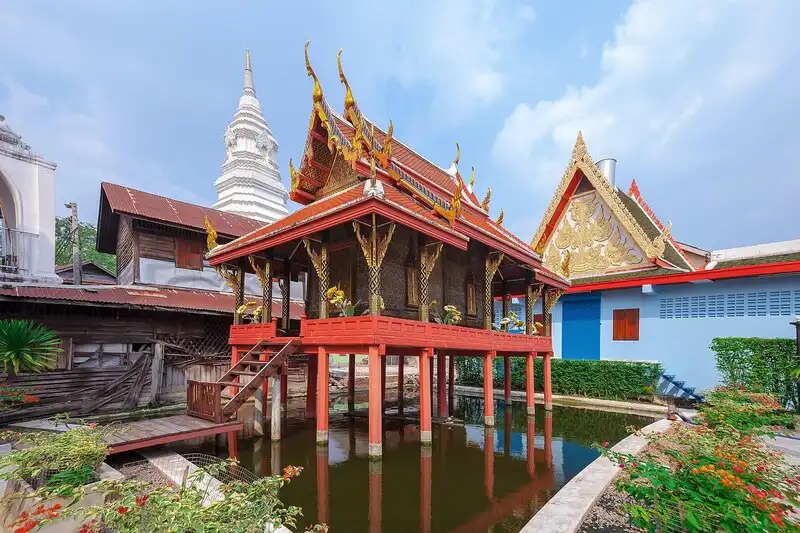
Wat Apsornsawan Worawihan is a third-class royal temple (worawihan type) tucked away in the Talat Phlu area on Bangkok’s Thonburi side. It has a kind of charm you remember after one visit, largely because inside the ordination hall (ubosot) there are 28 identical Buddha images in the Maravijaya posture, cast to the same size and appearance, enshrined together on a single pedestal. The unified arrangement looks dignified and unusual, and it’s not something you come across often in Bangkok. That’s why this temple works equally well for visitors who simply want a quiet place to pay respect and for those who enjoy studying Rattanakosin-era art and architecture—especially the distinctly Chinese aesthetic popular in the reign of King Rama III.
Historically, the temple was said to have been known as “Wat Mu” (Pig Temple). Local tradition tells of a Chinese man named Wu who built the temple on land once used for raising pigs; after the construction was completed, many pigs reportedly wandered around the area, and villagers began calling it Wat Mu. However, there is no definitive evidence identifying the exact founding date, so this remains a local historical memory that best explains the origin of the former name. During the reign of King Rama III, Chao Chom Noi (Suharanakong), daughter of Chao Phraya Phonlathep (Chim), re-established the temple. Later, King Rama III carried out further restoration and renovation, bestowed the new name “Wat Apsornsawan,” and granted a Buddha image in the “receiving a plum” posture to be enshrined within the temple.
If you enjoy slowly taking in architecture detail by detail, Wat Apsornsawan encourages you to “walk gently.” The ubosot and the viharn were built in a Chinese-influenced style favored during King Rama III’s reign, modeled after the design approach associated with Wat Ratcha-orot. The overall mood of the buildings feels restrained and calm, yet carefully intentional—from the proportions and the sense of open space around the ubosot to the Chinese atmosphere that makes the temple stand out from more familiar Thai temple forms elsewhere in Bangkok.
The heart of the temple is the ubosot. As soon as you step inside, what immediately catches your eye is the group of 28 Buddha images arranged as a single primary ensemble. This kind of grouped composition leads many visitors to describe the temple as a place you “have to see in person.” When morning light—or a soft afternoon glow—falls across the figures, the scene gains a quiet depth without needing any extra theatrics. Many visitors specifically highlight the “28 Buddhas” as the temple’s signature feature, along with the peaceful atmosphere that suits prayer and merit-making.
Another important element is the Buddha image in the “receiving a plum” posture, often affectionately called “Luang Pho Samo.” King Rama III granted this image to the temple, and because this posture is not commonly found in most temples, people interested in Buddhist art often come specifically to pay respects. Even if you didn’t arrive with an art-history agenda, the calm dignity of the image and the surrounding ambiance make it easy to understand why many visitors feel this temple carries a quiet, deep presence.
Near the ubosot, there is also a Tripitaka library hall (Hor Trai) in an Ayutthaya-period artistic style. It serves as an important piece of evidence for the area’s layered timeline. In Thai temples, hor trai traditionally functioned as a place to preserve scriptures and Buddhist knowledge; at the same time, it represents craftsmanship and construction refinement from earlier periods. If you enjoy wooden architecture and an older atmosphere, this is a spot worth lingering at briefly before returning to the ubosot to absorb the stillness once more.
One of the temple’s understated strengths is its location, which helps you plan a satisfying visit without rushing. Visitors often mention that you can connect your walk to nearby temples such as Wat Paknam Phasi Charoen and Wat Khun Chan, making it suitable for those who want a relaxed, half-day temple route. And if you’d like to shift from temple space to canal-side community life, you can also plan a stop at “Baan Silapin” (The Artist’s House) and the Khlong Bang Luang area nearby, ideal for strolling, photography, and a glimpse of riverside living.
Getting There If you’re coming by BTS, take the Silom Line to a station that connects conveniently toward the Talat Phlu/Phetkasem area, then continue by taxi or motorcycle taxi to Phetkasem Soi 23. The temple address is within Phetkasem Soi 23 (Soi Punyaritthaseni), Phetkasem Road. If you’re driving, set your map pin to the temple address and allow a bit of extra time because it’s a residential neighborhood. For a slower, more atmospheric route, there is also information indicating you can arrive by boat along Khlong Bangkok Yai—a lovely option if you want a true Thonburi-style “temple & canal” day.
For the best balance of calm and good light, early morning through late morning is ideal: fewer crowds, a quieter mood, and comfortable pacing for appreciating architectural detail. If you prefer evenings, the temple is open until 22:00, which makes it easy to drop by after work or after exploring Talat Phlu without feeling rushed. Whenever you visit, dress respectfully, keep noise low, and treat the worship spaces with care so both visitors and the local community can share the temple peacefully.
In the end, if you ask who Wat Apsornsawan is for, the answer is: both those who want a simple, quiet place to pay respects and those curious about King Rama III-era history. The temple clearly reflects its period through Chinese-influenced architecture adapted into a Thai religious setting and through the distinctive arrangement of 28 Buddha images that forms a rare, memorable ensemble. Combined with the Ayutthaya-style Tripitaka library hall, the temple feels like multiple layers of time sharing one space—still alive and rooted in the everyday world of Talat Phlu on the Thonburi side of Bangkok.
| Name | Wat Apsornsawan Worawihan |
| Type | Third-Class Royal Temple (Worawihan) |
| Location | 174 Phetkasem Soi 23 (Soi Punyaritthaseni), Phetkasem Road, Bangkok |
| Open Days | Daily |
| Opening Hours | 05:00 – 22:00 |
| Phone | 02 457 8078 |
| Current Abbot | Phra Wachirakhun (Paisal Visalo) |
| Highlights | 28 identical Buddha images in the ubosot, Chinese-influenced ubosot & viharn (Rama III era), Luang Pho Samo (Receiving a Plum posture), Ayutthaya-style Tripitaka library hall (Hor Trai) |
| Nearby Attractions + Distance | First One Market (Talat Phlu) – 0.8 km Sane Market – 1.0 km Baan Silapin (The Artist’s House) – 1.4 km Khlong Bang Luang Floating Market – 1.5 km Wat Nang Nong Worawihan – 1.8 km Wat Ratcha-orot Ratchaworawihan – 2.0 km |
| Nearby Restaurants + Distance + Phone | Mee Krob Chin Lee – 1.2 km – 02 466 9170 Talat Phlu Chive Cakes (Lee Bo Ngek) – 1.3 km – 081 858 5583 Je Aoi Talat Phlu Pork Satay – 1.4 km – 091 776 9558 Yong Hui Duck Noodles (Branch 1, Talat Phlu) – 1.6 km – 098 250 0915 Mee Krob Chin Lee (Media Listing) – 1.2 km – 089 488 1538 |
| Nearby Accommodations + Distance + Phone | Season Place – 1.3 km – 02 472 5252 Jolly Suites & Spa – 1.0 km – 02 878 9701 W Station – 2.5 km – 097 049 2626 Station8 Hostel – 2.8 km – 090 982 5738 Klean Residence Hotel – 2.8 km – 02 439 0293 Anantara Riverside Bangkok Resort & Spa – 3.0 km – 02 476 0022 Baan Khun Nait (Wang Derm) Hotel – 2.7 km – 02 891 0875 Nivas Siam – 2.4 km – 090 236 6463 |
Frequently Asked Questions (FAQ)
Q: What time does Wat Apsornsawan Worawihan open?
A: The published visiting hours are daily from 05:00 – 22:00.
Q: What is the main highlight most visitors come to see?
A: The standout feature is the group of 28 identical Buddha images in the ubosot, enshrined together on a single pedestal as a rare and striking ensemble.
Q: Can I get there by boat?
A: There is information indicating you can travel by boat along Khlong Bangkok Yai, which suits a relaxed “temple & canal” style trip on the Thonburi side.
Q: If I want to continue sightseeing nearby, where should I go?
A: Nearby options include Baan Silapin (about 1.4 km) and Khlong Bang Luang Floating Market (about 1.5 km), both great for strolling and photography.
Q: Is this temple suitable for photography?
A: Yes, but please photograph respectfully, keep noise low, and avoid disturbing worshippers—especially inside the ubosot.
 Wat Apsornsawan Worawihan Map
 Category:
  Group:
  Last Update: 3 DayAgo
Comment
 Nearby Attractions
| Keyword (Advance) |
 Facebook Fanpage
 Region
 Art, Culture and Heritage
 Historical Sites and Monuments(
 Landmarks and Memorials(
 Royal Palace(
 Art, Craft Centres, Tradition(
 Museums(
 Historical Houses and The Ancient City(
 Art Gallery(
 Educational Places
 Museum for Study(
 Library(
 University
 Church(
 Mosque(
 Other religious and spiritural sites(
 Research and Development
 Royal Project(
 Suburban Living
 Village, Community(
 Local Market(
 Floating Market(
 Nature and Wildlife
 River, Canal(
 Bays and Beaches(
 Other natural attractions(
 Entertainment and Agricultural
 Zoos and Aquariums(
 Animal camps and shows(
 Stadium(
 Farm, Parks, Gardens and Ecotourism(
 Amusement Park(
 Waterpark(
 Theater(
 Cinema(
 Shopping
 Shopping and Night Market(
 Department Store(
 Spas and Wellness
 Spas and Wellness(
 Restaurant
 Michelin Star(
 Accommodation
 Hotel(
 Call Customer Service in Tourism
 Call Customer Service in Tourism(
 Travel Articles, Recipes
 Travel Review, Food Review(
 Royal Thai Desserts, Traditional Dessert, Thai Dessert Recipes(