

 Home
Home Chiang Mai(












Rating: 2.4/5 (19 votes)
 |
|  Map
Map 
 Have Map
  No Map
Bangkok attractions
Attractions in Thailand
Open Days: Daily
Opening Hours: 08:00 – 17:00
Wat Ratchaburana Ratchaworawihan (Wat Liap) is an old temple at the Bangkok-side base of Phra Phuttha Yodfa Bridge (Phra Nakhon District). Locals have long called it “Wat Liap” because it sits right alongside the historic old-town area and close to Pak Khlong Talat. That location makes the temple feel like a calm pause inside the city’s constant motion—within a short walk you can move from the flower market and riverside routes to food spots and other classic old-town landmarks, all in one unhurried day.
Historically, Wat Ratchaburana Ratchaworawihan is believed to date back to the late Ayutthaya period. It was originally known as “Wat Liap,” and a well-known local account links the temple to a wealthy Chinese merchant named “Liap,” who helped establish it in what was once a busy trading quarter. Because the temple stood near a key transportation corridor, it remained in people’s memory through multiple eras—from the Thonburi period, when it served as a residence for senior monastics, to the early Rattanakosin period, when major restorations elevated it to royal temple status and the name “Wat Ratchaburana Ratchaworawihan” came into use, reflecting restoration and patronage associated with the monarchy.
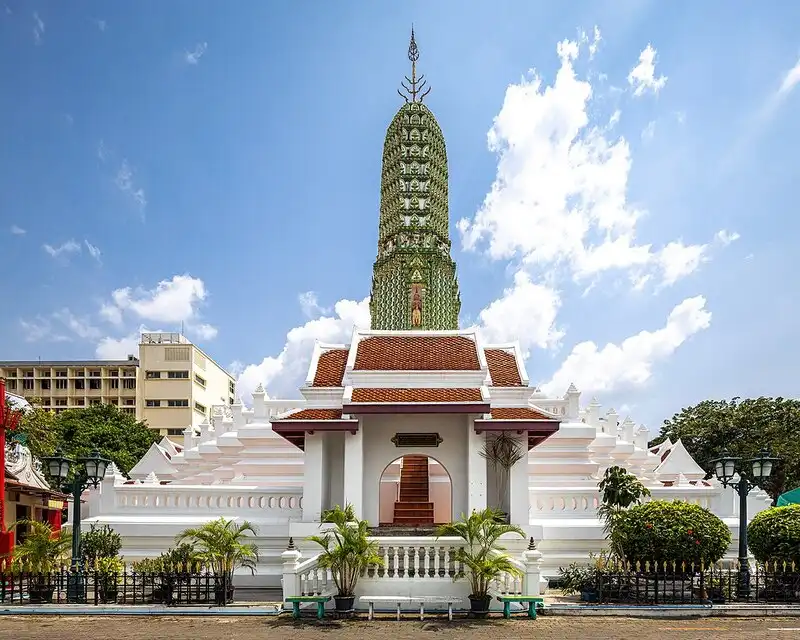
What makes this temple worth visiting—even if you have passed through the Phra Phuttha Yodfa Bridge area many times—is the distinctive architecture within the compound, especially the prominent “Phra Phuttha Prang,” a large Khmer-style prang built in the reign of King Rama III. It has been restored in multiple periods to preserve its structure as part of the city’s living heritage. The current four-porched ordination hall (ubosot) is also a key building today, and the overall atmosphere reflects a Bangkok royal temple that has experienced prosperity, loss, and renewal through enduring faith.
Looking back along the temple’s timeline, Wat Ratchaburana Ratchaworawihan once received as many as 162 Buddha images brought from various provincial towns during the reign of King Rama II. A viharn was built to enshrine part of that collection, reinforcing that this was not merely a neighborhood temple but one connected to the broader mechanism of religious and artistic centralization in the capital. Put simply, it became a kind of memory house for both state devotion and public faith, expressed through sacred art and royal-era restorations.
Its most difficult chapter unfolded during World War II. Because the temple stands near strategic sites such as Phra Phuttha Yodfa Bridge and the area associated with the Wat Liap power station (today within the context of electricity authorities), it suffered severe bomb damage, and several important structures collapsed. One of the most-discussed losses was the former ordination hall and its mural paintings attributed to Khrua In Khong, a master artist of the early Rattanakosin era, which were reportedly destroyed. After the war, the temple endured a prolonged hardship that even included a temporary dissolution, before renewed efforts by the Sangha and devoted supporters led to restoration and reconstruction. The present ordination hall was later built so the temple could once again function fully as a spiritual center.
Visiting the temple today can feel like walking across a “seam of the city.” On one side is the temple’s age and its surrounding community; on the other is Bangkok’s ever-changing urban artery. The quiet within the sacred precinct contrasts clearly with the movement of traffic and people around the bridge. And if you appreciate details that many overlook, the temple also contains a “Japanese cemetery,” a small but thought-provoking trace of wider historical connections—a reminder that Bangkok has long been a port city where many nationalities arrived and left tangible marks behind.
The best time to stop by for worship and a leisurely walk is in the morning or late afternoon, when the light is gentler and crowds are usually thinner than midday. As with many old-town temples, you’ll meet both locals who come to make merit and visitors who drop in because the temple sits near popular sightseeing routes. Dressing modestly, keeping voices at a respectful volume, and being mindful when taking photos near areas used for religious activities will help keep your visit smooth and considerate for everyone.
Getting There: If you’re using the MRT Blue Line, you can start in the old-town zone (for example, around Sam Yot Station) and then continue by taxi, bus, or on foot toward Phra Phuttha Yodfa Bridge depending on what feels easiest. City buses and taxis also pass through the Wang Burapha–Saphan Phut area throughout the day. Another option that fits old-town travel nicely is to plan Wat Liap within the same route as Pak Khlong Talat and a riverside walk along the Chao Phraya—so you can enjoy an easy day and then continue to food spots or museums without having to jump far across the city.
If you want a simple “one-day in Phra Nakhon” plan, Wat Ratchaburana Ratchaworawihan works well as either your starting point or a restful stop between sights. Begin with worship, walk around the prang and key areas in the compound, then head to Pak Khlong Talat for the color and energy of the flower market. From there, you can continue toward Tha Maharaj or nearby museum areas, or extend into the classic temple route by moving on to Wat Pho and the Grand Palace within the same day. The heart of this neighborhood is that it’s genuinely walkable, and every lane seems to carry its own story—no need to cram it all in; let the city tell you what it wants to show.
| Place Name | Wat Ratchaburana Ratchaworawihan (Wat Liap) |
| Location | 119 Chakphet Road, Wang Burapha Phirom Subdistrict, Phra Nakhon District, Bangkok |
| Characteristics | Phra Phuttha Prang (large Khmer-style prang), historic old-town temple by Phra Phuttha Yodfa Bridge, near Pak Khlong Talat |
| Period | Believed to date to the Ayutthaya period; continuously restored in the Rattanakosin era |
| Key Evidence | Severely damaged during World War II and later restored; Japanese cemetery within the temple compound |
| Name Origin | Commonly called “Wat Liap”; the official name reflects its royal-era restoration and status |
| Abbot (Latest) | Phra Thammawachiranayok (Preecha Abhiwaṇṇo) P. Th. 9 |
| Travel | MRT old-town zone (e.g., Sam Yot) then taxi/bus/walk toward Saphan Phut; easy to pair with Pak Khlong Talat and riverside routes |
| Current Status | Open for worship and visits during typical temple hours (recheck if there is a special ceremony) |
| Temple Contact (Verified) | 02-221-3936, 02-221-9544 |
| Nearby Tourist Attractions (Distance) | Pak Khlong Talat (approx. 0.5 km) Chao Phraya Sky Park (approx. 0.8 km) Khlong Ong Ang / Saphan Han (approx. 1.6 km) Museum Siam (approx. 2.0 km) Wat Pho (approx. 2.3 km) The Grand Palace / Wat Phra Kaew (approx. 2.6 km) |
| Popular Restaurants Nearby (Distance + Phone) | On Lok Yun (approx. 0.7 km) – 02-223-9621 Thipsamai Pad Thai Pratu Phi (approx. 2.5 km) – 02-226-6666 Jay Fai (approx. 2.6 km) – 02-223-9384 Savoey Tha Maharaj (approx. 2.2 km) – 02-055-6258 (ext. 4) Nai Ek Roll Noodles (approx. 2.7 km) – 02-226-4651 Krua Apsorn (Dinso Road) (approx. 2.2 km) – 02-685-4531 |
| Popular Accommodations Nearby (Distance + Phone) | Riva Arun Bangkok (approx. 2.2 km) – 02-221-1188 sala rattanakosin Bangkok (approx. 2.4 km) – 02-622-1388, 081-936-1388 Chakrabongse Villas (approx. 2.3 km) – 02-222-1290 Royal Orchid Sheraton Riverside Hotel Bangkok (approx. 3.3 km) – 02-266-0123 Mandarin Oriental, Bangkok (approx. 3.8 km) – 02-659-9000 Riva Surya Bangkok (approx. 4.5 km) – 02-633-5000 |
Frequently Asked Questions (FAQ)
Q: Are Wat Ratchaburana Ratchaworawihan and Wat Liap the same temple?
A: Yes. “Wat Liap” is the commonly used name, while the official name is “Wat Ratchaburana Ratchaworawihan.”
Q: What is nearby, and where can I continue sightseeing after visiting?
A: The temple is close to Pak Khlong Talat and Saphan Phut, and it is convenient to continue to Khlong Ong Ang, Museum Siam, Wat Pho, and the Grand Palace area.
Q: What are the main highlights of this temple?
A: The standout feature is the large Khmer-style prang, along with the temple’s history of restoration after severe World War II damage. Another lesser-known point of interest is the Japanese cemetery within the compound.
Q: What is the easiest way to get there by public transit?
A: Use the MRT in the old-town zone (for example, around Sam Yot) and then continue by taxi, bus, or a walk toward Saphan Phut and Chakphet Road, depending on your preference.
Q: Did the temple really have mural paintings associated with Khrua In Khong?
A: There are accounts that the former ordination hall had mural paintings associated with Khrua In Khong, and that they were heavily damaged during the war before later restoration and rebuilding.
Q: How should I prepare for a visit to an old-town temple in Bangkok?
A: Dress modestly, keep your voice at a respectful level, be mindful when taking photos near religious activities, and allow time to walk around the prang to absorb the atmosphere.
 Tel: 022213936, 022219544
 Wat Ratchaburana Ratchaworawihan (Wat Liap) Map
 Category:
  Group:
  Last Update: 3 DayAgo
Comment
 Nearby Attractions
| Keyword (Advance) |
 Region
|
 Phra Nakhon(