

 Home
Home Chiang Mai(










Rating: 3.8/5 (4 votes)
 |
|  Map
Map 
 Have Map
  No Map
Bangkok attractions
Attractions in Thailand
Open Days: Daily
Opening Hours: 08:30 – 20:00
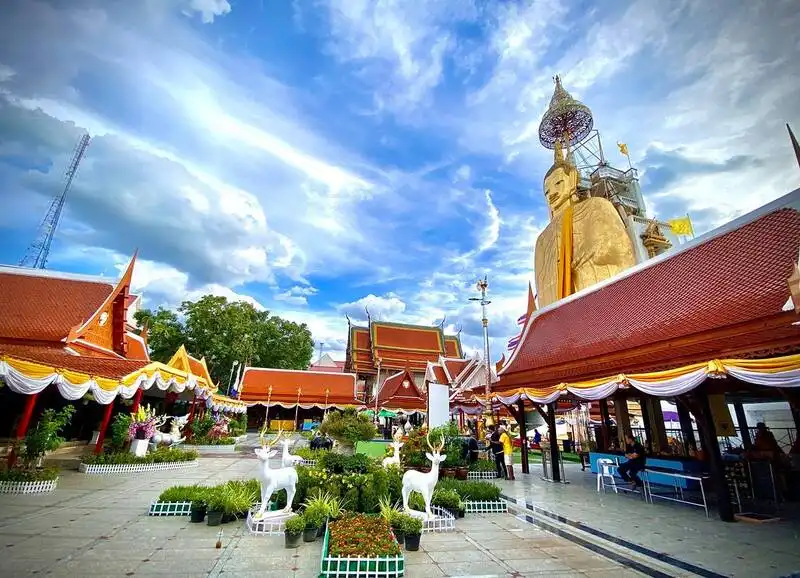
Wat Intharawihan is a historic temple in the Bang Khun Phrom area on Wisut Kasat Road, Phra Nakhon District. Many visitors come with one clear intention—to see the towering standing Buddha known as “Luang Pho To.” Yet once you step inside, the atmosphere shifts immediately from the city’s bustle to the calm of an old community temple. Shaded by trees and easy to walk around, the grounds invite you to slow down and notice details you might not expect. This makes the temple a great stop for anyone who wants to explore Bangkok at a gentler pace, combining worship, merit-making, and art appreciation in one place.
According to local accounts, the temple was founded in the late Ayutthaya period, around 1752. It was originally known as “Wat Bang Khun Phrom,” reflecting the name of the surrounding community. Later, it became widely known as Wat Intharawihan and developed into an important spiritual landmark in the Thewet–Bang Khun Phrom area. The massive standing Buddha eventually became the temple’s defining symbol—so recognizable that many people can identify the temple even before entering its gates.
One of the first highlights you encounter is the set of “three ceremonial entrance gates,” designed in traditional Thai pavilion style. Looking closely makes the experience even richer, as each pavilion element carries symbolic meaning. The central pavilion depicts the Great Renunciation of the Bodhisattva at the Anoma River, while the right pavilion features Indra and the left shows Brahma. These gates function not only as an entrance but as a visual introduction, gently guiding visitors into the Buddhist beliefs and narratives woven throughout the temple grounds.
The most important highlight of Wat Intharawihan is the standing Buddha known officially as “Phra Phuttha Si Ariya Mettrai,” more commonly called “Luang Pho To.” This alms-holding standing Buddha reaches a height of 32 meters and rises prominently above the Bang Khun Phrom skyline. For many visitors, it is the main reason for coming here. Standing close to the statue, its scale feels less overwhelming than reassuring, giving a sense of protection often associated with long-established community temples.
The story of Luang Pho To’s construction is linked to the reign of King Rama IV and to the deep faith of people at that time. Historical accounts note that construction began during the era of Somdet Phra Phutthachan (To Phrommarangsi) and continued over multiple periods before completion. As a result, the statue is not simply a monumental structure for photographs but a testament to faith accumulated across generations. It is also believed that relics of the Buddha were enshrined at the top of the statue, adding spiritual significance alongside its physical grandeur.
Inside the ordination hall, another distinctive feature awaits—mural paintings that depict the life of Somdet Phra Phutthachan (To Phrommarangsi), along with images of buildings associated with him and various trees integrated into the scenes. These murals are compelling not only for their artistry but for how they feel like a visual record of community memory. The story of Somdet To remains closely connected to everyday life in old Bangkok neighborhoods, where faith and tradition have been passed down from generation to generation.
Another area many visitors enjoy is the space beneath the ordination hall, where a small museum displays antique items. Nearby, the sermon hall houses a statue of Somdet Phra Phutthachan (To Phrommarangsi). Together, these spaces turn a simple temple visit into a deeper exploration of history—allowing visitors to learn about the temple itself and about Bang Khun Phrom, a neighborhood that has long played an important role in Bangkok’s past.
Beyond the main highlights, there are many smaller spots throughout the temple for those who enjoy exploring details. These include a pavilion enshrining a replica of the Buddha’s footprint, statues of Guanyin (Avalokiteshvara) and Phra Sangkachai, an open-air museum, and a bell tower with a four-gabled roof. The grounds are also home to several types of Bodhi trees—Thai, Sri Lankan, and Indian varieties—which are increasingly rare to find together. Taking your time here reveals the temple as a small “garden of beliefs,” blending Buddhist art, local stories, and natural shade into a single peaceful space.
The best times to visit for worship and exploration are in the morning or late afternoon, when the light is softer, the weather more comfortable, and the crowds thinner. Dressing modestly, keeping your voice low, and observing posted guidelines help ensure a respectful and pleasant visit—especially around the ordination hall and areas where people are actively engaged in religious activities.
Getting There Wat Intharawihan is located on Wisut Kasat Road in the Bang Khun Phrom area. It is easily accessible by public buses that pass through the neighborhood, including routes 49, 33, 53, 64, 3, 65, 30, and 32. The temple also fits well into a walking itinerary that links Thewet, Bang Lamphu, and Phra Athit Road, as distances within the old city are ideal for a relaxed day-long loop.
| Place Name | Wat Intharawihan |
| Location | 114 Wisut Kasat Road, Bang Khun Phrom Subdistrict, Phra Nakhon District, Bangkok 10200 |
| Key Features | Three traditional Thai entrance gates, the 32-meter-tall standing Buddha (Luang Pho To), murals about Somdet To, an antique museum beneath the ordination hall, and multiple Bodhi tree species |
| Historical Period | Believed to date back to the late Ayutthaya period (around 1752, according to local accounts) |
| Key Evidence / Significance | Home to the 32-meter-tall standing Buddha “Phra Phuttha Si Ariya Mettrai (Luang Pho To)” and murals depicting the life of Somdet Phra Phutthachan (To Phrommarangsi) |
| Current Abbot | Phra Sophon Thammavong, Ph.D. |
| Getting There | Public buses 49, 33, 53, 64, 3, 65, 30, and 32 serve the Bang Khun Phrom–Thewet area; suitable for combining with Bang Lamphu and Phra Athit Road |
| Current Status | Open to visitors and worshippers |
| Contact Numbers (Verified) | +66 2-282-0461, +66 2-282-3094 |
| Nearby Attractions (Distance) | Bank of Thailand Museum (approx. 1.5 km) Thewet Pier (approx. 2.0 km) Thewet Market (approx. 2.0 km) Phra Athit Road (approx. 3.0 km) Khao San Road (approx. 3.3 km) Giant Swing (approx. 4.8 km) |
| Nearby Restaurants (Distance + Phone) | Chiew Charn Panich (Thewet rice porridge) (approx. 2.2 km) – +66 62-669-6292 Kopi Hia Tai Kee (Phan Fa branch) (approx. 4.3 km) – +66 62-686-0770 Mont Nom Sod (Giant Swing branch) (approx. 4.8 km) – +66 2-224-1147 Wiset Kai Yang Restaurant (approx. 3.5 km) – +66 94-989-3388 Kopi Hia Tai Kee (Giant Swing branch) (approx. 4.9 km) – +66 62-678-3003 |
| Nearby Accommodations (Distance + Phone) | The Raweekanlaya Bangkok (approx. 2.5 km) – +66 2-628-5999 Chillax Heritage (approx. 3.3 km) – +66 2-281-8899 Chillax Resort (approx. 3.4 km) – +66 2-629-4400 New Siam Riverside (approx. 3.6 km) – +66 2-282-4554 Dewan Bangkok (approx. 3.8 km) – +66 2-629-4610 The Siam Hotel (approx. 4.5 km) – +66 2-206-6999 |
Frequently Asked Questions (FAQ)
Q: Which area of Bangkok is Wat Intharawihan located in?
A: The temple is located in the Bang Khun Phrom subdistrict on Wisut Kasat Road, Phra Nakhon District, close to the Thewet area and within easy reach of Bang Lamphu and Phra Athit Road.
Q: What is the main highlight of Wat Intharawihan?
A: The main highlight is the 32-meter-tall standing Buddha known as Phra Phuttha Si Ariya Mettrai (Luang Pho To), along with the ordination hall murals depicting the life of Somdet Phra Phutthachan (To Phrommarangsi).
Q: What is special about the three entrance gates of the temple?
A: The gates are designed in traditional Thai style and feature symbolic elements—the central pavilion depicts the Great Renunciation, the right shows Indra, and the left shows Brahma—giving the entrance a strong narrative and spiritual meaning.
Q: What is the best time to visit Wat Intharawihan?
A: Morning or late afternoon is recommended, as the weather is more comfortable and the temple is less crowded, allowing for a more relaxed visit.
Q: Which bus routes can be used to reach Wat Intharawihan?
A: Several public bus routes serve the area, including 49, 33, 53, 64, 3, 65, 30, and 32. From the nearest stop, the temple can be reached on foot following local signage.
Q: Are there recommended places to visit after Wat Intharawihan?
A: Visitors can continue to the Thewet area, Thewet Market, Phra Athit Road, or Khao San Road. For museum enthusiasts, the Bank of Thailand Museum is also located nearby.
 Wat Intharawihan Map
 Category:
  Group:
  Last Update: 2 DayAgo
Comment
 Nearby Attractions
| Keyword (Advance) |
 Region
|
 Phra Nakhon(