

 Home
Home Chiang Mai(















Rating: 4.3/5 (6 votes)
 |
|  Map
Map 
 Have Map
  No Map
Bangkok attractions
Attractions in Thailand
Open Days: Daily
Opening Hours: 07:00 – 17:00 Please recheck before visiting
Wat Bamphen Chin Phot (Yong Hok Yi) is one of Thailand’s Chinese-sect (Mahayana) temples that many people purposely stop by when exploring Yaowarat. But if you look a little deeper, it’s more than just a “Chinese temple in a small alley”. It is an important monastery under the Chinese Sangha in Thailand and is often regarded as the first major monastery of the Mahayana Chinese sect (Chan tradition, Linji lineage) in the Thai context. Its uniqueness lies in both its religious standing and the historical thread that stretches from the early Rattanakosin era to the present day. The temple is located in the alley of Wat Kanmatuyaram, off Yaowarat Road, Samphanthawong Subdistrict, Samphanthawong District, Bangkok.
To put it plainly, Wat Bamphen Chin Phot is among the older Chinese-sect monasteries in Thailand. It did not begin as an officially established “temple” in the administrative sense. Instead, it originated as an abandoned shrine to Avalokitesvara Bodhisattva known as “Yong Hok Am”. A nameboard is said to bear an inscription dating to the Qianlong reign, the Yibao year (A.D. 1795), corresponding to B.E. 2338. This is often cited as a trace of how closely the site was tied to Bangkok’s Chinese community from the early Rattanakosin period—even before some Vietnamese-sect Buddhist temples in Bangkok took form. For a time, it is also said that Annamese monks stayed here temporarily before moving out after a Vietnamese-sect temple was completed, according to stories passed down through generations.
Later, an Ajahn (Chinese Buddhist master) named Sak Heng, who traveled from China around before B.E. 2414, came to reside at this site. He restored the Avalokitesvara shrine, bringing it back to life, and renamed it “Yong Hok Yi”. Another nameboard is said to be dated B.E. 2430 (the 13th year of the Guangxu reign, A.D. 1887), marking a clearer chapter in the site’s identity as a Chinese-sect monastery in Thailand. After that, there was a formal petition requesting a royal bestowal of the temple’s name from King Chulalongkorn (Rama V).
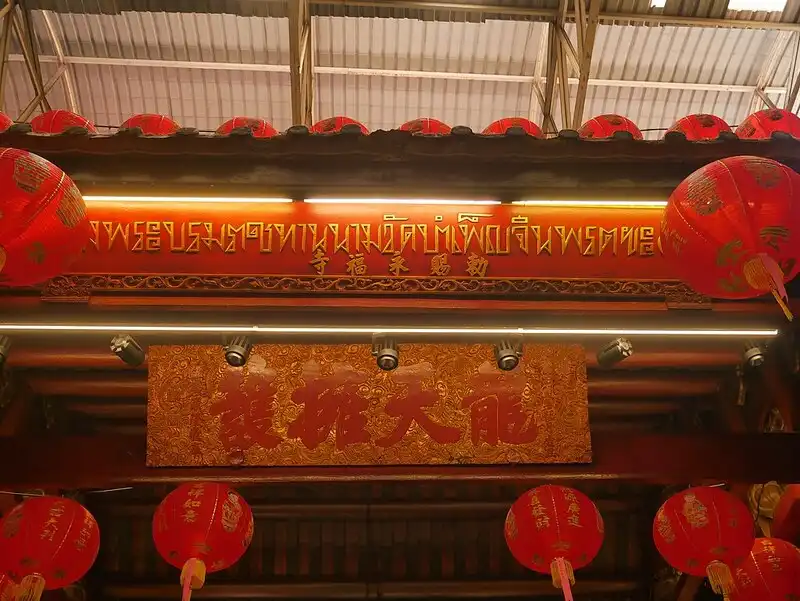
What firmly places this temple on the historical map is the royal bestowal of the name “Wat Bamphen Chin Phot” and the granting of an ecclesiastical title to Ajahn Sak Heng, appointing him as the first Chief Prelate of the Chinese sect. This reflects a deeper relationship between the Thai royal court and Bangkok’s Chinese community—not only in commerce and settlement, but also in recognition and organization of the Chinese Sangha in Thailand. Today, the royal nameboard is still spoken of as being displayed at the front of the ordination hall, serving as a physical proof that visitors can see for themselves.
If you ask what you’re meant to feel here, Wat Bamphen Chin Phot offers a very “Yaowarat” experience: you step just a short distance away from the main road, and the noise of food stalls and crowds begins to fade. The sacred space immediately does its job. The temple’s compact size does not mean its meaning is small. In many ways, it helps visitors focus more on intention. You can walk slowly, noticing details typical of a Chinese temple setting—the atmosphere of offerings, the gentle drift of incense, and the quiet rhythm of worshippers who seem to understand the unspoken rules without needing many signs.
In terms of devotion, Mahayana Chinese temples are often places where people come to pray about “real life” matters—health, work, family, and safety. The good news is that you do not need to be an expert to visit. Basic etiquette is enough: dress respectfully, speak softly, avoid photography where the temple does not allow it, and if you light incense or candles, do so in moderation so the smoke does not disturb others. This kind of simplicity makes Wat Bamphen Chin Phot well-suited for people who want to worship with sincerity, without rushing, and without turning it into a performance.
Another charm is its location. The temple sits in a neighborhood where you can continue exploring on foot right away. If you like a trip that does not require hopping in and out of cars between stops, this is a strong starting point. After worship, you can step back into Yaowarat and choose your pace: food, photography, markets, or wandering older lanes around Sampeng and nearby alleys. It feels even more fitting when you remember that Yaowarat has been a key zone shaped by Chinese community life for many eras, while this temple stands as a religious and cultural marker placed right in the middle of everyday urban movement.
If you visit during major Chinese-community festivals such as Chinese New Year, the Hungry Ghost Festival, or the Vegetarian Festival, the area becomes especially lively. Generally, crowds increase and travel can take longer, while the temple may also manage space differently to suit the number of visitors. If you want a calmer experience, weekday mornings are often easier for walking. But if you come specifically to absorb the festival atmosphere, that is another kind of experience entirely—just plan your timing and transport accordingly.
Getting There One of the most convenient ways today is to use the MRT and get off at Wat Mangkon Station. From there, walk into the Yaowarat-side lanes following directions that the temple’s own page has shared. A commonly mentioned landmark is entering Yaowarat Soi 8 and heading toward the area before Ratchawong Intersection. This makes public transport friendly for both tourists and locals who prefer not to drive into heavy traffic. If you drive, it’s best to allow extra time for parking and consider using nearby buildings, malls, or paid parking, then walking onward, since the narrow streets in Yaowarat naturally limit parking availability.
In the end, if you are looking for a Chinese temple that carries more than “stop-by” value, Wat Bamphen Chin Phot is a good answer. It brings you back to traces of early Chinese settlement, the revival of a monastery under a traveling master from China, and formal recognition in the reign of Rama V. All of that sits inside a small space you can genuinely walk through. It doesn’t take long to visit, yet it can feel like you have touched a part of Bangkok’s history that most people pass without noticing.
| Place Name | Wat Bamphen Chin Phot (Yong Hok Yi) |
| Location | Alley of Wat Kanmatuyaram, Yaowarat Road, Samphanthawong, Bangkok |
| Status / Affiliation | Chinese Sangha in Thailand (Mahayana Chinese Sect, Chan tradition, Linji lineage) |
| Key Era | Early Rattanakosin (often cited with A.D. 1795 / B.E. 2338), and the “Yong Hok Yi” naming period (B.E. 2430 / A.D. 1887), before receiving the royal bestowal of the name “Wat Bamphen Chin Phot” in the reign of Rama V |
| Key Evidence / Notable Items | Traces of the former name “Yong Hok Am”, the “Yong Hok Yi” nameboard, the royal nameboard “Wat Bamphen Chin Phot”, and the temple’s role as a significant Chinese-sect monastery in Thailand |
| Abbot (Latest) | Ajahn Yen Yi (Luang Chin Thammarak Chin Prajit) |
| Key Features | An older Chinese-sect temple in Yaowarat with structural significance in Thailand’s Chinese Sangha, a historical marker connecting the Chinese community and Thai society, easy access and ideal for combining with a Yaowarat walk without changing zones |
| Getting There | MRT Wat Mangkon Station, then walk into Yaowarat Soi 8 toward the area before Ratchawong Intersection; if driving, allow extra time for parking and continue on foot |
| Contact | 02-222-4789 |
| Nearby Attractions (Approx. Distance) | Wat Mangkon Kamalawat (Leng Noei Yi) – 0.6 km Odeon Circle Gate – 0.8 km Sampeng Market – 0.9 km Wat Traimit (Temple of the Golden Buddha) – 1.3 km Talat Noi – 1.8 km |
| Nearby Restaurants (Approx. Distance + Phone) | Jek Pui Curry Rice (Jae Chia) – 0.6 km – 02-222-5229 Lhong Tou Cafe – 0.8 km – 064-935-6499 Si Morakot Red Pork Rice – 1.2 km – 02-221-1188 Yaowarat Famous Bread – 1.1 km – 02-623-3235 Nai Ek Roll Noodles (Guay Jub) – 0.9 km – 02-226-4651 |
| Nearby Accommodations (Approx. Distance + Phone) | B2 Chinatown Yaowarat Premier Hotel – 0.7 km – 02-089-1455 Shanghai Mansion Bangkok – 0.9 km – 02-221-2121 Hotel Royal Bangkok@Chinatown – 0.8 km – 02-226-0026 ASAI Bangkok Chinatown – 0.9 km – 02-220-8999 The Quarter Hualamphong by UHG – 2.0 km – 02-092-7999 |
Frequently Asked Questions (FAQ)
Q: Where is Wat Bamphen Chin Phot (Yong Hok Yi) located?
A: The temple is in the alley of Wat Kanmatuyaram off Yaowarat Road, Samphanthawong, Bangkok, in an area that makes it easy to continue exploring Yaowarat on foot.
Q: Which MRT station should I use to get to Wat Bamphen Chin Phot?
A: MRT Wat Mangkon Station is recommended. From there, walk into Yaowarat Soi 8 toward the area before Ratchawong Intersection, following common local directions.
Q: Is the temple open every day, and what are the opening hours?
A: Generally, it is open daily around 07:00 – 17:00, but you should recheck before visiting, especially during festivals or special events.
Q: Why is this temple significant within Thailand’s Chinese sect tradition?
A: It is often described as an important monastery under Thailand’s Chinese Sangha, with roots traced back to the early Rattanakosin era and formal royal recognition in the reign of King Rama V.
Q: When is the best time to visit if I want a calmer walk?
A: Weekday mornings are often less crowded than evenings or weekends. If you want the full Yaowarat atmosphere, visiting in the evening can be great—just plan extra time.
Q: Are there any etiquette tips for visiting a Chinese Mahayana temple?
A: Dress respectfully, keep your voice low, light incense only as needed so you don’t disturb others, and follow the temple’s rules—especially regarding photography.
 Wat Bamphen Chin Phot (Yong Hok Yi) Map
 Category:
  Group:
  Last Update: 2 DayAgo
Comment
 Nearby Attractions
| Keyword (Advance) |
 Facebook Fanpage
 Region
 Art, Culture and Heritage
 Historical Sites and Monuments(
 Landmarks and Memorials(
 Royal Palace(
 Art, Craft Centres, Tradition(
 Museums(
 Historical Houses and The Ancient City(
 Art Gallery(
 Educational Places
 Museum for Study(
 Library(
 University
 Church(
 Mosque(
 Other religious and spiritural sites(
 Research and Development
 Royal Project(
 Suburban Living
 Village, Community(
 Local Market(
 Floating Market(
 Nature and Wildlife
 River, Canal(
 Bays and Beaches(
 Other natural attractions(
 Entertainment and Agricultural
 Zoos and Aquariums(
 Animal camps and shows(
 Stadium(
 Farm, Parks, Gardens and Ecotourism(
 Amusement Park(
 Waterpark(
 Theater(
 Cinema(
 Shopping
 Shopping and Night Market(
 Department Store(
 Spas and Wellness
 Spas and Wellness(
 Restaurant
 Michelin Star(
 Accommodation
 Hotel(
 Call Customer Service in Tourism
 Call Customer Service in Tourism(
 Travel Articles, Recipes
 Travel Review, Food Review(
 Royal Thai Desserts, Traditional Dessert, Thai Dessert Recipes(