
 Home
Home North(
 Chiang Mai(


Rating: 2.8/5 (11 votes)
 |
|  Map
Map 
 Have Map
  No Map
Phranakhon Si Ayutthaya attractions
Attractions in Thailand
Open Days: Daily
Opening Hours: 06:30 – 17:00 (approx.)
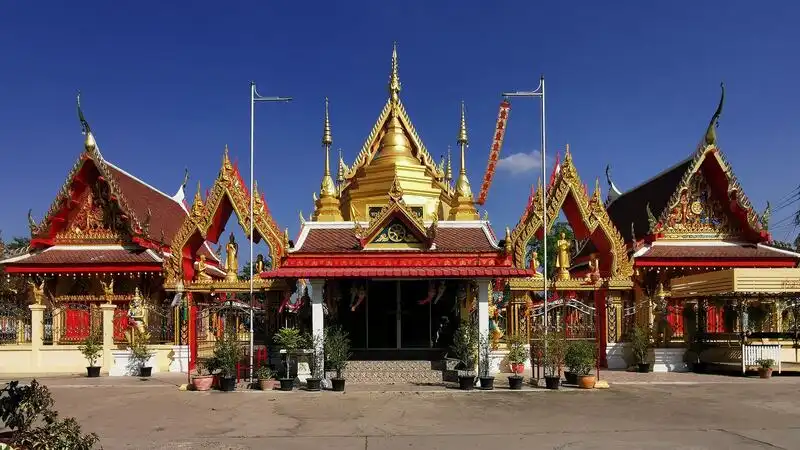
Wat Ban Pho (Wat Pho, Ban Pho Subdistrict) is located at 23 Moo 3, Ban Pho Subdistrict, Bang Pa-In District, Phra Nakhon Si Ayutthaya. It is a community temple under the Mahanikaya order whose history is commonly traced back to the late Ayutthaya period, often dated to around 2300 BE, with no clearly recorded founder. For this reason, the temple stands as an example of a local monastery that has “grown with its place,” preserving collective memory through restorations, revered objects, and significant events that have been passed down for generations—especially notable episodes in the Rattanakosin era that brought Wat Ban Pho wider recognition.
The temple is easy to access because it sits directly along Road 3477, a route that conveniently connects communities in the Bang Pa-In area and nearby neighborhoods. Being a “roadside temple” makes it a practical stop for visitors who come specifically to pay respects, as well as for travelers who happen to pass by and want a short, quiet pause in a traditional Thai temple atmosphere. In general, community temples in Ayutthaya tend to feel simple rather than showy, yet orderly in a way that naturally calms the mind—and Wat Ban Pho clearly belongs to that character.
What makes Wat Ban Pho particularly interesting for local history is the presence of “Ayutthaya traces” in its Buddhist art and the devotional logic behind the main images in the ordination hall. Widely shared information describes the principal Buddha image in the ubosot as a stucco seated Buddha in the Maravijaya posture, set within an Ayutthaya-style arched shrine, with two additional stucco seated Buddhas in the same posture and Ayutthaya style placed to the left and right. Together, these three images sit on a large raised base (chukchi), and the main image is known as “Luang Pho Pho Thong Saksit.” This continuity of Ayutthaya-era aesthetics into the present means that Wat Ban Pho is not only a place for merit-making within the community, but also a site where visitors can “read time” through living artistic forms in a single space.
As you enter the ubosot zone, many visitors notice how the three-image arrangement, elevated on a substantial base, creates a strong sense of weight and visual focus. Paying respect here is therefore not merely a gesture of hands pressed together; it can feel like standing before a long-held faith that the community has preserved for centuries. The very fact that the principal image has a distinct name—Luang Pho Pho Thong Saksit—also suggests a deep association with blessings, stability, and the well-being of local families, especially those who have lived in the area across multiple generations.
Another point that adds historical weight to Wat Ban Pho is an event in 2509 BE. Publicly circulated accounts state that the King and the Queen made a royal visit to preside over the ceremony of raising the chofa finials for the ubosot on 24 June 2509 BE, and that they also participated in the casting of a likeness statue of Somdet Phra Phutthachan (To Phromrangsi) as well as a likeness statue of Luang Pu Khong, intended for enshrinement in the northern and southern vihara within the ubosot precinct. The same accounts further note the royal planting of a bodhi tree and a sandalwood tree in front of the ubosot. This episode gives Wat Ban Pho a “layer of royal-ceremonial memory” over its foundation as a community temple, a combination that is relatively uncommon among ordinary local monasteries and that also reflects the temple’s role as a place for communal merit-making, ceremonies, and local unity.
In Thai temple culture, the chofa-raising ceremony is not simply a technical milestone for builders or an architectural detail. It carries strong symbolism, because the chofa can be read as the “peak of faith” atop one of the temple’s most important structures—the ubosot. The ceremony therefore marks the readiness of the sacred space for monastic acts and serves as a communal milestone that the principal religious structure has been properly completed and restored. When such a ceremony is linked to a royal visit, the ubosot’s meaning as the spiritual and social center of the Ban Pho community becomes even more pronounced.
Meanwhile, the casting of likeness statues of Somdet To and Luang Pu Khong reflects the community’s devotion to revered masters and exemplary monks in Thai religious history. In many Thai contexts, a likeness statue functions as a “symbol of virtue” that people recall when making merit, asking for guidance, or seeking moral support in uncertain times. Placing these images on opposite sides of the ubosot area—in the northern and southern vihara—also creates a natural, respectful route of worship, and many visitors find themselves spending longer than expected in this part of the temple because it brings together “stories of belief” and “local memory” in a seamless way.
Architecturally, the ubosot is described with fairly precise dimensions: approximately 8.55 meters wide and 23.25 meters long. This detail helps visitors and those interested in conservation visualize the real proportions of the space. Once the scale is understood, it becomes clear that the interior is not expansive in the manner of major royal temples in Ayutthaya’s historic core, but instead sized appropriately for a community temple—large enough for monastic rites, merit-making ceremonies, and local religious functions, while still maintaining a quiet atmosphere that does not overwhelm worshippers with an overly vast interior.
The appeal of visiting Wat Ban Pho lies in experiencing a place that is both straightforward and quietly detailed. At first glance, the temple may not look dramatic, but a slower walk reveals layers that connect different eras—from late Ayutthaya in artistic expression to mid-Rattanakosin in restoration and ceremonial memory. The narrative of the royal planting of the bodhi and sandalwood trees in front of the ubosot also gives that front area a gentle symbol of “growth” alongside the sanctity of the main hall. For this reason, many visitors feel the temple is well-suited for a quiet, reflective visit rather than a quick stop for photos.
For those who wish to make merit in a traditional way, Wat Ban Pho, as a community temple, typically participates in religious activities aligned with the Buddhist calendar, such as merit-making on major holy days, listening to sermons, offering alms and necessities, and candlelit circumambulation during Makha Bucha, Visakha Bucha, and Asalha Bucha. It also commonly takes part in seasonal traditions such as the beginning and end of Buddhist Lent and kathin/pha pa ceremonies. Kathin in particular is often a major community event because it relies on shared faith and collective organization. When the temple has community-supported events or announcements, visitors can see more clearly that this is a “living temple,” not merely a sacred structure standing in place.
If you want your Bang Pa-In trip to feel more textured, Wat Ban Pho can be a meaningful stop that expands the itinerary beyond Bang Pa-In Palace or the more widely known riverside temples. Here, Ayutthaya is told through the lens of everyday community life. You see that local faith is not confined to large archaeological sites; it also thrives in community monasteries that continue to serve the people around them. With a well-planned route, you can begin with Bang Pa-In’s primary attractions, then stop to pay respects to Luang Pho Pho Thong Saksit, before heading out for food and accommodation in either the Ayutthaya city area or Bang Pa-In zone.
Getting There Wat Ban Pho is convenient to reach because it is located along Road 3477. If you are driving, set your map pin to “Wat Ban Pho, Bang Pa-In” or “Wat Pho, Ban Pho Subdistrict,” then follow the main route into Ban Pho Subdistrict. This road connects smoothly with the Bang Pa-In area and major routes toward Ayutthaya. If you travel by train, you can get off at Bang Pa-In Station and continue to the temple by local hired transport or taxi. It is advisable to allow extra time on weekends and holidays, as traffic around Bang Pa-In can be heavier due to visitors heading to Bang Pa-In Palace and nearby attractions.
When visiting, dress respectfully, avoid overly short or tight clothing, remove shoes before entering religious buildings, keep voices low in the ubosot area, and avoid touching Buddha images or artistic elements unnecessarily. If you wish to take photos, do so discreetly and avoid disturbing worshippers who may be praying or making merit at the same time.
Overall, Wat Ban Pho is a community temple in Bang Pa-In with layered value: a late-Ayutthaya origin narrative, Ayutthaya-influenced Buddhist art within the ubosot, and a notable 2509 BE episode connected to the chofa-raising ceremony and the casting of likeness statues of important religious figures. Because the temple is easy to access and remains an active community monastery, it suits both travelers who want a calm place to pay respects during a Bang Pa-In day trip and those who wish to understand Ayutthaya through a quieter, yet equally meaningful, local perspective.
| Name | Wat Ban Pho (Wat Pho, Ban Pho Subdistrict) |
| Address | 23 Moo 3, Ban Pho Subdistrict, Bang Pa-In District, Phra Nakhon Si Ayutthaya 13160 |
| Place Summary | A Mahanikaya community temple often dated to the late Ayutthaya period, known for its ubosot and the principal image “Luang Pho Pho Thong Saksit,” as well as accounts of a chofa-raising ceremony in 2509 BE. |
| Key Highlights | The principal image “Luang Pho Pho Thong Saksit,” three Ayutthaya-style stucco Buddha images on a large base, an ubosot measuring about 8.55 m x 23.25 m, and narratives connected to a 2509 BE chofa-raising ceremony and the casting of likeness statues of Somdet To and Luang Pu Khong. |
| Period | Late Ayutthaya (around 2300 BE) – Rattanakosin (notable event in 2509 BE) |
| Key Evidence | Ayutthaya-influenced Buddhist art in the ubosot and publicly circulated accounts of the 2509 BE ceremony linked to the chofa-raising, likeness casting, and the royal planting of a bodhi and sandalwood tree in front of the ubosot. |
| Name Origin | “Wat Ban Pho” aligns with the local place name “Ban Pho,” following the common Thai practice of naming temples after their community location. |
| Abbot (Latest) | - |
| Travel | Along Road 3477; drive by pinning “Wat Ban Pho, Bang Pa-In”; train to Bang Pa-In Station then continue by local hired transport/taxi. |
| Current Status | Open for worship and visits as usual |
| Contact Number (Verified) | 035-728-259 |
| Nearby Tourist Attractions (Approx. Distance) | 1) Bang Pa-In Palace – 12 km – Tel. 035-261-044 2) Wat Niwet Thammaprawat Ratchaworawihan – 14 km – Tel. 035-262-139 3) Wat Yai Chai Mongkhon Worawihan – 28 km – Tel. 035-242-640 4) Bang Sai Royal Folk Arts and Crafts Center – 22 km – Tel. 035-366-253 5) Ayutthaya Historical Study Centre – 32 km – Tel. 035-245-123 |
| Nearby Restaurants (Approx. Distance) | 1) Rak Bang Pa-In Cafe – 14 km – Tel. 094-862-9987 2) The Artisans Ayutthaya – 25 km – Tel. 061-195-9514 3) U-Khao Restaurant & Cafe – 27 km – Tel. 062-793-9993 4) The Summer House Ayutthaya – 30 km – Tel. 094-224-2223 5) Baan Por (Bang Pa-In) – 16 km – Tel. 085-197-6767 |
| Nearby Accommodations (Approx. Distance) | 1) sala bang pa-in – 16 km – Tel. 035-246-388 2) Kantary Hotel Ayutthaya – 30 km – Tel. 035-337-177 3) Classic Kameo Hotel, Ayutthaya – 31 km – Tel. 035-212-535 4) Krungsri River Hotel – 31 km – Tel. 035-244-333 5) Centara Ayutthaya – 32 km – Tel. 035-243-555 |
Frequently Asked Questions (FAQ)
Q: Where is Wat Ban Pho located?
A: The temple is located at 23 Moo 3, Ban Pho Subdistrict, Bang Pa-In District, Phra Nakhon Si Ayutthaya, and it sits along Road 3477, making it convenient to reach by car.
Q: When was Wat Ban Pho founded?
A: It is commonly described as dating back to the late Ayutthaya period, around 2300 BE, and the founder is not clearly recorded.
Q: What is the main highlight inside the ubosot?
A: The key highlight is the principal image “Luang Pho Pho Thong Saksit,” together with three Ayutthaya-style stucco Buddha images arranged on a large raised base.
Q: Is there an important historical event connected to the temple in 2509 BE?
A: Publicly circulated accounts mention an event on 24 June 2509 BE involving a chofa-raising ceremony and the casting of likeness statues of Somdet To and Luang Pu Khong, along with the planting of a bodhi and sandalwood tree in front of the ubosot.
Q: How much time should I plan for a visit?
A: If you want to pay respects, view the ubosot, and worship the important images without rushing, it is reasonable to allow about 30–60 minutes.
Q: What contact number can I use to reach the temple?
A: The contact number provided is 035-728-259.
 Wat Ban Pho Map
 Category:
  Group:
  Last Update: 2 MonthAgo
Comment
 Nearby Attractions
| Keyword (Advance) |
 Region
|
 Phranakhon Si Ayutthaya(