
 Home
Home North(
 Chiang Mai(


Rating: 4.3/5 (6 votes)
 |
|  Map
Map 
 Have Map
  No Map
Phranakhon Si Ayutthaya attractions
Attractions in Thailand
Open Days: Daily
Opening Hours: 08.00–17.00
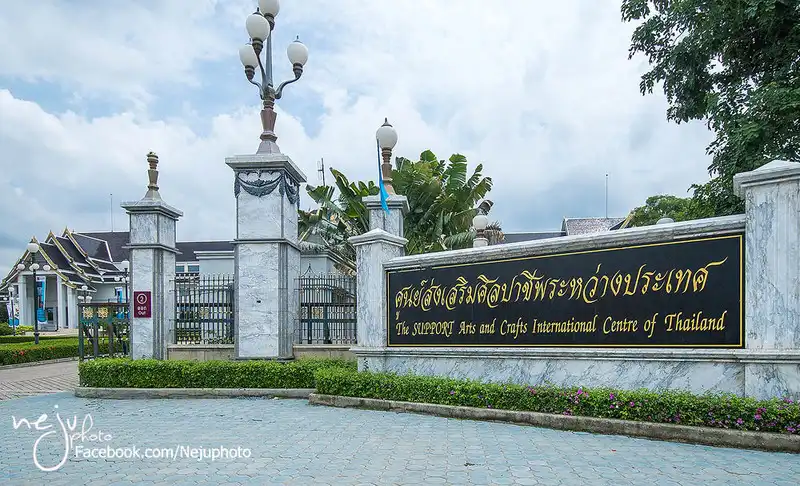
The Support Arts and Crafts International Centre of Thailand (SACICT) is one of Ayutthaya’s most compelling contemporary attractions, especially for travelers who want to see a side of Ayutthaya beyond ancient ruins alone. Instead of taking you solely back through history via heritage sites, SACICT invites you into a living world of Thai craftsmanship—still active today as art, culture, livelihood, and a creative economy that goes far beyond the idea of a simple souvenir. Visiting here is not just about browsing beautiful objects; it is about understanding why Thai craft continues to endure, and how “skills” from communities across the country can be elevated into products with standards, stories, and value that speak to both Thai visitors and international travelers.
To understand the deeper meaning of this place, it helps to look back at the roots of the “arts and crafts for livelihood” concept in Thailand. One of the significant royal duties of Her Majesty Queen Sirikit, The Queen Mother, was accompanying His Majesty the King on royal visits to people in all regions of Thailand over many decades. These continued visits enabled Her Majesty to see the true realities of people’s lives—their hardships, their joys, and the fragility of household income in everyday living. The issue of poverty was a major concern, as it placed many families in a constant struggle with uncertainty. A key royal intention, therefore, was to create practical occupations for people, so their income could increase to a level sufficient for living amid changing social and economic conditions. This approach matters because it was not merely short-term relief, but a foundation for skills, sustainable work, and self-reliance.
With a royal vision that recognized the value of local wisdom, Her Majesty Queen Sirikit, The Queen Mother, took a strong interest in traditional craftsmanship and folk arts made largely from local materials. Such work reflects the refinement of the makers and the distinctive identity of each region. Her Majesty supported this by arranging for teachers to travel and train people, improving product quality and craftsmanship standards. Once trainees became proficient and their work reached an acceptable level, the products were purchased using Her Majesty’s personal funds. This support helped transform “handicraft work”—once often made in spare time or for household use—into a real occupation with market demand and measurable quality. Over time, this effort expanded into the SUPPORT Foundation and a more structured arts-and-crafts training system that continued to develop in scale and seriousness.
Bang Sai itself is widely recognized as a significant base for arts-and-crafts training at the area level, with the development of training centers and activities that demonstrate systematic skills transfer. At the same time, as global commerce and consumer demand evolved, Thai crafts also needed a stage that could do more than “train”—namely, a platform that can communicate craft value, create markets, and connect Thai craftsmanship with diverse audiences: Thai visitors, tourists, collectors, designers, entrepreneurs, and international buyers. This is the context in which the Support Arts and Crafts International Centre of Thailand (SACICT) stands out. It is a space where Thai handicrafts are presented in a structured way across exhibition, retail, and creative-economy development—while still grounded in Thai skills and local wisdom.
Arriving at SACICT, many visitors immediately sense that it is a “craft hub” that is neither small nor temporary. It operates with an organizational framework and a carefully managed environment, and it curates work that reflects Thai handicrafts across multiple levels—from home decor and clothing to gifts, souvenirs, and household items, including more contemporary interpretations. This often changes the perspective of those who once assumed that “Thai handicrafts = old-style souvenirs.” As you walk through, you begin to see the breadth of design, materials, and function. The experience can feel like reading Thailand through the language of handmade work, because each piece is not only aesthetically appealing but also rooted in community backgrounds, locally connected materials, and production processes that require time, patience, and mastery.
The charm of visiting lies in how it helps people develop a new way of looking at craft. Instead of judging only whether something is “beautiful,” a more attentive walk encourages deeper questions: Where do the materials come from? How long does the technique take to master? How does this craft relate to climate or lifestyle? And when a traditional craft is adapted into contemporary design, how can the same kind of work fit seamlessly into modern homes or become a meaningful gift for many occasions? For international travelers and creative professionals especially, SACICT can be a strong source of inspiration, because it shows that “Thai identity” is not confined to museums—it can be developed further to align with today’s world in practical, compelling ways.
Another aspect that sets SACICT apart from typical “souvenir shopping” venues is its role as a central platform designed to connect craft with exhibition storytelling and market development. At certain times, visitors may encounter demonstrations or curated displays that make complex crafts easier to understand, revealing that the refinement in the work is not accidental—it comes from disciplined practice and sustained standards. Having a platform like this is important for Thai handicrafts at a national level, because it gives small producers and communities a place where their work is seen appropriately, presented with dignity, and connected to broader audiences and buyers.
From a travel perspective, Ayutthaya already offers many places that make you “feel the past.” SACICT, however, helps you “feel continuity” in Thai culture. It shows that culture does not end in history; it lives in the hands of makers, in the ways materials and patterns are thought through, in the teacher-to-student transmission of skill, and in the process of upgrading craftsmanship so it can support livelihoods. For many travelers, a satisfying itinerary is a balanced one: spend the morning exploring key temples or heritage zones, then come here in the afternoon to rest your eyes with art, reset your mind with living learning, and end your day with a gift that carries a real story—not something bought merely out of obligation.
To make the most of your visit without rushing, it helps to allow time for close viewing—because the more closely you look, the more detail you see. Many pieces reveal texture, layered patterns, clean edges, and subtle color work that can be missed at a glance. If you visit with family, walking children through crafts that are “actually usable” makes the learning easier: they see that art does not have to live only on walls; it can live in everyday life. It also helps children notice the difference between handmade work and industrial production—a useful way of seeing that supports long-term learning. For photography lovers, SACICT often provides clean, orderly visuals that communicate “contemporary Thai” very well—especially close-up shots of patterns and textures that add weight to images without needing grand backdrops.
Getting There SACICT in Bang Sai can be planned either by private car or by transferring from key points in Ayutthaya or the Bangkok metropolitan area. If you drive from Bangkok or the Rangsit–Pathum Thani area, many travelers choose routes that connect into Bang Sai District and then head toward Chang Yai Subdistrict, where the centre is located. In general, having a private car is the most flexible option, because it makes it easy to combine this visit with Bang Pa-In Royal Palace, Ayutthaya Old Town, or riverside grilled river prawn restaurants. If you use public transport, you can plan to reach Ayutthaya first and then continue on to Bang Sai as convenient. In any case, planning your time around the opening hours will help you walk comfortably without feeling rushed.
What many visitors take away from SACICT is not only “what they bought,” but a new mental picture of what “Thai handicrafts” can be. When you see such variety in one place, you begin to understand that Thai handmade work is not merely cultural decoration. It is knowledge, skill, livelihood, and a creative economy that is truly moving forward. Visiting here feels like seeing another layer of Thailand: a layer about people who work with precision, about standards and quality, about modern growth without abandoning roots, and about enabling culture to support people’s lives with dignity. That is why SACICT deserves a place on the list of Ayutthaya attractions for travelers who want more than photos of ancient ruins—and who want to bring home understanding, too.
| Place Name | The Support Arts and Crafts International Centre of Thailand (SACICT) |
| Address | 59 Moo 4, Chang Yai Subdistrict, Bang Sai District, Phra Nakhon Si Ayutthaya 13290 |
| Summary | A Thai handicrafts centre for exhibitions, learning, and shopping that connects Thai craft to contemporary audiences and both Thai and international visitors. Ideal for a half-day to full-day Ayutthaya trip. |
| Highlights | Wide range of Thai handicrafts for display and purchase, well-organized walk-through experience, excellent for story-rich souvenirs, suitable for designers/creative visitors and educational trips. |
| Latest Managing Organization | Thailand Institute of Crafts and Design (Public Organization) (SACIT) |
| Open Days | Daily |
| Opening Hours | 08.00–17.00 |
| Fees | Free admission |
| Contact | 0 3536 7054-9, Hotline 1289 |
| Travel | Private car is the most convenient option: plan your route into Bang Sai District and head to Chang Yai Subdistrict (destination: SACICT) for flexible trip-planning with Bang Pa-In / Ayutthaya Old Town. |
| Current Status | Open to visitors |
| Nearby Tourist Attractions (Approx. Distance) | 1) Bang Pa-In Royal Palace (approx. 20 km) Tel. 035-261-044 2) Japanese Village, Ayutthaya (approx. 30 km) Tel. 035-259-867 3) Ayutthaya Historical Park (approx. 32 km) Tel. 035-242-525 4) Wat Chaiwatthanaram (approx. 35 km) Tel. 035-242-286 5) Bang Sai Arts and Crafts Centre (approx. 12 km) Tel. 0 3528 3246-9 |
| Popular Restaurants Nearby (Approx. Distance) | 1) Rim Nam Bang Sai Restaurant (approx. 12 km) Tel. 035-367-733 2) Ruay Kung Phao (approx. 25 km) Tel. 086-007-1451 3) Krua Pa Lan (approx. 22 km) Tel. 035-366-142 4) Kung Phao Ratchakhram (approx. 24 km) Tel. 085-169-4770 5) Ruen Thai Kung Phao Wat Choeng Len (approx. 23 km) Tel. 035-333-410 |
| Popular Accommodations Nearby (Approx. Distance) | 1) SALA Bang Pa-In (approx. 20 km) Tel. 035-246-388 2) Centara Ayutthaya (approx. 32 km) Tel. 035-706-777 3) Classic Kameo Ayutthaya (approx. 30 km) Tel. 035-212-535 4) Krungsri River Hotel (approx. 32 km) Tel. 035-244-333 5) Baan Thai House Ayutthaya (approx. 33 km) Tel. 035-323-280 6) Kantary Hotel Ayutthaya (approx. 31 km) Tel. 035-337-177 |
Frequently Asked Questions (FAQ)
Q: Who is SACICT suitable for?
A: It’s ideal for visitors who want a well-organized way to explore Thai handicrafts, anyone looking for story-rich souvenirs, international travelers, and design/creative audiences—as well as families who want children to learn the value of handmade work.
Q: How many hours should I plan for a visit?
A: For a relaxed walk-through with time to browse and shop, 2–4 hours is recommended. If you want to study details and take more photos, you can plan for a half-day.
Q: Is there an admission fee?
A: Based on the latest available information, admission is free.
Q: If I want to buy souvenirs, what should I pay attention to?
A: Look closely at materials and finishing quality, choose pieces you can genuinely use, and consider items with clear community identity or distinctive techniques—you’ll get souvenirs with both beauty and meaning.
Q: What can I visit nearby after SACICT?
A: You can combine this trip with Bang Pa-In Royal Palace, Ayutthaya Old Town, the Japanese Village, or Wat Chaiwatthanaram—just plan travel time around each site’s opening hours.
Q: Which day is more comfortable with fewer crowds?
A: Weekdays are generally more comfortable, and visiting in the morning usually gives you more time to explore in detail before the day gets hotter and busier.
 Tel: 03536 6252-4, 035283246-9
 International Center for the Arts Map
 Category:
  Group:
  Last Update: 2 MonthAgo
Comment
 Nearby Attractions
| Keyword (Advance) |
 Region
|
 Phranakhon Si Ayutthaya(